
Quick Answer
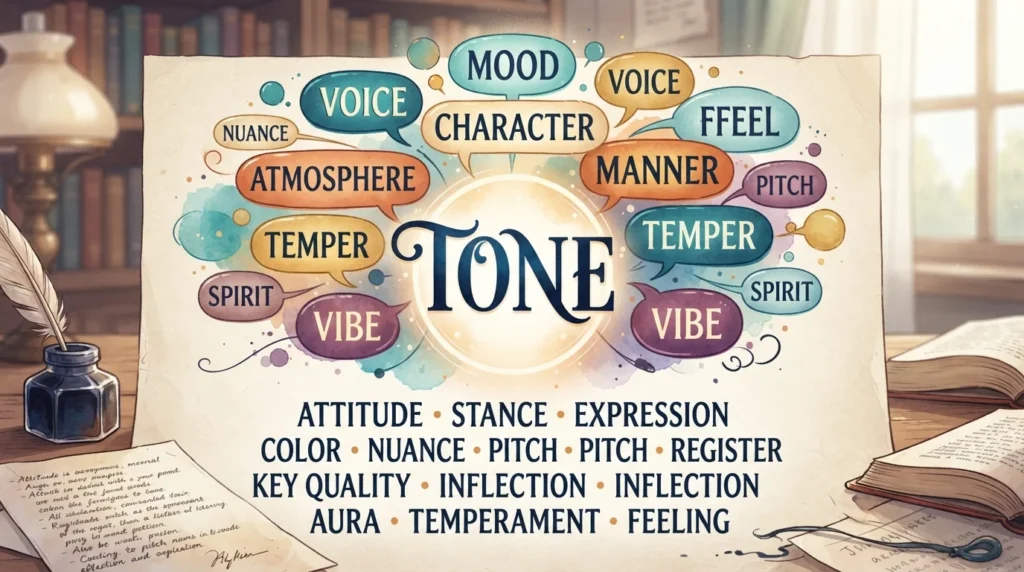
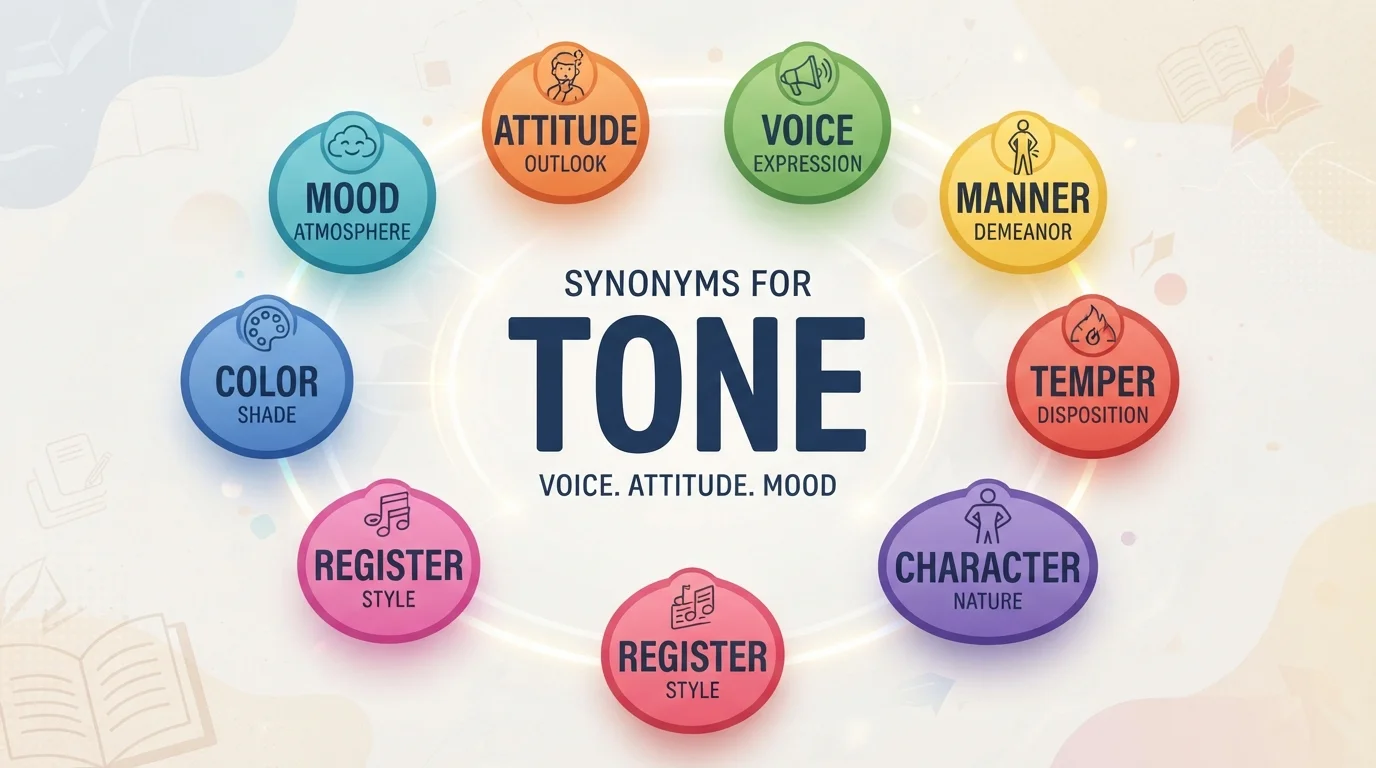
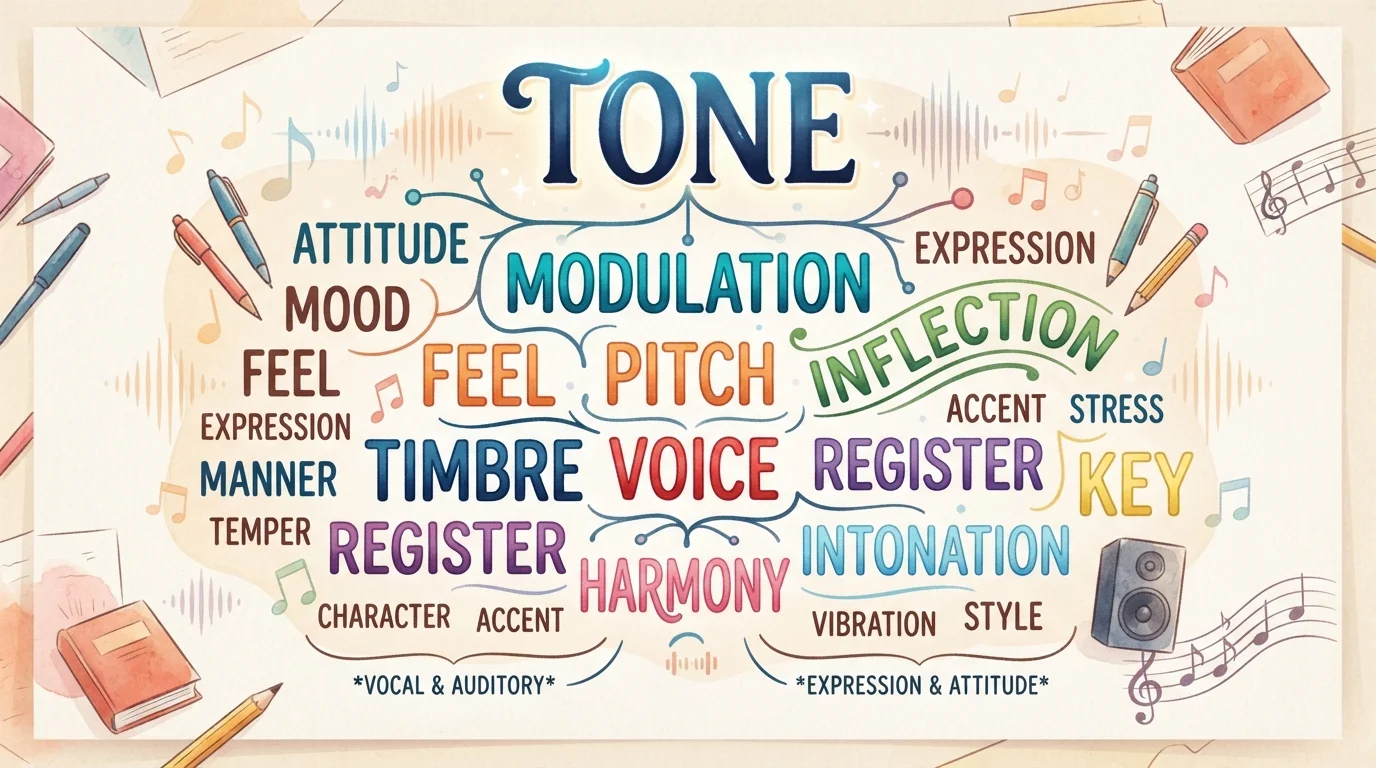
Common synonyms for tone include mood, attitude, voice, style, manner, feeling, character, atmosphere, register, expression, inflection, pitch, timbre, sound, quality, shade, hue, tint, and color. The right alternative depends on whether tone refers to writing, speech, emotion, sound, music, or color.
Quick Reference: Synonyms for Tone by Meaning
| Meaning of “synonyms for tone” | Useful alternatives | Best for |
|---|---|---|
| Attitude in writing/speech | attitude, manner, stance, outlook, approach | Emails, essays, conversations |
| Emotional quality | mood, feeling, atmosphere, emotional quality | Creative writing, reviews |
| Writer’s distinctive style | voice, style, manner, expression | Literature, content |
| Level of formality | register, formality, language level | Academic/professional writing |
| General character | character, quality, tenor, character | Formal analysis |
| Speech quality | inflection, intonation, delivery, manner of speaking | Conversation |
| Sound quality | timbre, quality, resonance, texture | Music/audio |
| Musical pitch | pitch, note, frequency | Music/acoustics |
| Color quality | shade, hue, tint, color, saturation | Art/design |
| Body firmness | firmness, definition, muscle definition | Fitness/body description |
What Does “Tone” Mean?
Tone has several distinct meanings, so there is no single synonym that works everywhere.
In communication, synonyms for tone usually means the attitude or emotional quality expressed through words, voice, or behavior.
Her email had a friendly tone.
Here, tone describes how the message feels to the reader.
But tone can also refer to:
- Attitude in communication
- Emotional quality or mood
- A writer’s or speaker’s voice
- Level of formality
- Sound quality
- Pitch or musical sound
- Color or visual quality
- Physical firmness or definition
The distinction matters because a word that replaces tone in one sense may be completely wrong in another.
1. Tone Meaning “Attitude”
When you say that someone has a friendly, rude, respectful, angry, or professional tone, you usually mean the attitude conveyed by their words.
Attitude
Attitude is one of the closest alternatives when tone refers to the speaker’s or writer’s emotional or evaluative position.
His tone was dismissive.
His attitude was dismissive.
The two can overlap, but they are not identical. Tone describes what is communicated; attitude can describe the person’s underlying viewpoint or disposition.
Manner
Manner refers to the way someone speaks, behaves, or expresses something.
She answered in a calm tone.
She answered in a calm manner.
Manner is broader than tone.
Stance
Stance means a person’s position or attitude toward an issue.
The article has a critical tone.
The article takes a critical stance.
Use stance when you mean the position being taken, not simply the emotional feel of the writing.
Approach
Approach describes the way someone chooses to deal with a subject or situation.
The company adopted a supportive tone.
The company adopted a supportive approach.
The second sentence focuses more on the company’s method than its language.
2. synonyms for tone Meaning “Mood or Emotional Quality”
Tone can describe the emotional atmosphere created by a piece of writing, conversation, film, speech, or event.
Mood
Mood is one of the most common alternatives, especially in creative writing.
The novel has a dark tone.
The novel has a dark mood.
There is an important distinction:
- Tone = the attitude or emotional quality expressed by the creator or speaker.
- Mood = the feeling created in the audience or experienced within the work.
They often overlap, but they are not technically identical.
Feeling
Feeling is a broad, accessible alternative.
The song has a nostalgic tone.
The song has a nostalgic feeling.
Use feeling when you want simple, natural language rather than technical analysis.
Atmosphere
Atmosphere refers to the overall emotional or sensory quality surrounding a situation, place, or work.
The story has an unsettling tone.
The story creates an unsettling atmosphere.
Atmosphere is particularly useful for fiction, films, places, events, and settings.
Emotional quality
Emotional quality is a clear phrase when precision matters.
The email has a warm emotional quality.
It is more explanatory than tone, rather than a perfect one-word replacement.
3. Tone Meaning “Writer’s Voice”
In literary and content analysis, tone is often discussed alongside voice and style.
Voice
Voice refers to the distinctive way a writer or speaker expresses ideas.
The author’s tone is conversational.
The author’s voice is conversational.
These can overlap, but voice is usually broader and more enduring. A writer may have a recognizable voice while changing tone from one article to another.
Style
Style refers to the overall way something is written, spoken, designed, or presented.
The article uses a formal tone.
The article uses a formal style.
But style includes more than tone. It can involve vocabulary, sentence structure, organization, formatting, and other choices.
Expression
Expression refers to the way an idea, emotion, or attitude is communicated.
His tone showed disappointment.
His expression showed disappointment.
Be careful: expression can also mean a facial expression or a particular phrase.
4. Tone Meaning “Formality”
When people discuss formal tone, informal tone, professional tone, academic tone, or casual tone, they are often talking about the level and type of language used.
Register
Register is the most precise linguistic term for language variation associated with a particular situation, audience, or level of formality.
The email uses a formal tone.
The email uses a formal register.
Register is especially useful in academic or linguistic writing.
Formality
Formality refers specifically to how formal or informal something is.
The tone of the message is professional.
The formality of the message is high.
Formality cannot replace tone in every sentence.
Language level
Language level is a plain-English phrase for the degree of formality or complexity in communication.
It works better in explanations than in polished analytical writing.
5. Tone Meaning “Way of Speaking”
When tone refers to how someone’s voice sounds while speaking, several alternatives become more precise.
Inflection
Inflection refers to changes in the pitch of the voice while speaking.
Her tone changed at the end of the sentence.
Her inflection changed at the end of the sentence.
Use inflection when the change in vocal pitch or expression matters.
Intonation
Intonation refers to the pattern of pitch movement in speech.
It is especially useful in linguistics and pronunciation.
English intonation can change how a statement sounds.
Intonation is more technical than tone.
Delivery
Delivery means the way a person presents spoken material.
His tone made the speech sound sincere.
His delivery made the speech sound sincere.
Delivery includes pace, emphasis, volume, pauses, and vocal expression, so it is broader.
Manner of speaking
This phrase describes how someone speaks without claiming that pitch or emotion is the only factor.
6. Tone Meaning “Sound Quality”
In music and audio, tone can refer to the quality or character of a sound.
Timbre
Timbre is the distinctive quality that makes two sounds with the same pitch and loudness sound different.
The guitar has a warm tone.
The guitar has a warm timbre.
Timbre is the more technically precise term.
Sound quality
Sound quality is a broad phrase describing how a sound is perceived.
The recording has a rich tone.
The recording has rich sound quality.
Resonance
Resonance refers to the quality or strength produced by vibration and amplification within a sound-producing system.
It is related to tone but is not a direct synonym in every context.
Texture
In music and audio discussion, texture can describe the perceived character or layering of sound.
Again, it is related rather than identical.
7. Tone Meaning “Pitch”
In music, tone can refer to a musical sound or pitch-related concept.
Pitch
Pitch is the perceived highness or lowness of a sound.
She sang in a high tone.
She sang at a high pitch.
But don’t automatically substitute pitch for tone.
Tone can describe sound quality, while pitch describes frequency-related highness or lowness.
Note
A note can refer to a specific musical sound or written representation.
Play a higher tone.
Play a higher note.
The second sentence can work in a musical context, but the concepts are not identical.
Frequency
Frequency is the physical rate of vibration, measured in cycles per second.
It is a technical scientific term rather than a general synonym for tone.
8. Tone Meaning “Color”
In art, photography, design, and visual description, tone can refer to a particular quality or variation of color.
Shade
A shade is a variation of a color, often referring to a darker version.
The room uses warm earth tones.
The room uses warm earth shades.
The words overlap, but shade is more specific.
Hue
Hue refers to the basic color family, such as red, blue, or green.
The image has a blue tone.
The image has a blue hue.
Hue is more technically specific to color.
Tint
A tint is generally a color made lighter by adding white.
The wall has a soft pink tone.
The wall has a soft pink tint.
Color
Color is the broadest and simplest term.
The photograph has a warm tone.
The photograph has warm colors.
This changes the meaning somewhat, because tone may describe the overall visual quality rather than individual colors.
9. Tone Meaning “Physical Firmness”
In phrases such as muscle tone or toned muscles, tone refers to muscular firmness or definition.
Useful alternatives include:
- firmness
- definition
- muscle definition
- muscularity
- conditioning
- physical conditioning
Example
Exercise can improve muscle tone.
Exercise can improve muscle definition.
These are related but not always identical in technical usage.
Avoid treating tone in this sense as equivalent to strength. A person can be strong without having the same degree of visible muscle definition.
Tone vs. Voice vs. Style
These three are especially easy to confuse in writing.
| Term | Main idea | Example |
|---|---|---|
| Tone | Attitude or emotional quality | friendly, serious, critical |
| Voice | Distinctive personality of the writer/speaker | conversational, authoritative |
| Style | Overall way of writing or presenting | concise, literary, technical |
Simple rule
Voice = who you sound like.
Tone = how you sound in a particular situation.
Style = how you construct and present the work.
A writer can have one recognizable voice but use many different tones.
Tone vs. Mood
This distinction matters in literary analysis.
Tone
The attitude expressed by the writer, speaker, or creator.
The writer’s tone is sarcastic.
Mood
The feeling experienced or created by the reader, listener, or audience.
The story creates an anxious mood.
A work can have a sarcastic tone that creates an uncomfortable mood.
Tone vs. Register
Tone
Focuses on attitude or emotional quality.
The email has a friendly tone.
Register
Focuses on language appropriate to a particular context or level of formality.
The email uses a professional register.
An email can therefore have a formal register but a warm tone.
Tone Synonyms by Context
Professional Writing
Useful choices:
- professional manner
- attitude
- register
- approach
- style
- voice
- formality
- communication style
Example:
Use a professional tone in the email.
Possible rewrite:
Use a professional register in the email.
This works when you mean formal language, but not necessarily when you mean warmth or friendliness.
Academic Writing
Useful choices:
- register
- stance
- voice
- manner
- style
- attitude
- scholarly voice
- analytical approach
For example:
The paper adopts a cautious tone.
Could become:
The paper adopts a cautious stance.
if the meaning is the author’s position rather than the emotional quality.
Customer Service
Useful alternatives:
- manner
- attitude
- communication style
- approach
- voice
- demeanor
For example:
Maintain a friendly tone with customers.
Friendly manner or friendly communication style can work, but tone is usually the most natural choice.
Creative Writing
Useful alternatives:
- mood
- voice
- atmosphere
- feeling
- emotional quality
- style
- attitude
The exact choice depends on whether you’re describing the creator’s attitude or the feeling produced by the work.
Speech and Conversation
Useful alternatives:
- inflection
- intonation
- manner
- delivery
- attitude
- voice
- pitch
For vocal sound, inflection, intonation, and pitch are more precise than simply using tone.
Tone Synonyms: Comparison Table
| Word/Phrase | Meaning | Tone/Register | Replace “tone”? |
|---|---|---|---|
| Attitude | Position or feeling toward something | Neutral | Often |
| Mood | Emotional atmosphere/feeling | Neutral | Sometimes |
| Voice | Distinctive expression of writer/speaker | Neutral | Sometimes |
| Style | Overall manner of presentation | Neutral | Sometimes |
| Manner | Way something is expressed or done | Neutral/formal | Often |
| Stance | Position on an issue | Formal | Sometimes |
| Register | Contextual/formality level of language | Academic | Sometimes |
| Approach | Way of dealing with something | Neutral | Sometimes |
| Inflection | Change in vocal pitch | Technical | Only for speech |
| Intonation | Pattern of pitch in speech | Technical | Only for speech |
| Pitch | Highness/lowness of sound | Technical | Only for sound |
| Timbre | Distinctive quality of sound | Technical | Only for sound |
| Shade | Variation of color | Neutral | Only for color |
| Hue | Basic color category | Technical | Only for color |
| Tint | Lighter color variation | Neutral | Only for color |
| Atmosphere | Overall emotional/sensory environment | Neutral | Sometimes |
| Feeling | Emotional quality | Neutral | Sometimes |
| Demeanor | Outward behavior or manner | Formal | Sometimes |
| Delivery | Way spoken material is presented | Neutral | Sometimes |
| Character | Distinctive quality or nature | Formal | Sometimes |
10 Sentence Transformations
1. Original
The email has a friendly tone.
Alternative:
The email has a friendly manner.
Why: Manner can describe the way the message is expressed, although tone remains more natural here.
2. Original
The article has a critical tone.
Alternative:
The article takes a critical stance.
Why: Stance emphasizes the author’s position rather than the emotional quality of the prose.
3. Original
The writer uses a conversational tone.
Alternative:
The writer uses a conversational voice.
Why: Voice emphasizes the writer’s distinctive way of communicating.
4. Original
The story has a dark tone.
Alternative:
The story creates a dark atmosphere.
Why: Atmosphere focuses more strongly on the feeling created by the story.
5. Original
The message has a formal tone.
Alternative:
The message uses a formal register.
Why: Register is more precise when the issue is formality and context-appropriate language.
6. Original
Her tone became angry.
Alternative:
Her manner became confrontational.
Why: Confrontational specifies the nature of the changed behavior rather than simply naming an emotion.
7. Original
His tone was calm.
Alternative:
His manner was calm.
Why: Manner can describe the way someone behaves or communicates, although the original is more natural in many speech contexts.
8. Original
The singer has a warm tone.
Alternative:
The singer has a warm timbre.
Why: Timbre is more precise when describing the distinctive quality of a voice.
9. Original
The violin has a bright tone.
Alternative:
The violin has a bright timbre.
Why: Timbre refers specifically to the sound quality that distinguishes one instrument or voice from another.
10. Original
The photograph has a warm tone.
Alternative:
The photograph has a warm color cast.
Why: Color cast is more specific when the image has an overall shift toward a particular color.
Common Collocations With “Tone”
Tone + adjective
- friendly tone
- professional tone
- formal tone
- informal tone
- casual tone
- conversational tone
- serious tone
- respectful tone
- polite tone
- warm tone
- positive tone
- negative tone
- neutral tone
- critical tone
- sarcastic tone
- humorous tone
- playful tone
- confident tone
- authoritative tone
- reassuring tone
- apologetic tone
- aggressive tone
- hostile tone
- dismissive tone
- defensive tone
- cautious tone
- optimistic tone
- pessimistic tone
- compassionate tone
- empathetic tone
- enthusiastic tone
- urgent tone
- calm tone
- measured tone
- diplomatic tone
- persuasive tone
- objective tone
- academic tone
- technical tone
Common verbs
- use a tone
- adopt a tone
- maintain a tone
- strike a tone
- set the tone
- establish a tone
- convey a tone
- create a tone
- change the tone
- shift the tone
- adjust the tone
- soften the tone
- strengthen the tone
- lighten the tone
- change the tone of a message
Common Mistakes With Tone Synonyms
1. Treating tone and mood as identical
They overlap, but tone generally concerns the attitude expressed, while mood concerns the emotional atmosphere or feeling created.
2. Using “voice” for every kind of tone
A writer’s voice is broader and more characteristic. Tone can change from one piece of writing to another.
3. Using “style” when you mean attitude
Style includes many elements besides attitude.
The article has a respectful tone.
Changing this to:
The article has a respectful style.
is possible in some contexts, but less precise.
4. Using “pitch” for emotional tone
In:
His tone was angry.
Pitch is not an appropriate replacement.
Pitch concerns how high or low the voice sounds.
5. Using “register” for emotional attitude
Register concerns language use in relation to context, especially formality.
A message can have a formal register and a friendly tone at the same time.
6. Confusing tone with intention
A person’s intention is what they intend to communicate or accomplish. Tone is how that communication comes across.
7. Assuming tone is always intentional
Readers can perceive a tone that the writer did not intend.
For example, an email intended to be efficient may be perceived as cold or dismissive.
8. Replacing “tone” just to sound more sophisticated
If you’re simply describing the attitude conveyed by a message, synonyms for tone is often the clearest and most natural word.
How to Choose the Right Synonym for Tone
Use attitude when you mean someone’s position or feeling toward something.
Use mood when you mean the emotional atmosphere.
Use voice when you mean a writer’s distinctive personality or manner of expression.
Use style when you mean the broader way something is written or presented.
Use register when you mean the level and type of language used for a particular context.
Use stance when you mean a position on an issue.
Use inflection or intonation when you mean changes or patterns in vocal pitch.
Use pitch when you mean how high or low a sound is.
Use timbre when you mean the distinctive quality of a sound.
Use shade, hue, or tint when tone refers to color.
When Not to Replace “synonyms for tone”
Sometimes the original word is better.
Consider:
Please adjust the tone of your email.
This is concise and natural. Replacing it with manner, attitude, voice, or register may make the sentence less precise.
Likewise:
The tone of the conversation changed.
This can cover a broad change in emotional quality, attitude, or interpersonal atmosphere without forcing you to specify exactly what changed.
A synonyms for tone is useful when it adds precision, not merely variety.
Editor’s Choice: Most Useful Alternatives
For everyday writing, five alternatives cover a large portion of the useful territory:
- Attitude — when the focus is someone’s position or feeling.
- Mood — when the focus is emotional atmosphere.
- Voice — when the focus is a distinctive writer or speaker identity.
- Register — when the focus is formality and context.
- Manner — when the focus is the way something is expressed.
For sound and color, switch to more specialized vocabulary such as timbre, pitch, hue, or shade rather than forcing communication-related synonyms into those contexts.