

Quick Answer: What Are the Best Synonyms for Mindset?
The best synonym for mindset depends on the intended meaning:
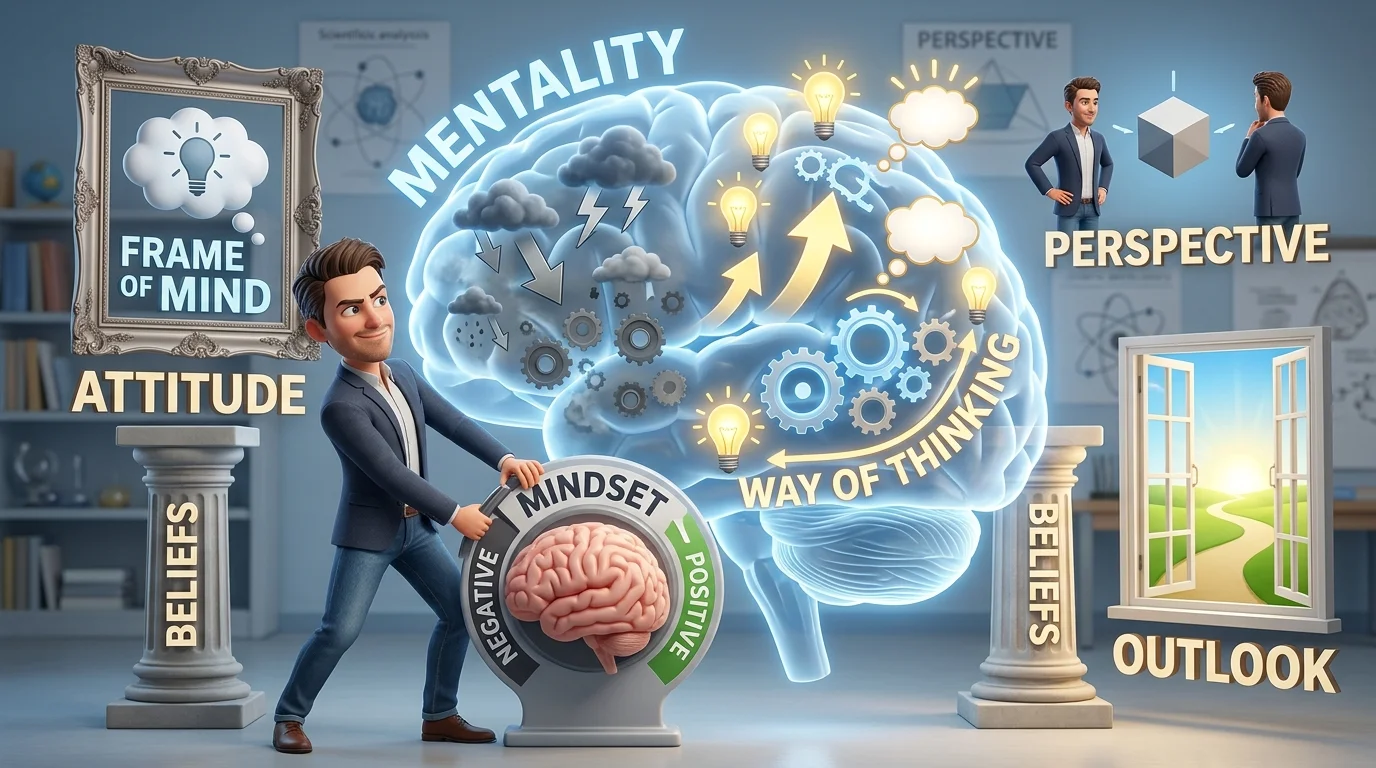
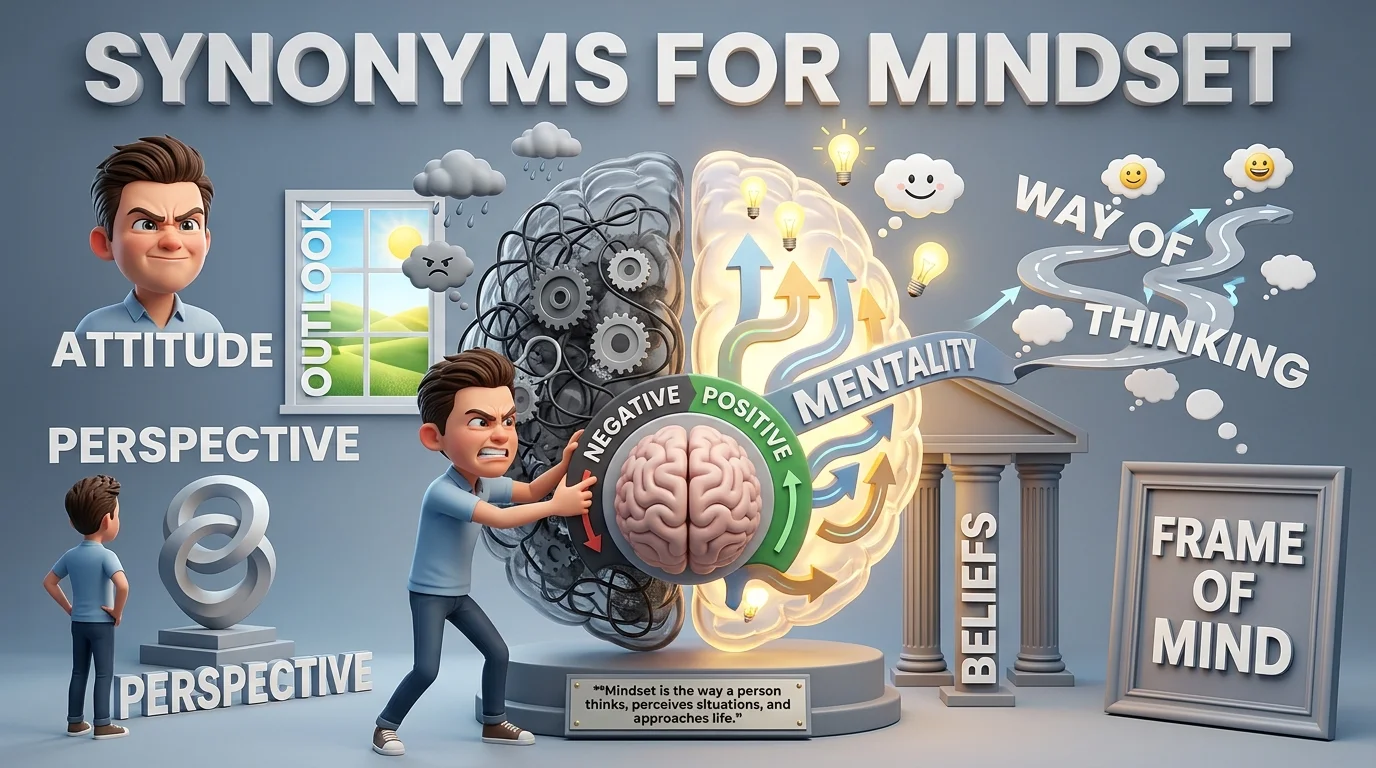
- Attitude — a person’s feelings or position toward something
- Mentality — a characteristic way of thinking
- Outlook — a general view of life, situations, or the future
- Perspective — a particular way of viewing or interpreting something
- Viewpoint — an opinion or position on an issue
- Way of thinking — a person’s characteristic thought process
- Frame of mind — a person’s current mental or emotional state
- State of mind — a person’s current psychological condition
- Philosophy — a set of guiding beliefs or principles
- Belief system — connected beliefs that influence thinking and behavior
- Worldview — a broad understanding of the world and life
- Approach — a way of dealing with a situation or problem
- Disposition — a person’s natural tendency or temperament
- Temperament — characteristic emotional tendencies
- Stance — a person’s position on an issue
- Position — an opinion or standpoint
- Orientation — a general direction or focus
- Frame of reference — the perspective used to interpret something
- Attitude of mind — a characteristic mental attitude
- Mental framework — an organized structure for understanding something
- Thought pattern — a recurring way of thinking
- Thinking pattern — a habitual pattern of thought
- Mental outlook — a person’s general mental perspective
- Consciousness — awareness or state of being aware
- Perception — the way something is understood or interpreted
- Ideology — a structured system of ideas or beliefs
- Dogma — a set of beliefs treated as authoritative
- Conviction — a strongly held belief
- Mindset orientation — a particular direction in thinking
- Mental attitude — a person’s characteristic way of approaching something
- Cognitive framework — a structured way of processing and interpreting information
30+ Synonyms for Mindset
1. Attitude
Attitude is one of the closest everyday alternatives to mindset. It refers to how someone feels, thinks, or responds toward a person, situation, or subject.
Example:
“She has a positive attitude toward challenges.”
Use attitude when the focus is on someone’s reaction or feelings rather than their entire system of thinking.
2. Mentality
Mentality refers to a characteristic way of thinking, especially one shared by a person, group, or culture.
Example:
“A competitive mentality can motivate athletes to improve.”
Mentality is especially useful when describing a consistent pattern of thought.
3. Outlook
Outlook describes someone’s general way of viewing life, circumstances, or the future.
Example:
“Her optimistic outlook helped her remain confident during difficult times.”
Use outlook when discussing whether someone’s general perspective is optimistic, pessimistic, realistic, or hopeful.
4. Perspective
Perspective refers to a particular way of viewing, understanding, or interpreting something.
Example:
“Travel can change your perspective on different cultures.”
Perspective is often more situation-specific than mindset.
5. Viewpoint
A viewpoint is a particular opinion, position, or way of looking at an issue.
Example:
“From my viewpoint, the decision was reasonable.”
It works especially well when discussing opinions or positions.
6. Way of Thinking
Way of thinking is a straightforward phrase describing how someone generally processes ideas and situations.
Example:
“Education can change the way of thinking of an entire generation.”
It is clear, natural, and useful when you want to avoid a more abstract term.
7. Frame of Mind
Frame of mind refers to a person’s mental or emotional condition at a particular time.
Example:
“You need the right frame of mind before making an important decision.”
Unlike mindset, frame of mind can emphasize a temporary condition.
8. State of Mind
State of mind describes someone’s current psychological or emotional condition.
Example:
“He was not in the right state of mind to make a decision.”
This is usually more temporary than a long-term mindset.
9. Philosophy
Philosophy can describe a set of principles or beliefs that guide how someone approaches life or work.
Example:
“Her philosophy is to focus on progress rather than perfection.”
It is a good alternative when mindset represents a deliberate set of guiding principles.
10. Belief System
A belief system is a connected set of beliefs that influences how a person understands the world and behaves.
Example:
“His belief system strongly influences his decisions.”
This is broader and more structured than mindset.
11. Worldview
A worldview is a broad understanding or interpretation of life, society, reality, and human existence.
Example:
“Education can significantly influence a person’s worldview.”
Worldview is broader and deeper than mindset.
12. Approach
Approach refers to the way someone deals with a problem, task, situation, or goal.
Example:
“She has a practical approach to solving problems.”
Approach is best when mindset influences action or problem-solving.
13. Disposition
Disposition refers to a person’s natural tendency, temperament, or characteristic way of responding.
Example:
“His calm disposition helped him handle stressful situations.”
It often describes an enduring personal tendency.
14. Temperament
Temperament refers to a person’s characteristic emotional and behavioral tendencies.
Example:
“Her patient temperament made her an effective teacher.”
It is related to mindset but focuses more on natural emotional characteristics.
15. Stance
A stance is a person’s position or attitude toward a particular issue.
Example:
“The company has taken a strong stance on workplace safety.”
Stance is more specific than mindset because it usually concerns a particular issue.
16. Position
Position can mean an opinion, belief, or standpoint regarding a particular subject.
Example:
“His position on education reform has changed over time.”
Use it when mindset refers to a clearly expressed opinion.
17. Orientation
Orientation refers to a person’s general direction, focus, or approach toward something.
Example:
“The organization has a customer-focused orientation.”
It is particularly useful in professional, academic, and business writing.
18. Frame of Reference
A frame of reference is the perspective or set of assumptions used to interpret information or experiences.
Example:
“People interpret the same event differently because they have different frames of reference.”
This is a more formal and analytical alternative.
19. Mental Framework
A mental framework is an organized structure through which someone understands or processes information.
Example:
“Critical thinking provides a useful mental framework for solving complex problems.”
It works especially well in academic and professional writing.
20. Thought Pattern
A thought pattern is a recurring way of thinking.
Example:
“Negative thought patterns can affect decision-making.”
This term is useful when discussing habitual thinking.
21. Thinking Pattern
Thinking pattern has a similar meaning to thought pattern and refers to a recurring style of processing information.
Example:
“Changing your thinking patterns can improve problem-solving.”
22. Mental Outlook
Mental outlook refers to someone’s general perspective or attitude toward life or circumstances.
Example:
“Exercise can contribute to a healthier mental outlook.”
It is particularly useful when discussing optimism or pessimism.
23. Mental Attitude
Mental attitude refers to the way a person mentally approaches a situation, challenge, or experience.
Example:
“A positive mental attitude can influence how people respond to setbacks.”
It is close to mindset but sounds slightly more formal.
24. Perception
Perception refers to the way someone interprets or understands something.
Example:
“Experience can change our perception of failure.”
Perception is not a perfect synonym because it focuses on interpretation rather than an entire way of thinking.
25. Consciousness
Consciousness refers broadly to awareness, perception, and the state of being mentally aware.
Example:
“Social consciousness can influence people’s decisions.”
It is much broader and more philosophical than mindset.
26. Ideology
An ideology is a structured system of ideas or beliefs, often related to politics, society, economics, or culture.
Example:
“The movement developed an ideology centered on equality.”
Ideology should not replace mindset unless the context involves an organized system of beliefs.
27. Dogma
Dogma refers to beliefs or principles accepted as authoritative and not usually questioned.
Example:
“The organization challenged traditional dogma.”
Dogma has a much stronger and more rigid meaning than mindset.
28. Conviction
A conviction is a strongly held belief or opinion.
Example:
“She expressed her conviction that persistence leads to success.”
It is useful when mindset refers to a firmly held belief.
29. Mental Model
A mental model is an internal representation or conceptual model that helps someone understand how something works.
Example:
“Developing better mental models can improve decision-making.”
This is especially useful in psychology, education, business, and personal development.
30. Cognitive Framework
A cognitive framework is a structured way of processing, organizing, and interpreting information.
Example:
“Critical thinking provides a cognitive framework for evaluating evidence.”
This is a strong formal and academic alternative.
31. Mental Set
A mental set refers to a tendency to approach a problem using an established method or familiar pattern.
Example:
“A mental set can make it difficult to recognize a new solution.”
It is a specialized psychological term rather than a general synonym.
32. Attitude of Mind
Attitude of mind refers to a characteristic mental attitude or way of approaching circumstances.
Example:
“An attitude of mind focused on learning can encourage continuous improvement.”
33. Mental Perspective
Mental perspective describes the way someone mentally views or interprets circumstances.
Example:
“A healthy mental perspective can help people handle setbacks.”
34. Mental Orientation
Mental orientation refers to the general direction or focus of someone’s thinking.
Example:
“His mental orientation is strongly focused on long-term goals.”
Synonyms for Mindset by Context
Positive Mindset
When you mean a constructive or optimistic mindset, consider:
- Positive attitude
- Optimistic outlook
- Constructive attitude
- Growth mindset
- Positive outlook
- Healthy perspective
- Empowering mentality
- Solution-focused approach
- Forward-thinking attitude
Example:
Original:
“She has a positive mindset.”
Alternatives:
“She has an optimistic outlook.”
“She has a constructive attitude.”
“She has a solution-focused approach.”
Growth Mindset
When mindset refers to believing that abilities can improve through learning and effort, useful alternatives include:
- Growth-oriented attitude
- Learning mindset
- Development-oriented mentality
- Improvement-focused approach
- Learning-oriented perspective
- Progress-oriented outlook
However, growth mindset has a specific psychological meaning, so these alternatives are not always exact replacements.
Negative Mindset
When mindset refers to consistently negative thinking, consider:
- Negative outlook
- Pessimistic attitude
- Defeatist mentality
- Negative thought pattern
- Cynical perspective
- Limiting beliefs
- Unproductive thinking pattern
Example:
“She needs to change her negative mindset.”
Possible alternative:
“She needs to change her negative thought patterns.”
Professional Mindset
In business or workplace writing, useful alternatives include:
- Professional attitude
- Professional outlook
- Work mentality
- Business perspective
- Professional orientation
- Strategic approach
- Work philosophy
- Performance-oriented approach
Academic Mindset
For education and academic writing, consider:
- Learning orientation
- Academic attitude
- Intellectual perspective
- Cognitive framework
- Learning approach
- Scholarly outlook
- Educational philosophy
Mindset vs. Attitude
Mindset and attitude are closely related, but they are not always interchangeable.
Mindset usually describes an established way of thinking that influences how someone interprets situations.
Attitude often describes someone’s feelings or response toward a particular person, thing, or situation.
Mindset:
“She has a growth mindset.”
Attitude:
“She has a positive attitude toward learning.”
Mindset is often broader and more deeply connected to patterns of thought.
Mindset vs. Mentality
Mentality is one of the closest alternatives to mindset.
Both can describe a characteristic way of thinking.
Mindset:
“He has a competitive mindset.”
Mentality:
“He has a competitive mentality.”
However, mentality can sometimes sound more fixed or collective, while mindset often suggests something that can be changed or developed.
Mindset vs. Outlook
Outlook usually describes someone’s general view of life or the future.
Mindset can be broader and may influence how someone approaches specific challenges.
Outlook:
“She has an optimistic outlook on life.”
Mindset:
“She has a problem-solving mindset.”
Use outlook for general perspective and mindset for a characteristic approach to thinking.
Mindset vs. Perspective
A perspective is often a particular way of viewing or interpreting something.
A mindset is generally more habitual or established.
Perspective:
“From his perspective, the decision was reasonable.”
Mindset:
“His entrepreneurial mindset encourages him to take calculated risks.”
Mindset vs. State of Mind
A state of mind usually describes a person’s current mental or emotional condition.
A mindset often describes a more established pattern of thinking.
State of mind:
“She was not in the right state of mind to work.”
Mindset:
“She has a disciplined mindset.”
Sentence Transformations
Original
“He has a positive mindset.”
Alternatives
“He has a positive attitude.”
“He has an optimistic outlook.”
“He has a constructive mentality.”
“He has a solution-focused approach.”
“He has a positive way of thinking.”
Each sentence is similar, but each alternative emphasizes a slightly different aspect.
Original
“A growth mindset helps students learn from mistakes.”
Alternatives
“A growth-oriented attitude helps students learn from mistakes.”
“A learning-focused mentality helps students learn from mistakes.”
“An improvement-oriented approach helps students learn from mistakes.”
The original remains the most precise if you specifically mean the established concept of growth mindset.
Grammar and Usage
Mindset as a Noun
Mindset is primarily used as a noun.
Examples:
- “She has a positive mindset.”
- “A flexible mindset helps with problem-solving.”
- “His mindset changed after the experience.”
Common Collocations With Mindset
Natural combinations include:
- Positive mindset
- Negative mindset
- Growth mindset
- Fixed mindset
- Healthy mindset
- Productive mindset
- Successful mindset
- Entrepreneurial mindset
- Creative mindset
- Open mindset
- Flexible mindset
- Resilient mindset
- Abundance mindset
- Scarcity mindset
- Strategic mindset
- Learning mindset
Mindset Toward vs. Mindset About
Both structures can occur, but they have slightly different uses.
Mindset toward is useful when describing an attitude toward a subject or activity.
“His mindset toward failure has changed.”
Mindset about can also be used in everyday English.
“Her mindset about money changed after starting a business.”
Common Mistakes When Using Synonyms for Mindset
Mistake 1: Treating Every Related Word as an Exact Synonym
Words such as attitude, outlook, perspective, mentality, and worldview overlap with mindset but emphasize different things.
Mistake 2: Using State of Mind for a Permanent Mindset
State of mind often refers to a temporary mental condition.
Mistake 3: Using Worldview for Every Mindset
A worldview is much broader and can include beliefs about reality, morality, society, and human existence.
Mistake 4: Using Ideology in Casual Contexts
Ideology suggests an organized system of beliefs and is often associated with politics, economics, or social theories.
Mistake 5: Confusing Mindset With Personality
Personality describes relatively enduring characteristics of a person. Mindset describes patterns of thinking that can change with experience and learning.
When Not to Use These Alternatives
Do not use attitude if you specifically mean a long-term way of thinking.
Do not use state of mind if you mean an established mental framework.
Do not use worldview if the subject is simply someone’s approach to a specific task.
Do not use ideology unless you mean a structured system of beliefs.
Do not use temperament when you are talking about learned beliefs or thought patterns.
Do not use perspective when you need to emphasize a deeply established pattern of thinking.
Do not use philosophy unless the mindset represents guiding principles or beliefs.
Best Synonyms for Formal Writing
For formal and academic writing, the strongest choices include:
- Mentality
- Perspective
- Outlook
- Mental framework
- Cognitive framework
- Frame of reference
- Orientation
- Belief system
- Philosophy
- Thought pattern
Choose the term that precisely describes the type of thinking being discussed.
Best Synonyms for Professional Writing
For workplace and business content, consider:
- Attitude
- Mentality
- Outlook
- Approach
- Orientation
- Philosophy
- Perspective
- Strategic approach
- Professional attitude
- Work philosophy
Example:
Instead of:
“Employees need the right mindset.”
You could write:
“Employees need a constructive attitude.”
Or:
“Employees need a solution-focused approach.”
Or:
“Employees need a professional outlook.”
Best Synonyms for Personal Development
For self-improvement content, useful alternatives include:
- Growth mindset
- Positive attitude
- Learning mindset
- Constructive outlook
- Empowering perspective
- Improvement-oriented mentality
- Resilient mindset
- Solution-focused approach
- Positive way of thinking
These terms are especially useful when discussing habits, motivation, resilience, and personal growth.
How to Choose the Right Synonym for Mindset
Ask yourself what you mean by mindset.
Do you mean someone’s attitude toward something?
Use attitude.
Do you mean their general view of life or the future?
Use outlook.
Do you mean how they interpret a specific situation?
Use perspective.
Do you mean a characteristic way of thinking?
Use mentality.
Do you mean their current mental condition?
Use state of mind.
Do you mean a broad system of beliefs?
Use worldview or belief system.
Do you mean how they deal with a task or problem?
Use approach.
Do you mean recurring thoughts?
Use thought pattern or thinking pattern.
Do you mean a formal conceptual structure?
Use mental framework or cognitive framework.
This makes your word choice more accurate and prevents vague repetition.
Editor’s Choice: The 5 Best Alternatives
1. Mentality
The closest formal alternative for a characteristic way of thinking.
2. Attitude
The best everyday alternative when mindset refers to someone’s feelings or response.
3. Outlook
Best for someone’s general view of life, circumstances, or the future.
4. Perspective
Best when mindset refers to a particular way of interpreting a situation.
5. Approach
Best when mindset influences how someone handles a task, challenge, or problem.
5 Key Takeaways
- Mindset describes an established way of thinking, interpreting situations, or approaching challenges.
- Mentality is one of the closest alternatives, while attitude emphasizes feelings or responses.
- Outlook focuses on a general view of life or the future, while perspective focuses on a particular interpretation.
- Approach is best when mindset describes how someone handles a task or problem.
- More specialized terms such as worldview, ideology, cognitive framework, and belief system should only be used when their specific meanings fit the context.