
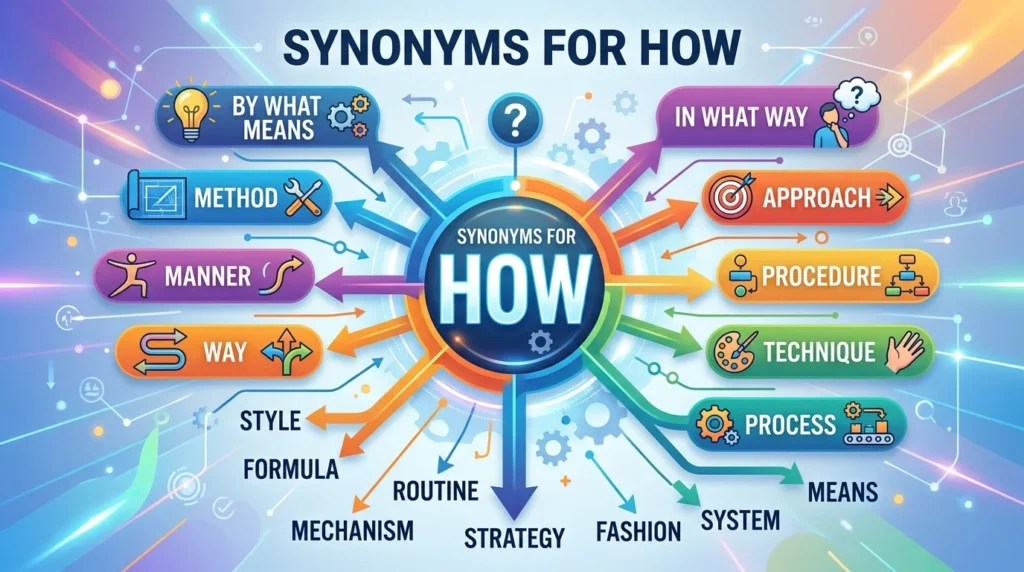
Quick Synonym List
Because how has several meanings, the best alternative depends on context.
Asking about method or means
- in what way
- by what means
- by what method
- using what method
- through what process
- by which method
- in what manner
Referring to the way something happens
- the way
- the manner
- the method
- the means
- the process
- the technique
- the approach
- the procedure
- the mechanism
Asking about condition or state
- in what condition
- in what state
- what condition
- what it is like
- what state
Asking about degree or extent
- to what extent
- how much
- how far
- how greatly
- how strongly
- to what degree
Asking about quality or experience
- what … like
- in what respect
- in what way
- what manner
Formal alternatives
- in what manner
- by what means
- by what method
- to what extent
- in what respect
- in what way
Important: These are not interchangeable synonyms in every sentence. How is unusually broad. Its correct replacement depends on whether it asks about method, condition, degree, manner, or experience.
What Does “How” Mean?
How is an adverb and question word used to ask about the manner, method, condition, degree, or circumstances of something.
For example:
How did you solve the problem?
Here, how asks about the method.
How are you?
Here, it asks about someone’s condition or state.
How tall is the building?
Here, it asks about degree or measurement.
How does this machine work?
Here, it asks about method or mechanism.
How do you like the new design?
Here, it asks about someone’s opinion or reaction.
This variety is why there is no single word that can replace how everywhere.
The Main Senses of “How”
1. How = In What Way?
This is the most common meaning.
How did you do that?
= In what way did you do that?
Other alternatives:
- in what way
- in what manner
- by what method
- by what means
- using what method
Best choice
In what way is usually the closest formal equivalent.
How did she solve the problem?
In what way did she solve the problem?
The second sentence is grammatically correct but more formal and less natural in ordinary conversation.
2. How = By What Means?
When asking how something was accomplished, by what means can be appropriate.
How did they obtain the information?
By what means did they obtain the information?
This version is more formal and can suggest a particular method or means of achieving something.
Best contexts
- academic writing
- legal writing
- formal questions
- analytical writing
- technical descriptions
3. How = By What Method?
When the focus is specifically on a procedure or technique:
How was the experiment conducted?
By what method was the experiment conducted?
By what method is more precise when the answer is expected to be a particular technique or procedure.
4. How = In What Manner?
In what manner is a formal alternative to how when asking about the way an action was performed.
How was the information presented?
In what manner was the information presented?
This expression is grammatical but considerably more formal.
In everyday English, simply how is usually better.
5. How = The Way
Sometimes how introduces a clause referring to the way something happens.
I like how you organized the room.
This can often be rewritten as:
I like the way you organized the room.
Here, the way is often more natural than trying to substitute a single synonym.
Another example
I remember how she solved the problem.
I remember the way she solved the problem.
Both are natural.
6. How = Manner
Manner refers to the way something is done or expressed.
I admired how he handled the situation.
I admired the manner in which he handled the situation.
The second version is much more formal.
Manner works particularly well in phrases such as:
- manner in which
- manner of speaking
- manner of presentation
- manner of behavior
7. How = Method
Method refers to an organized way of doing something.
How did you calculate the result?
What method did you use to calculate the result?
Notice the grammatical change.
How asks the question directly.
What method asks for the specific procedure.
This is often more precise than simply replacing how.
8. How = Means
Means refers to a method or way of achieving something.
How did they achieve their goal?
By what means did they achieve their goal?
This is especially useful in formal or analytical writing.
Common expression
by means of
Example:
The device communicates by means of a wireless connection.
Here, by means of means using or through.
9. How = Process
When how asks about a series of steps, process may be the better noun.
How is the product manufactured?
What is the manufacturing process?
Or:
How does the application work?
What is the process behind the application?
Process is not a universal synonym for how. It works when the answer involves stages or procedures.
10. How = Technique
Technique means a particular way of performing a task or achieving a result.
How did she improve her pronunciation?
What technique did she use to improve her pronunciation?
Use technique when the specific skill or method matters.
11. How = Approach
Approach describes the way someone deals with a problem, task, or situation.
How did the team address the problem?
What approach did the team take?
This is particularly common in professional and academic writing.
12. How = Procedure
Procedure refers to an established or prescribed series of actions.
How should we handle the application?
What procedure should we follow?
Use procedure when there is a defined process or set of rules.
“How” for Degree
One of the most important uses of how is asking about degree or extent.
How much
How much does it cost?
Possible alternatives:
- what amount
- what quantity
- to what extent
- how great an amount
But the alternatives usually require restructuring the sentence.
How much does it cost?
is far more natural than:
To what extent does it cost?
The latter does not mean the same thing.

How many
How many people attended?
This asks about number, not manner.
Possible restructuring:
What number of people attended?
But this is formal and often awkward.
How many is normally the best choice.
How far
How far can ask about physical distance or extent.
How far is the station?
To what distance is the station?
The second version is unnatural in ordinary English.
For abstract extent:
How far has the project progressed?
To what extent has the project progressed?
Here, to what extent can be a useful formal alternative.
How greatly
How greatly did the policy affect the industry?
Possible formal alternative:
To what extent did the policy affect the industry?
The second version is often more natural in academic writing.
“How” for Condition
When asking about someone’s condition, how does not simply mean in what way.
How are you?
Possible alternatives include:
- How are things?
- How is everything?
- What are you like? ❌
- What is your condition? — overly formal in ordinary conversation
For natural everyday English, How are you? is generally the best expression.
“How” for Description
Sometimes how can be replaced by what … like.
How is the new restaurant?
Depending on meaning:
What is the new restaurant like?
These are not always identical.
How is it? can ask for an evaluation or condition.
What is it like? usually asks for a description of its qualities or characteristics.
Example
How was the movie?
This can mean:
Did you like it? Was it good or bad?
But:
What was the movie like?
more strongly invites a description of its style, story, atmosphere, or qualities.
“How” in Indirect Questions
How is commonly used in indirect questions:
I don’t know how she did it.
Can you explain how this works?
We need to determine how the system failed.
Possible formal restructuring:
We need to determine the manner in which the system failed.
But such substitutions can make writing unnecessarily heavy.
For most writing, how is clearer.
Formal Alternatives to “How”
If you need a more formal style, consider:
| Everyday | More formal |
|---|---|
| How did it happen? | In what way did it happen? |
| How was it done? | By what means was it done? |
| How was it performed? | In what manner was it performed? |
| How did you do it? | By what method did you do it? |
| How does it work? | By what mechanism does it operate? |
| How much did it change? | To what extent did it change? |
| How did the team respond? | What approach did the team take? |
| How should we proceed? | What procedure should we follow? |
Formal does not automatically mean better. How is often more direct and readable.
Academic Alternatives to “How”
Academic writing frequently uses more specific structures instead of repeatedly using how.
Method
How was the study conducted?
→ What method was used to conduct the study?
Extent
How effective was the treatment?
→ To what extent was the treatment effective?
Mechanism
How does the system work?
→ What mechanism does the system use?
Approach
How did the researchers address the issue?
→ What approach did the researchers take to address the issue?
These rewrites are not simple synonym substitutions. They make the type of information being requested more explicit.
Professional Alternatives to “How”
In business and workplace writing, useful alternatives include:
- what approach
- what method
- what process
- what procedure
- by what means
- to what extent
- in what way
- through what process
Example
Instead of:
How can we improve customer service?
You could write:
What approach can we take to improve customer service?
Or:
What methods can we use to improve customer service?
Each version changes the focus slightly.
“How” in Technical Writing
Technical writing often benefits from replacing a broad question with a precise technical term.
Example
How does the device operate?
Could become:
What is the operating mechanism of the device?
Or:
What process does the device use?
Another example
How is the data transferred?
Could become:
By what method is the data transferred?
Or:
What protocol is used to transfer the data?
The more precise noun is often better than a formal synonym for how.
Comparison: How vs. The Way
These are often interchangeable when how introduces a clause.
I like how you explained it.
I like the way you explained it.
Both are natural.
However, the way is a noun phrase and can sometimes be clearer when you want to emphasize a particular manner.
I don’t like the way he talks to customers.
This gives a stronger sense that the speaker is referring to a specific manner of behavior.
Comparison: How vs. Manner
How is a question word or adverb.
Manner is a noun meaning the way something is done.
How did she respond?
What was her manner of responding?
The second is much less natural. A better formal rewrite is:
In what manner did she respond?
Manner is useful in phrases such as:
in a professional manner
in a respectful manner
the manner in which
Comparison: How vs. Method
Method is more specific.
How did you solve it?
asks generally about the way.
What method did you use?
asks specifically for the procedure or technique.
Use method when you want the actual approach used to achieve a result.
Comparison: How vs. Means
Means focuses on the way something was achieved.
How did they get the information?
By what means did they obtain the information?
The second sounds formal and may be appropriate in legal, academic, or analytical writing.
Comparison: How vs. To What Extent
These can overlap when how asks about degree.
How successful was the program?
To what extent was the program successful?
The second is more formal and explicitly asks about degree.
But they cannot replace each other in every sentence:
How did you open the door?
❌ To what extent did you open the door?
The meanings are completely different.
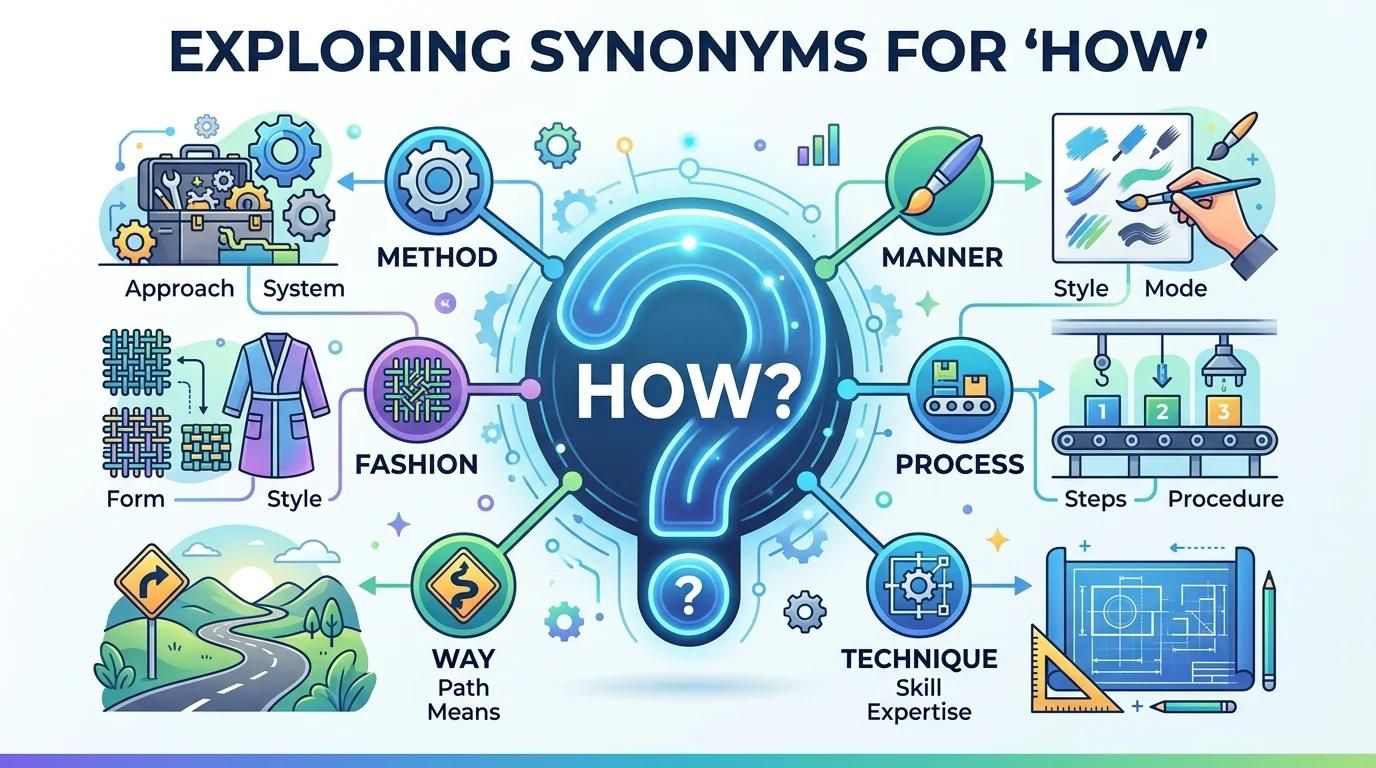
Comparison Table
| Alternative | Meaning | Tone | Best use | Direct replacement? |
|---|---|---|---|---|
| In what way | manner | Formal | Formal questions | Often |
| By what means | method/means | Formal | Academic/legal | Sometimes |
| By what method | specific procedure | Formal | Research/technical | Sometimes |
| In what manner | manner | Very formal | Formal prose | Sometimes |
| The way | manner | Neutral | Clauses/descriptions | Often |
| Method | procedure | Neutral/formal | Tasks/research | No |
| Means | way of achieving something | Formal | Analysis | No |
| Process | series of steps | Neutral/formal | Procedures | No |
| Technique | specific method | Neutral/formal | Skills/tasks | No |
| Approach | way of dealing with something | Neutral/professional | Problems/projects | No |
| Procedure | established method | Formal | Rules/processes | No |
| To what extent | degree | Formal | Academic analysis | Only for degree |
| What … like | characteristics/description | Neutral | Experiences/things | Only in some uses |
Sentence Transformations
1. Asking about a method
Original:
How did you solve the problem?
Alternative:
What method did you use to solve the problem?
Why: The rewrite explicitly asks for the procedure used.
2. Formal writing
Original:
How was the information obtained?
Alternative:
By what means was the information obtained?
Why: By what means gives the sentence a more formal register.
3. Academic writing
Original:
How effective was the program?
Alternative:
To what extent was the program effective?
Why: To what extent clearly signals that the question concerns degree.
4. Describing behavior
Original:
I liked how she handled the situation.
Alternative:
I liked the way she handled the situation.
Why: The way is a natural noun-phrase alternative to how in this structure.
5. Professional writing
Original:
How should we address the issue?
Alternative:
What approach should we take to address the issue?
Why: Approach emphasizes the strategy rather than merely the manner.
6. Technical writing
Original:
How does the system work?
Alternative:
What mechanism does the system use?
Why: Mechanism identifies the technical means by which the system operates.
7. Process
Original:
How is the application processed?
Alternative:
What process is used to handle the application?
Why: Process is clearer when the answer involves defined stages.
8. Everyday description
Original:
How was the concert?
Alternative:
What was the concert like?
Why: What was … like? asks for a description of the experience rather than simply a general evaluation.
Common Expressions With “How”
How to
How to introduces instructions or a method.
How to write a professional email
Possible alternatives:
- the way to
- a method for
- instructions for
- a guide to
But in titles and instructional content, how to is usually the clearest and most natural structure.
How about?
How about? is used to suggest something or ask for someone’s opinion.
How about going tomorrow?
Possible alternatives:
- What about going tomorrow?
- Would you like to go tomorrow?
- What do you think about going tomorrow?
It is not synonymous with in what way.
How come?
How come? is an informal way of asking why.
How come you’re late?
= Why are you late?
Do not treat how come as a general synonym for how.
How so?
How so? means:
In what way?
It is used when asking someone to explain a statement.
You said the plan was risky. How so?
= In what way was it risky?
How far?
How far asks about distance or extent.
How far is the airport?
How far have we progressed?
How long?
How long asks about duration or physical length.
How long will the meeting last?
How long is the bridge?
The appropriate alternative depends on whether you mean duration or length.
How often?
How often asks about frequency.
How often do you exercise?
Possible restructuring:
At what frequency do you exercise?
But this is much more formal and less natural in ordinary conversation.
Common Mistakes
1. Assuming “how” has one synonym
It does not. Its meaning changes according to context.
2. Replacing “how” with “in what way” everywhere
This can make natural English unnecessarily formal.
How are you?
❌ In what way are you?
The second sentence does not communicate the same natural greeting.
3. Confusing “how” with “why”
How asks about method or manner.
Why asks about reason or cause.
How did it happen?
= By what means or process?
Why did it happen?
= For what reason?
4. Confusing “how” with “what”
How is the movie?
usually asks for an evaluation.
What is the movie like?
asks more directly for a description.
5. Using “to what extent” for every “how”
To what extent only works when how asks about degree or extent.
6. Making formal writing unnecessarily complicated
Replacing every how with phrases such as in what manner can reduce readability.
Clear writing does not require formal alternatives when the original word is already precise.
When “How” Is Better Than an Alternative
There are many situations where how should not be replaced.
Everyday questions
How are you?
How did you do that?
How does this work?
How much is it?
Instructions
Here’s how to install the software.
Natural conversation
How was your trip?
Clear explanatory writing
This section explains how the system works.
In each case, replacing how with a longer phrase can make the sentence less natural.
How is short, familiar, flexible, and precise enough for most everyday uses.
Which Alternative Should You Choose?
If you mean “in what way”
Use in what way.
If you mean “by what means”
Use by what means.
If you mean a specific procedure
Use method or procedure.
If you mean a series of stages
Use process.
If you mean a specific skill or procedure
Use technique.
If you mean a strategy for dealing with something
Use approach.
If you mean degree or extent
Use to what extent.
If you mean a description
Use what … like.
If you mean Keep how.manner in formal writing
Use in what manner.