
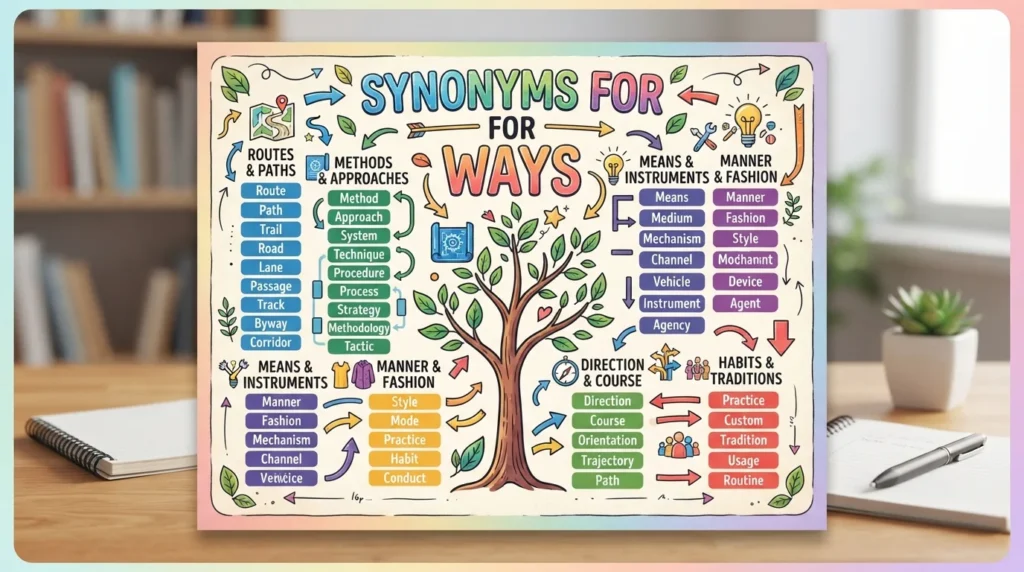
Quick Synonym List
Because ways has several meanings, there is no single synonym that works in every sentence.
Ways meaning “methods”
- methods
- means
- techniques
- approaches
- procedures
- processes
- practices
- systems
- strategies
- formulas
Ways meaning “choices or possibilities”
- options
- alternatives
- possibilities
- choices
- opportunities
- courses of action
- solutions
- avenues
Ways meaning “routes or directions”
- paths
- routes
- roads
- directions
- tracks
- passages
- trails
- courses
Ways meaning “manners or styles”
- manners
- styles
- modes
- fashions
- approaches
- forms
- patterns
Ways meaning “behavior”
- behavior
- conduct
- actions
- practices
- habits
- mannerisms
Ways meaning “means of achieving something”
- means
- methods
- resources
- mechanisms
- tools
- instruments
- channels
- avenues
Key distinction: Ways is a broad word. Methods describe how something is done, options describe choices, routes describe ways of getting somewhere, and manners describe how someone behaves or performs an action. Choosing the right alternative requires looking at the meaning of ways in the sentence.
What Does “Ways” Mean?
Ways is the plural of way, but way has many different meanings in English. As a result, the best synonym for ways depends heavily on context.
Consider these examples:
There are several ways to solve the problem.
Here, ways means methods or approaches.
We discussed several ways to reduce costs.
Here, ways means possible strategies or courses of action.
There are two ways to the village.
Here, ways means routes or paths.
I don’t like the ways he treats people.
Here, ways refers to manners or patterns of behavior.
There are many ways to learn a language.
Here, ways means methods or approaches.
This is why replacing ways with a random thesaurus word can easily change the meaning.
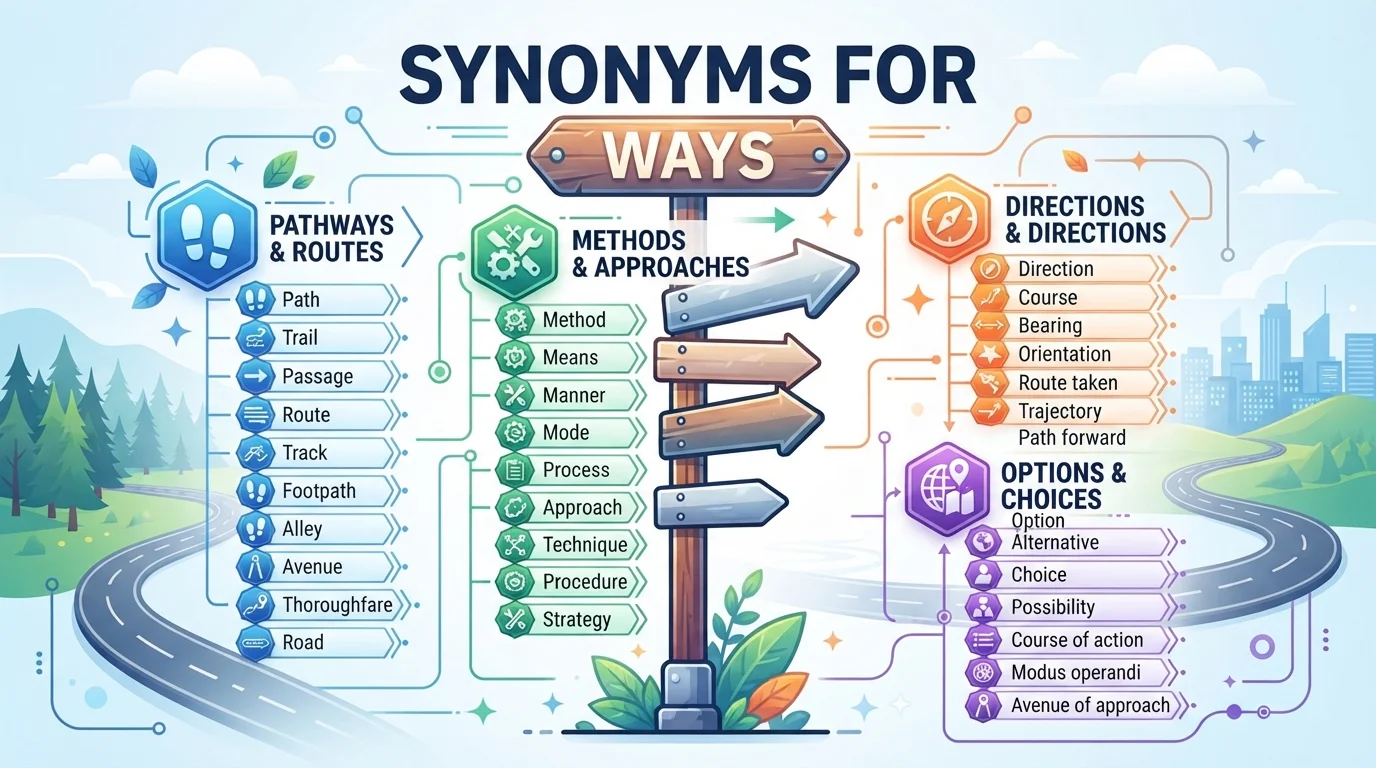
The Best Synonyms for Ways
1. Methods
Methods are organized or established ways of doing something.
- Meaning: Procedures or techniques used to achieve a result
- Tone: Neutral to formal
- Best for: Education, research, work, problem-solving, and instructions
- Relationship: Very close synonym when ways means methods
Example:
There are several methods for improving pronunciation.
Instead of:
There are several ways to improve pronunciation.
Method is especially useful when you want to emphasize a specific procedure.
Watch out
Not every way is a method. A route, personal manner, or possibility is not necessarily a method.
2. Means
Means refers to a method or resource used to achieve something.
Example:
They found a way to reduce costs.
They found a means of reducing costs.
The expression by means of is particularly common in formal writing.
The device communicates by means of a wireless connection.
Best for
- Formal writing
- Academic writing
- Business
- Problem-solving
- Describing how something is achieved
Watch out
Means can also refer to financial resources:
People with limited means may need financial assistance.
So it is not always interchangeable with ways.
3. Approaches
Approaches describe particular ways of dealing with a problem, task, subject, or situation.
Example:
We considered several ways to solve the problem.
We considered several approaches to solving the problem.
Approach is especially natural in professional and academic writing.
Best for
- Problems
- Projects
- Research
- Management
- Decision-making
- Learning
Why choose it?
Approach emphasizes a general strategy or perspective, rather than a precise series of steps.
4. Techniques
A technique is a particular skillful method used to accomplish something.
Example:
The instructor demonstrated several ways to improve memory.
The instructor demonstrated several memory techniques.
Best for
- Writing
- Art
- Sports
- Learning
- Cooking
- Communication
- Professional skills
Difference from methods
A method can be a complete procedure, while a technique is often a specific skill or tactic within a larger method.
5. Procedures
Procedures are established or prescribed ways of doing something.
Example:
The company has several ways of handling customer complaints.
The company has several procedures for handling customer complaints.
Best for
- Organizations
- Workplaces
- Healthcare
- Government
- Safety
- Administrative tasks
Procedure often implies that the steps are defined or standardized.
6. Processes
A process is a series of actions or stages through which something happens or is accomplished.
Example:
We need to find better ways to manage applications.
We need to improve the application process.
Best for
- Manufacturing
- Business
- Technology
- Administration
- Research
- Project management
Watch out
Process emphasizes a sequence of stages. It is not a universal replacement for way.
7. Strategies
A strategy is a planned approach designed to achieve a goal.
Example:
The team discussed ways to increase sales.
The team discussed strategies for increasing sales.
Best for
- Business
- Marketing
- Education
- Competition
- Personal goals
- Problem-solving
A strategy usually implies planning and a specific objective.
8. Practices
Practices are customary or established ways of doing something.
Example:
The organization is reviewing its ways of handling employee complaints.
The organization is reviewing its complaint-handling practices.
Best for
- Workplace behavior
- Professional standards
- Industry customs
- Education
- Business operations
Practice often suggests something done repeatedly or according to an accepted standard.
9. Systems
A system is an organized set of procedures or components used to accomplish something.
Example:
The company developed new ways to track inventory.
The company developed new inventory-management systems.
Best for
- Technology
- Business
- Administration
- Organizations
- Processes
A system is generally more structured than a simple way.
10. Options
Options are different choices available to someone.
Example:
We need to consider different ways of responding.
We need to consider different options.
Best for
- Decisions
- Planning
- Purchases
- Problem-solving
- Negotiations
Important distinction
When ways means possible choices, options is often the best replacement.
But:
There are several ways to get to the airport.
does not normally mean:
There are several options to get to the airport.
The second sentence changes the focus from routes to choices.
Synonyms for Ways Meaning “Choices”
Alternatives
Alternatives are different possibilities that can be chosen instead of the original or usual option.
We need to find other ways to reduce expenses.
We need to find alternative ways to reduce expenses.
Or:
We need to consider alternatives to the current system.
Best for
- Problem-solving
- Planning
- Business
- Decisions
- Formal writing
Possibilities
Possibilities are things that could happen or could be done.
There are many ways this problem could be solved.
There are many possibilities for solving this problem.
Possibility emphasizes what could happen rather than a specific established method.
Choices
Choices are available alternatives between which someone can decide.
You have several ways to complete the assignment.
You have several choices for completing the assignment.
Choices emphasizes the decision-maker.
Courses of Action
A course of action is a possible plan or set of actions that someone can take.
We need to consider different ways to respond.
We need to consider different courses of action.
This expression is especially useful in professional and formal writing.
Solutions
A solution is a way of resolving a problem.
We need to find new ways to address the issue.
We need to find new solutions to the issue.
Watch out
Not every way of approaching a problem is a solution. A solution specifically aims to resolve the problem.
Synonyms for Ways Meaning “Routes”
Sometimes ways refers to physical routes.
There are several ways to the city.
Possible alternatives include:
- routes
- paths
- roads
- trails
- tracks
- passages
- directions
- courses
Routes
Route is usually the strongest choice when discussing directions or travel.
There are three ways to reach the airport.
There are three routes to the airport.
Best for
- Driving
- Public transportation
- Travel
- Navigation
- Delivery
Paths
A path can be a physical route or a figurative course toward a goal.
We followed several ways through the forest.
We followed several paths through the forest.
It can also be figurative:
Education can provide a path to a better career.
Roads
Use roads when the ways are specifically physical roads.
There are several ways into the town.
There are several roads into the town.
Do not use roads for every figurative use of ways.
Trails
A trail is a path, especially one used for walking, hiking, or following a route through natural surroundings.
There are several ways through the park.
There are several trails through the park.
Synonyms for Ways Meaning “Manner”
Another important meaning of ways is manner—how something is done or expressed.
I don’t like the way he speaks to people.
Possible alternatives include:
- manner
- style
- mode
- fashion
- approach
- behavior
- conduct
Manner
Manner is one of the closest alternatives when way means how something is done.
I admired the way she handled the situation.
I admired the manner in which she handled the situation.
The second version is more formal.
Style
Style refers to a distinctive way of doing, presenting, or expressing something.
I like the way she writes.
I like her writing style.
Best for
- Writing
- Art
- Fashion
- Communication
- Design
- Performance
Mode
Mode is a formal word for a particular way or manner of operating or doing something.
The machine has several operating modes.
It is common in technical writing.
Fashion
In the expression “in this fashion,” fashion means “in this way.”
The process was completed in the following way.
The process was completed in the following fashion.
Fashion in this sense is formal and somewhat old-fashioned.
Synonyms for Ways Meaning “Behavior”
Sometimes ways refers to how someone behaves.
I don’t like the way he treats his coworkers.
Possible alternatives include:
- behavior
- conduct
- actions
- habits
- manner
- mannerisms
- practices
Behavior
Behavior is the most useful alternative when ways refers to someone’s actions or conduct.
Her ways were becoming difficult to understand.
Her behavior was becoming difficult to understand.
Watch out
Behavior refers to actions and conduct, not necessarily methods.
Conduct
Conduct is a more formal word for behavior.
The employee’s way of dealing with customers was inappropriate.
The employee’s conduct toward customers was inappropriate.
It is particularly common in professional, legal, and official contexts.
Ways in Formal and Professional Writing
If you are replacing ways in professional writing, the best choice depends on the meaning.
| Instead of “ways” | Consider | Example |
|---|---|---|
| Ways to improve | Methods | Methods for improving efficiency |
| Ways to solve | Approaches | Approaches to solving the problem |
| Ways to achieve | Means | Means of achieving the goal |
| Ways to respond | Strategies | Strategies for responding |
| Ways of working | Practices | Workplace practices |
| Ways of handling | Procedures | Complaint-handling procedures |
| Ways of communicating | Channels | Communication channels |
| Ways of measuring | Methods | Measurement methods |
| Ways of reaching | Routes | Alternative routes |
| Ways of behaving | Conduct | Professional conduct |
The goal is not to make every sentence more formal. It is to select a word that tells the reader exactly what you mean.
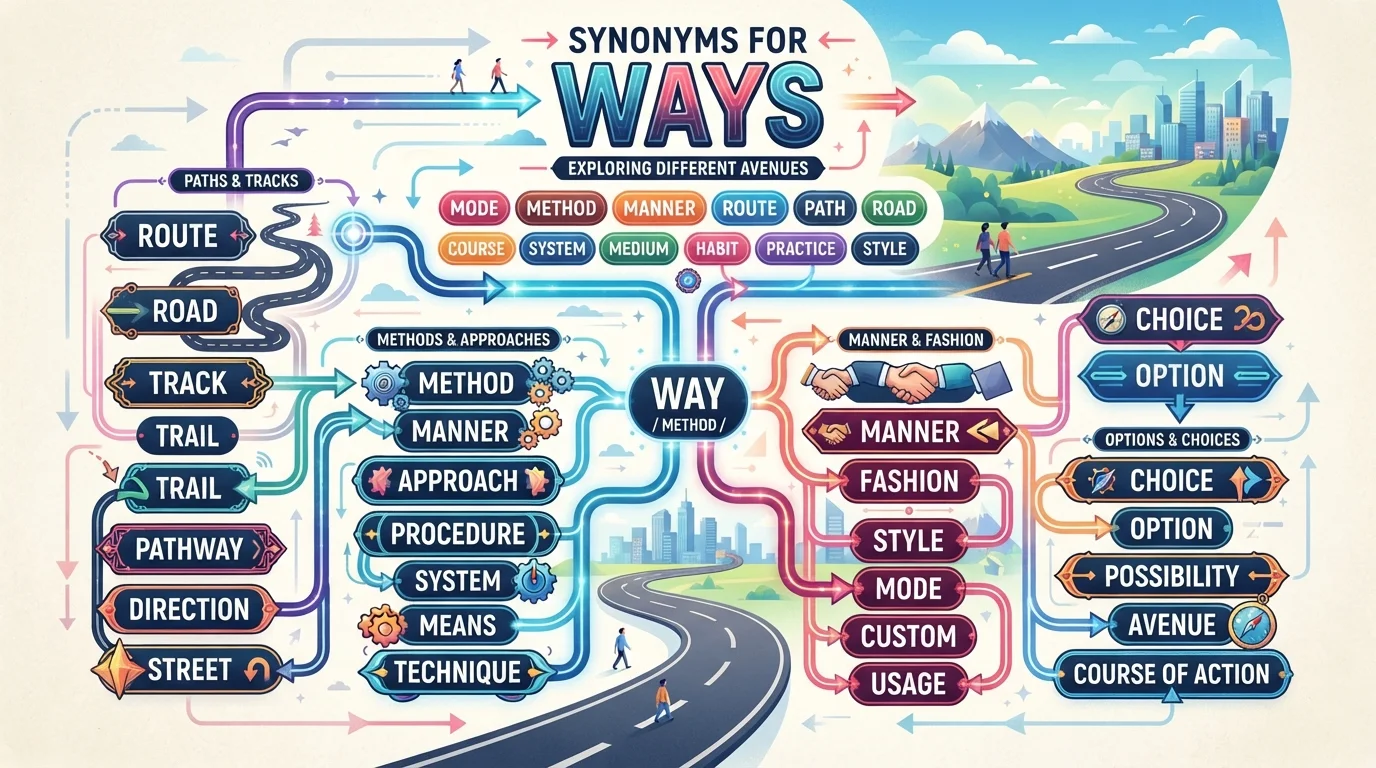
Ways vs. Methods
These words are closely related.
Ways is broader and more natural in everyday English.
There are many ways to learn vocabulary.
Methods is more specific and often more formal.
Researchers compared several methods for teaching vocabulary.
A way can be a method, but it can also be a route, option, style, or manner.
Therefore:
Every method can be a way, but not every way is a method.
Ways vs. Means
Means usually emphasizes how something is achieved.
We need to find a way to reduce costs.
We need to find a means of reducing costs.
The second sentence sounds more formal.
The phrase means of is especially common:
a means of communication
a means of transportation
Ways vs. Approaches
Approach emphasizes a general strategy or perspective.
There are several ways to solve the problem.
There are several approaches to solving the problem.
The second version sounds more analytical and is common in academic and professional writing.
Ways vs. Options
Use options when people are choosing among possibilities.
We have several ways to handle the problem.
We have several options for handling the problem.
Here the meanings are very close.
But:
There are several ways to the station.
does not mean:
There are several options to the station.
For physical travel, use routes or paths.
Ways vs. Manner
Manner is appropriate when way describes how something is performed.
I dislike the way he speaks.
I dislike his manner of speaking.
Manner is more formal and often works best in phrases such as:
- in a professional manner
- in a respectful manner
- the manner in which
- manner of speaking
Ways vs. Strategies
A strategy is a planned way of achieving a particular goal.
We need better ways to increase sales.
We need better strategies for increasing sales.
Use strategy when planning and goals are central.
A casual method does not necessarily qualify as a strategy.
Comparison Table
| Word/Phrase | Main Meaning | Tone | Strength | Best Use | Interchangeable? |
|---|---|---|---|---|---|
| Ways | General means, methods, routes, or manners | Neutral | Broad | Everyday English | — |
| Methods | Organized ways of doing something | Neutral/formal | Specific | Research, tasks | Often |
| Means | Way of achieving something | Formal | Specific | Formal writing | Sometimes |
| Approaches | General strategies | Professional | Specific | Problems/projects | Often |
| Techniques | Particular skills or methods | Neutral/formal | Specific | Skills | Sometimes |
| Procedures | Established steps | Formal | Specific | Organizations | Sometimes |
| Strategies | Planned methods for goals | Professional | Specific | Business/planning | Sometimes |
| Options | Choices | Neutral | Specific | Decisions | Sometimes |
| Alternatives | Different choices | Neutral/formal | Specific | Problem-solving | Sometimes |
| Routes | Paths from one place to another | Neutral | Specific | Travel | Only for physical ways |
| Paths | Physical or figurative routes | Neutral | Broad | Travel/goals | Sometimes |
| Manners | Ways of behaving or doing | Formal | Specific | Behavior | Sometimes |
| Styles | Distinctive ways of doing something | Neutral | Specific | Writing/design | Sometimes |
| Processes | Series of steps | Neutral/formal | Specific | Business/technical | Sometimes |
| Practices | Established or customary ways | Professional | Specific | Work/culture | Sometimes |
Sentence Transformations
1. General method
Original:
There are many ways to improve your writing.
Alternative:
There are many methods for improving your writing.
Why: Methods makes the sentence sound more instructional and systematic.
2. Professional strategy
Original:
We need to find new ways to attract customers.
Alternative:
We need to develop new strategies for attracting customers.
Why: Strategies emphasizes planned actions aimed at a business goal.
3. Formal writing
Original:
They found a way to solve the problem.
Alternative:
They found a means of solving the problem.
Why: Means gives the sentence a more formal tone.
4. Academic writing
Original:
Researchers used different ways to analyze the data.
Alternative:
Researchers used different methods to analyze the data.
Why: Methods is more precise in a research context.
5. Choices
Original:
We have several ways to handle the situation.
Alternative:
We have several options for handling the situation.
Why: Options emphasizes the choices available to decision-makers.
6. Routes
Original:
There are two ways to reach the village.
Alternative:
There are two routes to the village.
Why: Routes clearly indicates physical directions.
7. Behavior
Original:
I don’t like the way he treats customers.
Alternative:
I don’t like his behavior toward customers.
Why: Behavior identifies conduct rather than a method.
8. Manner
Original:
She handled the complaint in a professional way.
Alternative:
She handled the complaint in a professional manner.
Why: Manner is a natural formal alternative in this structure.
9. Technique
Original:
The trainer showed us several ways to improve our balance.
Alternative:
The trainer showed us several techniques for improving our balance.
Why: Techniques emphasizes specific skills or practices.
10. Process
Original:
We need better ways to process applications.
Alternative:
We need a better process for handling applications.
Why: Process emphasizes the organized sequence of work.
Common Expressions With “Ways”
Ways to
Ways to means possible methods of achieving something.
ways to save money
ways to improve communication
ways to solve a problem
Common alternatives include:
- methods for
- approaches to
- strategies for
- techniques for
- means of
In Many Ways
In many ways means “in several respects” or “in several different senses.”
The two approaches are similar in many ways.
Possible alternatives:
- in several respects
- in various respects
- in several respects
- in multiple respects
In Some Ways
In some ways means “in certain respects.”
The new system is better in some ways.
Possible alternative:
The new system is better in certain respects.
By Any Means
By any means refers to any available method.
We need to solve the problem by any means necessary.
This expression can imply determination to achieve an objective regardless of the method.
By All Means
By all means is an idiomatic expression meaning “certainly” or “yes, go ahead.”
“May I use your computer?”
“By all means.”
It does not simply mean “in all ways.”
No Way
No way can mean that something is impossible or that someone strongly refuses.
No way am I agreeing to that.
It is informal and should not be treated as a synonym for no method.
The Way
The way can mean a method, manner, route, or style depending on context.
I like the way you explained it.
Here it means manner.
Do you know the way to the station?
Here it means route.
That’s not the way to solve the problem.
Here it means method.
Formal Alternatives to “Ways”
For formal writing, choose the alternative that identifies the exact meaning.
Instead of “ways to improve”
- methods for improvement
- approaches to improvement
- strategies for improvement
- measures for improvement
Instead of “ways of doing”
- methods of operation
- procedures
- practices
- processes
- techniques
Instead of “ways to achieve”
- means of achieving
- methods for achieving
- strategies for achieving
- approaches to achieving
Instead of “ways of communicating”
- communication methods
- communication channels
- communication mechanisms
- modes of communication
Formal writing should not automatically replace ways. The specific noun is useful only when it provides additional meaning.
Professional Alternatives to “Ways”
In workplace communication, these words are especially useful:
- approaches
- methods
- strategies
- processes
- procedures
- practices
- options
- alternatives
- channels
- mechanisms
For example:
We need to discuss ways to improve customer service.
Could become:
We need to discuss approaches to improving customer service.
Or:
We need to evaluate strategies for improving customer service.
The first sounds analytical; the second suggests deliberate planning.
Academic Alternatives to “Ways”
Academic writing often benefits from replacing broad language with precise terms.
Instead of:
There are many ways to explain this result.
Consider:
There are several possible explanations for this result.
Instead of:
Researchers used different ways to collect data.
Use:
Researchers used different data-collection methods.
Instead of:
The study examines ways students learn vocabulary.
Use:
The study examines vocabulary-learning strategies.
The more specific version tells the reader exactly what is being discussed.
Casual Alternatives to “Ways”
In everyday conversation, ways is often already the best word.
Useful alternatives include:
- options
- choices
- tricks
- approaches
- paths
- routes
- methods
- ideas
For example:
Do you know any ways to fix this?
Could become:
Do you know any tricks for fixing this?
But tricks changes the meaning. It suggests practical tips or clever techniques rather than general methods.
Common Mistakes
1. Using “methods” for physical routes
There are three methods to the airport.
This is incorrect if you mean roads or routes.
Use:
There are three routes to the airport.
2. Using “options” for every type of way
Options are choices. They are not necessarily methods, routes, or manners.
3. Assuming “approach” means exact procedure
An approach is usually a general strategy rather than a detailed step-by-step procedure.
4. Using “strategy” without a goal
A strategy normally involves planning toward an objective.
5. Using “manner” in casual speech unnecessarily
What’s your manner of fixing this?
sounds unnatural.
How do you fix this?
is much better.
6. Confusing “ways” with “means”
Means has specialized uses, including financial resources and methods of achieving something.
7. Replacing “ways” just to sound sophisticated
“Ways” is not a weak word. It is often the most natural and understandable choice.
8. Ignoring the plural meaning
Sometimes ways refers to several methods; sometimes it refers to several routes, choices, or manners. The surrounding sentence determines the meaning.
When “Ways” Is Better Than a Synonym
There are many cases where ways is the strongest choice because it is broad and natural.
For example:
There are many ways to learn English.
This sentence is simple and accessible.
Changing it to:
There are many methodological approaches to English-language acquisition.
would be unnecessarily technical for most readers.
Likewise:
Can you show me some ways to save money?
sounds natural in everyday conversation.
A more formal phrase such as:
Can you identify several financial optimization strategies?
changes the tone and may suggest something more specialized than the original.
The purpose of a synonym is not to make a sentence sound complicated. It is to make the meaning more precise when precision is useful.
Which Synonym Should You Choose?
If you mean a method
Use method.
Several methods can solve the problem.
If you mean a strategy
Use approach or strategy.
We considered several approaches.
If you mean a specific skill
Use technique.
The coach taught several techniques.
If you mean an established sequence
Use procedure or process.
Follow the correct procedure.
If you mean a choice
Use option or alternative.
We have several options.
If you mean a physical route
Use route, path, or road.
There are several routes to the airport.
If you mean behavior
Use behavior, conduct, or manner.
His conduct was inappropriate.
If you mean style
Use style, mode, or manner.
She has a distinctive writing style.
If you mean a favorable possibility
Use opportunity or avenue.
The program creates new opportunities.