
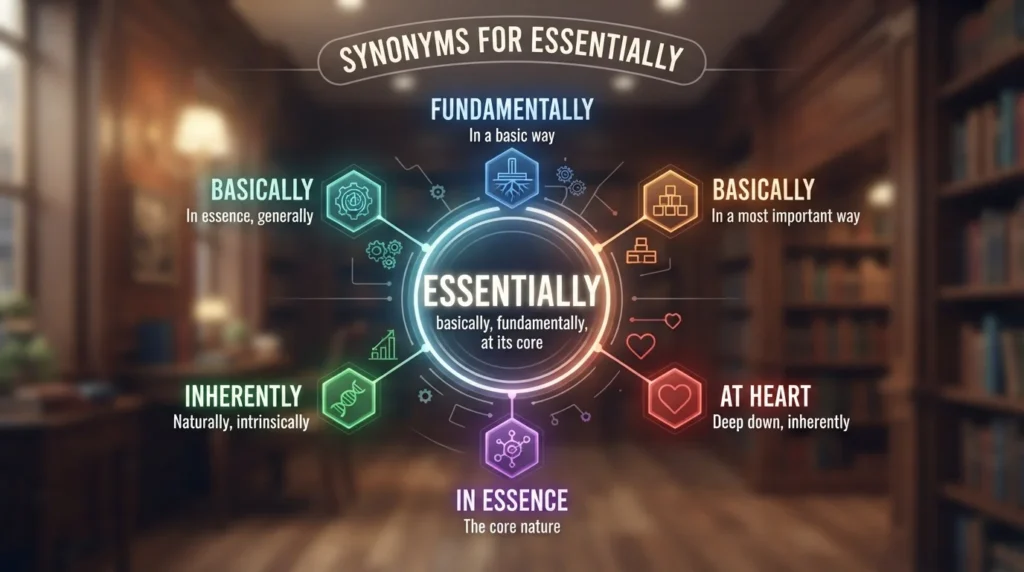
Quick Reference: Synonyms for Essentially
| Alternative | Best meaning | Tone | Direct replacement? |
|---|---|---|---|
| basically | In simple or general terms | Neutral/conversational | Often |
| fundamentally | At the basic or underlying level | Formal | Often |
| in essence | In its essential nature | Neutral/formal | Often |
| at heart | In its true nature | Neutral | Sometimes |
| primarily | Mainly; chiefly | Neutral/formal | Sometimes |
| chiefly | Mainly | Formal | Sometimes |
| mainly | Mostly; for the most part | Neutral | Sometimes |
| principally | Mainly; chiefly | Formal | Sometimes |
| in principle | In theory or according to a basic rule | Formal | No |
| at its core | At the central or defining level | Neutral | Often |
| at its heart | At the central nature of something | Neutral | Often |
| intrinsically | By its inherent nature | Formal/academic | Sometimes |
| inherently | As a natural or built-in quality | Formal | Sometimes |
| underlyingly | At an underlying level | Rare/awkward | Usually no |
| effectively | In practical effect | Neutral/formal | Sometimes |
| in effect | In actual operation or result | Formal | Sometimes |
| virtually | Almost completely | Neutral/formal | No |
| practically | Almost; in practical terms | Neutral | Sometimes |
| more or less | Approximately; broadly | Conversational | Sometimes |
| in substance | In the essential content | Formal | Sometimes |
| to all intents and purposes | Practically speaking | Formal/idiomatic | Sometimes |
| at bottom | Ultimately; fundamentally | Formal/literary | Sometimes |
| ultimately | At the deepest or final level | Neutral/formal | Sometimes |
| in reality | In actual fact | Neutral | Context-dependent |
| in fact | Actually; truthfully | Neutral | Context-dependent |
| actually | In fact | Neutral | Context-dependent |
| more fundamentally | At a deeper basic level | Formal | Context-dependent |
| in simple terms | Simplified explanation | Neutral | No |
| in simple words | Plain-language explanation | Neutral | No |
| to put it simply | Simplifying a statement | Neutral | No |
| at its simplest | In the simplest formulation | Neutral | No |
| in short | Briefly summarized | Neutral | No |
| in a nutshell | Very briefly | Informal | No |
The most useful choices are usually basically, fundamentally, in essence, primarily, mainly, at its core, effectively, and in effect.
What Does “Essentially” Mean?
Essentially is an adverb that usually means in the most important or basic sense of something.
It can also mean basically, fundamentally, mainly, or in practical effect, depending on the sentence.
For example:
“The two plans are essentially the same.”
Here, essentially means that their important or basic features are the same, even if some minor details differ.
But:
“The machine is essentially useless.”
Here, the meaning is closer to effectively or practically useless.
And:
“The problem is essentially financial.”
Here, essentially means primarily or fundamentally financial.
This is why simply replacing essentially with the first synonym in a thesaurus can change the meaning.
1. Basically
Basically is the most common everyday alternative to essentially.
It means in simple terms, for the most part, or at a basic level.
Example:
“The job is essentially customer service.”
→ “The job is basically customer service.”
Best for
- Everyday conversation
- Emails
- Explanations
- Informal writing
- Simplifying a complicated idea
Tone
Neutral to conversational.
Watch out
Basically can sound vague or overly casual in formal academic writing. If you are discussing an underlying principle, fundamentally may be more precise.
2. Fundamentally
Fundamentally means at the most basic, underlying, or important level.
It is one of the strongest alternatives when essentially refers to the nature of something.
Example:
“The two approaches are essentially different.”
→ “The two approaches are fundamentally different.”
Best for
- Academic writing
- Professional analysis
- Technical explanations
- Arguments about basic principles
Tone
Formal and analytical.
Difference from “essentially”
Essentially can simply summarize the main nature of something. Fundamentally more strongly points to its underlying structure or principle.
“They are essentially the same.”
This may simply mean their important features are alike.
“They are fundamentally the same.”
This suggests their basic nature or underlying principles are alike.
3. In Essence
In essence is a very close phrase-level synonym.
It means in its essential nature or when reduced to its most important characteristics.
Example:
“The proposal is essentially a cost-cutting measure.”
→ “In essence, the proposal is a cost-cutting measure.”
Best for
- Formal writing
- Essays
- Reports
- Explanations
- Summarizing the core idea
Tone
Neutral to formal.
Why choose it?
It clearly signals that you are moving past minor details to identify the central idea.
4. At Its Core
At its core means at the central or defining level.
Example:
“The conflict is essentially about control.”
→ “At its core, the conflict is about control.”
This phrase is especially natural when explaining the central issue behind a complicated situation.
Best for
- Analysis
- Business writing
- Essays
- Presentations
- Explanations
Tone
Neutral and clear.
Difference from “basically”
“At its core” emphasizes the central nature of something. “Basically” is broader and can simply introduce a simplified explanation.
5. At Heart
At heart means in someone’s or something’s true underlying nature.
Example:
“He is essentially an artist.”
→ “He is an artist at heart.”
The second sentence has a more personal or emotional tone.
Best for
- People
- Character descriptions
- Creative writing
- Personal writing
Tone
Warm, natural, sometimes literary.
Watch out
“At heart” does not work in every technical or factual sentence.
“The device is essentially electronic.”
“It’s electronic at heart” changes the tone and sounds figurative.
6. Primarily
Primarily means mainly or chiefly.
Use it when essentially identifies the main factor or purpose rather than the basic nature of something.
Example:
“The program is essentially designed for beginners.”
→ “The program is primarily designed for beginners.”
Best for
- Professional writing
- Academic writing
- Reports
- Business communication
Difference
Primarily answers:
“What is the main thing?”
Fundamentally answers:
“What is the basic or underlying nature?”
These are related but different questions.
7. Mainly
Mainly is a simple, natural alternative to essentially when the intended meaning is mostly or chiefly.
Example:
“The meeting was essentially about budget issues.”
→ “The meeting was mainly about budget issues.”
Best for
- Everyday English
- Emails
- General writing
- Simple explanations
Tone
Neutral.
Mainly is often clearer than essentially when you simply mean “mostly.”
8. Chiefly
Chiefly means mainly or principally.
Example:
“The region is essentially agricultural.”
→ “The region is chiefly agricultural.”
Best for
- Formal writing
- Historical writing
- Academic prose
- Descriptive writing
Tone
Formal.
It is less common in everyday American conversation than mainly or primarily.
9. Principally
Principally means mainly, chiefly, or for the most important reason.
Example:
“The organization exists essentially to support local artists.”
→ “The organization exists principally to support local artists.”
Best for
- Formal documents
- Academic writing
- Professional writing
Watch out
Do not confuse principally with principally as a spelling variant of principally—the word itself is principally. It comes from principal, meaning chief or main.
10. At Its Heart
At its heart is similar to at its core, but often sounds more natural when discussing ideas, organizations, stories, or values.
Example:
“The proposal is essentially about fairness.”
→ “At its heart, the proposal is about fairness.”
Best for
- Essays
- Speeches
- Editorial writing
- Creative or persuasive explanations
Tone
Natural and slightly expressive.
11. Inherently
Inherently means as a natural, built-in, or inseparable quality.
Example:
“The process is essentially risky.”
This could become:
“The process is inherently risky.”
But the meaning becomes more specific.
Inherently risky means that the risk is built into the nature of the process.
Best for
- Academic writing
- Technical writing
- Analytical writing
Important distinction
Essentially does not automatically mean inherently.
“The system is essentially political.”
This identifies its basic nature.
“The system is inherently political.”
This says being political is a built-in characteristic.
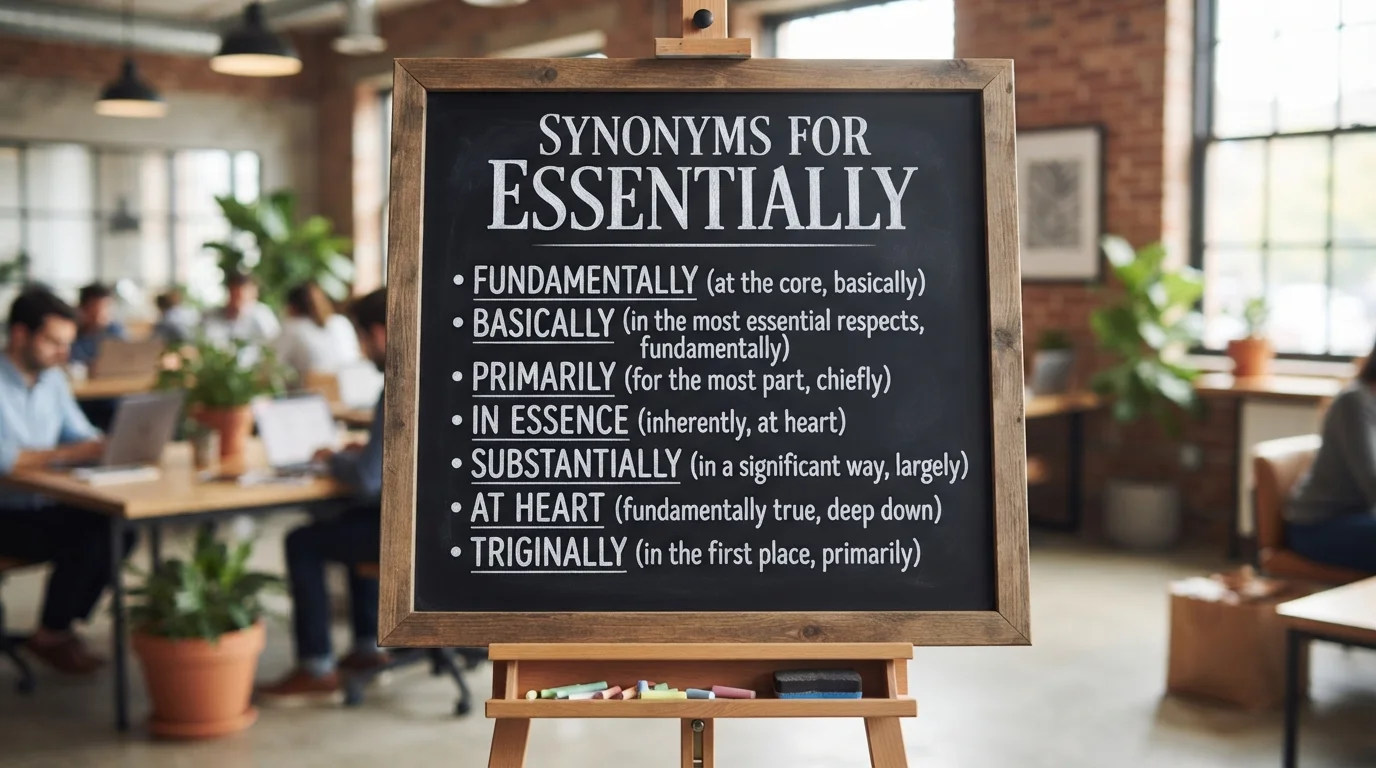
12. Intrinsically
Intrinsically means by its inherent nature or in itself.
Example:
“The material is not essentially valuable.”
In a suitable context:
“The material is not intrinsically valuable.”
The second version focuses more strongly on value existing within the thing itself.
Best for
- Philosophy
- Academic writing
- Ethics
- Technical analysis
Tone
Formal.
13. Effectively
Effectively is an important alternative when essentially means in practical effect.
Example:
“The company is essentially bankrupt.”
→ “The company is effectively bankrupt.”
This does not necessarily mean legally bankrupt. It means its practical situation is equivalent to bankruptcy.
Best for
- Business
- Economics
- Law-related explanations
- Professional analysis
Key distinction
Essentially can describe basic nature.
Effectively describes practical result or consequence.
“The two systems are essentially identical.”
= Their important characteristics are the same.
“The two systems are effectively identical.”
= In practice, there is little meaningful difference.
14. In Effect
In effect means in actual operation, result, or practical consequence.
Example:
“The policy essentially bans the practice.”
→ “The policy, in effect, bans the practice.”
Best for
- Legal writing
- Policy writing
- Academic analysis
- Professional writing
Tone
Formal.
It is particularly useful when the literal wording of something differs from its practical consequence.
15. Virtually
Virtually means almost completely or for practical purposes.
Example:
“The project is essentially finished.”
→ “The project is virtually finished.”
But these are not identical.
Essentially finished can mean the important work is done.
Virtually finished usually means it is almost completely finished.
Watch out
Do not use virtually merely because it sounds formal. It introduces the idea of almost.
16. Practically
Practically can mean almost or in practical terms.
Example:
“The proposal is essentially impossible.”
→ “The proposal is practically impossible.”
The second version can suggest that something is technically possible but unrealistic in practice.
Best for
- Everyday English
- Professional writing
- Practical explanations
17. Ultimately
Ultimately means at the deepest, final, or most decisive level.
Example:
“The disagreement is essentially about trust.”
→ “Ultimately, the disagreement is about trust.”
The two can be close, but ultimately often suggests the final underlying issue after considering other factors.
18. In Substance
In substance means in essential content or effect, despite differences in form.
Example:
“The revised agreement is essentially the same.”
→ “In substance, the revised agreement is the same.”
Best for
- Legal writing
- Formal analysis
- Contracts
- Academic writing
Tone
Formal.
19. More or Less
More or less means approximately, generally, or to some extent.
Example:
“The two versions are essentially identical.”
→ “The two versions are more or less identical.”
This is more conversational and less precise.
Best for
- Informal speech
- Casual writing
Watch out
Do not use it when exact precision matters.
20. In a Nutshell
In a nutshell means in a very brief summary.
Example:
“Essentially, the plan reduces costs and increases efficiency.”
→ “In a nutshell, the plan reduces costs and increases efficiency.”
This is not a direct synonym. It changes the sentence from describing essential nature to introducing a brief summary.
Best for
- Blogs
- Conversation
- Informal explanations
Essentially by Meaning
Because essentially has several uses, the best replacement depends on what you are trying to say.
If you mean “basically”
Use:
- basically
- in essence
- at its core
- at heart
- in simple terms
- in simple words
- to put it simply
Example:
“Essentially, the two systems work the same way.”
→ “Basically, the two systems work the same way.”
If you mean “fundamentally”
Use:
- fundamentally
- at its core
- at its heart
- in essence
- at bottom
- ultimately
Example:
“The problem is essentially philosophical.”
→ “The problem is fundamentally philosophical.”
If you mean “mainly”
Use:
- mainly
- primarily
- chiefly
- principally
- for the most part
Example:
“The audience is essentially made up of students.”
→ “The audience is mainly made up of students.”
If you mean “in practical effect”
Use:
- effectively
- in effect
- practically
- for practical purposes
- to all intents and purposes
Example:
“The new rule essentially prevents small companies from competing.”
→ “The new rule effectively prevents small companies from competing.”
If you mean “almost”
Use:
- virtually
- practically
- nearly
- almost
- more or less
Example:
“The building is essentially empty.”
If the intended meaning is “almost completely empty”:
“The building is virtually empty.”
Essentially vs. Basically
These are the closest everyday alternatives.
| Essentially | Basically |
|---|---|
| Often focuses on essential nature | Often simplifies an explanation |
| Neutral/formal | Neutral/conversational |
| Common in analytical writing | Common in speech |
| Can sound more precise | Can sound more casual |
Compare:
“The two theories are essentially different.”
This focuses on their fundamental difference.
“Basically, the two theories are different.”
This sounds more like a simplified explanation.
Essentially vs. Fundamentally
These often overlap, but fundamentally is stronger when discussing underlying principles.
“The proposal is essentially a compromise.”
= That is its basic character.
“The proposal is fundamentally a compromise.”
= Compromise is central to its underlying nature.
For academic or analytical writing, fundamentally can be more precise when you are making a claim about basic principles.
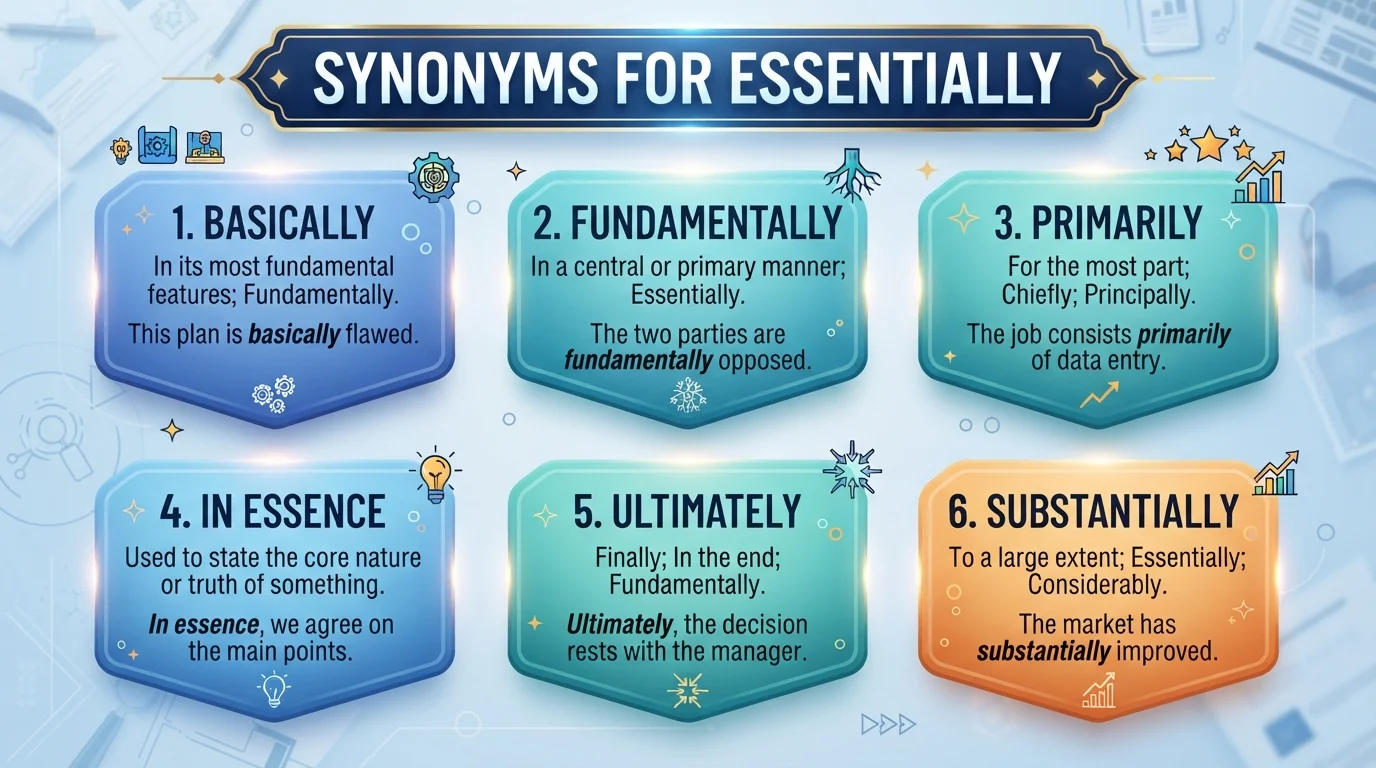
Essentially vs. Primarily
Use primarily when the meaning is mainly.
“The course is essentially for beginners.”
Possible rewrite:
“The course is primarily for beginners.”
But:
“The issue is essentially philosophical.”
“Primarily philosophical” could imply that philosophy is the main category among several categories, while “essentially philosophical” points more toward the issue’s basic character.
Essentially vs. Effectively
This distinction is especially important.
Essentially = in its basic or important nature.
Effectively = in its practical result.
Compare:
“The two policies are essentially the same.”
Their important characteristics are alike.
“The two policies are effectively the same.”
They produce substantially the same practical result.
Essentially vs. Virtually
These should not be treated as interchangeable.
Essentially can mean “in the important sense.”
Virtually usually means “almost completely.”
Compare:
“The work is essentially complete.”
The important work is finished.
“The work is virtually complete.”
Almost all of the work is finished.
Comparison Table
| Word/Phrase | Core meaning | Tone | Strength | Best use |
|---|---|---|---|---|
| essentially | In basic or important nature | Neutral/formal | Moderate | General analysis |
| basically | In simple/general terms | Conversational | Moderate | Everyday explanations |
| fundamentally | At the underlying level | Formal | Strong | Analysis |
| in essence | In essential nature | Formal | Moderate | Summaries |
| at its core | At the central level | Neutral | Strong | Explanations |
| mainly | For the most part | Neutral | Moderate | General writing |
| primarily | Chiefly | Formal/neutral | Moderate | Professional writing |
| chiefly | Mainly | Formal | Moderate | Formal prose |
| inherently | By built-in nature | Formal | Strong | Technical/academic |
| intrinsically | In itself | Formal | Strong | Philosophy/analysis |
| effectively | In practical effect | Neutral/formal | Strong | Practical consequences |
| in effect | In actual operation/result | Formal | Strong | Policy/legal writing |
| virtually | Almost completely | Neutral/formal | Strong | Near-complete states |
| practically | In practical terms/almost | Neutral | Moderate | Practical situations |
| ultimately | At the deepest/final level | Formal/neutral | Moderate | Analysis |
| more or less | Approximately | Informal | Weak/moderate | Casual speech |
| in substance | In essential content | Formal | Strong | Legal/formal writing |
| in a nutshell | In brief | Informal | — | Summaries |
Sentence Transformations
1. Simple explanation
Original:
“Essentially, the program teaches people how to manage money.”
Alternative:
“Basically, the program teaches people how to manage money.”
Why:
“Basically” works naturally when simplifying an explanation.
2. Underlying difference
Original:
“The two approaches are essentially different.”
Alternative:
“The two approaches are fundamentally different.”
Why:
“Fundamentally” emphasizes a difference in basic principles or nature.
3. Core idea
Original:
“The debate is essentially about fairness.”
Alternative:
“At its core, the debate is about fairness.”
Why:
“At its core” clearly identifies the central issue.
4. Main purpose
Original:
“The organization is essentially focused on education.”
Alternative:
“The organization is primarily focused on education.”
Why:
“Primarily” is better if education is the organization’s main focus.
5. Practical effect
Original:
“The new rule essentially prevents this practice.”
Alternative:
“The new rule effectively prevents this practice.”
Why:
“Effectively” emphasizes the rule’s practical result.
6. Formal summary
Original:
“The proposal is essentially a request for more funding.”
Alternative:
“In essence, the proposal is a request for more funding.”
Why:
“In essence” provides a clean formal summary of the proposal’s basic nature.
7. Almost complete
Original:
“The repairs are essentially finished.”
Alternative:
“The repairs are virtually finished.”
Why:
“Virtually” works when you mean almost completely finished.
8. Inherent quality
Original:
“The material is essentially resistant to heat.”
Alternative:
“The material is inherently resistant to heat.”
Why:
“Inherently” suggests that heat resistance is a built-in characteristic.
9. Formal analysis
Original:
“The revised contract is essentially the same as the original.”
Alternative:
“In substance, the revised contract is the same as the original.”
Why:
“In substance” is useful when the wording or form has changed but the essential content has not.
10. Casual summary
Original:
“Essentially, we need more time.”
Alternative:
“In simple terms, we need more time.”
Why:
“In simple terms” makes the sentence explicitly conversational and explanatory.
Common Collocations with “Essentially”
Some combinations sound especially natural:
- essentially the same
- essentially different
- essentially unchanged
- essentially identical
- essentially impossible
- essentially correct
- essentially complete
- essentially irrelevant
- essentially useless
- essentially meaningless
- essentially true
- essentially human
- essentially a question of
- essentially a matter of
- essentially based on
- essentially designed to
- essentially consists of
- essentially means
- essentially represents
- essentially involves
Examples
“The two versions are essentially the same.”
“The problem is essentially a matter of timing.”
“The process essentially consists of three steps.”
“The two arguments are essentially different.”
Common Mistakes with Essentially
1. Using “essentially” when you mean “almost”
Not every use of essentially means almost.
❌ “The building is essentially empty” = always “almost empty.”
The sentence may instead mean that the building is empty in the relevant or important sense.
If you specifically mean “almost completely,” use virtually or nearly.
2. Replacing essentially with “basically” in formal writing
“Basically” is perfectly correct, but it can sound more conversational.
For formal analysis, consider:
- fundamentally
- in essence
- primarily
- principally
- in substance
3. Treating “fundamentally” and “primarily” as identical
They answer different questions.
Fundamentally = What is it at its basic level?
Primarily = What is the main part or purpose?
4. Using “inherently” without meaning built-in
“Inherently” makes a stronger claim.
“The process is inherently difficult.”
This says difficulty is part of the process’s nature.
If you only mean that difficulty is its main feature, essentially may be better.
5. Using “effectively” when you mean “fundamentally”
“The systems are effectively different.”
This focuses on practical results.
“The systems are fundamentally different.”
This focuses on their underlying nature.
6. Assuming “virtually” is always a synonym
Virtually adds an “almost” meaning.
That makes it inappropriate in many sentences where essentially means “in essence.”
7. Overusing “essentially” as a filler
Writers sometimes use essentially before statements that do not need it.
“The system essentially has three parts.”
Often, this is cleaner:
“The system has three parts.”
If the word does not add a useful distinction, remove it.
8. Using a formal synonym just to sound sophisticated
A simpler word is often better.
“Basically, the plan changes the schedule.”
may be clearer than:
“In substance, the plan modifies the temporal arrangement.”
Choose the word that communicates the intended meaning most directly.
When Should You Keep “Essentially”?
Keep essentially when it accurately signals that you are talking about the important, basic, or defining nature of something.
For example:
“The two proposals are essentially the same.”
This is concise and natural.
You may also want to keep it when replacing it would create a different emphasis.
- essentially → basic nature
- basically → simple explanation
- fundamentally → underlying principle
- primarily → main factor
- effectively → practical result
- virtually → almost completely
- inherently → built-in characteristic
The original word is often the best choice when it already expresses exactly what you mean.
Which Synonym Should You Choose?
For everyday conversation
Use:
- basically
- mainly
- pretty much
- more or less
For professional writing
Use:
- essentially
- primarily
- fundamentally
- in effect
- effectively
For academic writing
Use:
- fundamentally
- in essence
- primarily
- principally
- intrinsically
- inherently
For formal documents
Use:
- in essence
- in substance
- principally
- fundamentally
- in effect
For explaining something simply
Use:
- basically
- in simple terms
- in simple words
- to put it simply
For identifying the central idea
Use:
- at its core
- at its heart
- in essence
- fundamentally
For practical consequences
Use:
- effectively
- in effect
- practically
For “almost”
Use:
- virtually
- nearly
- almost
- practically
Editor’s Choice: 5 Useful Alternatives
These are editorial recommendations based on meaning and natural usage, not objective rankings.
1. Basically
The easiest everyday replacement when essentially simply means “in simple or general terms.”
2. Fundamentally
A strong choice for underlying principles, important differences, and analytical writing.
3. In essence
A polished phrase for summarizing the essential nature of something.
4. Primarily
Best when essentially means “mainly” or “chiefly.”
5. Effectively
Useful when the intended meaning is “in practical effect.”