
synonyms for difference

Synonyms for Difference: 40+ Words for Contrast & Distinction

The best synonym for difference depends on what kind of difference you mean.

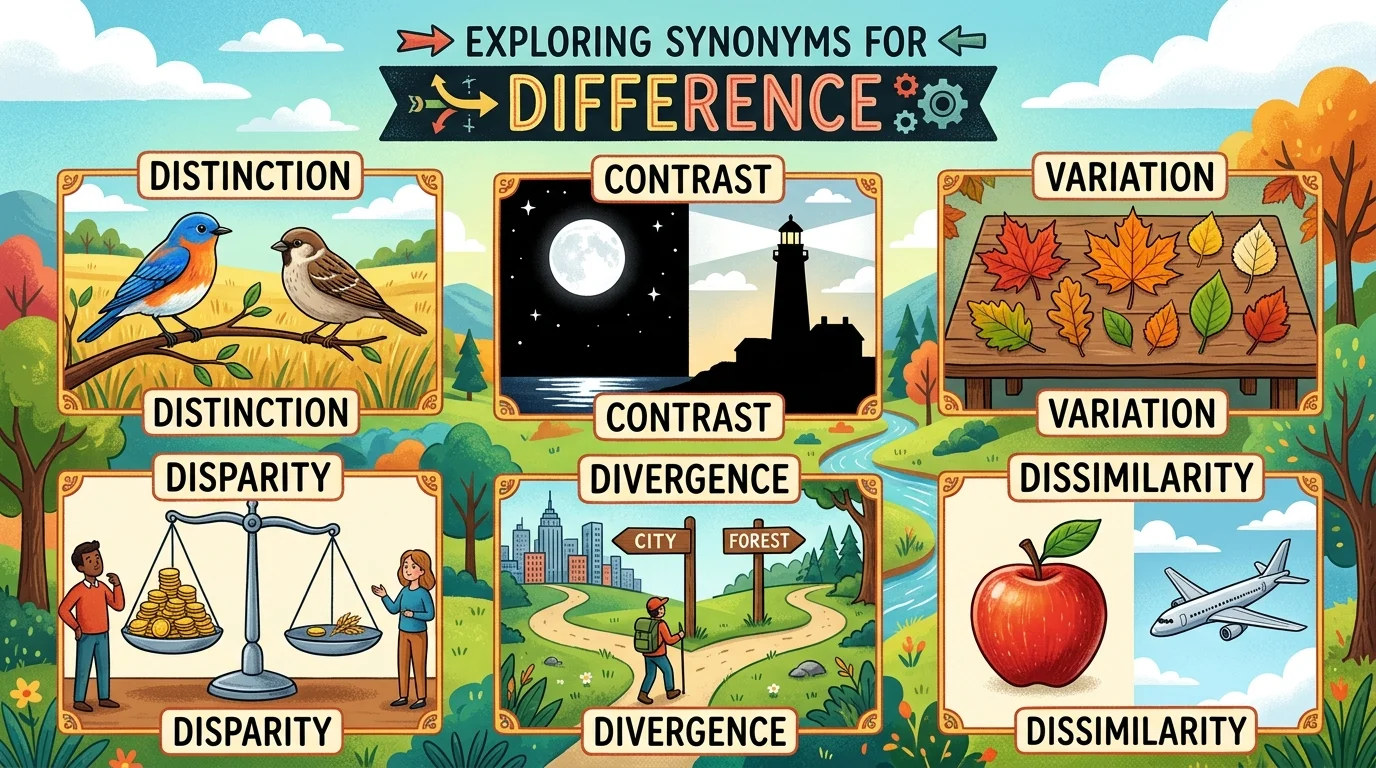
For a general contrast between two things, the strongest choices are:

  • distinction — a meaningful difference between things
  • contrast — a noticeable difference, especially between two things
  • disparity — a significant or often unfair difference
  • variation — a difference or change within a group or range
  • divergence — a movement or development in different directions
  • distinction — a clear feature that separates one thing from another
  • discrepancy — a difference between figures, statements, or expected and actual results
  • deviation — a departure from a standard, norm, or expected value
  • gap — a difference in level, amount, ability, or achievement
  • dissimilarity — lack of similarity

The most natural everyday alternatives are usually distinction, contrast, variation, gap, and difference itself.

Quick Synonym List

SynonymBest meaningTypical context
DistinctionA meaningful separating featureIdeas, categories, concepts
ContrastA clear or striking differencePeople, colors, opinions
DisparityA substantial differenceIncome, access, outcomes
VariationA difference within a rangeData, products, styles
DivergenceDevelopment in different directionsOpinions, trends, paths
DiscrepancyAn inconsistency between thingsData, records, accounts
DeviationDeparture from a norm or standardStatistics, behavior, processes
GapA measurable differenceSkills, income, performance
DissimilarityLack of resemblanceObjects, characteristics
DistinctionA feature that differentiatesAcademic/professional writing
DiscrepancyA mismatch or inconsistencyNumbers, reports
InequalityUnequal status, treatment, or distributionSociety, economics
ImbalanceLack of equality or proportionResources, power, systems
DiscretenessState of being separate/distinctTechnical contexts
ChangeA difference resulting from alterationTime, conditions, situations

What Does “Difference” Mean?

Difference is a noun referring to a way in which two or more things are unlike, or the amount by which they differ.

It has several important meanings.

1. A way things are unlike

There is a significant difference between the two approaches.

Here, distinction, contrast, or dissimilarity may work.

2. A measurable amount

The difference between 85 and 60 is 25.

Here, gap or discrepancy may sometimes work, but difference is the most precise mathematical term.

3. A disagreement

They had a difference of opinion.

Possible alternatives include:

  • disagreement
  • dispute
  • conflict
  • divergence
  • contention

4. A change or effect

The new policy made a significant difference.

Here, synonyms such as impact, effect, improvement, or change may be more appropriate.

This is important because difference does not have one universal synonym. The intended meaning determines the best replacement.


Synonyms for Difference Meaning “Contrast”

When you mean that two things are noticeably unlike each other, these are the strongest options.

Distinction

Distinction refers to a difference that separates one thing from another.

There is an important distinction between knowledge and wisdom.

It is especially useful in academic, analytical, and professional writing.

Contrast

Contrast emphasizes the difference between two things, particularly when the difference is obvious or striking.

The contrast between the two designs is remarkable.

It can also function as a verb:

The dark walls contrast with the bright furniture.

Dissimilarity

Dissimilarity means a lack of similarity.

Researchers examined the dissimilarities between the two groups.

It is accurate but more formal and less natural in everyday conversation than difference.

Disparateness

Disparateness describes the condition of being separate or fundamentally different.

The study highlights the cultural disparateness of the two communities.

It is relatively uncommon, so difference, distinction, or dissimilarity will usually be better.


Synonyms for Difference Meaning “Gap”

When you’re talking about a measurable difference in amount, ability, performance, or status, consider:

  • gap
  • disparity
  • discrepancy
  • differential
  • variance
  • spread
  • margin

Gap

Gap is an extremely natural alternative when two values, levels, or groups are separated by a noticeable amount.

There is a large difference in performance.

→ There is a large performance gap.

Common expressions include:

  • income gap
  • wealth gap
  • achievement gap
  • skills gap
  • generation gap
  • pay gap
  • knowledge gap

Disparity

Disparity suggests a substantial difference, often one that is concerning, unequal, or unfair.

There is a significant disparity in access to healthcare.

This word is particularly useful for social, economic, demographic, and institutional differences.

Differential

Differential can describe a difference between amounts, rates, or conditions.

The salary differential between the two positions is substantial.

It is more technical and formal than gap.

Margin

Margin describes the amount by which one result exceeds another.

The difference between the candidates was small.

→ The candidates won by a narrow margin.


Synonyms for Difference in Data and Statistics

When difference appears in technical or quantitative writing, precision matters.

Useful alternatives include:

  • discrepancy
  • deviation
  • variance
  • variation
  • differential
  • gap
  • spread
  • disparity

Discrepancy

A discrepancy is a difference or inconsistency between things that are expected to agree.

The accountant found a discrepancy between the two records.

This word often implies that something does not match.

Deviation

A deviation is a departure from an expected, standard, or average value.

The measurement showed a slight deviation from the expected result.

Don’t use deviation simply because two things are different. It normally implies a reference point or standard.

Variance

Variance can mean a difference or variation, especially in technical contexts.

The researchers examined variance across the sample.

In statistics, however, variance also has a specific mathematical meaning, so it should not casually replace difference.

Variation

Variation refers to differences among members of a group or changes in a quantity, form, or condition.

There was considerable variation in the responses.

This is often better than difference when discussing patterns across multiple observations.


Synonyms for “Difference of Opinion”

When difference means disagreement, use words that actually describe conflict or disagreement.

Disagreement

The most direct alternative.

They had a difference of opinion.

→ They had a disagreement.

Divergence

Divergence suggests that opinions, views, or positions have moved apart.

There is growing divergence between the two parties.

It is more formal than disagreement.

Dispute

A dispute is a disagreement that may involve argument or conflict.

The two sides became involved in a dispute over the proposal.

Conflict

Conflict is stronger than difference and implies opposition or incompatibility.

Their differences eventually led to conflict.

Don’t automatically replace difference of opinion with conflict, because people can disagree without being in conflict.

Disagreement vs. Difference

We have a difference of opinion.

sounds relatively neutral.

We have a disagreement.

is more direct.

We have a conflict.

suggests a much more serious problem.


Synonyms for Difference Meaning “Change”

Sometimes difference means an alteration or change in a condition.

What’s the difference since last year?

Depending on context, you could use:

  • change
  • alteration
  • shift
  • transformation
  • modification
  • development
  • adjustment
  • variation

Change

The broadest alternative.

What difference has the new policy made?

→ What change has the new policy produced?

Shift

Shift suggests movement from one position, condition, trend, or attitude to another.

There has been a significant shift in public opinion.
Transformation

Transformation

Transformation implies a major or fundamental change.

The difference in the company after the merger was dramatic.

→ The transformation of the company after the merger was dramatic.


Difference in Formal and Academic Writing

For formal writing, choose according to the exact relationship you are describing.

Useful formal alternatives

  • distinction
  • discrepancy
  • disparity
  • divergence
  • deviation
  • variation
  • differential
  • dissimilarity
  • inequality
  • divergence

Examples:

General:

The study identifies several differences between the groups.

More precise:

The study identifies several distinctions between the groups.

Quantitative:

The study identifies a significant disparity between the groups.

Data inconsistency:

The study identifies a discrepancy between the reported values.

Different directions:

The study identifies a divergence between the groups’ responses.

The more formal word isn’t automatically better. Difference is often the clearest choice.


Difference in Professional Writing

Depending on what you are describing, professional alternatives include:

If you mean…Use…
Two approaches aren’t alikedistinction
Results aren’t equaldisparity
Numbers don’t matchdiscrepancy
Performance levels aren’t equalgap
Opinions move apartdivergence
Results depart from expectationsdeviation
Results vary across casesvariation
Two things look unlikecontrast
Two things have little in commondissimilarity
One thing produces an outcomeimpact/effect

For example:

We noticed a difference between projected and actual sales.

If the numbers don’t match:

We noticed a discrepancy between projected and actual sales.

If you’re comparing performance:

We identified a performance gap between the teams.


Difference in Casual English

In everyday conversation, simple words are often more natural:

  • change
  • gap
  • contrast
  • disagreement
  • distinction
  • variation
  • separation
  • mismatch

Examples:

What’s the difference?

Usually, don’t replace it.

What’s the distinction?

This sounds more formal and analytical.

What’s the gap?

This only works when you’re talking about a measurable difference.

What’s the contrast?

This emphasizes how two things are visibly or conceptually different.


Difference Between People

When describing how people differ, the appropriate word depends on the characteristic.

Distinction

There is an important distinction between the two leadership styles.

Disparity

There is a significant disparity in their incomes.

Contrast

The contrast between their personalities is striking.

Gap

There is a substantial age gap between them.

Dissimilarity

The researchers observed considerable dissimilarity between the participants.

Gap is particularly natural when the difference can be expressed as a measurable distance.


Difference Between Ideas or Concepts

For concepts, distinction is often the best choice.

There is a difference between correlation and causation.

→ There is a distinction between correlation and causation.

This works because you’re identifying an important conceptual boundary.

Other possibilities:

  • distinction
  • contrast
  • divergence
  • discrepancy
  • variation

For example:

Their theories show a clear divergence.

This means their ideas move in different directions, not merely that they contain one or two different details.


Difference vs. Distinction

These words are close but not identical.

Difference is the general word for anything that makes things unlike.

Distinction usually refers to a meaningful or recognized difference.

There is a difference between the two products.

Neutral.

There is an important distinction between the two products.

This suggests the difference matters.

Best rule: use distinction when you’re explaining a conceptual or meaningful boundary.


Difference vs. Contrast

Difference is broader.

Contrast emphasizes the comparison between two things, especially when the difference is obvious.

I noticed a difference between the paintings.

The contrast between the paintings is striking.

The second sentence draws attention to the visual or conceptual opposition.


Difference vs. Disparity

Disparity is stronger and often suggests inequality.

There is a difference in income between the groups.

Neutral.

There is a disparity in income between the groups.

Suggests a meaningful or potentially concerning inequality.

This makes disparity particularly common in discussions of:

  • income
  • wealth
  • healthcare
  • education
  • opportunity
  • access
  • representation
  • outcomes

Difference vs. Discrepancy

A discrepancy is not simply any difference.

It usually means a mismatch between things that should correspond.

There is a difference between the two reports.

Could be intentional.

There is a discrepancy between the two reports.

Suggests that the reports do not agree when they should.

Therefore, discrepancy is especially useful for:

  • records
  • figures
  • calculations
  • reports
  • accounts
  • measurements
  • statements

Difference vs. Variation

Variation is especially useful when differences occur within a set, group, or range.

There are differences in temperature throughout the day.

There is considerable variation in temperature throughout the day.

The second emphasizes that temperatures change across observations.


Difference vs. Deviation

Deviation requires some kind of reference point.

The result differs from the expected value.

→ The result shows a deviation from the expected value.

You generally shouldn’t use deviation simply to make ordinary prose sound more sophisticated.


Difference vs. Gap

Gap often suggests measurable separation.

There is a difference between the two teams’ scores.

→ There is a four-point gap between the teams.

It is especially natural with:

  • age
  • income
  • pay
  • skills
  • knowledge
  • performance
  • achievement
  • scores
  • experience

Difference in the Phrase “Make a Difference”

Difference in the Phrase “Make a Difference”

The expression make a difference has a special meaning: to have an effect or produce a meaningful change.

Your support made a difference.

Possible alternatives:

  • had an impact
  • had an effect
  • helped
  • improved the situation
  • changed things
  • mattered

But don’t mechanically replace difference with distinction or contrast here.

Your support made a distinction.

is not a natural equivalent.

This is a good example of why context matters more than synonym count.


Difference in “No Difference”

The phrase make no difference means that something has no effect or does not matter.

It makes no difference to me.

Possible alternatives:

It doesn’t matter to me.

It has no effect on me.

It is irrelevant to me.

Again, these aren’t interchangeable in every situation.


Common Collocations

Some of the most useful expressions with difference include:

  • significant difference
  • major difference
  • substantial difference
  • slight difference
  • small difference
  • noticeable difference
  • clear difference
  • fundamental difference
  • important difference
  • key difference
  • subtle difference
  • meaningful difference
  • measurable difference
  • cultural difference
  • social difference
  • economic difference
  • age difference
  • gender difference
  • individual difference
  • difference in opinion
  • difference of opinion
  • difference between
  • difference in
  • make a difference
  • tell the difference
  • spot the difference
  • know the difference

Grammar and Usage

Difference is normally a countable noun when referring to a specific distinction.

There is a difference between them.

There are several differences between the proposals.

Difference between

Use difference between when comparing two or more things.

What is the difference between these two words?

Difference in

Use difference in when identifying the particular area in which things differ.

There is a difference in price.

We found differences in performance.

Difference of

Difference of occurs in expressions such as:

a difference of opinion

a difference of five points

a difference of $20

Tell the difference

The fixed expression tell the difference means to recognize how two things differ.

Can you tell the difference between the two versions?


Common Mistakes

1. Using “disparity” for every difference

Disparity normally suggests a significant inequality.

A tiny stylistic difference isn’t necessarily a disparity.

2. Using “discrepancy” for intentional differences

A discrepancy often suggests that two pieces of information don’t match when they should.

3. Using “deviation” without a standard

A deviation is a departure from a reference point, norm, or expected value.

4. Assuming “contrast” means exactly the same thing

Contrast emphasizes comparison and opposition. It is not always interchangeable with difference.

5. Replacing “make a difference” with “make a distinction”

These expressions have different meanings.

  • make a difference = have an effect
  • make a distinction = identify or establish a difference

How to Choose the Right Synonym

Use this simple decision guide:

  • General difference → difference
  • Important conceptual difference → distinction
  • Striking comparison → contrast
  • Large or unequal difference → disparity
  • Measurable separation → gap
  • Mismatch in information → discrepancy
  • Departure from a standard → deviation
  • Differences within a group → variation
  • Movement in different directions → divergence
  • Lack of similarity → dissimilarity
  • Unequal distribution or treatment → inequality
  • Lack of balance → imbalance
  • Difference in outcome or amount → differential

When “Difference” Is Better

Don’t feel obligated to replace difference.

It is often the clearest and most versatile word:

There is a difference between the two methods.

This is simple, precise, and natural.

Replacing it with:

There is a dissimilarity between the two methods.

doesn’t necessarily improve the sentence.

Likewise, disparity, discrepancy, or divergence can introduce meanings that weren’t present in the original.

The best synonym is therefore not the most sophisticated word. It is the word that expresses the exact relationship you mean

Quick Synonym List

SynonymBest meaningTypical context
DistinctionA meaningful separating featureIdeas, categories, concepts
ContrastA clear or striking differencePeople, colors, opinions
DisparityA substantial differenceIncome, access, outcomes
VariationA difference within a rangeData, products, styles
DivergenceDevelopment in different directionsOpinions, trends, paths
DiscrepancyAn inconsistency between thingsData, records, accounts
DeviationDeparture from a norm or standardStatistics, behavior, processes
GapA measurable differenceSkills, income, performance
DissimilarityLack of resemblanceObjects, characteristics
DistinctionA feature that differentiatesAcademic/professional writing
DiscrepancyA mismatch or inconsistencyNumbers, reports
InequalityUnequal status, treatment, or distributionSociety, economics
ImbalanceLack of equality or proportionResources, power, systems
DiscretenessState of being separate/distinctTechnical contexts
ChangeA difference resulting from alterationTime, conditions, situations

What Does “Difference” Mean?

Difference is a noun referring to a way in which two or more things are unlike, or the amount by which they differ.

It has several important meanings.

1. A way things are unlike

There is a significant difference between the two approaches.

Here, distinction, contrast, or dissimilarity may work.

2. A measurable amount

The difference between 85 and 60 is 25.

Here, gap or discrepancy may sometimes work, but difference is the most precise mathematical term.

3. A disagreement

They had a difference of opinion.

Possible alternatives include:

  • disagreement
  • dispute
  • conflict
  • divergence
  • contention

4. A change or effect

The new policy made a significant difference.

Here, synonyms such as impact, effect, improvement, or change may be more appropriate.

This is important because difference does not have one universal synonym. The intended meaning determines the best replacement.


Synonyms for Difference Meaning “Contrast”

When you mean that two things are noticeably unlike each other, these are the strongest options.

Distinction

Distinction refers to a difference that separates one thing from another.

There is an important distinction between knowledge and wisdom.

It is especially useful in academic, analytical, and professional writing.

Contrast

Contrast emphasizes the difference between two things, particularly when the difference is obvious or striking.

The contrast between the two designs is remarkable.

It can also function as a verb:

The dark walls contrast with the bright furniture.

Dissimilarity

Dissimilarity means a lack of similarity.

Researchers examined the dissimilarities between the two groups.

It is accurate but more formal and less natural in everyday conversation than difference.

Disparateness

Disparateness describes the condition of being separate or fundamentally different.

The study highlights the cultural disparateness of the two communities.

It is relatively uncommon, so difference, distinction, or dissimilarity will usually be better.


Synonyms for Difference Meaning “Gap”

When you’re talking about a measurable difference in amount, ability, performance, or status, consider:

  • gap
  • disparity
  • discrepancy
  • differential
  • variance
  • spread
  • margin

Gap

Gap is an extremely natural alternative when two values, levels, or groups are separated by a noticeable amount.

There is a large difference in performance.

→ There is a large performance gap.

Common expressions include:

  • income gap
  • wealth gap
  • achievement gap
  • skills gap
  • generation gap
  • pay gap
  • knowledge gap

Disparity

Disparity suggests a substantial difference, often one that is concerning, unequal, or unfair.

There is a significant disparity in access to healthcare.

This word is particularly useful for social, economic, demographic, and institutional differences.

Differential

Differential can describe a difference between amounts, rates, or conditions.

The salary differential between the two positions is substantial.

It is more technical and formal than gap.

Margin

Margin describes the amount by which one result exceeds another.

The difference between the candidates was small.

→ The candidates won by a narrow margin.


Synonyms for Difference in Data and Statistics

When difference appears in technical or quantitative writing, precision matters.

Useful alternatives include:

  • discrepancy
  • deviation
  • variance
  • variation
  • differential
  • gap
  • spread
  • disparity

Discrepancy

A discrepancy is a difference or inconsistency between things that are expected to agree.

The accountant found a discrepancy between the two records.

This word often implies that something does not match.

Deviation

A deviation is a departure from an expected, standard, or average value.

The measurement showed a slight deviation from the expected result.

Don’t use deviation simply because two things are different. It normally implies a reference point or standard.

Variance

Variance can mean a difference or variation, especially in technical contexts.

The researchers examined variance across the sample.

In statistics, however, variance also has a specific mathematical meaning, so it should not casually replace difference.

Variation

Variation refers to differences among members of a group or changes in a quantity, form, or condition.

There was considerable variation in the responses.

This is often better than difference when discussing patterns across multiple observations.


Synonyms for “Difference of Opinion”

When difference means disagreement, use words that actually describe conflict or disagreement.

Disagreement

The most direct alternative.

They had a difference of opinion.

→ They had a disagreement.

Divergence

Divergence suggests that opinions, views, or positions have moved apart.

There is growing divergence between the two parties.

It is more formal than disagreement.

Dispute

A dispute is a disagreement that may involve argument or conflict.

The two sides became involved in a dispute over the proposal.

Conflict

Conflict is stronger than difference and implies opposition or incompatibility.

Their differences eventually led to conflict.

Don’t automatically replace difference of opinion with conflict, because people can disagree without being in conflict.

Disagreement vs. Difference

We have a difference of opinion.

sounds relatively neutral.

We have a disagreement.

is more direct.

We have a conflict.

suggests a much more serious problem.


Synonyms for Difference Meaning “Change”

Sometimes difference means an alteration or change in a condition.

What’s the difference since last year?

Depending on context, you could use:

  • change
  • alteration
  • shift
  • transformation
  • modification
  • development
  • adjustment
  • variation

Change

The broadest alternative.

What difference has the new policy made?

→ What change has the new policy produced?

Shift

Shift suggests movement from one position, condition, trend, or attitude to another.

There has been a significant shift in public opinion.

Transformation

Transformation implies a major or fundamental change.

The difference in the company after the merger was dramatic.

→ The transformation of the company after the merger was dramatic.


Difference in Formal and Academic Writing

For formal writing, choose according to the exact relationship you are describing.

Useful formal alternatives

  • distinction
  • discrepancy
  • disparity
  • divergence
  • deviation
  • variation
  • differential
  • dissimilarity
  • inequality
  • divergence

Examples:

General:

The study identifies several differences between the groups.

More precise:

The study identifies several distinctions between the groups.

Quantitative:

The study identifies a significant disparity between the groups.

Data inconsistency:

The study identifies a discrepancy between the reported values.

Different directions:

The study identifies a divergence between the groups’ responses.

The more formal word isn’t automatically better. Difference is often the clearest choice.


Difference in Professional Writing

Depending on what you are describing, professional alternatives include:

If you mean…Use…
Two approaches aren’t alikedistinction
Results aren’t equaldisparity
Numbers don’t matchdiscrepancy
Performance levels aren’t equalgap
Opinions move apartdivergence
Results depart from expectationsdeviation
Results vary across casesvariation
Two things look unlikecontrast
Two things have little in commondissimilarity
One thing produces an outcomeimpact/effect

For example:

We noticed a difference between projected and actual sales.

If the numbers don’t match:

We noticed a discrepancy between projected and actual sales.

If you’re comparing performance:

We identified a performance gap between the teams.


Difference in Casual English

In everyday conversation, simple words are often more natural:

  • change
  • gap
  • contrast
  • disagreement
  • distinction
  • variation
  • separation
  • mismatch

Examples:

What’s the difference?

Usually, don’t replace it.

What’s the distinction?

This sounds more formal and analytical.

What’s the gap?

This only works when you’re talking about a measurable difference.

What’s the contrast?

This emphasizes how two things are visibly or conceptually different.


Difference Between People

When describing how people differ, the appropriate word depends on the characteristic.

Distinction

There is an important distinction between the two leadership styles.

Disparity

There is a significant disparity in their incomes.

Contrast

The contrast between their personalities is striking.

Gap

There is a substantial age gap between them.

Dissimilarity

The researchers observed considerable dissimilarity between the participants.

Gap is particularly natural when the difference can be expressed as a measurable distance.


Difference Between Ideas or Concepts

For concepts, distinction is often the best choice.

There is a difference between correlation and causation.

→ There is a distinction between correlation and causation.

This works because you’re identifying an important conceptual boundary.

Other possibilities:

  • distinction
  • contrast
  • divergence
  • discrepancy
  • variation

For example:

Their theories show a clear divergence.

This means their ideas move in different directions, not merely that they contain one or two different details.


Difference vs. Distinction

These words are close but not identical.

Difference is the general word for anything that makes things unlike.

Distinction usually refers to a meaningful or recognized difference.

There is a difference between the two products.

Neutral.

There is an important distinction between the two products.

This suggests the difference matters.

Best rule: use distinction when you’re explaining a conceptual or meaningful boundary.


Difference vs. Contrast

Difference is broader.

Contrast emphasizes the comparison between two things, especially when the difference is obvious.

I noticed a difference between the paintings.

The contrast between the paintings is striking.

The second sentence draws attention to the visual or conceptual opposition.


Difference vs. Disparity

Disparity is stronger and often suggests inequality.

There is a difference in income between the groups.

Neutral.

There is a disparity in income between the groups.

Suggests a meaningful or potentially concerning inequality.

This makes disparity particularly common in discussions of:

  • income
  • wealth
  • healthcare
  • education
  • opportunity
  • access
  • representation
  • outcomes

Difference vs. Discrepancy

A discrepancy is not simply any difference.

It usually means a mismatch between things that should correspond.

There is a difference between the two reports.

Could be intentional.

There is a discrepancy between the two reports.

Suggests that the reports do not agree when they should.

Therefore, discrepancy is especially useful for:

  • records
  • figures
  • calculations
  • reports
  • accounts
  • measurements
  • statements

Difference vs. Variation

Variation is especially useful when differences occur within a set, group, or range.

There are differences in temperature throughout the day.

There is considerable variation in temperature throughout the day.

The second emphasizes that temperatures change across observations.


Difference vs. Deviation

Deviation requires some kind of reference point.

The result differs from the expected value.

→ The result shows a deviation from the expected value.

You generally shouldn’t use deviation simply to make ordinary prose sound more sophisticated.


Difference vs. Gap

Gap often suggests measurable separation.

There is a difference between the two teams’ scores.

→ There is a four-point gap between the teams.

It is especially natural with:

  • age
  • income
  • pay
  • skills
  • knowledge
  • performance
  • achievement
  • scores
  • experience

Difference in the Phrase “Make a Difference”

The expression make a difference has a special meaning: to have an effect or produce a meaningful change.

Your support made a difference.

Possible alternatives:

  • had an impact
  • had an effect
  • helped
  • improved the situation
  • changed things
  • mattered

But don’t mechanically replace difference with distinction or contrast here.

Your support made a distinction.

is not a natural equivalent.

This is a good example of why context matters more than synonym count.


Difference in “No Difference”

The phrase make no difference means that something has no effect or does not matter.

It makes no difference to me.

Possible alternatives:

It doesn’t matter to me.

It has no effect on me.

It is irrelevant to me.

Again, these aren’t interchangeable in every situation.


Common Collocations

Some of the most useful expressions with difference include:

  • significant difference
  • major difference
  • substantial difference
  • slight difference
  • small difference
  • noticeable difference
  • clear difference
  • fundamental difference
  • important difference
  • key difference
  • subtle difference
  • meaningful difference
  • measurable difference
  • cultural difference
  • social difference
  • economic difference
  • age difference
  • gender difference
  • individual difference
  • difference in opinion
  • difference of opinion
  • difference between
  • difference in
  • make a difference
  • tell the difference
  • spot the difference
  • know the difference

Grammar and Usage

Difference is normally a countable noun when referring to a specific distinction.

There is a difference between them.

There are several differences between the proposals.

Difference between

Use difference between when comparing two or more things.

What is the difference between these two words?

Difference in

Use difference in when identifying the particular area in which things differ.

There is a difference in price.

We found differences in performance.

Difference of

Difference of occurs in expressions such as:

a difference of opinion

a difference of five points

a difference of $20

Tell the difference

The fixed expression tell the difference means to recognize how two things differ.

Can you tell the difference between the two versions?


Common Mistakes

1. Using “disparity” for every difference

Disparity normally suggests a significant inequality.

A tiny stylistic difference isn’t necessarily a disparity.

2. Using “discrepancy” for intentional differences

A discrepancy often suggests that two pieces of information don’t match when they should.

3. Using “deviation” without a standard

A deviation is a departure from a reference point, norm, or expected value.

4. Assuming “contrast” means exactly the same thing

Contrast emphasizes comparison and opposition. It is not always interchangeable with difference.

5. Replacing “make a difference” with “make a distinction”

These expressions have different meanings.

  • make a difference = have an effect
  • make a distinction = identify or establish a difference

How to Choose the Right Synonym

Use this simple decision guide:

  • General difference → difference
  • Important conceptual difference → distinction
  • Striking comparison → contrast
  • Large or unequal difference → disparity
  • Measurable separation → gap
  • Mismatch in information → discrepancy
  • Departure from a standard → deviation
  • Differences within a group → variation
  • Movement in different directions → divergence
  • Lack of similarity → dissimilarity
  • Unequal distribution or treatment → inequality
  • Lack of balance → imbalance
  • Difference in outcome or amount → differential

When “Difference” Is Better

Don’t feel obligated to replace difference.

It is often the clearest and most versatile word:

There is a difference between the two methods.

This is simple, precise, and natural.

Replacing it with:

There is a dissimilarity between the two methods.

doesn’t necessarily improve the sentence.

Likewise, disparity, discrepancy, or divergence can introduce meanings that weren’t present in the original.

The best synonym is therefore not the most sophisticated word. It is the word that expresses the exact relationship you mean

FAQs About Synonyms for Difference

What is the best synonym for difference?

Distinction is often the best synonym when you mean a meaningful difference. Contrast, variation, gap, and disparity are better for specific contexts.

What is a formal word for difference?

Common formal alternatives include distinction, disparity, discrepancy, divergence, deviation, variation, and dissimilarity.

What is another word for a big difference?

Depending on context, use disparity, gap, contrast, substantial difference, marked difference, or significant difference.

What is a synonym for difference in opinion?

The most natural alternatives are disagreement, divergence, dispute, and conflict. Disagreement is the safest general choice.

What is the difference between difference and distinction?

Difference is the broad term for things being unlike. Distinction usually emphasizes a meaningful or recognized feature that separates them.

What is the difference between difference and disparity?

Disparity describes a significant difference, often involving inequality. Difference is neutral and much broader.

What is a synonym for difference in data?

Depending on the situation, use discrepancy, deviation, variation, variance, gap, or differential. The correct choice depends on what the numbers represent.

What is another word for a small difference?

You can use slight difference, minor difference, subtle difference, variation, distinction, or discrepancy, depending on context.

What is the opposite of difference?

Depending on the intended meaning, opposites include similarity, sameness, agreement, equality, and uniformity.

What is a synonym for “make a difference”?

Depending on context, use have an impact, have an effect, matter, help, improve, or change things.

Key Takeaways

  • Difference is a broad word covering contrasts, distinctions, gaps, changes, and other forms of unlikeness.
  • Distinction is ideal for meaningful conceptual or categorical differences.
  • Disparity suggests a substantial or unequal difference, while discrepancy suggests a mismatch.
  • Variation, deviation, and divergence are especially useful when describing data, standards, or changing directions.
  • The original word difference is often the clearest choice; a synonym should add precision rather than simply sound more sophisticated.

Conclusion

The best synonym for difference depends on what kind of difference you are describing. Distinction works well for meaningful conceptual boundaries, contrast for noticeable opposites, disparity for significant inequality, gap for measurable separation, and discrepancy for information that fails to match.

For academic and professional writing, words such as variation, deviation, divergence, and differential can provide useful precision, but only when their specific meanings fit. In ordinary English, difference remains one of the most flexible and natural choices.

Good synonym selection isn’t about replacing a familiar word with a more complicated one. It’s about choosing the word that tells the reader exactly how two things differ.

Scroll to Top