
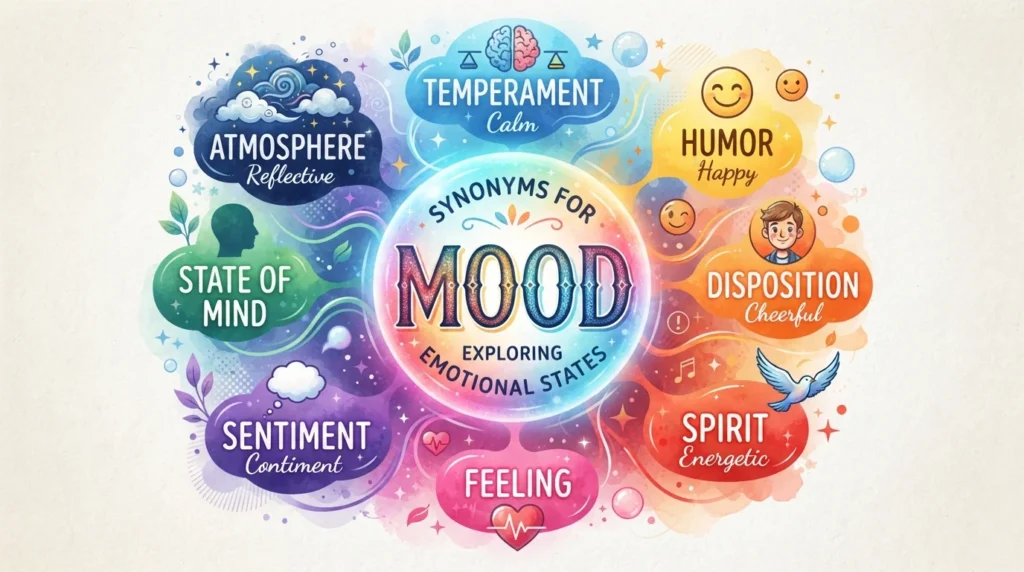
Quick Synonym List
The word mood has several meanings, so its alternatives are most useful when grouped by context.
Meaning | |
|---|---|
Current emotional condition | State of mind, emotional state, frame of mind, feelings, spirits |
Positive mood | Good spirits, cheerfulness, happiness, contentment, optimism, enthusiasm |
Negative mood | Irritability, gloom, sadness, melancholy, frustration, despondency |
General personality | Temperament, disposition, nature, character, personality |
Attitude toward something | Attitude, outlook, mindset, perspective, stance |
Mood of a place | Atmosphere, ambiance, vibe, feel, tone |
Mood of a group | Morale, collective mood, prevailing sentiment, general feeling |
Literary or artistic mood | Atmosphere, tone, emotional quality, feeling, ambiance |
Informal alternatives | Vibe, headspace, feeling, spirits, frame of mind |
Not every word in this list is a direct synonym. For example, sadness describes a particular mood, while temperament describes a person’s relatively stable emotional tendencies.
What Does “Mood” Mean?
Mood is a noun that usually refers to a person’s emotional state at a particular time. It can also describe the atmosphere of a place, the emotional quality of a work of art, or the prevailing feelings of a group.
Consider these examples:
“She’s in a cheerful mood today.” — Her current emotional condition.
“I’m not in the mood to talk.” — Her willingness or desire to do something.
“The restaurant has a relaxed mood.” — The atmosphere of a place.
“The film creates a mysterious mood.” — The emotional effect of an artistic work.
“The public mood has changed.” — The prevailing feelings of a group.
These meanings overlap, but they require different alternatives. Replacing mood with temperament in the first example would suggest a lasting personality trait rather than a temporary feeling.
The Best Synonyms for Mood
1. State of Mind
Meaning: A person’s current mental or emotional condition.
Tone: Neutral.
Best for: Everyday communication, psychology, personal reflection, and descriptions of emotional experiences.
Example: She wasn’t in the right state of mind to make an important decision.
How it differs: State of mind can include thoughts, concentration, and attitudes as well as emotions. It is broader than mood.
2. Emotional State
Meaning: The emotional condition someone is experiencing at a particular time.
Tone: Neutral to professional.
Best for: Psychology, health communication, research, and formal descriptions.
Example: The unexpected news affected his emotional state.
How it differs: Emotional state is more explicit and clinical than mood. It may refer to a particular emotion or a broader emotional condition.
3. Frame of Mind
Meaning: A person’s current way of thinking or feeling.
Tone: Neutral or conversational.
Best for: Decisions, work, motivation, personal reflection, and everyday situations.
Example: After taking a short break, she returned in a more positive frame of mind.
Watch out: Frame of mind often includes a person’s mental approach to a situation, not just their emotions.
4. Spirits
Meaning: A person’s emotional energy, cheerfulness, or general level of happiness.
Tone: Neutral to conversational.
Best for: Describing cheerful, discouraged, optimistic, or low emotional states.
Example: The encouraging message lifted everyone’s spirits.
How it differs: Spirits commonly appears in expressions such as high spirits, low spirits, and lift someone’s spirits. It is not a direct replacement in every sentence containing mood.
5. Feeling
Meaning: An emotional experience, impression, or sensation.
Tone: Neutral and conversational.
Best for: Everyday speech, personal experiences, and informal writing.
Example: She had a feeling of excitement before the concert.
How it differs: A feeling may be brief and specific, while a mood can be more general and last longer.
6. Temperament
Meaning: A person’s usual emotional nature and typical way of reacting.
Tone: Neutral to formal.
Best for: Personality descriptions, psychology, character analysis, and professional writing.
Example: His calm temperament helps him manage stressful situations.
Watch out: Temperament is relatively stable. Mood usually refers to a temporary emotional condition.
7. Disposition
Meaning: A person’s usual attitude, emotional tendencies, or characteristic way of behaving.
Tone: Formal or literary.
Best for: Character descriptions, professional evaluations, and literary writing.
Example: She has a cheerful disposition and enjoys meeting new people.
How it differs: Disposition describes a general tendency rather than how someone feels at one particular moment.
8. Attitude
Meaning: A person’s way of thinking or feeling about someone or something.
Tone: Neutral.
Best for: Workplace communication, relationships, opinions, and behavior.
Example: His positive attitude helped the team remain motivated.
How it differs: Attitude is often directed toward a particular person, task, or situation. A mood does not need a specific object.
9. Outlook
Meaning: A person’s general attitude toward life, the future, or a particular situation.
Tone: Neutral or professional.
Best for: Motivation, personal development, professional communication, and long-term perspectives.
Example: Despite the setback, she maintained an optimistic outlook.
Watch out: Outlook emphasizes expectations and perspective more than temporary emotion.
10. Mindset
Meaning: An established way of thinking that influences behavior, decisions, and responses.
Tone: Neutral to professional.
Best for: Education, business, personal development, and psychology.
Example: A flexible mindset helped the team adapt to unexpected changes.
How it differs: Mindset concerns thought patterns and beliefs rather than emotional mood alone.
11. Atmosphere
Meaning: The general feeling or emotional quality of a place, event, or situation.
Tone: Neutral.
Best for: Restaurants, celebrations, meetings, stories, films, and public events.
Example: Soft lighting created a peaceful atmosphere in the room.
How it differs: Atmosphere describes an environment rather than one individual’s emotional state.
12. Ambiance
Meaning: The distinctive atmosphere or character of a place.
Tone: Neutral to sophisticated.
Best for: Restaurants, hotels, interior design, travel, and event descriptions.
Example: The café’s warm lighting and quiet music created a welcoming ambiance.
Watch out: Ambiance is most natural when describing the sensory or emotional character of a physical setting.
13. Vibe
Meaning: The general feeling, impression, or atmosphere associated with a person, place, or situation.
Tone: Informal.
Best for: Everyday conversation, social media, music, fashion, and lifestyle writing.
Example: The small bookstore has a cozy, welcoming vibe.
How it differs: Vibe is casual and impressionistic. It may sound inappropriate in academic or formal writing.
14. Tone
Meaning: The attitude or emotional quality communicated through speech, writing, art, or an event.
Tone: Neutral or professional.
Best for: Literary analysis, communication, presentations, films, and music.
Example: The writer establishes a somber tone in the opening paragraph.
How it differs: Tone often describes the attitude expressed by a speaker, writer, or work, while mood describes the emotional effect experienced by the audience.
15. Morale
Meaning: The confidence, enthusiasm, and emotional condition of a person or group, particularly in relation to a shared activity.
Tone: Professional.
Best for: Workplaces, teams, schools, organizations, and military contexts.
Example: The successful project helped improve employee morale.
Watch out: Morale is more specific than mood. It concerns confidence and motivation, especially within a group.
Synonyms for Mood by Context
Mood as an Emotional State
When describing how someone feels at a particular time, use emotional state, state of mind, frame of mind, feelings, or spirits.
These expressions differ slightly. Emotional state is suitable for professional descriptions, while frame of mind is natural when someone’s feelings affect their thinking or decisions.
Original | Alternative | Difference |
|---|---|---|
She’s in a good mood. | She’s in good spirits. | Emphasizes cheerfulness. |
His mood changed suddenly. | His emotional state changed suddenly. | More clinical or formal. |
I’m not in the right mood to work. | I’m not in the right frame of mind to work. | Includes concentration and motivation. |
The news improved her mood. | The news lifted her spirits. | Natural, positive expression. |
Synonyms for a Good Mood
A good mood can involve happiness, optimism, relaxation, excitement, or satisfaction. These feelings are related but not identical.

Cheerfulness
A visibly happy, positive emotional condition.
Her cheerfulness made the gathering more enjoyable.

Contentment
A peaceful feeling of satisfaction rather than excitement.
He felt a sense of contentment after finishing his work.
An energetic feeling of interest and excitement.
The students approached the project with enthusiasm.
Other useful expressions include high spirits, optimism, happiness, joy, delight, and positive frame of mind. Choose according to the actual emotion rather than treating every positive feeling as interchangeable.
Synonyms for a Bad Mood
A bad mood may involve sadness, anger, frustration, anxiety, or irritability. More precise alternatives identify the particular feeling.
Alternative | Meaning | Example |
|---|---|---|
Irritability | A tendency to become annoyed easily | His irritability increased after a sleepless night. |
Gloom | A general feeling of sadness or pessimism | A sense of gloom settled over the team. |
Melancholy | Reflective or lingering sadness | The rainy afternoon filled her with melancholy. |
Frustration | Annoyance caused by obstacles or unmet expectations | Repeated delays caused considerable frustration. |
Despondency | Deep discouragement or loss of hope | The unsuccessful search left him feeling despondent. |
Unease | Mild anxiety or discomfort | She felt a growing sense of unease. |
These are names for particular emotional states, not universal replacements for mood.
Mood of a Place
For the mood of a room, restaurant, celebration, or other setting, choose atmosphere, ambiance, vibe, feel, or character.
Particularly natural for the sensory atmosphere of restaurants, hotels, and other interiors.
The restaurant has a romantic ambiance.

Atmosphere
A flexible word for the overall feeling of a place or event.
The market had a lively atmosphere.
A casual expression for an overall impression or feeling.
The coffee shop has a relaxed vibe.
Mood in Literature and Film
In literature, mood refers to the emotional atmosphere a work creates for its audience. Atmosphere, emotional quality, feeling, and sometimes ambiance are useful alternatives.
Tone is closely related but not identical. Tone generally describes the author’s or narrator’s attitude toward the subject, while mood describes the feeling created for the reader.
For example, a narrator may use a humorous tone while describing a frightening situation, creating an uneasy mood.
Mood of a Group
When discussing a workplace, sports team, community, or audience, useful alternatives include morale, collective mood, prevailing sentiment, general feeling, and atmosphere.
Morale is appropriate when confidence, enthusiasm, or motivation matters. Prevailing sentiment describes the dominant feeling or opinion within a group.
Neither term should automatically be used to represent every individual in that group.
Mood vs. Emotion vs. Temperament
A particular emotional response
She felt a sudden burst of joy when she heard the news.
A more general emotional condition
She remained in a cheerful mood throughout the afternoon.
A relatively stable emotional tendency
She has a naturally calm temperament.
An emotion is often associated with a particular event or cause. A mood may last longer and may not have an obvious cause. Temperament describes a person’s more enduring emotional characteristics. These are general distinctions rather than rigid rules about duration.
True Synonyms vs. Related Alternatives
Alternative | Relationship | Can replace mood? | Best context |
|---|---|---|---|
State of mind | Close alternative | Often | Personal mental condition |
Emotional state | Close alternative | Often | Formal descriptions |
Frame of mind | Near synonym | Often | Thinking and feeling |
Spirits | Contextual synonym | Sometimes | Happiness or discouragement |
Feeling | Broad alternative | Sometimes | Personal experiences |
Temperament | Related concept | Rarely directly | Stable personality |
Disposition | Related concept | Rarely directly | Usual emotional nature |
Attitude | Related concept | Sometimes | Responses to situations |
Mindset | Related concept | Sometimes | Patterns of thinking |
Atmosphere | Close contextual synonym | Often | Places and events |
Ambiance | Contextual synonym | Often | Physical settings |
Vibe | Informal alternative | Often | Casual descriptions |
Tone | Related concept | Sometimes | Writing and communication |
Morale | Sometimes | Group motivation |
How to Choose the Right Synonym
What kind of mood are you describing?
Suggested alternative
Emotional state
The unexpected news affected her emotional state.
10 Sentence Transformations
Original | Better alternative | Why |
|---|---|---|
She’s in a good mood today. | She’s in good spirits today. | Emphasizes cheerfulness. |
His mood changed after the meeting. | His emotional state changed after the meeting. | More formal and explicit. |
I’m not in the mood to study. | I’m not in the right frame of mind to study. | Includes motivation and concentration. |
She usually has a calm mood. | She has a calm temperament. | Describes a lasting characteristic. |
The restaurant has a romantic mood. | The restaurant has a romantic ambiance. | More natural for a physical setting. |
The party had a cheerful mood. | The party had a cheerful atmosphere. | Describes the feeling of an event. |
The team was in a positive mood. | Team morale was high. | Emphasizes group confidence. |
The story creates a frightening mood. | The story creates a frightening atmosphere. | Natural for literary analysis. |
His mood toward the proposal improved. | His attitude toward the proposal improved. | Identifies a response to something specific. |
The café has a relaxing mood. | The café has a relaxing vibe. | Sounds conversational. |
Grammar and Natural Usage
Mood is a countable noun in expressions such as a good mood, a bad mood, and different moods. It can also refer more generally to an emotional atmosphere.
Common expressions include:
In a good mood: feeling cheerful or positive.
In a bad mood: feeling unhappy, irritated, or dissatisfied.
In the mood for: wanting a particular activity or experience.
In no mood to: unwilling or disinclined to do something.
Mood swing: a noticeable change in emotional state.
Set the mood: create a particular atmosphere.
Lighten the mood: make a situation feel less serious or tense.
Mood of the moment: the prevailing feeling at a particular time.
For example, “I’m in the mood for pizza” expresses a desire, not an emotional state. “The music set the mood” refers to creating an atmosphere.
Mood also has a grammatical meaning. The indicative, imperative, and subjunctive are grammatical moods that express different ways of presenting an action or statement. In this context, grammatical mood is a technical term, and emotional synonyms such as feeling or temperament are inappropriate.
Common Mistakes
Using temperament for a temporary mood. Temperament describes relatively stable emotional tendencies.
Treating mood and emotion as identical. An emotion may be a particular response, while a mood is often more general.
Using ambiance for a person’s emotional state. Ambiance usually describes a place or environment.
Using morale for every group feeling. Morale specifically concerns confidence, enthusiasm, and motivation.
Confusing literary tone with mood. Tone concerns an expressed attitude; mood concerns the emotional effect on the audience.
Using attitude when no particular object is involved. Attitudes often concern specific people, ideas, or situations.
Using vibe in formal academic writing. Atmosphere or emotional quality is usually more appropriate.
Replacing mood with a specific emotion without evidence. A bad mood does not necessarily mean sadness or anger.
When “Mood” Is the Better Word
Mood is often the clearest and most natural choice because it describes an emotional condition without assuming exactly what someone feels or why.
For example, “Her mood improved after the walk” is direct and flexible. Replacing mood with temperament would incorrectly suggest a change in her lasting personality.
Similarly, “The music creates a peaceful mood” is entirely appropriate. There is no need to replace it with atmosphere unless that word better suits the surrounding sentence.