

Quick Answer
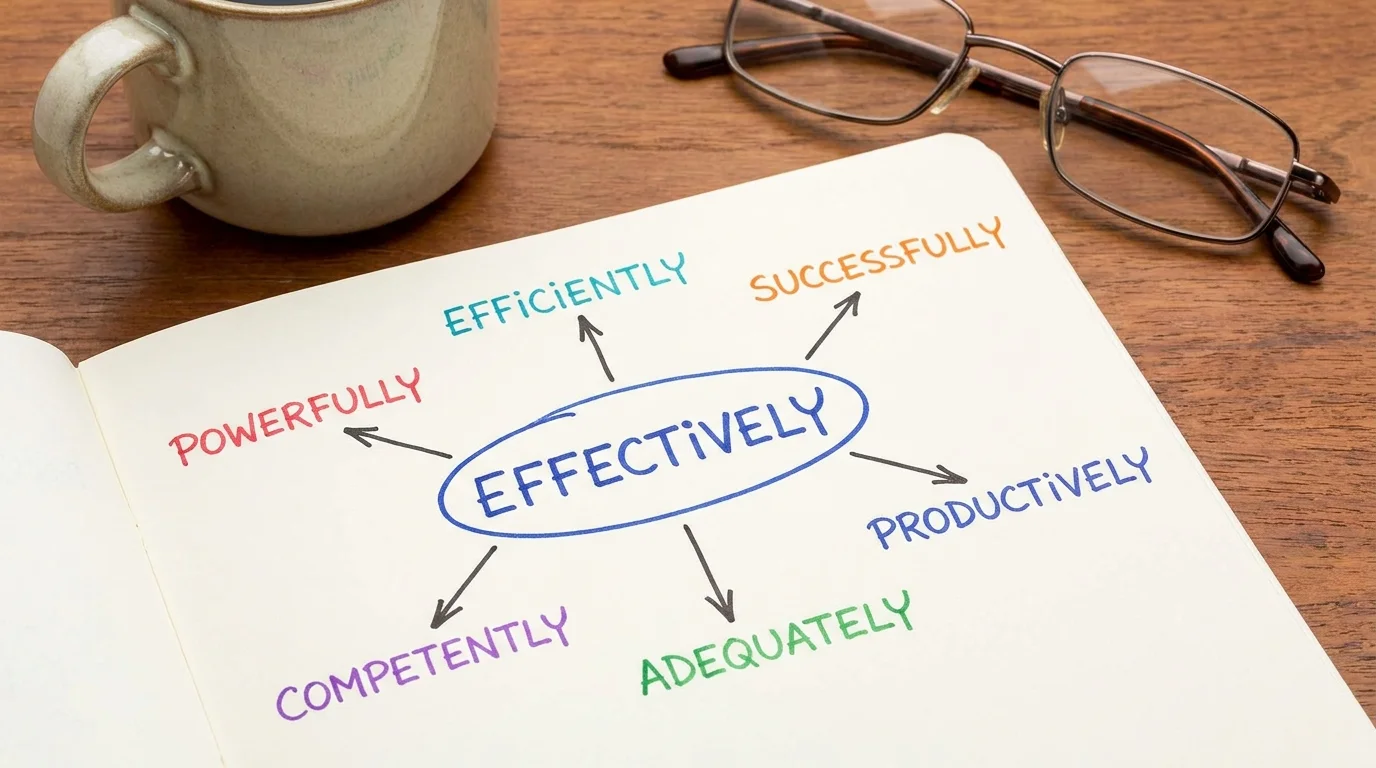
The best synonyms for effectively include successfully, efficiently, productively, competently, skillfully, adequately, satisfactorily, properly, accurately, practically, powerfully, convincingly, decisively, and successfully in practice. The right alternative depends on whether you mean achieving a result, using resources efficiently, performing a task well, or producing a strong impact.
Quick Synonym List
Closest Alternatives
- Successfully
- Efficiently
- Successfully in practice
- Competently
- Productively
- Properly
- Adequately
- Satisfactorily
Professional Alternatives
- Efficiently
- Competently
- Productively
- Appropriately
- Systematically
- Accurately
- Reliably
- Successfully
Alternatives for Strong Impact
- Powerfully
- Convincingly
- Persuasively
- Forcefully
- Decisively
- Impactfully
Alternatives for Practical Results
- Practically
- In practice
- Successfully
- In a useful way
- With results
- To good effect
What Does Effectively Mean?
Effectively has more than one common use.
Effectively = Successfully
“The team effectively solved the problem.”
Here, effectively means the team succeeded in solving it.
Effectively = Efficiently or Competently
“She effectively managed the project.”
This can suggest that she managed it successfully and competently, although efficiently would specifically emphasize good use of time or resources.
Effectively = In a Way That Produces a Strong Result
“The campaign effectively reached its target audience.”
The focus is on the result or impact.
Effectively = In Practical Effect
In some formal contexts, effectively means something is practically or functionally equivalent to something else.
“The company is effectively bankrupt.”
This does not necessarily mean the company has legally declared bankruptcy. It means that, in practical terms, its situation is similar to bankruptcy.
This sense should not automatically be replaced with successfully.
Closest Synonyms for Effectively
Successfully
Meaning: In a way that achieves the intended result.
How it differs: This is often the closest replacement when effectively means “with success.”
Tone: Neutral and professional.
Best for: Projects, tasks, goals, problem-solving, and achievements.
Example:
“The team successfully completed the project ahead of schedule.”
Watch out: Successfully focuses on the outcome. It does not necessarily say that the process was efficient.
Efficiently
Meaning: In a way that achieves a result while avoiding unnecessary time, effort, cost, or resources.
How it differs: Efficiently is narrower than effectively. Something can be effective without being efficient.
Example:
“The new software processes customer requests efficiently.”
Watch out: Do not use efficiently simply because something worked.
Competently
Meaning: In a capable and adequately skilled manner.
How it differs: Competently focuses on the person’s ability rather than simply the result.
Example:
“She handled the interview competently.”
Best for: Skills, professional performance, management, and work.
Skillfully
Meaning: In a highly capable or practiced manner.
Example:
“The designer skillfully combined traditional and modern elements.”
How it differs: Skillfully emphasizes technique or ability.
Productively
Meaning: In a way that produces useful results or makes good use of time and effort.
Example:
“The team worked productively throughout the afternoon.”
Watch out: Something can be productive without necessarily being efficient.
Properly
Meaning: Correctly or in the appropriate way.
Example:
“Make sure the equipment is properly installed.”
How it differs: Properly emphasizes correctness, not necessarily successful results.
Adequately
Meaning: Sufficiently or well enough for a particular purpose.
Example:
“The issue was adequately addressed.”
How it differs: This is weaker than effectively. It often means “enough to meet the requirement,” not “highly successful.”
Satisfactorily
Meaning: In a way that meets an acceptable standard or requirement.
Example:
“The complaint was resolved satisfactorily.”
How it differs: It suggests an acceptable result rather than an outstanding one.
Professional Alternatives to Effectively
Systematically
Meaning: In an organized and methodical way.
Example:
“The researchers systematically reviewed the available evidence.”
Use this when the method or process matters.
Accurately
Meaning: Correctly and without significant error.
Example:
“The software accurately identified the relevant records.”
Accurately is not a direct synonym for effectively. It focuses on correctness.
Reliably
Meaning: Consistently and dependably.
Example:
“The system reliably detects unusual activity.”
Choose it when consistency is more important than speed or efficiency.
Appropriately
Meaning: In a way that is suitable for the situation.
Example:
“The manager responded appropriately to the complaint.”
Use it when effectively means “in a suitable manner.”
Successfully
For business writing, successfully is often the cleanest alternative when you are describing a completed goal.
“The company successfully launched its new service.”
It sounds natural without adding unnecessary complexity.
Alternatives When You Mean Strong Impact
Sometimes effectively describes how strongly something influences people or produces an effect.
Powerfully
Meaning: With considerable force, influence, or emotional impact.
Example:
“The documentary powerfully communicates its message.”
Use it when the effect is strong or emotionally significant.
Convincingly
Meaning: In a way that successfully persuades someone that something is true or reasonable.
Example:
“The lawyer convincingly presented the evidence.”
Choose this when persuasion is the important idea.
Persuasively
Meaning: In a way that influences someone to accept an idea or take action.
Example:
“She persuasively argued for the proposed changes.”
This is especially useful in essays, presentations, debates, and professional communication.
Forcefully
Meaning: With strong emphasis, energy, or assertiveness.
Example:
“The organization forcefully rejected the proposal.”
Forcefully can sound stronger or more confrontational than effectively.
Decisively
Meaning: In a way that settles an issue or produces a definite result.
Example:
“The team acted decisively during the crisis.”
Use it when speed and firmness in decision-making matter.
Alternatives for Practical Effect
Practically
Meaning: In a way that relates to real-world use or practical circumstances.
Example:
“The proposal is practically impossible to implement.”
Here, practically does not mean effectively in the usual “successfully” sense.
In Practice
Meaning: In actual use or real-world circumstances.
Example:
“The system looks simple in theory, but it works differently in practice.”
This is useful when contrasting theory with real-world results.
To Good Effect
Meaning: Successfully or in a way that produces a favorable result.
Example:
“The author uses humor to good effect.”
This phrase can be a natural alternative in polished writing.
Synonyms vs. Near Synonyms
| Alternative | Relationship | Can Replace “Effectively”? | Tone | Best Context |
|---|---|---|---|---|
| Successfully | Close synonym | Usually | Neutral | Goals/results |
| Efficiently | Near synonym | Sometimes | Professional | Time/resources |
| Competently | Contextual alternative | Sometimes | Professional | Skills/performance |
| Skillfully | Contextual alternative | Sometimes | Positive | Technique/ability |
| Productively | Near synonym | Sometimes | Professional | Work/output |
| Properly | Contextual alternative | Sometimes | Neutral | Correctness |
| Adequately | Near synonym | Sometimes | Formal | Minimum requirements |
| Satisfactorily | Contextual alternative | Sometimes | Formal | Acceptable outcomes |
| Accurately | Contextual alternative | No | Professional | Correctness |
| Reliably | Contextual alternative | No | Professional | Consistency |
| Powerfully | Contextual alternative | No | Strong | Impact |
| Convincingly | Contextual alternative | Sometimes | Formal | Persuasion |
| Persuasively | Contextual alternative | Sometimes | Formal | Arguments |
| Decisively | Contextual alternative | Sometimes | Strong | Decisions |
| Practically | Different sense | Rarely | Neutral | Real-world use |
Comparison Table
| Word/Phrase | Meaning | Tone | Strength | Best Use | Interchangeable? |
|---|---|---|---|---|---|
| Effectively | Producing the desired result | Neutral/professional | Strong | General results | — |
| Successfully | Achieving the desired result | Neutral | Strong | Goals/projects | Often |
| Efficiently | Achieving results with minimal waste | Professional | Strong | Resources/time | Sometimes |
| Competently | With sufficient ability | Professional | Medium | Work/performance | Sometimes |
| Skillfully | With high ability or technique | Positive | Strong | Expertise | Sometimes |
| Productively | Producing useful output | Professional | Medium–strong | Work | Sometimes |
| Properly | Correctly or suitably | Neutral | Medium | Procedures | Sometimes |
| Adequately | Sufficiently | Formal | Mild | Requirements | Sometimes |
| Accurately | Correctly | Professional | Specific | Data/information | No |
| Reliably | Consistently | Professional | Specific | Systems/services | No |
| Convincingly | Persuasively | Formal | Strong | Arguments | Sometimes |
| Powerfully | With strong impact | Strong | Strong | Communication | Sometimes |
| Decisively | With a definite result | Strong | Strong | Decisions | Sometimes |
How to Choose the Right Alternative
Choose Successfully for Achieved Goals
Use successfully when the main point is that something worked or was completed.
“The company successfully entered the international market.”
Choose Efficiently for Time or Resources
Use efficiently when you want to emphasize minimizing waste.
“The warehouse operates efficiently.”
Choose Competently for Professional Ability
Use competently when describing how someone performs a task.
“He handled the negotiations competently.”
Choose Skillfully for Technique
Use skillfully when someone’s expertise or technique is impressive.
“She skillfully explained a complex topic.”
Choose Productively for Work and Output
Use productively when useful work or results are being generated.
“The team spent the meeting productively.”
Choose Accurately for Correct Information
Use accurately when correctness is the key point.
“The report accurately reflects current sales figures.”
Choose Convincingly for Persuasion
Use convincingly when an argument, explanation, or presentation persuades people.
“The writer convincingly explains why the policy should change.”
Choose Reliably for Consistent Performance
Use reliably when something performs consistently over time.
“The backup system reliably protects important files.”
Effectively vs. Efficiently
This is one of the most important distinctions.
Effectiveness asks: Does it achieve the intended result?
Efficiency asks: Does it achieve the result with minimal waste of time, money, effort, or resources?
For example:
“The treatment was effective.”
This means it produced the desired result.
“The treatment was efficient.”
This is unusual in many medical contexts because efficient focuses on resource use rather than simply whether the treatment worked.
In business:
“The team worked effectively.”
The team achieved what it needed to achieve.
“The team worked efficiently.”
The team used its time and resources well.
Something can be effective but inefficient or efficient but ineffective.
Effectively vs. Successfully
These words often overlap.
“She effectively solved the problem.”
“She successfully solved the problem.”
Both suggest the problem was solved.
The difference is subtle:
- Successfully emphasizes the outcome.
- Effectively can emphasize the way something produces a desired effect.
When describing a completed achievement, successfully is often the simpler choice.
Effectively vs. Properly
These are not interchangeable in every sentence.
“The machine was properly installed.”
means it was installed correctly.
“The machine was effectively used.”
means it was used in a way that produced a useful result.
Something can be installed properly but still be used ineffectively.
Effectively vs. Accurately
Accurately means correctly.
Effectively means successfully producing the intended result.
“The software accurately identified the error.”
The software identified the correct error.
“The software effectively identified the error.”
The software succeeded in identifying the error.
Accuracy and effectiveness can overlap, but they describe different qualities.
Sentence Transformations
1. General Success
Original:
“The team effectively completed the project.”
Better Alternative:
“The team successfully completed the project.”
Why:
Successfully puts the focus directly on achieving completion.
2. Resource Use
Original:
“The company effectively manages its resources.”
Better Alternative:
“The company efficiently manages its resources.”
Why:
If the intended meaning is good use of time, money, or materials, efficiently is more precise.
3. Professional Ability
Original:
“She effectively handled the difficult client.”
Better Alternative:
“She competently handled the difficult client.”
Why:
Competently emphasizes her ability to deal with the situation.
4. Strong Technique
Original:
“The artist effectively used light and shadow.”
Better Alternative:
“The artist skillfully used light and shadow.”
Why:
Skillfully highlights artistic technique.
5. Correctness
Original:
“The data was effectively recorded.”
Better Alternative:
“The data was accurately recorded.”
Why:
If the intended meaning is that the information was recorded without errors, accurately is better.
6. Persuasion
Original:
“The speaker effectively explained the problem.”
Better Alternative:
“The speaker convincingly explained the problem.”
Why:
Convincingly adds the idea that the explanation persuaded the audience.
7. Consistency
Original:
“The system effectively protects customer information.”
Better Alternative:
“The system reliably protects customer information.”
Why:
Reliably emphasizes dependable protection over time.
8. Strong Impact
Original:
“The campaign effectively communicated its message.”
Better Alternative:
“The campaign powerfully communicated its message.”
Why:
Powerfully emphasizes the strength of the campaign’s impact. Grammar and Usage
Effectively Verb
Effectively is an adverb. It commonly modifies verbs and describes how an action is performed or what result it produces.
Common patterns include:
effectively + verb
“She effectively managed the project.”
verb + effectively
“The system works effectively.”
effectively + adjective
“The two systems are effectively identical.”
effectively + phrase
“The company has effectively ended the program.”
The exact meaning depends heavily on the surrounding words.
Effective vs. Effectively
Effective is an adjective:
“The strategy was effective.”
Effectively is an adverb:
“The strategy worked effectively.”
Do not use effective when the sentence requires an adverb.
Common Mistakes
Mistake 1: Treating effectively and efficiently as identical
They are related but different.
Fix: Use effectively for achieving the intended result and efficiently for achieving it with good use of resources.

Mistake 2: Using successfully when you mean efficiently
“The factory successfully uses its machinery.”
This says the factory achieves its goal, but it does not specifically communicate efficient resource use.
Better:
“The factory efficiently uses its machinery.”
Mistake 3: Using effectively when you mean accurately
If the main concern is correctness, use accurately.
“The report accurately describes the findings.”
Mistake 4: Confusing effectively with properly
Properly means correctly or suitably. Effectively focuses on results.
Mistake 5: Overusing effectively in business writing
“Effectively” appears frequently in corporate writing and can become vague.
Instead of:
“We effectively improved customer service.”
say:
“We reduced average response time and resolved more customer requests.”
Specific information is usually stronger than a general claim.
Mistake 6: Using “impactfully” automatically
Impactfully is used in modern English, but it is often less natural than simply saying powerfully, effectively, or describing the actual impact.
Prefer the clearest option for the sentence.
Mistake 7: Ignoring the second meaning of effectively
In:
“The project is effectively finished.”
effectively can mean for practical purposes, not “successfully.”
The context determines the meaning.
When Not to Use an Alternative
Sometimes effectively is the most accurate choice.
Keep it when you mean that an action produces the desired result without wanting to emphasize a narrower quality such as speed, accuracy, persuasion, or skill.
For example:
“The policy effectively reduced unnecessary spending.”
Replacing it with:
“The policy efficiently reduced unnecessary spending.”
changes the focus toward resource efficiency.
Likewise:
“The speaker effectively communicated the message.”
does not necessarily mean the speaker was skillful, powerful, or persuasive. It simply tells us that the communication achieved its intended effect.
The original word can therefore be the clearest option.
Writing Tips
The best synonym for effectively is usually the one that tells the reader why or how something worked.
Instead of choosing randomly, ask:
- Did it achieve the goal? → successfully
- Did it save time or resources? → efficiently
- Was it done with skill? → skillfully
- Was the person capable? → competently
- Was the information correct? → accurately
- Did it persuade? → convincingly or persuasively
- Did it work consistently? → reliably
- Did it have a strong impact? → powerfully
- Was it correctly done? → properly
- Was the result merely acceptable? → satisfactorily or adequately
Do Not Replace It Just for Variety
Consider:
“The new system effectively reduces errors.”
There is no need to replace effectively unless another word communicates something more specific.
Good writing is not about using as many synonyms as possible. It is about making the intended meaning clear.
Editor’s Choice
Successfully
The best general alternative when effectively means achieving a goal or desired result.
Efficiently
The best choice when time, money, effort, or resources are central.
Skillfully
A strong choice when ability and technique are important.
Accurately
Use this when correctness is the main point.
Convincingly
Especially useful for arguments, explanations, presentations, and persuasive communication.
Related Questions
What is another word for effectively?
Common alternatives include successfully, efficiently, competently, skillfully, productively, properly, adequately, accurately, reliably, and convincingly. The correct choice depends on the intended meaning.
What is a professional synonym for effectively?
Professional alternatives include successfully, efficiently, competently, productively, accurately, reliably, and appropriately. Choose the word that describes the specific result or quality.
What is a formal synonym for effectively?
Depending on context, formal alternatives include successfully, efficiently, competently, adequately, satisfactorily, and appropriately.
Is effectively the same as efficiently?
No. Effectively means achieving the intended result, while efficiently emphasizes achieving a result with minimal waste of time, effort, money, or resources.
What is the opposite of effectively?
Depending on context, possible opposites include ineffectively, unsuccessfully, poorly, inefficiently, inadequately, and unsuccessfully. Ineffectively is the most direct general opposite.
Is effectively formal?
Effectively is neutral and widely used in both everyday and professional English. It is particularly common in business, academic, technical, and formal writing.
What is the difference between effective and effectively?
Effective is an adjective describing something that produces the desired result: “an effective strategy.” Effectively is an adverb describing how an action is performed or its practical result: “The strategy worked effectively.”
Key Takeaways
- Effectively usually means achieving a desired result, but it can also mean “in practical effect.”
- Use successfully when the main focus is achieving a goal.
- Use efficiently when the focus is saving time, money, effort, or resources.
- Use accurately, skillfully, competently, or convincingly when those specific qualities matter.
- Do not replace effectively simply to avoid repetition; choose another word only when it expresses your intended meaning more precisely.