
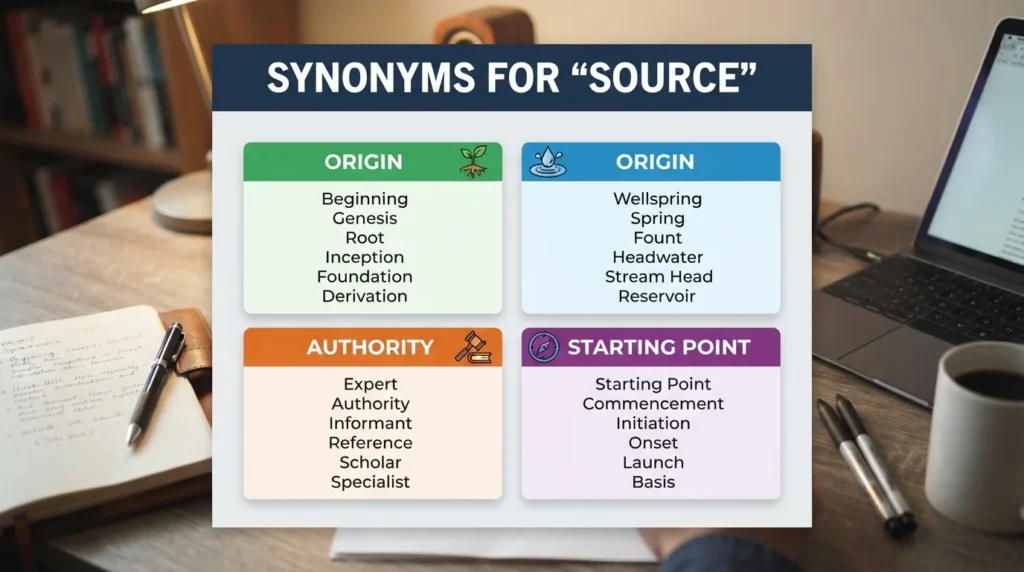
Quick List: 40+ Synonyms for Sourcea
Source as an origin
- Origin
- Root
- Beginning
- Start
- Starting point
- Birthplace
- Foundation
- Basis
- Originator
- Cause
Source as information or evidence
- Reference
- Evidence
- Documentation
- Record
- Report
- Publication
- Study
- Research
- Citation
- Material
- Resource
- Authority
Source as a person
- Informant
- Contact
- Witness
- Insider
- Contributor
- Interviewee
- Provider
- Authority
Source as a supplier or provider
- Supplier
- Provider
- Vendor
- Producer
- Distributor
- Manufacturer
- Seller
- Supply
Source as a cause or reason
- Cause
- Root
- Basis
- Reason
- Driver
- Factor
- Origin
Source as funding
- Funding
- Financing
- Capital
- Backing
- Revenue
- Income
- Financial support
What Does “Source” Mean?
Source is a broad noun with several meanings. It can refer to the origin of something, a place where information comes from, a person who provides information, a supplier, or a cause of something.
It can also function as a verb:
The journalist sourced the information from government records.
Because the word has so many uses, the best synonym changes with the sentence.
For example:
What is the source of this information?
Here, reference, publication, or origin may work depending on what you mean.
But:
The company found a new source of raw materials.
Here, supplier or provider may be more appropriate.
1. Origin
Origin is one of the closest alternatives to source when you mean where something begins or comes from.
- Meaning: The beginning or starting point of something
- Tone: Neutral
- Best for: Ideas, traditions, products, events, words, problems
Example:
Researchers investigated the origin of the tradition.
Source and origin overlap, but origin emphasizes the beginning rather than the continuing supply.
2. Root
Root refers to the fundamental origin or underlying cause of something.
- Tone: Neutral
- Best for: Problems, beliefs, traditions, conflicts, ideas
Example:
The researchers identified the root of the problem.
This is especially natural when source means an underlying cause.
3. Beginning
Beginning means the point at which something starts.
Example:
The book explains the beginning of the conflict.
It is simple and accessible but usually less precise than origin in formal writing.
4. Starting Point
Starting point refers to the place, stage, or idea from which something begins.
Example:
The report provides a useful starting point for further research.
This is a phrase-level alternative rather than a one-word synonym.
5. Foundation
Foundation means the underlying basis on which something is built or developed.
Example:
Education is the foundation of the program.
Use foundation when the source provides support or a basis rather than simply being where something originated.
6. Basis
Basis means the underlying reason, principle, fact, or support for something.
Example:
The study formed the basis of the new policy.
This is common in academic, professional, and formal writing.
7. Cause
Cause means something that produces an effect or makes something happen.
Example:
Scientists are investigating the cause of the disease.
Use cause instead of source when you specifically mean the reason something happened.
8. Originator
Originator refers to the person or organization that first created, proposed, or introduced something.
Example:
She was the originator of the proposal.
This is useful when the “source” is specifically the creator of an idea or work.
9. Reference
Reference is one of the most useful alternatives to source in academic and informational writing.
It refers to material used to support or verify information.
Example:
The article includes several reliable references.
However, a reference is not always exactly the same as a source. A source is where information originates; a reference is often something a writer points readers to for verification.
10. Evidence
Evidence means information, facts, or observations that support a claim or conclusion.
Example:
The researchers found strong evidence supporting the theory.
Source and evidence should not automatically be treated as interchangeable.
A document can be a source of evidence, but the document itself is not necessarily the evidence.
11. Documentation
Documentation refers to written or recorded material that provides information, proof, or a record of something.
Example:
The claim is supported by official documentation.
This is particularly useful in professional, legal, technical, and administrative contexts.
12. Record
A record is documented information preserved for future reference.
Example:
Historical records provide information about the event.
It works well when the source is an archived document, database entry, official file, or historical account.
13. Report
A report is a written or spoken account of information, findings, or events.
Example:
According to a government report, the number increased last year.
Report is especially useful when the source itself is a formal account.
14. Publication
Publication refers to a book, article, journal paper, report, or other material made available to readers.
Example:
The claim comes from a peer-reviewed publication.
It is a strong choice in academic and research contexts.
15. Study
A study is an organized investigation designed to examine a question or issue.
Example:
A recent study examined the effects of the policy.
Use study when the source is specifically research.
16. Research
Research refers to systematic investigation and the information produced by that investigation.
Example:
Current research suggests that the method may be effective.
Research is broader than a single source, so it should not replace source when referring to one specific document.
17. Citation
A citation identifies a source or reference used in a piece of writing.
Example:
Add a citation after the factual claim.
A citation is not necessarily the source itself. It is the reference or notation pointing to the source.
18. Material
Material is a broad term for information, documents, texts, or other content used for a purpose.
Example:
The researchers reviewed historical material.
It is useful when referring to a collection of information rather than one specific source.
19. Resource
Resource refers to something useful that provides information, support, materials, or other assistance.
Example:
The library is an excellent resource for students.
A resource can be a source of information, but the words emphasize different ideas.
20. Authority
Authority can mean a person, organization, or publication considered knowledgeable or reliable on a subject.
Example:
The report cites several recognized authorities on the subject.
It can also refer to an official body, so context matters.
21. Informant
An informant is a person who provides information, often privately or to a journalist, investigator, or researcher.
Example:
The journalist spoke with an anonymous informant.
It is more specific than source.
22. Contact
A contact is a person who provides information, assistance, or access to an organization or community.
Example:
The reporter confirmed the information with a government contact.
This is common in journalism and professional settings.
23. Witness
A witness is someone who personally saw or experienced an event.
Example:
A witness provided information about the accident.
A witness can be a source, but not every source is a witness.
24. Insider
An insider is someone with internal knowledge of an organization, group, or situation.
Example:
An insider provided details about the negotiations.
This term can imply that the person has access to information unavailable to the general public.
25. Contributor
A contributor is someone who supplies information, ideas, writing, money, or other material.
Example:
Several contributors provided information for the report.
It is broader than source and often emphasizes participation rather than information origin.
26. Interviewee
An interviewee is someone who answers questions during an interview.
Example:
The interviewee provided valuable information about the project.
This is appropriate when the source is specifically a person being interviewed.
27. Supplier
A supplier is a person or company that provides goods or materials.
Example:
The company found a new supplier for its raw materials.
This is a common synonym for source in business contexts:
We need a reliable source of materials.
We need a reliable supplier of materials.
28. Provider
A provider is a person or organization that supplies something, especially a service, resource, or form of support.
Example:
The company is a major provider of cloud services.
Use provider for services, resources, information, care, or support.
29. Vendor
A vendor is a person or business that sells goods or services.
Example:
The retailer works with several software vendors.
Vendor emphasizes selling, while supplier emphasizes supplying.
30. Producer
A producer is a person or organization that makes or creates something.
Example:
The country is a major producer of coffee.
A producer can be a source of a product, but the two terms are not always interchangeable.
31. Distributor
A distributor supplies or delivers products from producers to retailers, customers, or other businesses.
Example:
The company works with a regional distributor.
Use this term when distribution is the important part of the relationship.
32. Manufacturer
A manufacturer is a company or person that makes products.
Example:
Contact the manufacturer for technical specifications.
It is a specialized alternative when the source is the company that physically produces the goods.
33. Supply
Supply can refer to the available amount of something or the act of providing it.
Example:
The river is an important source of drinking water.
You could say:
The river provides an important supply of drinking water.
But the grammatical structure changes, so this is a contextual alternative rather than a direct substitution.
34. Funding
When source refers to money used to support something, funding is often more precise.
Example:
The organization disclosed its sources of funding.
Possible alternatives include:
- funding
- financing
- capital
- backing
- financial support
- revenue
- income
35. Financing
Financing refers to money provided to fund a project, purchase, company, or activity.
Example:
The company secured additional financing for the expansion.
It is more specific than source when the context concerns money.
36. Capital
Capital means money or other financial assets used for investment or business activity.
Example:
The company raised additional capital from investors.
It should not replace source unless money or investment is specifically meant.
37. Backing
Backing means financial, organizational, or personal support.
Example:
The project received financial backing from several investors.
This can be a useful alternative to source of support.
38. Revenue Stream
A revenue stream is a continuing source of income.
Example:
Advertising became an important revenue stream for the company.
This is more precise than source when discussing recurring business income.
39. Driver
Driver refers to something that causes or strongly influences an outcome.
Example:
High demand was a major driver of price increases.
Use driver when source means an important causal force.
40. Factor
A factor is something that contributes to a result or situation.
Example:
Cost was an important factor in the decision.
A factor may contribute to an outcome without being its sole source or cause.
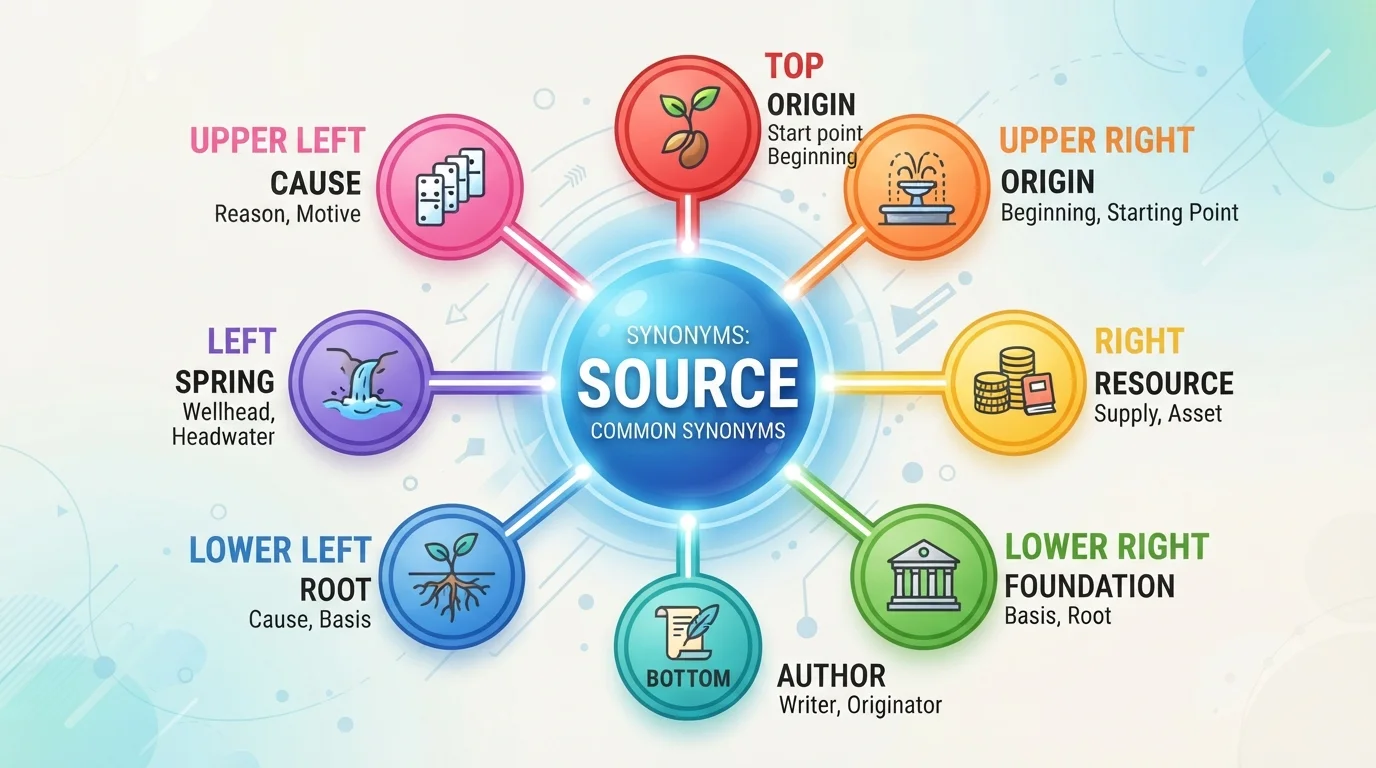
Source by Context
Academic Writing
Common alternatives include:
- Reference
- Publication
- Study
- Research
- Evidence
- Documentation
- Record
- Citation
- Scholarly work
- Primary source
- Secondary source
Example:
The paper draws on several academic sources.
Depending on the sentence, you could write:
The paper draws on several academic studies.
or:
The paper draws on several scholarly publications.
These alternatives are more specific about what the sources actually are.
Journalism
Useful alternatives include:
- Informant
- Contact
- Witness
- Insider
- Interviewee
- Contributor
- Official
- Report
Example:
According to a source familiar with the matter…
Depending on what is known, this could become:
According to an official familiar with the matter…
or:
According to a witness…
Do not use a more specific label unless it accurately describes the person.
Business
Depending on meaning, use:
- Supplier
- Provider
- Vendor
- Manufacturer
- Distributor
- Producer
- Partner
- Funding source
- Revenue stream
Example:
We are looking for a reliable source of office supplies.
We are looking for a reliable supplier of office supplies.
Scientific and Technical Writing
Useful alternatives include:
- Origin
- Cause
- Source
- Input
- Reference
- Data source
- Signal source
- Energy source
- Primary source
- Research
Example:
The researchers identified the source of the signal.
Here, origin may work, but source may actually be the standard technical term.
Source vs. Origin
These words are closely related but emphasize different things.
Origin = where something began.
Source = where something comes from or where it is obtained.
Compare:
Researchers investigated the origin of the language.
This emphasizes its beginnings.
Researchers identified the source of the data.
This emphasizes where the data came from.
Source vs. Reference
A source provides information.
A reference points to information or identifies material used to support a claim.
This book is a source of historical information.
The book is listed as a reference at the end of the paper.
A source can become a reference when it is cited in a document.
Source vs. Evidence
Evidence supports a claim.
A source is where information comes from.
The interview was a source of information.
The interview provided evidence supporting the claim.
The interview can be the source, while specific statements from it may serve as evidence.
Source vs. Supplier
Source is broader.
Supplier specifically provides goods, materials, or sometimes services.
We found a new source of information.
We found a new supplier of steel.
Do not use supplier for an academic or informational source.
Source vs. Cause
A cause produces an effect.
A source can simply be where something originates or comes from.
Pollution was the cause of the damage.
The factory was the source of the pollution.
The first focuses on causation. The second focuses on origin.
Comparison Table
| Word | Main meaning | Best context | Direct synonym for “source”? |
|---|---|---|---|
| Origin | Where something begins | History, ideas, events | Often |
| Root | Fundamental origin/cause | Problems, traditions | Sometimes |
| Beginning | Starting point | General writing | Sometimes |
| Foundation | Underlying support | Ideas, systems | Contextual |
| Basis | Underlying reason/support | Academic, professional | Contextual |
| Cause | Something producing an effect | Science, analysis | Contextual |
| Reference | Material used for information | Academic writing | Often |
| Evidence | Support for a claim | Research, arguments | No, not usually |
| Documentation | Recorded supporting material | Professional, legal | Contextual |
| Record | Preserved information | History, administration | Contextual |
| Report | Formal account | Journalism, business | Contextual |
| Publication | Published work | Academic, research | Contextual |
| Study | Research investigation | Academic, scientific | Contextual |
| Citation | Reference to a source | Academic writing | No |
| Resource | Useful source of help/information | Education, research | Sometimes |
| Informant | Person providing information | Journalism, investigation | Contextual |
| Witness | Person who observed an event | Legal, journalism | Contextual |
| Insider | Person with internal knowledge | Journalism, business | Contextual |
| Supplier | Provider of goods | Business | Contextual |
| Provider | Provider of services/resources | Business, services | Contextual |
| Vendor | Seller of goods/services | Business | Contextual |
| Producer | Maker of goods | Manufacturing | Contextual |
| Distributor | Product distributor | Business | Contextual |
| Manufacturer | Product maker | Business | Contextual |
| Funding | Money supporting something | Finance, nonprofits | Contextual |
| Financing | Financial support | Business | Contextual |
| Capital | Investment money | Finance | Contextual |
| Backing | Financial/organizational support | Business | Contextual |
| Driver | Influential cause | Analysis, business | Contextual |
| Factor | Contributing element | Research, analysis | Contextual |
Sentence Transformations
1. Original
What is the source of this information?
Alternative:
What is the origin of this information?
Why: Use origin when you are asking where the information came from.
2. Original
The article uses several reliable sources.
Alternative:
The article uses several reliable references.
Why: References works well when discussing materials cited in writing.
3. Original
The study was an important source of evidence.
Alternative:
The study provided important evidence.
Why: The revised sentence focuses on what the study contributed rather than calling the study itself “evidence.”
4. Original
We need a new source for the materials.
Alternative:
We need a new supplier for the materials.
Why: Supplier identifies a business or person providing materials.
5. Original
The journalist spoke to a confidential source.
Alternative:
The journalist spoke to a confidential informant.
Why: Informant specifically describes someone who provides information.
6. Original
Researchers investigated the source of the problem.
Alternative:
Researchers investigated the root cause of the problem.
Why: Root cause emphasizes the underlying reason rather than merely where the problem originated.
7. Original
The company needs another source of funding.
Alternative:
The company needs another funding stream.
Why: This emphasizes an additional channel through which money is obtained.
8. Original
The report is a useful source for researchers.
Alternative:
The report is a useful reference for researchers.
Why: Reference is natural when researchers use the report for consultation or citation.
9. Original
The factory is the source of the pollution.
Alternative:
The factory is the origin of the pollution.
Why: Origin can work, although source may actually be more natural because pollution is being traced to where it is emitted.
10. Original
Cost was a major source of concern.
Alternative:
Cost was a major cause for concern.
Why: The phrase cause for concern is more precise when discussing something that creates worry.
Common Collocations with “Source”
Understanding common combinations helps you choose better alternatives.
Information
- source of information
- reliable source
- credible source
- trusted source
- primary source
- secondary source
- original source
- independent source
- official source
- anonymous source
Academic
- academic source
- scholarly source
- primary source
- secondary source
- source material
- source citation
- source text
- historical source
Business
- source of income
- source of funding
- source of revenue
- source of supply
- source of materials
- reliable source
- alternative source
- local source
Causation
- source of the problem
- source of the conflict
- source of concern
- source of pressure
- source of tension
- source of uncertainty
- source of energy
Physical
- water source
- energy source
- power source
- heat source
- light source
- food source
- fuel source

Common Mistakes with Synonyms for “Source”
1. Treating “evidence” as an exact synonym
A source provides information; evidence supports a claim.
They overlap but are not identical.
2. Using “citation” to mean the actual source
A citation identifies or points to a source. It is not necessarily the source itself.
3. Using “supplier” for information
A supplier normally provides goods, materials, or services.
information source ✓
information supplier ✗
4. Using “origin” when continued supply is meant
A source can provide something continuously.
The river is a source of water.
Origin does not always express this ongoing supply.
5. Assuming “cause” always means source
A source can be a location or provider without being a cause.
The library is a source of information.
A library is not the “cause” of the information.
6. Using “authority” to mean any source
An authority generally implies expertise, official status, or recognized credibility.
Not every source has authority.
7. Using “research” for one specific document
Research is a broad activity or body of work. A particular paper, report, or study may be the source.
8. Choosing a more specific word without evidence
If you know only that someone provided information, source may be safer than insider, official, or witness.
When Should You Keep “Source”?
You do not always need a synonym.
Keep source when:
- the meaning is already clear
- you are discussing information generally
- the identity or type of provider is unknown
- you mean a place from which something is obtained
- you are using a standard technical expression
- the broader meaning is useful
For example:
The website is a reliable source of information.
There is no need to replace source simply to avoid repetition.
In many cases, a precise synonym is better than a decorative one—but replacing a clear word just for variety can make writing less accurate.
Which Synonym Should You Choose?
Use this quick decision guide:
If you mean where something began:
→ origin
If you mean the underlying cause:
→ root or cause
If you mean supporting material:
→ reference or documentation
If you mean proof supporting a claim:
→ evidence
If you mean a research paper or investigation:
→ study or research
If you mean a published work:
→ publication
If you mean a person who provides information:
→ informant, contact, witness, or insider, depending on the facts
If you mean a business providing goods:
→ supplier
If you mean a company selling products or services:
→ vendor
If you mean a service provider:
→ provider
If you mean an organization making a product:
→ manufacturer or producer
If you mean financial support:
→ funding, financing, or capital
If you mean something that contributes to an outcome:
→ factor or driver
Editor’s Choice
These are practical choices for different meanings, not an overall ranking.
- Origin — best for beginnings
- Reference — best for cited informational material
- Evidence — best for support of a claim
- Publication — best for published research or writing
- Informant — best for a person providing information
- Supplier — best for goods and materials
- Provider — best for services and resources
- Cause — best for direct causation
- Root — best for underlying causes
- Funding — best for financial support