
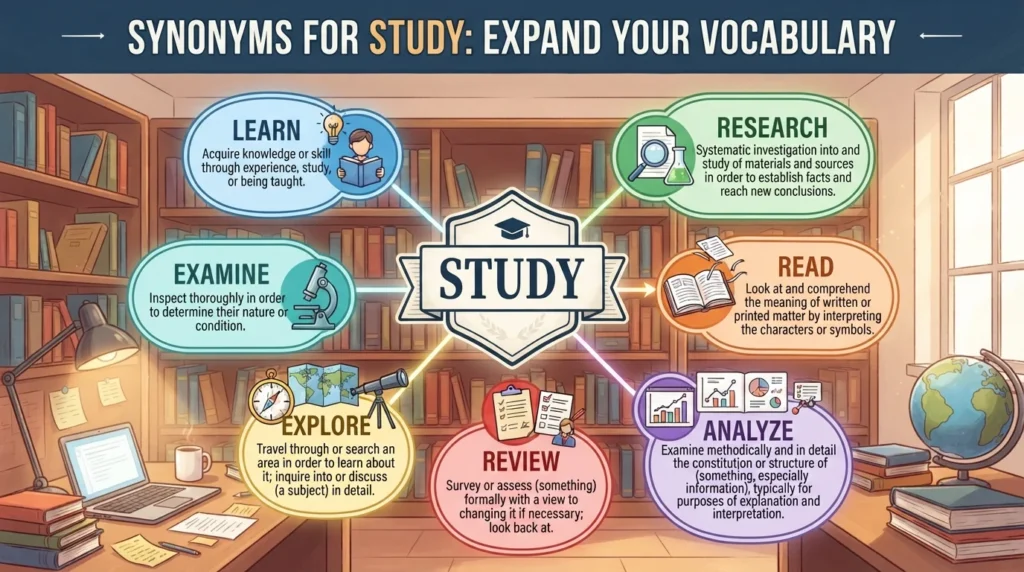
Quick Synonym List
Synonyms for study by meaning
Meaning | Useful alternatives |
|---|---|
Learning a subject | Learn, read, master, explore, absorb |
Preparing for an exam | Revise, review, practice, prepare, go over |
Conducting research | Research, investigate, explore, inquire into |
Examining carefully | Examine, analyze, scrutinize, inspect, assess |
Observing something | Observe, monitor, watch, investigate |
An academic study | Research, investigation, analysis, examination, inquiry |
A written study | Report, paper, dissertation, thesis, monograph |
A room for studying | Office, home office, library, reading room |
What Does “Study” Mean?
Study functions as both a verb and a noun. Its meaning changes according to the context.
As a verb, it commonly means spending time learning a subject, examining something carefully, or conducting research.
As a noun, it can refer to the activity of learning, a research project, a written academic work, or a room used for reading and working.
“She studies biology.” — Learns an academic subject.
“He studied for the exam.” — Prepared for a test.
“Researchers studied the effects of pollution.” — Conducted research.
“She studied the painting carefully.” — Examined something closely.
“The study included 200 participants.” — A research investigation.
“He spent the evening in his study.” — A room used for reading or work.
These meanings overlap, but their alternatives are not always interchangeable.
1. Synonyms for Study When It Means Learning

Learn
Meaning: Gain knowledge, understanding, or skills through education or experience.
Example: “She is learning Spanish.”
Difference: Study emphasizes the effort or activity of learning, while learn can emphasize the knowledge or skill gained.
Read
Meaning: Obtain information from written material.
Example: “He spent the afternoon reading about ancient history.”
Watch out: Reading is one way to study, but studying may also involve experiments, discussions, or practical exercises.
Master
Meaning: Develop a thorough understanding of a subject or a high level of skill.
Example: “She worked hard to master the fundamentals of mathematics.
Watch out: Master suggests successful learning, not merely the process of studying.
Explore
Meaning: Learn about a subject by examining its different aspects.
Example: “Students explored the history of modern architecture.”
Best for: Broad learning, introductory courses, and open-ended investigation.
Absorb
Meaning: Take in and understand information.
Example: “She needed time to absorb the new material.
Difference: Absorb emphasizes understanding or taking in information rather than the act of studying.
Other useful learning-related alternatives include educate oneself, familiarize oneself with, acquire knowledge of, train in, and work through. These are contextual expressions rather than direct replacements.
2. Synonyms for Study When Preparing for an Exam
Each describes a different part of exam preparation.
Review
Review means examining previously learned material again to strengthen understanding or memory.
“I need to review my notes before tomorrow’s exam.”
In American English, review is particularly natural for exam preparation.

Revise
Revise commonly means reviewing material for an examination in British English.
“She’s revising for her chemistry exam.”
In American English, revise more commonly means editing or changing written work. American students usually say they are studying or reviewing for an exam.
Practice
Practice means repeatedly performing an activity to improve a skill.
“He practiced solving algebra problems.”
It is especially useful for mathematics, languages, music, and practical skills.
Prepare
Prepare is broader than study. It may include reviewing material, completing assignments, organizing resources, or getting ready mentally.
“She’s preparing for her final examinations.”
Go over
Go over is a conversational phrasal verb meaning to review or examine something.
“Let’s go over the main concepts before the test.”
Brush up on
Brush up on means refreshing knowledge or skills that someone has previously learned.
“I need to brush up on my French before the trip.”
It is not appropriate when learning a subject for the first time.
3. Synonyms for Study When It Means Research
Meaning: Investigate a subject systematically to discover information or develop understanding.
Example: “The team researched the effects of air pollution.”
Best for: Academic work, scientific investigations, historical inquiries, and evidence-based projects.
Investigate
Meaning: Examine a subject, problem, or event to discover facts or establish an explanation.
Example: “Researchers investigated the causes of the unexpected results.
Difference: Investigate often emphasizes answering a specific question or resolving uncertainty.
Examine
Meaning: Consider something carefully to understand its characteristics, condition, or meaning.
Example: “The study examined changes in consumer behavior.”
Best for: Academic papers, reports, and detailed assessments.
Analyze
Meaning: Examine something by considering its parts, structure, or relationships.
Example: “The researchers analyzed the survey responses.”
Watch out: Analysis is a specific method of examination, not a synonym for every kind of research.
Explore
Meaning: Investigate a subject broadly or consider different possibilities.
Example: “The project explores the relationship between technology and education.”
Difference: Explore can suggest an open-ended investigation rather than a narrowly defined test.
4. Synonyms for Study When It Means Examine Carefully
Sometimes study describes looking closely at something to understand it.
“She studied the map before choosing a route.”
Here, studied does not mean attending classes or conducting formal research.
Useful alternatives include examine, inspect, scrutinize, observe, analyze, assess, evaluate, consider, and look closely at.
Alternative | Main meaning | Example |
|---|---|---|
Examine | Look at or consider carefully | “She examined the document.” |
Inspect | Check closely, often for problems | “The engineer inspected the equipment.” |
Scrutinize | Examine with exceptional care | “The committee scrutinized the proposal.” |
Observe | Watch or notice systematically | “Scientists observed the animals.” |
Analyze | Examine parts and relationships | “She analyzed the financial data.” |
Assess | Judge characteristics or condition | “The team assessed the damage.” |
Evaluate | Judge quality, value, or effectiveness | “Researchers evaluated the program.” |
Consider | Think carefully about something | They considered several alternatives.” |
Scrutinize is particularly useful when the examination is detailed or critical. Inspect often involves checking physical objects, while evaluate involves forming a judgment using relevant criteria.
5. Synonyms for Study as a Noun
When study refers to a research project, its alternatives include research, investigation, analysis, examination, inquiry, survey, experiment, trial, case study, and assessment.
These words describe different research methods or activities.
Alternative | Best context |
|---|---|
Research | General systematic investigation |
Investigation | Examining a particular question or problem |
Analysis | Detailed examination of information |
Examination | Careful consideration of a subject |
Inquiry | A process of seeking information |
Survey | Collecting information from a population or sample |
Experiment | Testing a hypothesis under specified conditions |
Trial | Testing an intervention or procedure |
Case study | Detailed investigation of a particular case |
Assessment | Evaluating a condition, result, or performance |
For example, “The study involved 100 participants” might refer to an experiment, survey, or observational investigation. Calling it an experiment without knowing its research design could be inaccurate.
6. Synonyms for Study as an Academic Paper
A study can also refer to a written account of research.
Depending on the document, alternatives include research paper, academic article, report, dissertation, thesis, monograph, and research publication.
A research paper presents findings or arguments. A dissertation or thesis is usually produced as part of an academic degree. A monograph is a detailed written treatment of a specialized subject.
These are related terms, not universal synonyms.
7. Synonyms for Study as a Room
Example: “He spent the evening reading in his study.”
A home office emphasizes work, while a library suggests a room containing books. A den is usually an informal room for relaxation or personal activities and may not be primarily used for studying.
True Synonyms vs. Related Alternatives
Alternative | Relationship | Can replace “study”? | Best use |
|---|---|---|---|
Learn | Close contextual alternative | Sometimes | Acquiring knowledge |
Review | Contextual alternative | Sometimes | Revisiting material |
Practice | Related activity | Sometimes | Improving skills |
Memorize | Narrower activity | Sometimes | Remembering information |
Research | Close contextual synonym | Often | Systematic investigation |
Investigate | Close contextual synonym | Often | Seeking facts |
Examine | Close contextual synonym | Often | Careful consideration |
Analyze | Narrower activity | Sometimes | Examining components |
Scrutinize | More intensive alternative | Sometimes | Detailed examination |
Observe | Related activity | Sometimes | Watching systematically |
Evaluate | Contextual alternative | Sometimes | Judging effectiveness |
Experiment | Specific research method | Sometimes | Controlled testing |
Report | Related noun | Sometimes | Written findings |
Home office | Contextual noun | Sometimes | Room used for work |
Study vs. Learn
Study emphasizes the activity or effort involved in gaining knowledge. Learn emphasizes acquiring knowledge or developing skills.
Compare:
“She studied French for three years.”
“She learned French.”
The first tells us about the learning activity and its duration. The second suggests that she acquired knowledge of the language, although it does not specify her level of proficiency.
Someone can study a subject extensively without mastering it.
Study vs. Research
Study is broader than research in everyday English.
A student may study biology by reading textbooks and attending classes. A scientist may research a specific biological process by conducting experiments and analyzing evidence.
Use research when systematic investigation is central to the meaning.

Study vs. Analyze
Analyze means examining something in detail, often by considering its parts or relationships.
For example:
“The researchers studied the results.”
This is broad.
“The researchers analyzed the results.”
This specifically describes examining the data or findings.
Use analyze when the process of detailed examination matters.
Study vs. Examine
Examine is one of the most versatile alternatives to study when the meaning involves careful observation or consideration.
“The researchers examined the relationship between sleep and memory.”
“She examined the painting closely.”
However, examine does not naturally replace study when describing ordinary educational activities.
“She examines mathematics at university” would not normally mean that she studies mathematics as an academic subject.
Professional and Academic Alternatives
In academic and professional writing, choose a verb that accurately describes the activity.
Investigate: Explore a question or problem to establish facts.
Analyze: Examine information in detail.
Evaluate: Judge quality, effectiveness, or value.
Assess: Determine a condition, characteristic, or outcome.
Examine: Consider something carefully.
Explore: Investigate a topic or possibility.
Review: Revisit or systematically consider existing material.
Observe: Watch or record behavior or events.
For example, “This paper studies workplace communication” is acceptable, but “This paper examines workplace communication” may be more precise if the paper presents a detailed examination rather than new experimental research.
Sentence Transformations
Original | Alternative | Why |
|---|---|---|
“She studies Spanish.” | “She is learning Spanish.” | Emphasizes acquiring knowledge |
“I need to study for the exam.” | “I need to review for the exam.” | Emphasizes revisiting material |
“He studied the map.” | “He examined the map.” | Emphasizes careful inspection |
“Scientists studied the problem.” | “Scientists investigated the problem.” | Emphasizes seeking an explanation |
“They studied the survey results.” | “They analyzed the survey results.” | Specifies detailed analysis |
“The committee studied the proposal.” | “The committee reviewed the proposal.” | Natural professional wording |
“She studied the painting.” | “She scrutinized the painting.” | Emphasizes exceptionally close attention |
“The researchers studied animal behavior.” | “The researchers observed animal behavior.” | Specifies observation as the method |
“The study assessed student performance.” | “The investigation assessed student performance.” | Suitable when describing a research project |
“He went into his study.” | “He went into his home office.” | Identifies the room’s function |
Common Mistakes
Treating study and learn as identical. Studying is an activity; learning involves acquiring knowledge or skills. The distinction matters when discussing educational outcomes.
Using research for ordinary homework. Reading a textbook to prepare for a quiz is usually studying, not conducting research.
Confusing review with revision. In American English, review is the usual word for revisiting exam material, while revise commonly refers to editing or changing written work.
Using analyze for every kind of examination. Analysis involves detailed examination, often of parts or relationships. Simply observing something does not necessarily mean analyzing it.
Calling every research study an experiment. Surveys, observational studies, case studies, and experiments have different methods.
Replacing study with memorize. Memorization is only one possible study technique. Studying may involve understanding, analysis, practice, and application.
When “Study” Is the Better Word
Study is already a clear and versatile word. It is especially useful when you want to describe educational activity or research without specifying a narrower method.
For example:
“She studies environmental science.”
This is natural and informative. Replacing studies with investigates would suggest a different activity.
Similarly, “The study examined several factors” is a standard academic construction. Replacing study with a more specialized research term is useful only when that term accurately describes the project