
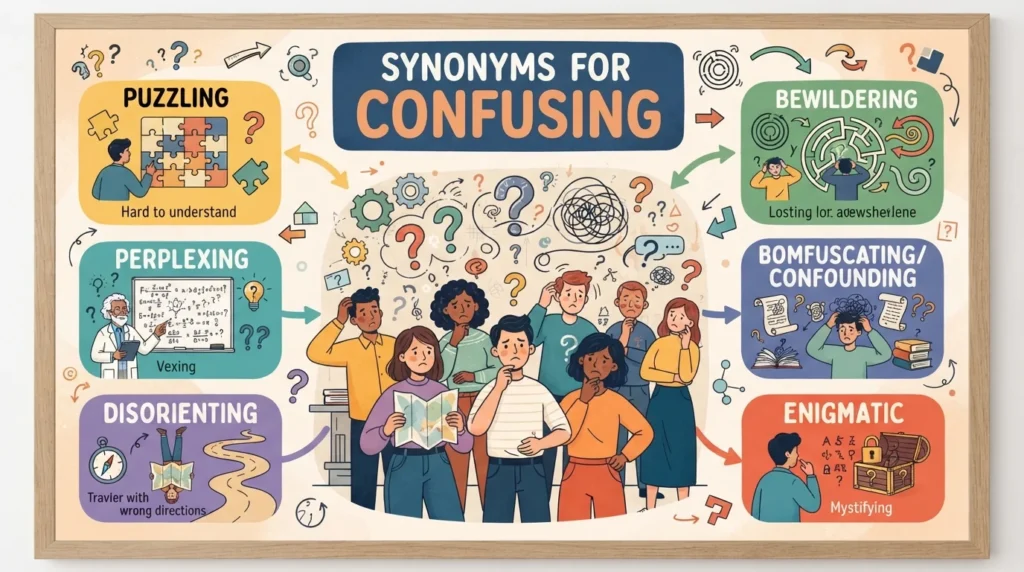
Quick Synonym List
Meaning | Alternatives |
|---|---|
Closest alternatives | Puzzling, perplexing, baffling, bewildering, mystifying |
Difficult to understand | Unclear, obscure, incomprehensible, unintelligible, hard to follow |
Complex or complicated | Complicated, complex, intricate, convoluted, labyrinthine |
Open to interpretation | Ambiguous, vague, equivocal, open-ended |
Poorly organized | Disorganized, muddled, jumbled, incoherent, rambling |
Likely to create a false impression | Misleading, deceptive, ambiguous |
Surprising or unexpected | Baffling, puzzling, inexplicable, mysterious |
Informal alternatives | Hard to follow, all over the place, a head-scratcher, mind-boggling |
Some of these are direct synonyms; others describe a particular cause or effect of confusion. For example, a complex explanation can still be clear, while a simple sentence can be confusing because its meaning is ambiguous.
What Does “Confusing” Mean?
Confusing is an adjective describing something that is difficult to understand, interpret, follow, or make sense of.
It can refer to instructions, explanations, information, situations, behavior, questions, and experiences.
Compare:
“The instructions are confusing.” — They are difficult to understand or follow.
“His response was confusing.” — Its meaning or intention was unclear.
“The results are confusing.” — They are difficult to interpret or explain.
“The website is confusing.” — Its organization or navigation makes it difficult to use.
The most precise synonym identifies why something causes confusion.
The Best Synonyms for Confusing
1. Puzzling
Meaning: Difficult to understand or explain.
Tone: Neutral.
Best for: Situations, behavior, questions, results, and unexpected events.
Example: The sudden change in the schedule was puzzling.
How it differs: Puzzling often suggests that something raises questions or requires thought rather than being poorly explained.
2. Perplexing
Meaning: Difficult to understand, especially when the explanation or solution is not obvious.
Tone: Neutral to formal.
Best for: Problems, situations, behavior, and unexpected results.
Example: The researchers encountered a perplexing pattern in the data.
How it differs: Perplexing can suggest deeper or more sustained confusion than puzzling.
3. Baffling
Meaning: Extremely difficult to understand or explain.
Tone: Neutral to emphatic.
Best for: Mysteries, behavior, results, decisions, and unexpected events.
Example: The equipment’s sudden failure was baffling to the engineers.
Watch out: Baffling is stronger than confusing. Use it when the difficulty is substantial.
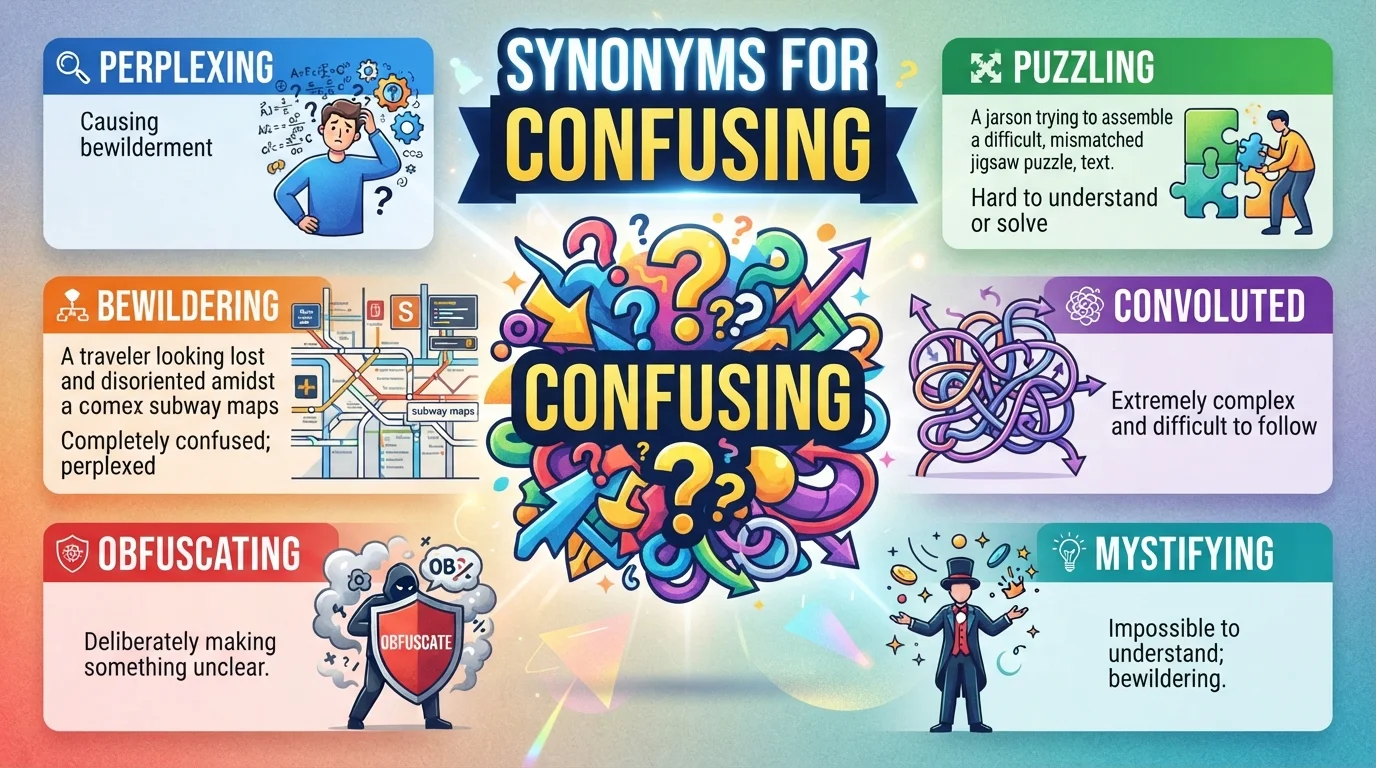
4. Bewildering
Meaning: Causing intense confusion or making someone feel disoriented.
Tone: Neutral to expressive.
Best for: Complex situations, unfamiliar environments, sudden changes, and overwhelming experiences.
Example: The airport’s numerous signs and corridors were bewildering to first-time visitors.
How it differs: Bewildering often emphasizes the experience of being overwhelmed or unable to find one’s bearings.
5. Unclear
Meaning: Not expressed, explained, or understood clearly.
Tone: Neutral or professional.
Best for: Instructions, explanations, communication, requirements, and workplace writing.
Example: The instructions were unclear about when the assignment was due.
How it differs: Unclear is less emotionally charged than confusing and often identifies a communication problem.
6. Ambiguous
Meaning: Having more than one possible interpretation.
Tone: Neutral, professional, or academic.
Best for: Statements, instructions, language, policies, and agreements.
Example: The sentence was ambiguous because it could refer to either employee.
Watch out: Something is not necessarily ambiguous simply because it is difficult to understand. Ambiguity specifically involves multiple possible meanings.
7. Complicated
Meaning: Involving many interconnected parts, details, or steps.
Tone: Neutral.
Best for: Procedures, systems, instructions, problems, and technical explanations.
Example: The registration process was unnecessarily complicated.
How it differs: Complicated describes complexity. Something can be complicated without being confusing if it is explained clearly.
8. Convoluted
Meaning: Excessively complicated, indirect, or difficult to follow.
Tone: Neutral to critical.
Best for: Explanations, arguments, procedures, writing, and organizational systems.
Example: The report contained a convoluted explanation of a relatively simple issue.
How it differs: Convoluted often suggests that unnecessary complexity makes something harder to understand.
9. Vague
Meaning: Not expressed with enough detail or precision.
Tone: Neutral to critical.
Best for: Instructions, promises, descriptions, answers, and plans.
Example: The manager gave vague instructions about the project’s next steps.
Watch out: Vague means insufficiently specific. Ambiguous means open to more than one interpretation.
10. Misleading
Meaning: Likely to create an incorrect impression or understanding.
Tone: Critical or professional.
Best for: Information, statistics, advertising, explanations, and statements.
Example: The chart was misleading because its vertical axis did not begin at zero.
Watch out: Misleading suggests that the information may cause an incorrect conclusion. It does not necessarily mean that the person presenting it intended to deceive.
11. Incoherent
Meaning: Lacking a clear, logical connection between ideas or parts.
Tone: Formal or critical.
Best for: Arguments, explanations, writing, and presentations.
Example: The report was incoherent because its conclusions did not follow from the evidence presented.
How it differs: Incoherent identifies a lack of logical organization rather than general difficulty.
12. Muddled
Meaning: Disorganized, unclear, or mixed up.
Tone: Conversational to neutral.
Best for: Explanations, thoughts, instructions, and accounts of events.
Example: His muddled explanation left everyone unsure about the next step.
How it differs: Muddled emphasizes poor organization or a failure to distinguish ideas clearly.
13. Obscure
Meaning: Difficult to understand, often because the meaning is not immediately apparent.
Tone: Formal or literary.
Best for: Language, references, explanations, and technical writing.
Example: The document contained several obscure technical terms.
Watch out: Obscure can also mean little-known. An obscure author is not necessarily a confusing author.
14. Incomprehensible
Meaning: Impossible or extremely difficult to understand.
Tone: Formal or emphatic.
Best for: Explanations, speech, writing, and unfamiliar information.
Example: The instructions were incomprehensible to someone without technical training.
How it differs: Incomprehensible is much stronger than confusing.
15. Hard to Follow
Meaning: Difficult to understand as information, events, or ideas develop.
Tone: Conversational or neutral.
Best for: Presentations, stories, explanations, instructions, and conversations.
Example: The presentation was hard to follow because the speaker kept switching topics.
How it differs: This phrase is especially useful when the sequence or organization creates the confusion.
Synonyms for Confusing by Context
Confusing Instructions
For instructions that are difficult to understand or follow, use unclear, ambiguous, vague, complicated, poorly organized, or hard to follow.
Alternative | When to use it | Example |
|---|---|---|
Unclear | The instructions were unclear. | |
Ambiguous | There are multiple possible interpretations | The deadline instructions were ambiguous. |
Vague | Important details are missing | The directions were too vague. |
Complicated | There are many steps or requirements | The application process is complicated. |
Disorganized | The steps are presented in a poor order | The instructions were disorganized. |
Confusing Situation
A situation may be puzzling because its cause is unknown, bewildering because too many things are happening, or chaotic because events lack order.
For example:
The sudden changes created a confusing situation.
A more precise alternative is:
The sudden changes created a bewildering situation.
This version emphasizes how overwhelming the changes felt.
Confusing Explanation
Useful alternatives include unclear, convoluted, muddled, rambling, incoherent, and hard to follow.
A convoluted explanation contains excessive complexity. A rambling explanation wanders between topics, while an incoherent explanation lacks logical connections.
Confusing Feelings or Behavior
When someone’s behavior is difficult to interpret, use puzzling, perplexing, baffling, inconsistent, contradictory, or mixed.
For example, mixed signals describes communication that suggests conflicting intentions. Contradictory behavior identifies actions that appear inconsistent with one another.
Confusing Information or Data
In academic, scientific, and professional writing, more specific alternatives include ambiguous, inconsistent, contradictory, inconclusive, difficult to interpret, and poorly presented.
These are not interchangeable. Inconclusive results do not establish a clear finding, while contradictory results conflict with one another.
Confusing vs. Puzzling vs. Complicated vs. Ambiguous
The general term
The instructions were confusing, and I wasn’t sure what to do.
Something is difficult to explain
The unexpected test results were puzzling.
Something has many interconnected parts
The application requires a complicated approval process.
Something has multiple possible meanings
The policy’s wording was ambiguous.
True Synonyms vs. Related Alternatives
Alternative | Relationship | Can replace confusing? | Best context |
|---|---|---|---|
Puzzling | Often | Unexplained situations | |
Perplexing | Close synonym | Often | Difficult problems |
Baffling | Stronger synonym | Often, if justified | Mysteries |
Bewildering | Stronger synonym | Sometimes | Overwhelming situations |
Unclear | Near synonym | Often | Communication |
Ambiguous | Contextual alternative | Only for multiple meanings | Language and instructions |
Complicated | Related concept | Sometimes | Processes and systems |
Convoluted | Contextual alternative | Often for explanations | Excessive complexity |
Vague | Related concept | Sometimes | Insufficient detail |
Misleading | Related concept | Only for false impressions | Information and claims |
Incoherent | Contextual alternative | Sometimes | Disconnected ideas |
Muddled | Near synonym | Often | Disorganized explanations |
Incomprehensible | Stronger alternative | Only for extreme difficulty | Speech and writing |
Hard to follow | Close phrase-level alternative | Often | Stories and presentations |
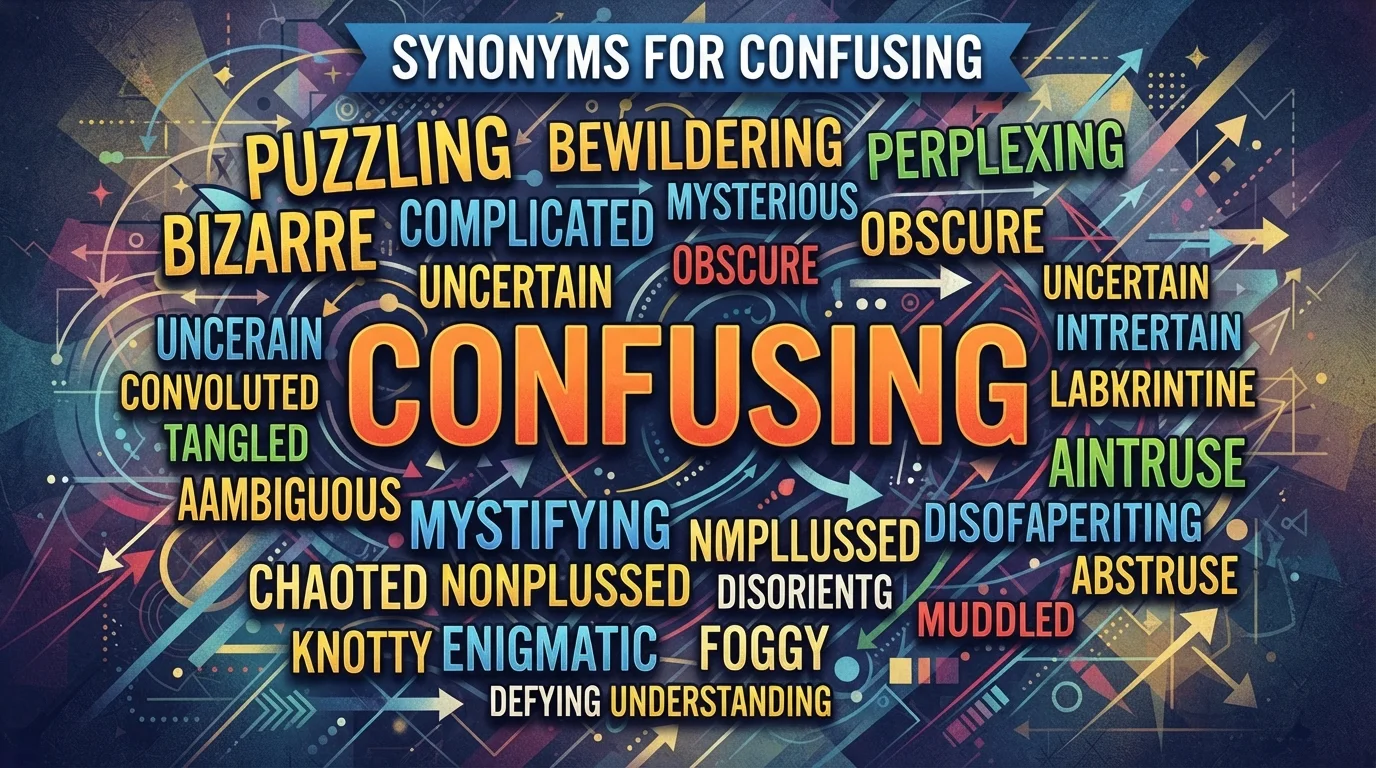
How to Choose the Right Alternative
What is causing the confusion?
Suggested alternative
Puzzling
The sudden change was puzzling.
10 Sentence Transformations
Original | Better alternative | Why |
|---|---|---|
The instructions are confusing. | The instructions are unclear. | Identifies a lack of clarity. |
His behavior is confusing. | His behavior is puzzling. | Emphasizes difficulty understanding his actions. |
The results are confusing. | The results are difficult to interpret. | More precise in research writing. |
The process is confusing. | The process is unnecessarily complicated. | Identifies excessive complexity. |
Her statement was confusing. | Her statement was ambiguous. | Indicates multiple possible meanings. |
The presentation was confusing. | The presentation was hard to follow. | Emphasizes poor sequencing or delivery. |
The explanation was confusing. | The explanation was convoluted. | Highlights unnecessary complexity. |
The directions were confusing. | The directions were vague. | Identifies missing details. |
The conflicting messages were confusing. | The conflicting messages were bewildering. | Emphasizes intense confusion. |
The advertisement was confusing. | The advertisement was misleading. | Specifies that it created a false impression. |
Grammar and Usage
Confusing is an adjective derived from the verb confuse. Its related forms include confused, confusion, and confusingly.
The difference between confusing and confused is especially important:
Confusing describes something that causes confusion: “The explanation is confusing.”
Confused describes someone who experiences confusion: “I’m confused by the explanation.”
Common combinations include confusing instructions, confusing situation, confusing explanation, confusing message, confusing results, and confusing terminology.
The comparative and superlative forms are more confusing and most confusing, rather than confusinger and confusingest.
Common Mistakes
Confusing confusing with confused. The instructions are confusing; the person reading them may be confused.
Treating complicated as inherently confusing. A complicated process can still be explained clearly.
Using ambiguous for every unclear statement. Ambiguity requires multiple possible interpretations.
Using misleading when information is merely difficult. Misleading information creates a false impression.
Overusing baffling or incomprehensible. These words suggest much greater difficulty than ordinary confusion.
Confusing vague with ambiguous. Vague language lacks specificity; ambiguous language permits different interpretations.
Using incoherent for every poorly written explanation. Incoherence specifically concerns a lack of logical connection.
Replacing confusing simply to sound more formal. A longer or more technical alternative is useful only when it improves precision.
When “Confusing” Is the Better Word
Confusing is often the clearest choice when you know something is difficult to understand but do not want to specify the cause.
For example, “The website’s navigation is confusing” communicates a usability problem without assuming that the issue is excessive complexity, ambiguous labels, or poor organization.
In everyday conversation, “That’s confusing” is also more natural than unnecessarily strong expressions such as “That’s utterly incomprehensible.”