
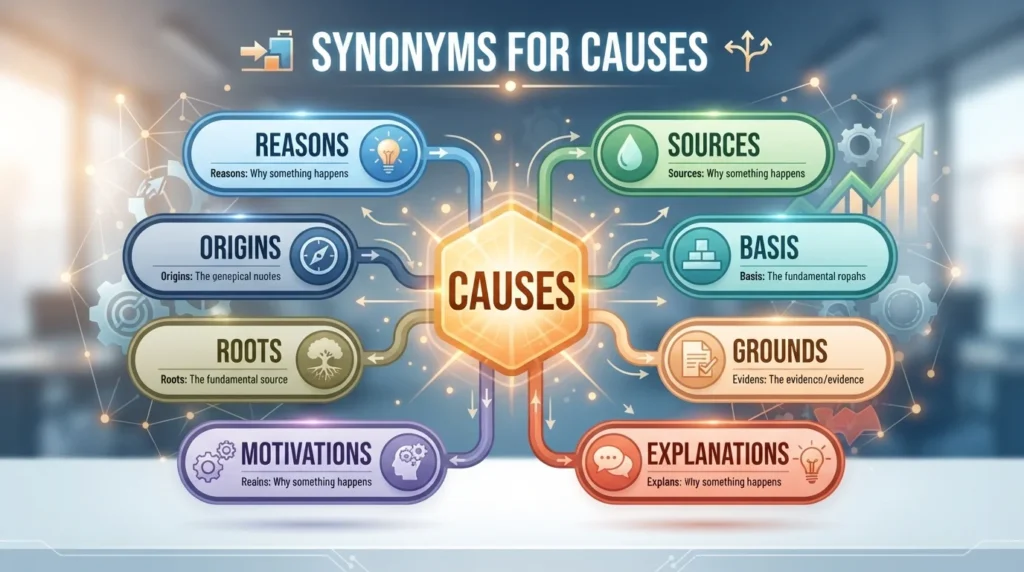
Quick Synonym List
The word causes can be either a plural noun or a verb, so its alternatives fall into two distinct groups.
Meaning | |
|---|---|
General reasons | Reasons, explanations, factors, grounds |
Origins of a problem | Roots, root causes, sources, origins |
Immediate causes | Triggers, catalysts, precipitating factors |
Contributing causes | Contributing factors, influences, conditions, drivers |
Personal reasons | Motives, motivations, intentions |
Scientific causes | Causal factors, mechanisms, determinants, antecedents |
Causes as a verb | Produces, creates, generates, brings about, leads to |
Starts an event | Triggers, initiates, sets off, sparks, provokes |
Produces a negative result | Inflicts, induces, brings on, gives rise to |
Contributes to an outcome | Contributes to, influences, plays a part in, helps bring about |
Social or charitable causes | Missions, movements, campaigns, initiatives |
The most important distinction
Causes as a noun
“The causes of the problem are unclear.”
Reasons, factors, sources
Causes as a verb
“The problem causes delays.”
Creates, produces, leads to
What Does “Causes” Mean?
Causes has three important uses in English.
As a plural noun, it refers to the reasons, events, conditions, or circumstances responsible for something happening.
For example:
Researchers are investigating the causes of the equipment failure.
As a verb, it is the third-person singular present form of cause. It means to make something happen or bring about a particular result.
Heavy rainfall causes flooding in low-lying areas.
As a plural noun referring to goals or movements, it describes issues or principles that people support.
She volunteers for several environmental causes.
These meanings require different synonyms. Reasons can replace causes in some noun phrases, but it cannot replace the verb in “Smoking causes health problems.” Similarly, campaigns may describe charitable causes but not the causes of an accident.
1. Synonyms for Causes as a Noun
Reasons
Meaning: Explanations for why something happened or why someone acted.
Tone: Neutral.
Best for: Everyday explanations, decisions, behavior, and general writing.
Example: The manager explained the reasons for the delay.
Reasons is a natural alternative when discussing explanations or motives. However, a reason someone gives for an action is not necessarily its actual cause.
Factors
Meaning: Circumstances or elements that contribute to an outcome.
Tone: Neutral to academic.
Best for: Research, business, economics, health, and complex problems.
Example: Several factors contributed to the company’s declining sales.
Factors is useful when an outcome has multiple influences. It is less definitive than causes because a factor may be associated with an outcome without independently producing it.
Sources
Meaning: Places, circumstances, or things from which something originates.
Tone: Neutral or professional.
Best for: Problems, stress, pollution, information, and technical issues.
Example: Investigators identified several possible sources of the contamination.
A source identifies where something comes from. It does not always explain the complete causal process.
Origins
Meaning: The beginnings or earliest points from which something develops.
Tone: Neutral to formal.
Best for: Historical events, ideas, diseases, traditions, and long-term problems.
Example: Historians continue to study the origins of the conflict.
Origins emphasizes where something began, while causes emphasizes why it happened.
Roots
Meaning: The fundamental or underlying sources of a problem or situation.
Tone: Neutral or figurative.
Best for: Social problems, disagreements, organizational difficulties, and long-standing issues.
Example: The organization examined the roots of employee dissatisfaction.
Roots suggests that a problem has deeper origins than its immediate symptoms.
Triggers
Meaning: Events or conditions that initiate a particular reaction or process.
Tone: Neutral or technical.
Best for: Sudden events, reactions, technical failures, and behavioral responses.
Example: Investigators examined the triggers of the unexpected shutdown.
A trigger starts an event but may not explain all the conditions that made the event possible.
Drivers
Meaning: Forces or factors that strongly influence change or development.
Tone: Professional or academic.
Best for: Economics, business, technology, social trends, and organizational change.
Example: Innovation and customer demand are important drivers of market growth.
Drivers is particularly useful when describing forces behind an ongoing trend rather than a single event.
Determinants
Meaning: Factors that influence or help determine a particular result.
Tone: Academic or technical.
Best for: Statistics, economics, public health, and social science.
Example: The study examined several determinants of educational achievement.
Determinants is more technical than causes. In research, the term does not automatically establish a proven causal relationship.
Motives
Meaning: Reasons that lead someone to act in a particular way.
Tone: Neutral to formal.
Best for: Human behavior, personal decisions, crime fiction, and investigations.
Example: Investigators considered several possible motives for the theft.
A motive concerns someone’s intention or reason for acting. It is not a suitable replacement for the physical causes of an earthquake.
Explanations
Meaning: Accounts or statements that clarify why something happened.
Tone: Neutral.
Best for: General communication, academic discussion, investigations, and problem-solving.
Example: The engineers proposed several explanations for the system failure.
An explanation describes a possible cause or process. It is not necessarily the cause itself.
Catalysts
Meaning: Things that accelerate or stimulate change.
Tone: Neutral to formal; technical in chemistry.
Best for: Social change, business transformation, historical developments, and chemical processes.
Example: The unexpected announcement became a catalyst for organizational change.
In figurative use, a catalyst helps bring about or accelerate change. In chemistry, it has a specific definition and is not simply another word for cause.
Underlying Conditions
Meaning: Existing circumstances that make an event or outcome more likely.
Tone: Professional or academic.
Best for: Complex systems, risk analysis, organizational problems, and research.
Example: The investigation identified underlying conditions that increased the risk of failure.
This phrase is particularly helpful when distinguishing deeper contributing circumstances from an immediate trigger.
2. Synonyms for Causes as a Verb
When causes functions as a verb, it describes something producing an event, condition, or result. The following alternatives differ in how directly they express causation.
Produces
Meaning: Brings something into existence or generates a particular result.
Tone: Neutral or technical.
Example: The chemical reaction produces heat.
Produces is particularly natural for measurable outputs, scientific processes, manufacturing, and predictable results.
Creates
Meaning: Makes something exist or brings about a new situation.
Tone: Neutral.
Example: Poor communication creates unnecessary problems.
Creates works for situations, opportunities, difficulties, and physical products. It often sounds more natural than causes in everyday business writing.
Leads To
Meaning: Results in or contributes to a later outcome.
Tone: Neutral.
Example: Poor maintenance can lead to expensive repairs.
Leads to often describes a process or chain of events. It does not always imply that the first event is the only cause of the outcome.
Brings About
Meaning: Makes an event, change, or result happen.
Tone: Neutral to formal.
Example: The new management approach brought about significant improvements.
This phrase is especially useful for major changes, reforms, developments, and broader outcomes.
Triggers
Meaning: Starts an event, reaction, or process.
Tone: Neutral to technical.
Example: A sudden temperature change triggers the alarm.
Triggers emphasizes the event that starts a process. It may be inappropriate when discussing a gradual influence or a distant underlying cause.
Generates
Meaning: Produces or creates something, often as an output of a process.
Tone: Professional or technical.
Example: The updated system generates detailed performance reports.
Use generates for energy, data, revenue, interest, results, and similar outputs.
Results In
Meaning: Has a particular consequence or outcome.
Tone: Neutral to formal.
Example: Insufficient preparation often results in avoidable mistakes.
Results in focuses on the outcome of a process or action. The grammatical structure is something results in something else.
Provokes
Meaning: Causes a reaction, response, or strong feeling.
Tone: Neutral to critical.
Example: The announcement provoked widespread criticism.
Provokes is especially natural for emotional, political, or social reactions. It can suggest a strong or unwelcome response.
Induces
Meaning: Brings about a particular physical, psychological, or other effect.
Tone: Formal or technical.
Example: The medication may induce drowsiness.
Induces is common in scientific and medical writing. It can also describe deliberately encouraging a person to do something, but that is a different grammatical use.
Gives Rise To
Meaning: Causes something to emerge or develop.
Tone: Formal.
Example: Rapid growth can give rise to new organizational challenges.
This phrase is useful in analytical writing, particularly when one situation creates another over time.
Contributes To
Meaning: Plays a part in producing an outcome.
Tone: Neutral to academic.
Example: Inadequate training contributes to workplace errors.
Contributes to is especially important when several factors are involved and the evidence does not establish a single sufficient cause.
Sparks
Meaning: Suddenly initiates an event, discussion, or reaction.
Tone: Neutral to expressive.
Example: The discovery sparked renewed interest in the subject.
Sparks is a vivid alternative for the beginning of debates, ideas, controversies, interest, and change.
3. Synonyms for Charitable and Social Causes
Causes can also refer to principles, goals, or issues that individuals and organizations support.

Mission
An organization’s central purpose or long-term goal.
The nonprofit’s mission is to protect local wildlife.
A planned effort to address a particular issue.
The organization launched an initiative to reduce food waste.

Campaign
An organized series of activities intended to achieve a particular goal.
The charity organized a fundraising campaign.
Other useful alternatives include movement, effort, project, advocacy initiative, and charitable endeavor. A movement generally involves people working collectively toward a broader social objective, while a campaign is often a more specific, organized effort.
4. Causes vs. Reasons vs. Factors vs. Triggers
These four terms are closely related but communicate different aspects of causation.
Word | Main meaning | Example | Important distinction |
|---|---|---|---|
Causes | What produces an outcome | The causes of the fire remain unknown. | General causal relationship |
Reasons | Why something happens or someone acts | She explained her reasons for resigning. | Can refer to motives or explanations |
Factors | Elements that influence an outcome | Several factors affect housing costs. | May be one of several influences |
Triggers | Events that initiate a process | The sensor triggers the alarm. | Emphasizes the immediate starting event |
One event can involve several kinds of causes
Illustrative example: a machine overheats.
Underlying condition
Inadequate cooling capacity
Contributing factor
High ambient temperature
Immediate trigger
A sudden increase in workload
Outcome
The machine overheats
5. Synonyms for Causes by Writing Context
Academic and scientific writing
Useful alternatives include causal factors, determinants, mechanisms, antecedents, contributing factors, produces, and results in.
Choose the term according to the strength of the evidence. For example, a study finding that two variables are associated should not automatically describe one as causing the other.
“Several factors were associated with the outcome” is more accurate when the research has not established causation.
Professional and business writing
Useful alternatives include drivers, sources, contributing factors, generates, creates, brings about, and leads to.
For example, “Several factors caused the decline in productivity” could become “Several factors contributed to the decline in productivity” if no single cause has been established.
Everyday conversation
Reasons, makes, creates, brings on, sets off, and leads to are generally natural.
Instead of “The noise causes me stress,” you might say “The noise stresses me out” in informal conversation. This is a sentence-level rewrite rather than a direct synonym substitution.
Technical writing
Use produces for outputs, triggers for initiating events, generates for data or energy, and results in for consequences.
Technical writing benefits from identifying the precise relationship between an input, a process, and its outcome.
6. How to Choose the Right Synonym
What meaning of “causes” do you need?
Suitable alternative
Reasons
The report outlines the reasons for the delay.7. Ten Sentence Transformations
Original | Better alternative | Why |
|---|---|---|
The causes of the delay are unclear. | The reasons for the delay are unclear. | Natural general explanation |
Several causes affect productivity. | Several factors affect productivity. | Recognizes multiple influences |
The causes of the conflict are complex. | The roots of the conflict are complex. | Emphasizes deeper origins |
The alarm causes an immediate response. | The alarm triggers an immediate response. | Identifies an initiating event |
The equipment causes excessive noise. | The equipment produces excessive noise. | Describes a physical output |
Poor planning causes delays. | Poor planning leads to delays. | Describes a consequence |
The change causes additional expenses. | The change generates additional expenses. | Suitable for business writing |
The announcement causes concern. | The announcement provokes concern. | Emphasizes a reaction |
Several conditions cause the problem. | Several conditions contribute to the problem. | Avoids overstating individual causation |
She supports several important causes. | She supports several charitable initiatives. | Specifies organized efforts |
8. Grammar and Natural Usage
The word causes has two grammatical functions.
As a plural noun, it refers to more than one cause:
The causes of the accident are under investigation.
As a verb, it agrees with a third-person singular subject in the simple present:
Excessive heat causes the material to expand.
Common grammatical patterns include cause of, cause for, cause something, cause someone to do something, and be caused by.
Compare “The storm caused damage” with “The damage was caused by the storm.” Both express the same basic causal relationship but emphasize different parts of the sentence.
Be careful when substituting results in and results from. “The storm results in flooding” identifies the storm as the cause, whereas “Flooding results from the storm” identifies flooding as the outcome.
9. Common Mistakes
Treating reasons and causes as identical. A person’s stated reason for acting may differ from the actual cause of an event.
Using triggers for every cause. A trigger is generally an initiating event, not necessarily an underlying condition.
Confusing correlation with causation. Two things occurring together does not establish that one causes the other.
Using factors as proof of causation. A factor may influence or be associated with an outcome without independently causing it.
Replacing causes with motives in scientific writing. Motives describe reasons for intentional behavior, not ordinary physical processes.
Using catalysts too broadly. A catalyst usually initiates or accelerates change and has a specialized meaning in chemistry.
Confusing results in with results from. These phrases reverse the grammatical direction of the causal relationship.
Treating social causes as causal explanations. A charitable cause is a goal or issue people support, not a reason an event happened.
10. When “Causes” Is the Better Word
Causes is often the clearest choice when a direct causal relationship is intended and adequately supported.
For example, “The chemical reaction causes a temperature increase” may be clearer than a more elaborate alternative. Similarly, “The causes of the accident remain unknown” is straightforward and avoids suggesting that investigators have already identified particular contributing factors or triggers.
Do not replace causes merely to make a sentence sound more academic. A more specialized word is useful only when it accurately identifies the relationship being described.