
Quick Answer
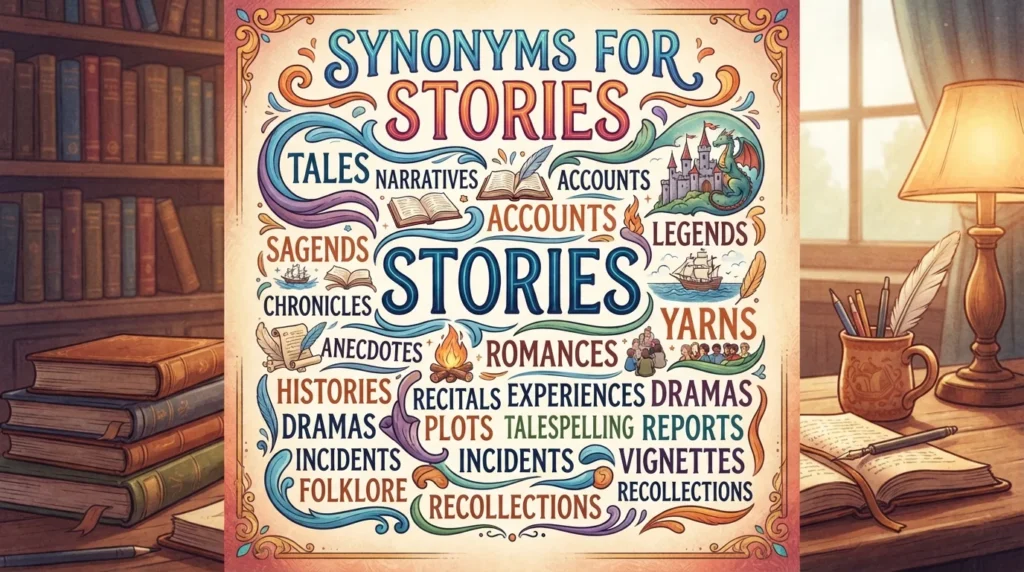
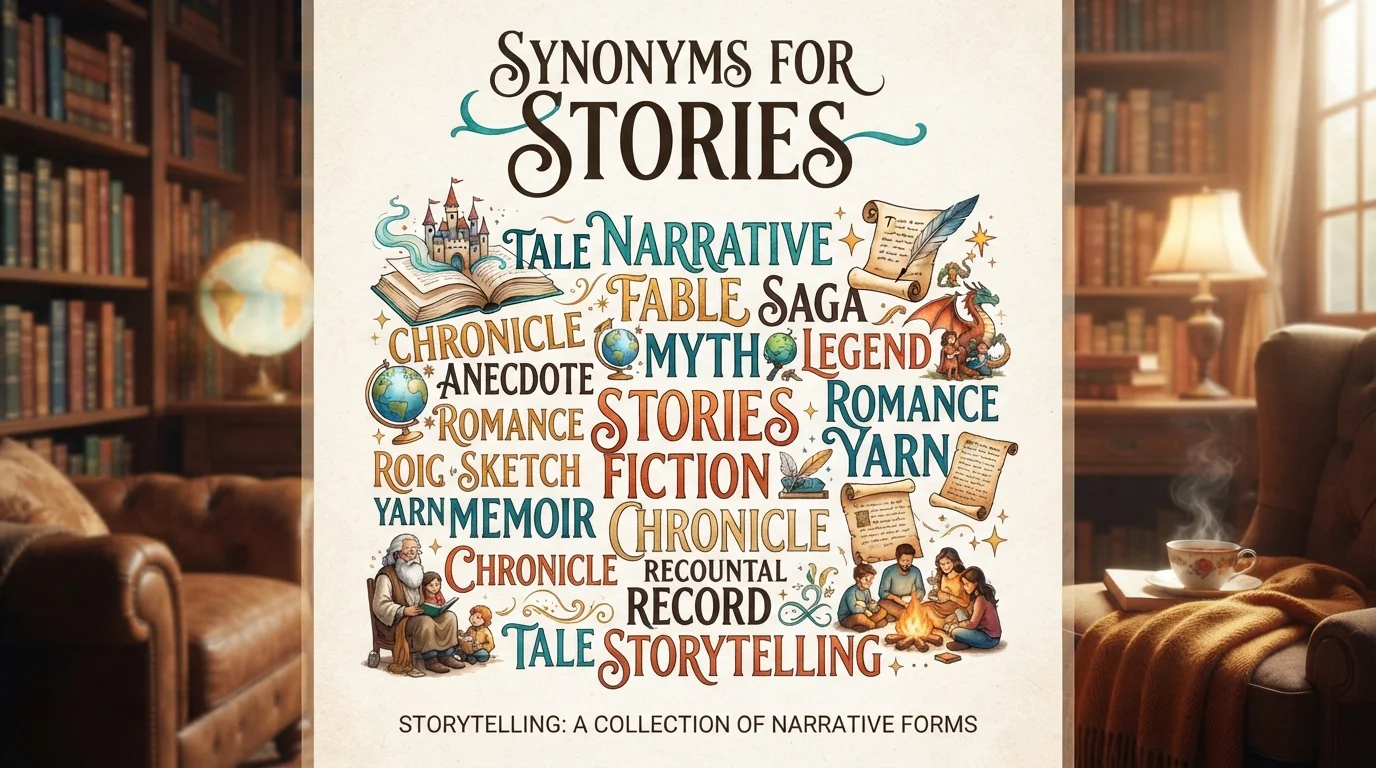
Common synonyms for stories include tales, narratives, accounts, anecdotes, chronicles, reports, recollections, histories, sagas, legends, fables, episodes, incidents, experiences, memoirs, case studies, narratives, fiction, plots, yarns, rumors, hearsay, and accounts. The right choice depends on whether you mean fiction, real events, news, personal experiences, traditional tales, or building levels.
Quick Reference: Synonyms for Stories
| Alternative | Main meaning | Tone |
|---|---|---|
| Tales | Narratives, often entertaining | Neutral/literary |
| Narratives | Structured accounts of events | Formal |
| Accounts | Descriptions of events or experiences | Neutral/formal |
| Anecdotes | Short, interesting real-life stories | Neutral |
| Chronicles | Records of events over time | Formal/literary |
| Histories | Accounts of past events | Formal |
| Reports | Factual accounts or descriptions | Professional |
| Recollections | Memories of past experiences | Warm/literary |
| Experiences | Things that happened to someone | Neutral |
| Incidents | Individual events | Neutral |
| Episodes | Individual events within a larger sequence | Neutral |
| Memoirs | Personal accounts of one’s life | Literary |
| Legends | Traditional or famous stories | Literary |
| Fables | Short stories with a moral | Literary |
| Myths | Traditional stories explaining beliefs/origins | Literary |
| Sagas | Long, dramatic stories or histories | Literary |
| Yarns | Long, amusing or exaggerated stories | Informal |
| Fiction | Invented narratives | Neutral/literary |
| Novellas | Shorter works of fiction | Literary |
| Novels | Long works of fiction | Literary |
| Plots | Sequences of events in a story | Literary |
| Rumors | Unverified claims circulating among people | Negative/neutral |
| Hearsay | Information heard from others rather than directly known | Formal/legal |
| Claims | Assertions presented as true | Neutral |
| Accounts | Versions or descriptions of events | Neutral |
| Case studies | Detailed accounts of specific cases | Academic/professional |
| Testimonials | Personal statements supporting a person/product/experience | Professional |
| Reports | Organized descriptions of findings/events | Formal |
| Records | Documented information about past events | Formal |
| Histories | Accounts of past events or development | Formal |
| Chronicles | Historical records arranged over time | Formal/literary |
| Building levels | Floors of a building | Technical/general |
| Floors | Horizontal levels of a building | Neutral |
| Levels | Vertical divisions of a structure | Neutral |
| Storeys | British spelling for building floors | British English |
Note: These are not interchangeable in every context. Story, account, report, rumor, and novel can refer to very different things.
What Does “Stories” Mean?
Stories is the plural of story, and the word has several meanings.
The most common meaning is a narrative describing a series of events, either real or imagined.
She told us several funny stories about college.
But stories can also mean:
- Fictional narratives
- Real accounts of events
- Personal experiences
- Short anecdotes
- Historical records
- Traditional tales, myths, or legends
- News reports
- Rumors or unverified claims
- Plots in books, films, or plays
- Floors or levels of a building
Because these meanings are different, choosing the right synonym requires context.
1. Stories Meaning “Tales”
Tales
Tales is one of the closest and most natural alternatives to stories, especially when the narratives are entertaining, traditional, unusual, or imaginative.
He told stories about his travels.
He told tales about his travels.
Tales can sound slightly more literary than stories.
It also appears in expressions such as:
- fairy tales
- folk tales
- cautionary tales
- traditional tales
- tall tales
Best for:
- entertainment
- folklore
- children’s literature
- traditional narratives
- imaginative storytelling
2. Stories Meaning “Narratives”
Narratives
Narratives are accounts that present events in a connected sequence.
The book contains several stories about migration.
The book contains several narratives about migration.
Narrative sounds more formal and analytical than story.
It is common in:
- academic writing
- literary criticism
- journalism
- history
- social sciences
- film criticism
Important distinction
A story can be casual and conversational.
A narrative often emphasizes the structure or presentation of events.
3. Stories Meaning “Accounts”
Accounts
An account is a description or version of something that happened.
She shared stories of her childhood.
She shared accounts of her childhood.
Account works especially well when factual accuracy or a person’s version of events matters.
Common phrases
- eyewitness accounts
- personal accounts
- first-hand accounts
- detailed accounts
- written accounts
- historical accounts
- firsthand accounts
An account does not have to be entertaining. It can simply document what happened.
4. Stories Meaning “Anecdotes”
Anecdotes
An anecdote is a short, often interesting or amusing story about a real person or event.
He shared several stories from his career.
He shared several anecdotes from his career.
This is a particularly good choice when the stories are:
- short
- personal
- memorable
- amusing
- based on real experiences
Example
During the presentation, she told an amusing anecdote about her first job.
Anecdote is more specific than story.
5. Stories Meaning “Personal Experiences”
Sometimes someone says:
She shared stories about her childhood.
The intended meaning may simply be experiences or memories.
Experiences
Experiences are things a person has lived through or encountered.
He shared stories from his travels.
He shared experiences from his travels.
This changes the emphasis. Experiences focuses on what happened to the person rather than how the events were narrated.
Recollections
Recollections are memories of past experiences.
She shared stories of her childhood.
She shared recollections of her childhood.
This is more reflective and literary.
Memories
Memories focuses on remembered experiences rather than the narrative itself.
He told stories about his grandfather.
He shared memories of his grandfather.
The second version sounds more personal and emotional.
6. Stories Meaning “Historical Records”
Histories
A history is an account of past events, especially the development of a person, place, group, or subject.
The museum contains stories of the region.
The museum contains histories of the region.
History is more specifically concerned with the past and is often more factual or systematic.
Chronicles
Chronicles are records of events arranged roughly in the order in which they occurred.
The book tells stories of the kingdom.
The book chronicles the history of the kingdom.
As a noun, chronicles can also refer to historical narratives.
Best for:
- historical writing
- long periods of time
- records of events
- literary descriptions of history
7. Stories Meaning “News Reports”
In journalism, story has a specific meaning: a report about an event, issue, person, or development.
For example:
The newspaper published several stories about the election.
Possible alternatives include:
- reports
- articles
- reports
- pieces
- news reports
- features
- coverage
Reports
Reports are factual presentations of information or events.
The newspaper published several stories about the accident.
The newspaper published several reports about the accident.
Report is often more factual and less narrative-focused.
Articles
An article is a written piece published in a newspaper, magazine, journal, or website.
She writes stories for the newspaper.
She writes articles for the newspaper.
These are not always interchangeable because an article can be an opinion piece, review, analysis, or other type of content.
Features
A feature is a longer, more developed journalistic piece, often emphasizing people, context, or storytelling.
8. Stories Meaning “Rumors”
Sometimes stories refers to claims that may not be true.
I’ve heard stories about what happened.
Depending on context, alternatives include:
- rumors
- hearsay
- gossip
- claims
- reports
- allegations
- speculation
Rumors
A rumor is information circulating without confirmed evidence.
There were stories that the company would close.
There were rumors that the company would close.
This is a useful replacement when the original stories refers to unverified information.
Hearsay
Hearsay means information learned from another person rather than directly observed or known.
It is particularly common in legal contexts.
Gossip
Gossip usually refers to informal talk about other people’s private lives or behavior.
It often carries a negative or disapproving sense.
Don’t automatically use “gossip”
A story can be unverified without being gossip.
9. Stories Meaning “Fiction”
When stories refers to invented narratives, more specific words may be appropriate.
Fiction
Fiction refers broadly to invented literary narratives.
She writes stories for children.
She writes fiction for children.
Novels
A novel is a relatively long fictional prose work.
A short story is not a novel, so these terms should not be treated as interchangeable.
Novellas
A novella is longer than a typical short story but shorter than a full-length novel.
Short stories
If the original simply says stories, short stories is more precise only when the narratives are actually short works of fiction.
10. Stories Meaning “Traditional Narratives”
Different types of traditional stories have their own names.
Legends
Legends are traditional stories associated with historical or cultural figures, places, or events, often containing elements that may not be historically verified.
Myths
Myths are traditional stories associated with cultural, religious, or origin traditions.
Fables
Fables are usually short stories that teach a moral lesson, often using animals as characters.
Sagas
Sagas are long stories involving extended events, families, generations, or dramatic adventures.
Fairy tales
Fairy tales are traditional fictional stories often involving magical or supernatural elements.
Do not use these words as generic synonyms unless the story actually belongs to that category.
11. Stories Meaning “Plots”
In literary or film analysis, story can refer to the sequence of events that make up a work.
Plot
A plot is the structured sequence of events in a narrative.
The movie has an interesting story.
The movie has an interesting plot.
This can work, but the emphasis changes.
Story = what happens.
Plot = how the events are arranged and connected as a narrative structure.
12. Stories Meaning “Building Levels”
There is another completely different meaning of stories.
The building has twenty stories.
Here, stories means levels or floors of a building.
Floors
The building has twenty floors.
This is the most natural alternative in American English.
Levels
The building has twenty levels.
Levels can work, although floors is generally more natural for buildings.
Storeys
Storeys is the British spelling of stories when referring to floors of a building.
The building is five storeys high.
For American English, stories is the standard spelling.
Stories vs. Tales vs. Narratives
| Word | Main emphasis | Typical use |
|---|---|---|
| Stories | General narratives | Everyday and broad use |
| Tales | Entertaining, traditional, or imaginative narratives | Literature/folklore |
| Narratives | Structured presentation of events | Academic/literary |
| Accounts | Description or version of events | Journalism/history |
| Anecdotes | Short real-life stories | Speeches/conversation |
| Chronicles | Events recorded over time | History/literature |
Stories vs. Accounts
These words overlap, but their purpose differs.
Story often emphasizes the narrative.
Account emphasizes the description or report of what happened.
Compare:
She told us a funny story about her vacation.
The focus is entertainment.
She gave an account of the accident.
The focus is factual description.
Stories vs. Narratives
Narrative is often more analytical.
The book contains several stories about war.
The book contains several narratives about war.
The second sounds more appropriate in academic or literary analysis.
Use story when the writing is conversational or accessible. Use narrative when discussing structure, perspective, representation, or storytelling.
Stories vs. Anecdotes
Anecdote is narrower.
A story can be long or short, fictional or real.
An anecdote is usually:
- short
- personal
- based on a real event
- interesting or amusing
So:
He told stories about his career.
does not necessarily mean:
He told anecdotes about his career.
But if the stories were short personal incidents, anecdotes may be more precise.
Stories vs. Rumors
This distinction is especially important.
Story is neutral.
Rumor means an unverified claim.
I heard a story about the company.
This could be a true account, anecdote, or fictional tale.
I heard a rumor about the company.
This explicitly signals uncertainty about whether the claim is true.
Synonyms for Stories by Context
Everyday Conversation
Use:
- tales
- accounts
- experiences
- anecdotes
- memories
- recollections
- incidents
Example:
My grandfather told us stories about his childhood.
Possible alternatives:
My grandfather told us tales about his childhood.
My grandfather shared memories of his childhood.
My grandfather shared anecdotes from his childhood.
Each has a different emphasis.
Academic Writing
Useful choices include:
- narratives
- accounts
- histories
- case studies
- records
- reports
- recollections
- testimonies
Example:
The researchers collected stories from participants.
More formal:
The researchers collected accounts from participants.
Or:
The researchers analyzed participants’ narratives.
Journalism
Useful alternatives:
- reports
- articles
- pieces
- features
- coverage
- accounts
- reports
Example:
The newspaper published several stories about the event.
More specific:
The newspaper published several reports about the event.
Fiction and Literature
Use:
- tales
- narratives
- fiction
- plots
- sagas
- legends
- myths
- fables
- novellas
- short stories
Choose based on the actual form of the work.
Personal Writing
Useful choices:
- memories
- experiences
- recollections
- anecdotes
- accounts
- personal narratives
These can make the writing more specific and less repetitive.

Stronger and More Specific Alternatives
| Word/Phrase | Meaning | Tone | Direct replacement? |
|---|---|---|---|
| Tales | Narratives, often entertaining | Literary/neutral | Often |
| Narratives | Structured accounts | Formal | Often |
| Accounts | Descriptions of events | Neutral/formal | Often |
| Anecdotes | Short personal stories | Neutral | Sometimes |
| Reports | Factual accounts | Formal | Context-dependent |
| Recollections | Memories of events | Literary | Sometimes |
| Experiences | Events personally lived through | Neutral | Sometimes |
| Histories | Accounts of the past | Formal | Sometimes |
| Chronicles | Records of events over time | Formal/literary | Sometimes |
| Legends | Traditional cultural stories | Literary | Only specific cases |
| Myths | Traditional explanatory stories | Literary | Only specific cases |
| Fables | Stories with moral lessons | Literary | Only specific cases |
| Sagas | Long dramatic narratives | Literary | Only specific cases |
| Yarns | Amusing or exaggerated stories | Informal | Sometimes |
| Rumors | Unverified claims | Neutral/negative | Only when applicable |
| Hearsay | Secondhand information | Formal | Only when applicable |
| Fiction | Invented narratives | Neutral | Only for invented works |
| Plots | Narrative event structure | Literary | Sometimes |
| Floors | Building levels | Neutral | Only architectural sense |
| Levels | Vertical divisions | Neutral | Only architectural sense |
10 Sentence Transformations
1. Original
She told us stories about her childhood.
Alternative:
She shared memories of her childhood.
Why: Memories makes the personal and reflective aspect clearer.
2. Original
The researcher collected stories from participants.
Alternative:
The researcher collected personal accounts from participants.
Why: Accounts gives the sentence a more formal, research-oriented feel.
3. Original
He told funny stories about his travels.
Alternative:
He told amusing anecdotes about his travels.
Why: Anecdotes works well for short, memorable real-life incidents.
4. Original
The book contains stories about the war.
Alternative:
The book contains narratives about the war.
Why: Narratives is useful in academic or literary analysis.
5. Original
The newspaper published several stories about the incident.
Alternative:
The newspaper published several reports about the incident.
Why: Reports emphasizes factual journalism.
6. Original
The children listened to stories before bed.
Alternative:
The children listened to tales before bed.
Why: Tales gives the sentence a slightly more traditional or literary feel.
7. Original
I heard stories that the company was closing.
Alternative:
I heard rumors that the company was closing.
Why: Rumors clearly indicates that the information has not been confirmed.
8. Original
The film has a compelling story.
Alternative:
The film has a compelling plot.
Why: Plot specifically emphasizes the sequence and structure of events.
9. Original
The building has thirty stories.
Alternative:
The building has thirty floors.
Why: Floors is the natural American English term for levels of a building.
10. Original
The museum displays stories of the region’s past.
Alternative:
The museum displays historical accounts of the region’s past.
Why: Historical accounts clearly signals documented narratives about earlier events.
Common Collocations With “Stories”
Types of stories
- short stories
- fictional stories
- true stories
- real-life stories
- personal stories
- family stories
- success stories
- love stories
- children’s stories
- bedtime stories
- folk stories
- traditional stories
- historical stories
- adventure stories
- mystery stories
- horror stories
- inspirational stories
- cautionary stories
- funny stories
- sad stories
- remarkable stories
- compelling stories
- powerful stories
- moving stories
- memorable stories
Story-related phrases
- tell stories
- share stories
- hear stories
- write stories
- read stories
- collect stories
- publish stories
- document stories
- retell stories
- narrate stories
- create stories
- build stories
- tell a story
- hear a story
- a story about
- a story of
- based on a true story
Common Mistakes With Story Synonyms
1. Using “narrative” as a fancy replacement everywhere
Narrative is useful, but it can sound unnecessarily formal in everyday writing.
Grandpa told us a narrative about his childhood.
Story is much more natural here.
2. Calling every story an anecdote
An anecdote is usually short and based on a real experience.
A long fictional narrative is not an anecdote.
3. Calling every story a rumor
A rumor is specifically an unverified claim.
Do not use rumor unless uncertainty about the truth is part of the meaning.
4. Using “history” for fictional stories
A history generally concerns real past events or a systematic account of development.
A fictional tale is not automatically a history.
5. Confusing “plot” and “story”
A plot is the structure or sequence of events in a narrative. It is not always the same thing as the whole story.
6. Using “legend” for any famous story
A legend is a particular type of traditional narrative. Not every famous story is a legend.
7. Using “myth” to mean “false story”
In everyday language, myth can mean a widely held but false belief. In cultural or literary studies, it has a more specific meaning involving traditional narratives.
8. Confusing stories and floors
In:
The building has 20 stories.
Stories means floors, not narratives.
When Not to Replace “Stories”
Stories is often the best word because it is broad, natural, and easy to understand.
For example:
Children love stories.
Replacing it with:
Children love narratives.
would make the sentence more formal without adding useful information.
Likewise:
Tell me your story.
is often warmer and more personal than:
Tell me your account.
The latter sounds more formal and factual.
Use a more specific alternative only when it communicates something that stories does not.
Which Synonym Should You Choose?
If you mean general narratives:
stories
If you mean entertaining or traditional narratives:
tales
If you mean formal structured narratives:
narratives
If you mean descriptions of real events:
accounts
If you mean short personal stories:
anecdotes
If you mean memories:
recollections or memories
If you mean lived events:
experiences
If you mean factual journalism:
reports
If you mean historical records:
histories or chronicles
If you mean traditional cultural stories:
legends, myths, or fables, depending on the type
If you mean invented literature:
fiction
If you mean the events and structure of a fictional work:
plot
If you mean unverified information:
rumors or hearsay
If you mean building levels:
floors or levels
Editor’s Choice: Most Useful Alternatives
For most writing, these alternatives provide the most useful distinctions:
- Tales — for entertaining, traditional, or imaginative stories.
- Narratives — for formal or analytical writing.
- Accounts — for descriptions of real events.
- Anecdotes — for short, memorable personal stories.
- Reports — for factual news or professional documentation.
Keep stories when you want the broadest, most natural word and do not need to specify the type of narrative.