

Quick Reference: Synonyms for Lying
| Alternative | Main meaning | Tone | Can replace “lying”? |
|---|---|---|---|
| deceiving | Deliberately causing someone to believe something false | Neutral | Often |
| telling falsehoods | Saying things that are untrue | Formal | Yes |
| being dishonest | Not being truthful | Neutral | Often |
| misleading | Creating a false or inaccurate impression | Neutral/formal | Sometimes |
| fibbing | Telling a small or relatively harmless lie | Informal | Context-dependent |
| fabricating | Inventing false information | Formal | Sometimes |
| falsifying | Deliberately altering or creating false records/information | Formal | Sometimes |
| misrepresenting | Presenting something inaccurately | Formal | Sometimes |
| prevaricating | Avoiding a direct or truthful answer | Formal | Sometimes |
| equivocating | Using deliberately ambiguous language | Formal | Sometimes |
| deceiving | Hiding or distorting truth to mislead | Neutral | Often |
| hoodwinking | Fooling or deceiving someone | Informal | Rarely |
| duping | Tricking someone into believing something false | Informal | Context-dependent |
| deluding | Causing someone to hold a false belief | Formal | Sometimes |
| misinforming | Giving false or inaccurate information | Neutral/formal | Sometimes |
| dissembling | Concealing true feelings or intentions | Formal/literary | Sometimes |
| prevaricating | Evading a straightforward answer | Formal | Sometimes |
| bluffing | Pretending confidence or knowledge | Neutral | No |
| inventing | Creating a false story or explanation | Neutral | Sometimes |
| making things up | Inventing information | Informal | Often |
| telling a fib | Telling a minor lie | Informal | Yes |
| telling a falsehood | Saying something untrue | Formal | Yes |
| being untruthful | Not telling the truth | Formal/neutral | Often |
| being deceitful | Habitually or deliberately deceptive | Neutral/formal | Often |
| being deceptive | Giving a false impression | Neutral/formal | Often |
| concealing the truth | Hiding relevant truth | Neutral/formal | Sometimes |
| withholding information | Keeping information from someone | Neutral/formal | Not always |
| covering up | Hiding wrongdoing or facts | Informal/neutral | Sometimes |
| distorting the truth | Altering facts or presenting them misleadingly | Neutral/formal | Sometimes |
| stretching the truth | Exaggerating or bending facts | Informal | Often |
| bending the truth | Presenting facts in a misleading way | Informal | Often |
| giving a false account | Providing an inaccurate description | Formal | Yes |
| giving false information | Providing information that is untrue | Neutral/formal | Yes |
| deceiving someone | Intentionally misleading someone | Neutral | Often |
| lying by omission | Misleading by leaving out important information | Neutral/formal | Specific |
| telling half-truths | Giving partly true information that creates a misleading impression | Neutral | Specific |
| pretense | False appearance or claim | Formal | Noun, not direct |
| dishonesty | Lack of truthfulness | Neutral | Noun, not direct |
| deception | Deliberate misleading or concealment | Formal/neutral | Noun, not direct |
What Does “Lying” Mean?
Lying usually means deliberately saying something that you know is untrue in order to make another person believe it.
For example:
“He was lying about where he had been.”
The word can describe a single false statement or a broader pattern of dishonesty.
However, lying is not always identical to every form of deception.
Someone can mislead another person without making a technically false statement. Someone can also withhold information without actually lying.
For example:
“The seller said the car had never been damaged.”
If the seller knows it was damaged and makes that statement anyway, this is a lie.
But:
“The seller mentioned the car’s new tires but did not mention the accident.”
That may be concealment or misleading by omission, depending on the circumstances. It is not automatically a direct lie.
That distinction matters when choosing a synonym.
1. Deceiving
Deceiving is one of the closest broader alternatives to lying.
It means deliberately causing someone to believe something false or misleading.
“She was lying to her parents.”
→ “She was deceiving her parents.”
Best for
- General writing
- Formal writing
- Discussions of dishonesty
- Situations involving more than spoken lies
Key difference
Lying specifically involves a false statement or assertion.
Deception is broader and can include:
- lies
- misleading behavior
- concealment
- disguises
- false appearances
2. Being Dishonest
Being dishonest means not being truthful or acting without honesty.
“He was lying about the results.”
→ “He was being dishonest about the results.”
This is natural when you do not want to specify exactly how the person was dishonest.
Tone
Neutral.
Why use it?
It can be less specific and sometimes less accusatory than directly saying someone is lying.
3. Misleading
Misleading means causing someone to form a false or inaccurate impression.
“The advertisement was lying about the product.”
A more natural version might be:
“The advertisement was misleading consumers.”
Important distinction
Something can be misleading without containing a literal lie.
For example, a statement may be technically true but presented in a way that causes people to reach a false conclusion.
So misleading is related to lying, but it is not an exact synonym.
4. Fibbing
Fibbing means telling a small, minor, or relatively harmless lie.
“The child was lying about eating the cookies.”
→ “The child was fibbing about eating the cookies.”
Tone
Informal and often mild.
It can make the dishonesty sound less serious.
Common expression
“It’s just a little fib.”
Do not use fibbing for serious deception unless you deliberately want a humorous or minimizing tone.
5. Fabricating
Fabricating means inventing false information, evidence, stories, or facts.
“The witness was lying about what happened.”
→ “The witness was fabricating an account of what happened.”
Best for
- Reports
- Journalism
- Academic writing
- Investigations
- Professional contexts
Difference
Fabricating emphasizes inventing something false, while lying is the broader act of knowingly stating something untrue.
6. Falsifying
Falsifying means deliberately making information, records, documents, or data false or inaccurate.
“The employee was lying about the financial records.”
→ “The employee was falsifying the financial records.”
Best for
- Financial documents
- Records
- Data
- Research
- Official information
Tone
Formal and serious.
Falsifying records is much more specific than simply lying.
7. Misrepresenting
Misrepresenting means describing or presenting something inaccurately or deceptively.
“The company was lying about the product’s capabilities.”
→ “The company was misrepresenting the product’s capabilities.”
Best for
- Business
- Marketing
- Legal contexts
- Professional writing
Key distinction
Misrepresent does not necessarily mean every detail is completely false. It can involve presenting something inaccurately or in a misleading way.
8. Prevaricating
Prevaricating means avoiding a direct answer or deliberately being evasive rather than speaking plainly.
“The witness kept lying about the issue.”
→ “The witness kept prevaricating.”
Tone
Formal.
Important distinction
Someone who prevaricates may avoid the truth without making a straightforward false statement.
Think:
lying → false statement
prevaricating → evasive or indirect response
9. Equivocating
Equivocating means using ambiguous or unclear language, often deliberately, to avoid committing to a clear answer.
“The spokesperson was lying about the company’s plans.”
A more precise alternative in some contexts:
“The spokesperson was equivocating about the company’s plans.”
Best for
- Interviews
- Debates
- Formal discussions
- Political or professional statements
Equivocation is not necessarily a lie. The speaker may use ambiguity to avoid giving a clear answer.
10. Misinforming
Misinforming means giving someone false or inaccurate information.
“The website was lying about the requirements.”
→ “The website was misinforming readers about the requirements.”
Difference
Misinforming focuses on the recipient receiving incorrect information.
Lying more strongly focuses on the speaker’s deliberate false statement.
A person can also misinform someone accidentally, so the word does not always imply intent.
11. Making Things Up
Making things up is an informal way to say inventing information or a story.
“He was lying about his experience.”
→ “He was making up stories about his experience.”
Tone
Conversational.
It is especially natural in everyday speech.
12. Telling a Fib
Telling a fib is a mild, informal expression for telling a small lie.
“She wasn’t telling the truth; she was telling a little fib.”
Best for
- Children
- Lighthearted contexts
- Informal conversation
It is not appropriate when you need to communicate the seriousness of deliberate deception.
13. Being Untruthful
Being untruthful means not telling the truth.
“The witness was lying.”
→ “The witness was being untruthful.”
Tone
Neutral to formal.
This can sound more restrained than the direct word lying.
14. Being Deceitful
Being deceitful means deliberately trying to deceive others.
“He was lying to his customers.”
→ “He was being deceitful with his customers.”
Tone
Formal/neutral.
Deceitful can suggest a broader pattern of dishonest behavior rather than one isolated false statement.
15. Dissembling
Dissembling is a formal or literary word meaning concealing one’s true feelings, intentions, or motives.
“She was lying about her intentions.”
In a suitable context:
“She was dissembling about her intentions.”
Tone
Formal/literary.
It is more specialized than lying and should not be used simply to make ordinary writing sound sophisticated.
16. Bluffing
Bluffing means pretending to have greater confidence, knowledge, strength, or certainty than you actually have.
“He claimed to know the answer, but he was bluffing.”
Important distinction
Bluffing can involve deception, but it is not automatically lying.
It is especially common in:
- games
- negotiations
- business
- competitive situations
17. Concealing the Truth
Concealing the truth means deliberately keeping the truth hidden.
“He was lying about what happened.”
→ “He was concealing the truth about what happened.”
This is broader than lying because a person can conceal information without saying anything false.
18. Withholding Information
Withholding information means deliberately not providing information that someone might expect or need.
“She wasn’t exactly lying; she was withholding information.”
This is an important distinction.
Withholding = not saying something.
Lying = saying something false.
The two can occur together.
19. Covering Up
Covering up means trying to hide wrongdoing, information, or an unpleasant fact.
“The company was lying about the incident.”
→ “The company was covering up the incident.”
Tone
Neutral to informal.
A cover-up can involve lies, but it can also involve destroying evidence, hiding records, or withholding information.
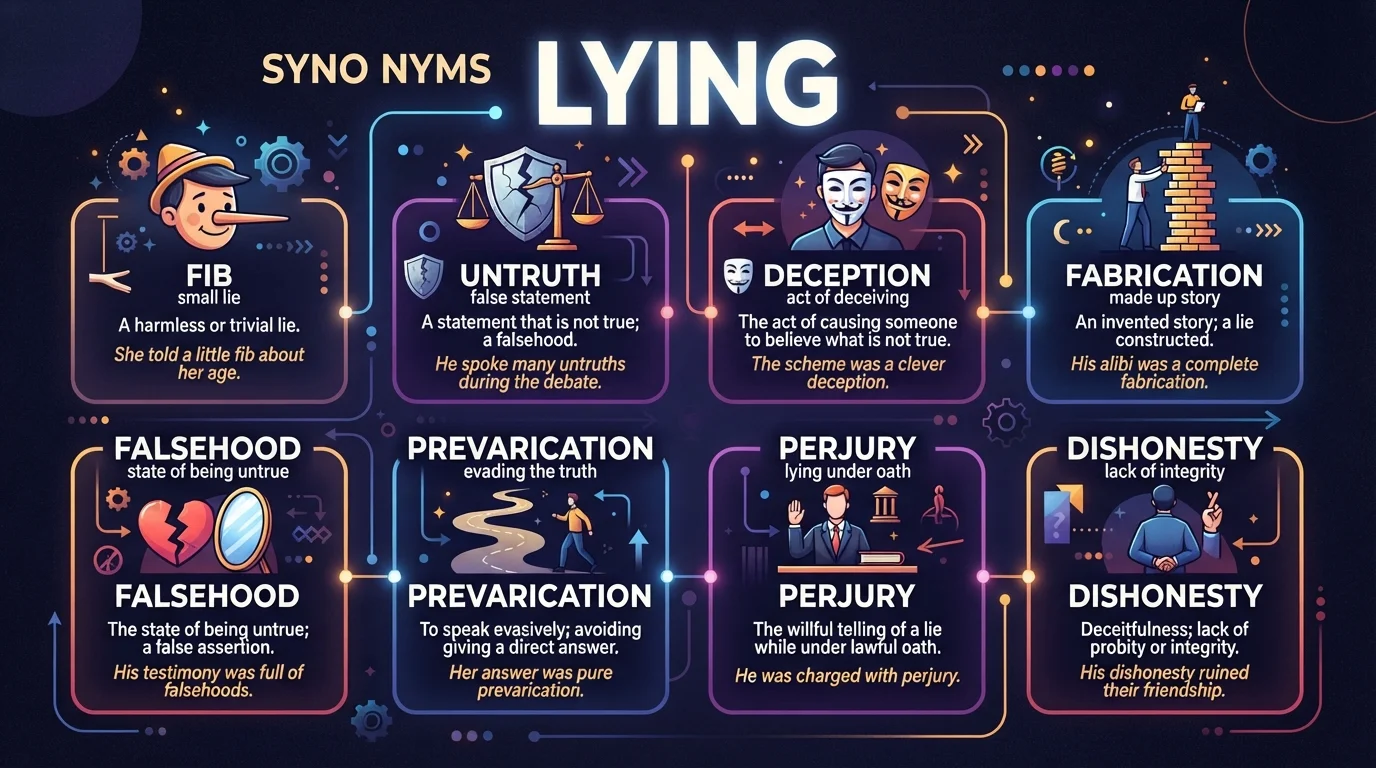
20. Stretching the Truth
Stretching the truth is an informal expression meaning exaggerating or presenting facts less accurately than they really are.
“He wasn’t exactly lying, but he was stretching the truth.”
Tone
Informal.
It often suggests exaggeration rather than a completely invented falsehood.
21. Bending the Truth
Bending the truth is similar to stretching the truth.
It means presenting facts in a distorted or misleading way.
“The advertisement bends the truth about the product’s results.”
It is less direct than simply saying:
“The advertisement lies about the results.”
22. Telling Half-Truths
A half-truth contains some true information while leaving out or distorting information that changes the overall impression.
“He wasn’t telling the whole story; he was telling half-truths.”
Key distinction
A half-truth is not necessarily a completely false statement.
It can be misleading because important context has been omitted.
23. Lying by Omission
Lying by omission refers to misleading someone by deliberately leaving out important information.
For example:
“The seller didn’t mention the previous accident.”
Whether this counts as lying depends on the circumstances and what was expected or required to be disclosed.
This phrase is useful when the issue is what someone failed to say, rather than a directly false statement.
Lying by Meaning
The easiest way to choose an alternative is to identify what the person is actually doing.
Saying something knowingly false
Use:
- lying
- telling falsehoods
- being untruthful
- making false statements
- giving false information
Deliberately misleading someone
Use:
- deceiving
- misleading
- being deceptive
- being deceitful
- duping
Inventing information
Use:
- fabricating
- making things up
- inventing
- concocting a story
- falsifying
Altering records or data
Use:
- falsifying
- manipulating data
- fabricating records
- altering records
- misrepresenting information
Avoiding a direct answer
Use:
- prevaricating
- equivocating
- evading
- being evasive
- dodging the question
Hiding information
Use:
- concealing
- withholding information
- covering up
- suppressing information
Exaggerating
Use:
- stretching the truth
- embellishing
- exaggerating
- inflating
- overstating
Lying vs. Deceiving
These words are closely related but not identical.
Lying usually involves making a false statement.
Deceiving is broader and means deliberately causing someone to believe something false.
For example:
“He lied about his qualifications.”
He made a false claim.
But deception could also involve:
“He used a fake certificate.”
That is deceptive even if he never verbally lies.
Lying vs. Misleading
Lying usually involves a knowingly false statement.
Misleading means causing a false impression.
A statement can be misleading without being literally false.
Example
“The product contains natural ingredients.”
That statement might be true but misleading if it creates the impression that the entire product is natural.
So misleading is broader and does not necessarily require a literal lie.
Lying vs. Fabricating
Lying = saying something you know is false.
Fabricating = inventing something that did not exist or did not happen.
“He lied about the meeting.”
“He fabricated an entire story about the meeting.”
The second sentence suggests a more extensive invention.
Lying vs. Prevaricating
Lying involves falsehood.
Prevaricating involves evasion.
“Did you take the money?”
“I don’t think that’s the question we should be asking.”
That response may be prevarication without being a direct lie.
Lying vs. Withholding
| Lying | Withholding |
|---|---|
| Says something false | Does not provide information |
| Usually involves an assertion | May involve silence |
| Can directly contradict reality | Can conceal reality without a false statement |
| “I didn’t take it.” | “I don’t want to discuss it.” |
The two can overlap, but they are not identical.
Lying vs. Exaggerating
Exaggerating means making something seem larger, better, worse, or more important than it really is.
It may or may not involve deliberate deception.
“He said he had waited for three hours when he had actually waited for thirty minutes.”
That could be an exaggeration and may also be a lie.
Comparison Table
| Word/Phrase | What it means | Intent required? | Tone |
|---|---|---|---|
| lying | Saying something known to be false | Usually yes | Neutral |
| deceiving | Causing someone to believe something false | Yes | Neutral/formal |
| misleading | Creating a false impression | Not always | Neutral/formal |
| fibbing | Telling a small lie | Usually | Informal |
| fabricating | Inventing false information | Yes | Formal |
| falsifying | Making records/data false | Yes | Formal |
| misrepresenting | Presenting something inaccurately | Usually | Formal |
| prevaricating | Avoiding a direct answer | Usually | Formal |
| equivocating | Using ambiguous language to avoid clarity | Usually | Formal |
| misinforming | Giving inaccurate information | Not necessarily | Neutral/formal |
| concealing | Keeping something hidden | Usually | Neutral/formal |
| withholding | Not giving information | Not necessarily | Neutral |
| covering up | Hiding wrongdoing or facts | Usually | Neutral/informal |
| stretching the truth | Exaggerating or bending facts | Usually | Informal |
| half-truths | Partly true but misleading claims | Usually | Neutral |
| bluffing | Pretending to have confidence/knowledge | Yes | Neutral |
| dissembling | Hiding true intentions/feelings | Yes | Formal/literary |
| duping | Tricking someone | Yes | Informal |
| deluding | Causing someone to hold a false belief | Yes | Formal |
Strong Alternatives by Context
For everyday conversation
Use:
- lying
- not telling the truth
- being dishonest
- making things up
- fibbing
- stretching the truth
For formal writing
Use:
- being untruthful
- making false statements
- misrepresenting
- fabricating
- falsifying
- deceiving
- concealing information
- prevaricating
For academic writing
Use:
- making false claims
- providing inaccurate information
- misrepresenting
- fabricating
- falsifying
- distorting
- misleading
For business writing
Use:
- misrepresenting
- providing false information
- misleading
- concealing
- falsifying
- making false claims
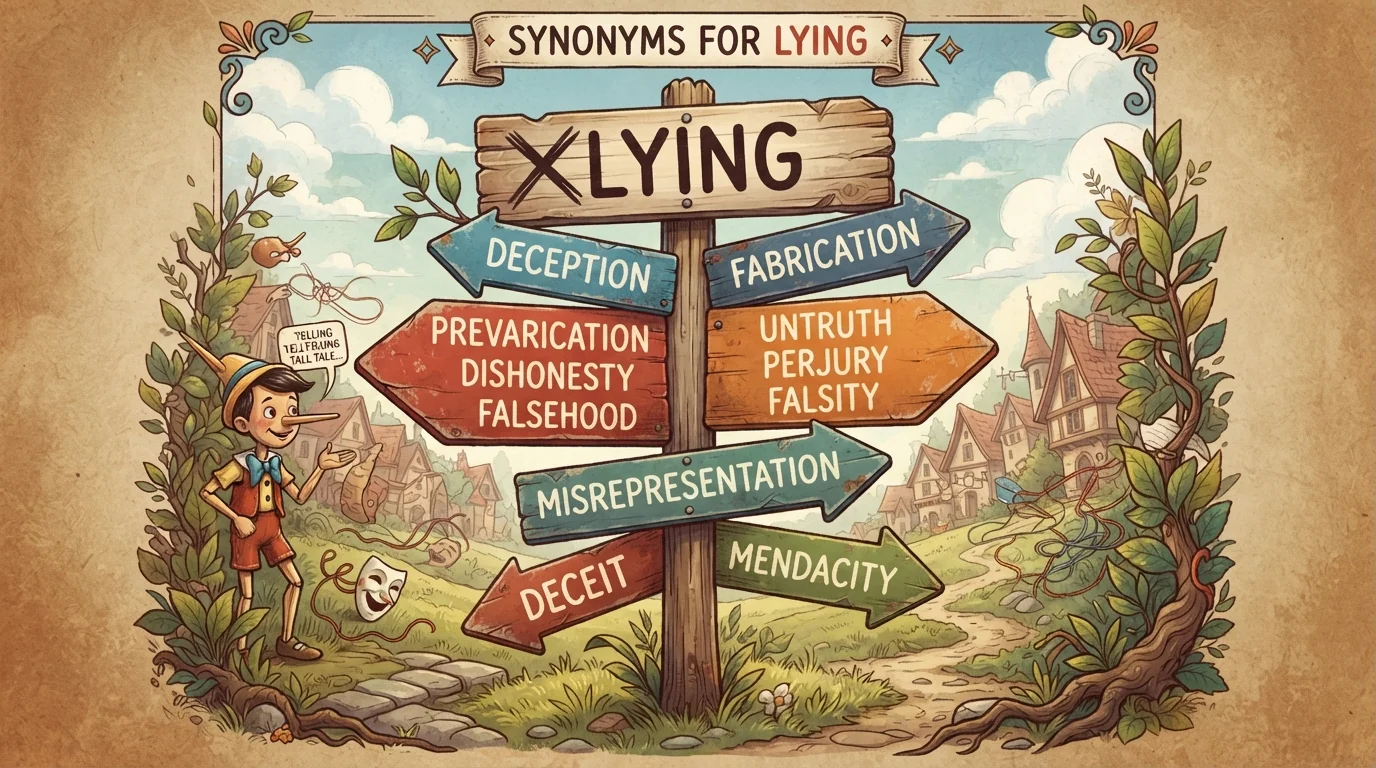
For legal or official contexts
Choose precise language such as:
- making a false statement
- providing false information
- misrepresenting
- falsifying records
- concealing information
- withholding information
The precise term matters because lying, misleading, withholding, and falsifying describe different conduct.
Sentence Transformations
1. Direct falsehood
Original:
“He was lying about his qualifications.”
Alternative:
“He was making false statements about his qualifications.”
Why:
The alternative is more formal and explicit.
2. Deception
Original:
“She was lying to her customers.”
Alternative:
“She was deceiving her customers.”
Why:
“Deceiving” emphasizes the broader act of causing customers to believe something false.
3. Misleading information
Original:
“The advertisement was lying about the product.”
Alternative:
“The advertisement was misleading consumers.”
Why:
“Misleading” is often more precise when the advertisement creates a false impression rather than making one clearly false statement.
4. Invented story
Original:
“He was lying about what happened.”
Alternative:
“He fabricated an account of what happened.”
Why:
“Fabricated” emphasizes that he invented the account.
5. Formal record
Original:
“The employee was lying about the financial records.”
Alternative:
“The employee was falsifying the financial records.”
Why:
“Falsifying” is more precise for deliberately making records inaccurate.
6. Evasive answer
Original:
“The spokesperson was lying when asked about the issue.”
Alternative:
“The spokesperson was prevaricating when asked about the issue.”
Why:
“Prevaricating” is appropriate if the spokesperson avoided giving a direct answer rather than simply making a false statement.
7. Minor lie
Original:
“The child was lying about eating the cookies.”
Alternative:
“The child was fibbing about eating the cookies.”
Why:
“Fibbing” signals a small, relatively harmless lie.
8. Omitted information
Original:
“She was lying about the incident.”
Alternative:
“She was concealing important information about the incident.”
Why:
The alternative works when the person is hiding information rather than necessarily making a direct false statement.
9. Exaggeration
Original:
“He was lying about how much experience he had.”
Alternative:
“He was stretching the truth about his experience.”
Why:
This suggests exaggeration rather than completely invented information.
10. Formal professional wording
Original:
“The company was lying about its sales figures.”
Alternative:
“The company was misrepresenting its sales figures.”
Why:
“Misrepresenting” is more suitable for formal business or analytical writing.
Common Mistakes
1. Treating every form of deception as lying
A person can deceive someone without making a false statement.
Deception is broader than lying.
2. Assuming misleading always means lying
A statement can be misleading even if it is technically true.
The key issue is the false impression, not necessarily a false sentence.
3. Calling every omission a lie
Leaving something unsaid is not automatically lying.
The context matters, including whether the information was relevant, expected, or required to be disclosed.
4. Using “fabricate” for ordinary exaggeration
Fabricate suggests invention.
“He fabricated the entire story.”
This is stronger than:
“He exaggerated the story.”
5. Using “prevaricate” to mean simply lie
Prevaricate emphasizes evasiveness rather than a straightforward false statement.
6. Using “fib” for serious deception
Fib is mild and often informal.
Calling serious deception a “fib” can minimize its significance.
7. Using “falsify” for every lie
Falsify is particularly useful for records, documents, data, accounts, or other information that someone deliberately makes false.
8. Assuming “dishonest” identifies the exact behavior
Dishonest is broad.
Someone may be dishonest by:
- lying
- cheating
- concealing information
- stealing
- manipulating
- misleading
So use a more specific word when precision matters.
When Not to Replace “Lying”
Lying is often the clearest word when you specifically mean knowingly saying something that is false.
For example:
“He was lying about where he had been.”
This is direct and easy to understand.
Replacing it with:
“He was prevaricating about his whereabouts.”
changes the meaning toward evasiveness.
Replacing it with:
“He was being deceptive about his whereabouts.”
makes the claim broader.
Replacing it with:
“He was fabricating information about his whereabouts.”
suggests that he invented information.
A more sophisticated word is not automatically a more accurate word.
What About “Lying Down”?
There is another completely different meaning of lying.
In:
“She is lying on the bed.”
lying is the present participle of lie, meaning to be in a horizontal or resting position.
Possible alternatives include:
- reclining
- resting
- lounging
- resting horizontally
- stretching out
- being sprawled out
Examples
“He was lying on the sofa.”
→ “He was reclining on the sofa.”
“She was lying on the grass.”
→ “She was resting on the grass.”
Important distinction
Lying = telling an untruth
Lying down = being in a horizontal position
These are completely different meanings.
Editor’s Choice: 5 Useful Alternatives
These are editorial recommendations based on meaning and natural usage, not objective rankings.
1. Deceiving
Best broad alternative when the focus is deliberate deception rather than only spoken falsehoods.
2. Misleading
Useful when someone creates a false impression, whether through wording, omission, or presentation.
3. Fabricating
Best when someone invents a false story, claim, record, or piece of information.
4. Misrepresenting
A precise formal option for inaccurately presenting facts, products, qualifications, or information.
5. Prevaricating
Useful when someone avoids giving a straightforward answer instead of making a direct false statement.