
Quick Answer
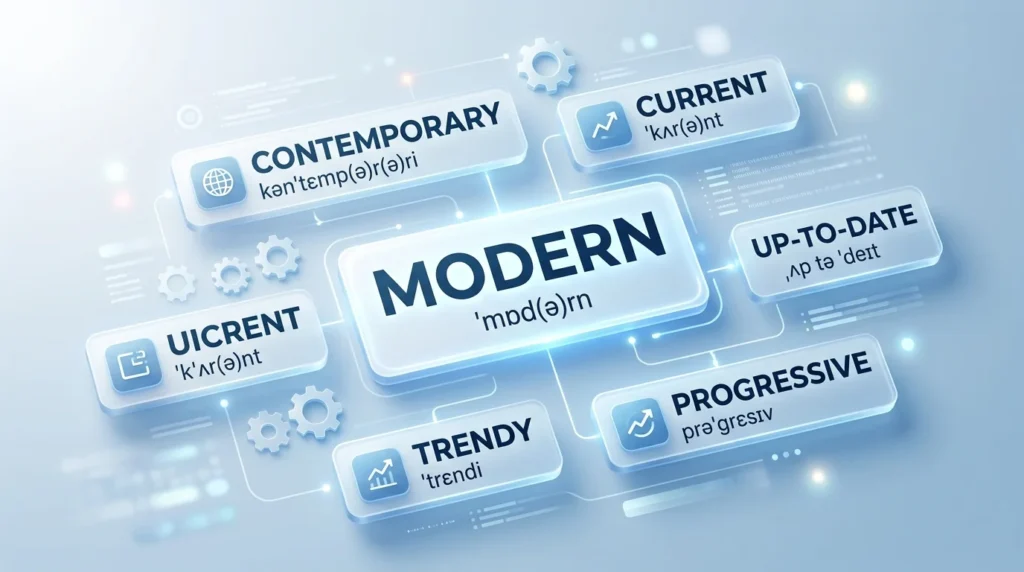
Common synonyms for modern include contemporary, current, up-to-date, present-day, recent, new, innovative, advanced, progressive, cutting-edge, state-of-the-art, and up-to-the-minute. The best alternative depends on the meaning. Contemporary works well for present-day culture and ideas, current emphasizes what exists now, while innovative highlights new methods or ideas.
Quick Synonym List
Here are useful alternatives to modern, grouped by meaning:
- Contemporary
- Current
- Present-day
- Up-to-date
- New
- Recent
- Latest
- Advanced
- Innovative
- Progressive
- Cutting-edge
- State-of-the-art
- Up-to-the-minute
- Trendy
- Fashionable
- Stylish
- Contemporary-style
- Futuristic
- Forward-looking
- Progressive-minded
- Sophisticated
- Developed
- High-tech
- Technological
- Digital
- Computerized
- Automated
- Renovated
- Updated
- Refreshed
- Revamped
- Newly developed
- Next-generation
- Avant-garde
- Novel
- Revolutionary
- Groundbreaking
- Advanced-design
- Present
- New-fashioned
Not all of these are exact synonyms. Some describe time, some describe technology, others describe style, ideas, design, or social attitudes.
What Does “Modern” Mean?
Modern generally means something related to the present time, something recently developed, or something that reflects current styles, technology, ideas, or attitudes.
For example:
“The company uses modern technology.”
Here, modern suggests technology that reflects current developments.
But consider:
“She lives in a modern house.”
Here, modern may describe the house’s design or architecture.
And:
“He has modern views.”
Here, modern refers to contemporary attitudes or ideas.
This flexibility explains why there is no single perfect synonym for every sentence.
Closest Synonyms for “Modern”
Contemporary
Meaning: Existing, happening, or belonging to the present period.
How it differs: Contemporary is one of the closest alternatives to modern, especially when talking about culture, art, literature, society, or ideas.
Tone: Neutral to formal.
Best for: Contemporary art, contemporary society, contemporary literature, contemporary issues.
Example:
“The museum features contemporary American art.”
Watch out: Contemporary often focuses on the present era rather than suggesting technological advancement.
Current
Meaning: Existing or relevant now.
How it differs: Current strongly emphasizes what is true, available, or relevant at the present time.
Example:
“Please check the current version of the software.”
Best for: Information, versions, events, trends, policies, and situations.
Watch out: A “current” product is not necessarily technologically advanced.
Present-Day
Meaning: Relating to the time in which we live now.
Example:
“Present-day technology has changed how people communicate.”
Tone: Neutral.
Best for: Historical comparisons and discussions of society, culture, and technology.
Up-to-Date
Meaning: Containing the latest information or using the latest developments.
Example:
“Make sure your antivirus software is up-to-date.”
Difference: Up-to-date often suggests that something has been updated recently and is not outdated.
Latest
Meaning: The most recent in time or development.
Example:
“The company announced its latest smartphone.”
Important: Latest is narrower than modern because it specifically identifies the newest or most recent item.
Recent
Meaning: Happening or appearing not long ago.
Example:
“The study examines recent changes in consumer behavior.”
Difference: Something can be recent without being modern in design, technology, or style.
Modern as “New or Recently Developed”
When modern means something newly created or developed, several alternatives can work.
New
Meaning: Recently made, discovered, introduced, or experienced.
Example:
“The company introduced a new payment system.”
Watch out: New only indicates novelty. It does not necessarily mean advanced or fashionable.
Newly Developed
This phrase is useful when something has recently been created or engineered.
Example:
“Researchers tested a newly developed device.”
It is more precise than simply saying “modern device.”
Next-Generation
Meaning: Representing the next stage of technological or product development.
Example:
“The company is developing next-generation batteries.”
Tone: Professional and technology-focused.
Advanced
Meaning: Highly developed or technically sophisticated.
Example:
“The laboratory uses advanced equipment.”
Difference: Advanced emphasizes capability or development rather than simply being contemporary.
Modern as “Technologically Advanced”
When modern describes technology, the best alternative depends on exactly what you want to emphasize.
High-Tech
Meaning: Using advanced technology.
Example:
“The new office has high-tech security systems.”
Tone: Informal to neutral.
State-of-the-Art
Meaning: Using the most advanced technology or methods currently available.
Example:
“The hospital has state-of-the-art equipment.”
Strength: Stronger than modern.
Watch out: Do not use it merely because something is relatively new.
Cutting-Edge
Meaning: At the newest and most advanced stage of development.
Example:
“The company develops cutting-edge artificial intelligence tools.”
Tone: Professional, promotional, and energetic.
Technological
Meaning: Related to technology.
Example:
“The industry has experienced major technological changes.”
Important: Technological is not always a synonym for modern. Something can be technological without being new or advanced.
Automated
Meaning: Operated automatically with little or no human control.
Example:
“The factory uses automated production systems.”
This is a specific alternative, not a general replacement for modern.
Digital
Meaning: Using digital technology or electronic data.
Example:
“The business has moved to a digital payment system.”
Again, digital is more specific than modern.
Modern as “Stylish or Fashionable”
Sometimes modern describes appearance rather than technology.
Stylish
Meaning: Attractive and fashionable in appearance.
Example:
“The hotel has a stylish interior.”
Use stylish when appearance is the main idea.
Fashionable
Meaning: Popular and considered attractive at a particular time.
Example:
“Neutral colors are fashionable this season.”
Difference: Fashionable is connected to current trends, while modern can describe a design that remains contemporary without necessarily following a temporary trend.
Trendy
Meaning: Very fashionable or popular at the moment.
Example:
“The café has a trendy interior.”
Tone: Casual.
Watch out: Something trendy may become unfashionable quickly.
Sophisticated
Meaning: Elegant, refined, or technically advanced.
Example:
“The company uses sophisticated software.”
Important: Sophisticated does not always mean modern. It can describe something complex or refined even when it is not new.
Modern as “Progressive”
Modern can also describe ideas, attitudes, or social thinking.
Progressive
Meaning: Favoring new ideas, social change, or improvement.
Example:
“She supports progressive approaches to education.”
Difference: Progressive concerns ideas, policies, or attitudes rather than simply being new.
Forward-Looking
Meaning: Focused on future development and improvement.
Example:
“The company has a forward-looking approach to technology.”
Forward-Thinking
Meaning: Willing to consider new ideas and future possibilities.
Example:
“He is known for his forward-thinking approach to business.”
Innovative
Meaning: Introducing new ideas, methods, or products.
Example:
“The startup developed an innovative solution.”
Difference: Something can be modern without being innovative. Innovative specifically suggests creativity and novelty.
Revolutionary
Meaning: Causing a major change or representing a dramatic departure from previous methods.
Example:
“The invention had a revolutionary effect on the industry.”
Watch out: This is much stronger than modern and should not be used for ordinary updates.
Groundbreaking
Meaning: Completely new and likely to have an important effect.
Example:
“The researchers made a groundbreaking discovery.”
This describes significance and originality, not simply modernity.
Avant-Garde
Meaning: Highly experimental and ahead of established artistic or cultural conventions.
Example:
“The gallery displayed avant-garde fashion designs.”
Tone: Specialized and sophisticated.
Best for: Art, fashion, literature, music, and design.
Modern as “Updated”
Sometimes modern means something has been changed or improved to fit current requirements.
Updated
Meaning: Changed to include newer information, features, or developments.
Example:
“We need an updated version of the report.”
This is often more precise than modern when talking about documents, software, information, or systems.
Renovated
Meaning: Repaired, improved, or redesigned, especially a building or physical space.
Example:
“The hotel has a recently renovated lobby.”
Watch out: A renovated building is not necessarily modern in style.
Revamped
Meaning: Significantly improved, redesigned, or reorganized.
Example:
“The company launched a revamped website.”
Tone: Neutral to conversational.
Refreshed
Meaning: Updated or improved to give something a newer appearance or feel.
Example:
“The brand introduced a refreshed visual identity.”
Synonyms vs. Near Synonyms
| Alternative | Relationship | Can Replace “Modern”? | Tone | Best Context |
|---|---|---|---|---|
| Contemporary | Close synonym | Usually | Neutral/formal | Culture, art, society |
| Current | Near synonym | Often | Neutral | Information, versions |
| Present-day | Close contextual alternative | Often | Neutral | Society, history |
| Up-to-date | Contextual alternative | Often | Neutral | Software, information |
| Latest | Contextual alternative | Sometimes | Neutral | Products, developments |
| New | Near synonym | Sometimes | Neutral | Products, ideas |
| Advanced | Contextual alternative | Sometimes | Professional | Technology, systems |
| Innovative | Contextual alternative | Sometimes | Professional | Ideas, products |
| Cutting-edge | Stronger alternative | Sometimes | Professional | Technology |
| State-of-the-art | Stronger alternative | Sometimes | Formal/professional | Equipment, facilities |
| Stylish | Contextual alternative | Sometimes | Positive | Design, appearance |
| Trendy | Contextual alternative | Sometimes | Casual | Fashion, interiors |
| Progressive | Meaning-specific alternative | Sometimes | Formal | Ideas, policies |
| Futuristic | Contextual alternative | Sometimes | Descriptive | Design, technology |
| Updated | Contextual alternative | Sometimes | Neutral | Documents, software |
| Renovated | Meaning-specific alternative | No | Neutral | Buildings |
| Revolutionary | Stronger alternative | Rarely | Strong | Major innovations |
Comparison Table
| Word/Phrase | Meaning | Tone | Strength | Best Use | Interchangeable? |
|---|---|---|---|---|---|
| Modern | Current or contemporary | Neutral | Moderate | General use | — |
| Contemporary | Belonging to the present period | Neutral/formal | Moderate | Art, culture, society | Usually |
| Current | Existing now | Neutral | Moderate | Information, events | Often |
| Up-to-date | Recently updated | Neutral | Moderate | Information, software | Context-dependent |
| Advanced | Highly developed | Professional | Strong | Technology | Sometimes |
| Innovative | New and creative | Professional | Strong | Ideas, products | Sometimes |
| Cutting-edge | Extremely advanced | Professional | Very strong | Technology | Sometimes |
| State-of-the-art | Most advanced available | Formal | Very strong | Equipment, facilities | Sometimes |
| Stylish | Fashionable and attractive | Neutral | Moderate | Design | Sometimes |
| Trendy | Currently fashionable | Casual | Moderate | Fashion, style | Sometimes |
| Progressive | Favoring change | Formal | Moderate | Ideas, policies | Context-dependent |
| Updated | Brought to a newer state | Neutral | Moderate | Software, documents | Sometimes |
| Futuristic | Suggesting the future | Descriptive | Strong | Design, technology | Rarely |
| Renovated | Repaired or redesigned | Neutral | Context-specific | Buildings | No |
| Revolutionary | Dramatically transformative | Strong | Very strong | Major innovations | Rarely |
How to Choose the Right Alternative
For Everyday English
Use modern, current, new, contemporary, or up-to-date depending on the sentence.
“The apartment has a modern design.”
This sounds completely natural.
For Professional Writing
Choose contemporary, advanced, innovative, updated, or current when they communicate a more specific meaning.
“The company uses advanced data-analysis tools.”
This is more informative than simply saying:
“The company uses modern tools.”
For Academic Writing
Contemporary is particularly useful when discussing present-day society, literature, politics, art, or culture.
“Contemporary literature often explores digital identity.”
Use current when referring to information or conditions that exist now.
For Technology
Choose according to the exact meaning:
- Modern — generally current technology
- Advanced — technically developed
- Innovative — introduces a new idea
- Cutting-edge — among the most advanced
- State-of-the-art — extremely advanced for its field
- Digital — based on digital technology
- Automated — performs tasks automatically
For Design and Architecture
Use:
- Contemporary
- Modern
- Minimalist
- Stylish
- Sleek
- Futuristic
Be careful: modern and contemporary can have different meanings in architecture and design discussions. “Modern” may refer to a particular design movement, while “contemporary” generally refers to current design.
For Social Ideas
Use progressive, forward-thinking, forward-looking, or contemporary when the context supports them.
“The organization promotes progressive educational policies.”
Here, progressive is more precise than modern.
Sentence Transformations
Example 1
Original:
“The company uses modern technology.”
Better Alternative:
“The company uses advanced technology.”
Why:
Advanced emphasizes technical capability rather than simply saying the technology is current.
Example 2
Original:
“She studies modern art.”
Better Alternative:
“She studies contemporary art.”
Why:
Contemporary is often more precise when referring to art produced in the present era.
Example 3
Original:
“Please use the modern version of the software.”
Better Alternative:
“Please use the latest version of the software.”
Why:
Latest clearly identifies the most recent version.
Example 4
Original:
“The website has a modern design.”
Better Alternative:
“The website has a sleek design.”
Why:
Sleek focuses on a clean, polished visual appearance rather than simply being current.
Example 5
Original:
“He has modern ideas about education.”
Better Alternative:
“He has progressive ideas about education.”
Why:
Progressive specifically communicates openness to change and new approaches.
Example 6
Original:
“The hospital has modern equipment.”
Better Alternative:
“The hospital has state-of-the-art equipment.”
Why:
This stronger phrase suggests highly advanced equipment, not merely relatively new equipment.
Example 7
Original:
“The company introduced a modern solution.”
Better Alternative:
“The company introduced an innovative solution.”
Why:
Innovative tells the reader that the solution introduces a new or creative approach.
Example 8
Original:
“The building has a modern interior.”
Better Alternative:
“The building has a contemporary interior.”
Why:
Contemporary emphasizes a current design aesthetic.
Example 9
Original:
“The report contains modern information.”
Better Alternative:
“The report contains up-to-date information.”
Why:
Up-to-date is much more natural when talking about information.
Example 10
Original:
“They opened a modernized office.”
Better Alternative:
“They opened a renovated office.”
Why:
If the office was physically repaired or redesigned, renovated communicates the specific action more accurately.
Common Collocations With “Modern”
Some combinations with modern are especially natural:
- modern technology
- modern society
- modern life
- modern medicine
- modern architecture
- modern design
- modern art
- modern culture
- modern world
- modern approach
- modern methods
- modern equipment
- modern facilities
- modern workplace
- modern lifestyle
- modern education
- modern business
- modern transportation
When a phrase is already natural, replacing modern is not automatically an improvement.
For example:
“Modern medicine has saved many lives.”
This is perfectly natural. A more complicated synonym could actually make the sentence less clear.
Grammar and Usage
“Modern” as an Adjective
Modern is primarily an adjective.
It normally comes before a noun:
“a modern building”
It can also follow a linking verb:
“The building is modern.”
“Modernize” as a Verb
The verb form is modernize in American English.
“The company plans to modernize its production system.”
It means to update something so that it better reflects current methods or technology.
“Modernization” as a Noun
The noun is modernization.
“The modernization of the transport system took several years.”
“Modernly”
Although modernly exists as a word, it is uncommon and often sounds unnatural. In most situations, rewrite the sentence using a more natural construction.
Instead of:
“The room was modernly designed.”
Use:
“The room had a modern design.”
or:
“The room was designed in a modern style.”
Common Mistakes
Mistake 1: Treating “New” and “Modern” as Identical
Something can be new without being modern.
A newly purchased product might use old technology.
New describes recency or novelty; modern can describe contemporary style, technology, or ideas.
Mistake 2: Using “Current” for Design
“She bought a current-style sofa.”
This sounds unnatural.
For design, modern, contemporary, stylish, or trendy may be better depending on the intended meaning.
Mistake 3: Calling Everything “Cutting-Edge”
Cutting-edge means highly advanced and at the forefront of development.
A normal recently released laptop may be modern without being genuinely cutting-edge.
Mistake 4: Confusing “Contemporary” With “Advanced”
A contemporary building belongs to the present era, but it is not necessarily technologically advanced.
Contemporary focuses primarily on time or current style.
Advanced focuses on development or capability.
Mistake 5: Using “Innovative” Simply to Mean “New”
An innovative idea does more than simply exist recently. It introduces a new or creative approach.
A new version of an existing product may be modern but not particularly innovative.
Mistake 6: Using “Renovated” for Technology
Renovated is generally associated with buildings and physical spaces.
You would normally say:
“The office was renovated.”
But:
“The software was updated.”
not:
“The software was renovated.”
Mistake 7: Using “Futuristic” as a General Synonym
Futuristic means resembling or suggesting the future.
“The car has a futuristic design.”
It does not simply mean “modern.”
Mistake 8: Making Writing Sound Unnecessarily Sophisticated
Replacing every instance of modern with words such as avant-garde, state-of-the-art, or cutting-edge can distort your meaning.
Choose the word that says exactly what you mean.
When Not to Use a Synonym
Sometimes modern is the best word.
For example:
“Modern life can be stressful.”
Replacing it with cutting-edge life would completely change the meaning.
Similarly:
“The building has a modern design.”
is simple and natural. You could use contemporary design, but that does not automatically make the sentence better.
Use a synonym when it adds precision.
For example:
“The company uses modern technology.”
is broad.
If you specifically mean that the technology is highly advanced:
“The company uses advanced technology.”
If you mean that it introduces a new approach:
“The company uses innovative technology.”
The second versions are better because they communicate more information.
Modern vs. Contemporary
These two words are often confused.
Modern is broader. It can mean current, recent, technologically advanced, or associated with modern styles and ideas.
Contemporary usually means belonging to or existing in the present period.
Compare:
“The company uses modern technology.”
Here, modern can imply current or advanced technology.
“The gallery displays contemporary art.”
Here, contemporary identifies art connected with the present era.
They overlap, but they are not interchangeable in every sentence.
Modern vs. Current
Current focuses strongly on what exists or matters now.
“Current market conditions”
Modern can describe something as contemporary or advanced.
“Modern manufacturing techniques”
You would not normally replace these automatically.
Modern vs. Advanced
Modern means current or contemporary.
Advanced means highly developed.
A device can be modern but not advanced.
For example, a newly released basic device may be modern because it is current, while a sophisticated research system may be advanced even if its underlying technology is several years old.
Modern vs. Innovative
Modern describes currentness or contemporary characteristics.
Innovative describes new and creative ideas or methods.
“The company has a modern office.”
describes the office.
“The company has an innovative business model.”
describes the originality of its approach.
Modern vs. Trendy
Modern can describe a lasting contemporary style.
Trendy usually suggests something popular right now.
A modern design may remain attractive for years, while a trendy design may be closely tied to a short-lived fashion.
Writing Tips for Using “Modern”
Be Specific When Possible
Instead of:
“The company uses modern methods.”
consider:
“The company uses automated production methods.”
if automation is what you actually mean.
Do Not Confuse Complexity With Quality
A precise word is better than an impressive-sounding word.
Advanced is not automatically better than modern. It simply communicates a different idea.
Consider the Audience
For general readers:
“modern technology”
may be clearer than:
“state-of-the-art technological infrastructure.”
For a technical report, greater precision may be appropriate.
Keep Natural Language Natural
If modern sounds right, keep it.
Good writing is not about replacing common words with unusual ones. It is about selecting vocabulary that gives readers the clearest possible meaning.
Editor’s Choice
Contemporary
The strongest general alternative when discussing present-day art, culture, society, literature, and ideas.
Current
The best choice when you mean something that exists or applies now.
Advanced
A strong professional choice when modern means technically developed.
Innovative
Best when the main idea is originality and new thinking.
Up-to-Date
Excellent for information, software, records, and systems that have been recently updated.
Cutting-Edge
Use when you genuinely mean something at the forefront of technological or professional development.
Related Questions
What Is Another Word for Modern?
Common alternatives include contemporary, current, present-day, up-to-date, new, advanced, innovative, progressive, stylish, trendy, and futuristic. The best choice depends on whether you mean current, advanced, fashionable, or progressive.
What Is a Formal Synonym for Modern?
Contemporary is one of the strongest formal alternatives. Depending on the context, advanced, progressive, present-day, or current may also work.
What Is a Professional Word for Modern?
In professional writing, current, contemporary, advanced, innovative, updated, and state-of-the-art can be useful, but each carries a slightly different meaning.
What Is a Better Word Than Modern?
There is no universally better word. Contemporary may be better for art and culture, advanced for technology, up-to-date for information, and innovative for new ideas.
Is “Contemporary” the Same as “Modern”?
Not always. Contemporary generally means belonging to the present period, while modern can also mean technologically advanced, fashionable, or associated with modern ideas and styles.
What Is the Opposite of Modern?
Depending on the context, opposites include old-fashioned, outdated, obsolete, traditional, ancient, historic, and antiquated. The correct antonym depends on what aspect of “modern” you are contrasting.
Is “Modern” a Formal Word?
Yes. Modern is a standard neutral English word and is appropriate in everyday, professional, and academic writing. You do not need to replace it simply because you are writing formally.
Key Takeaways
- Modern has several meanings, including current, contemporary, technologically advanced, fashionable, and progressive.
- Contemporary is usually one of the closest alternatives when discussing present-day culture, art, society, or ideas.
- Use advanced, cutting-edge, or state-of-the-art when technological development is the main point.
- Use up-to-date for information, software, records, and systems that have been recently updated.
- Do not replace modern automatically; choose a more specific alternative only when it makes the meaning clearer.