
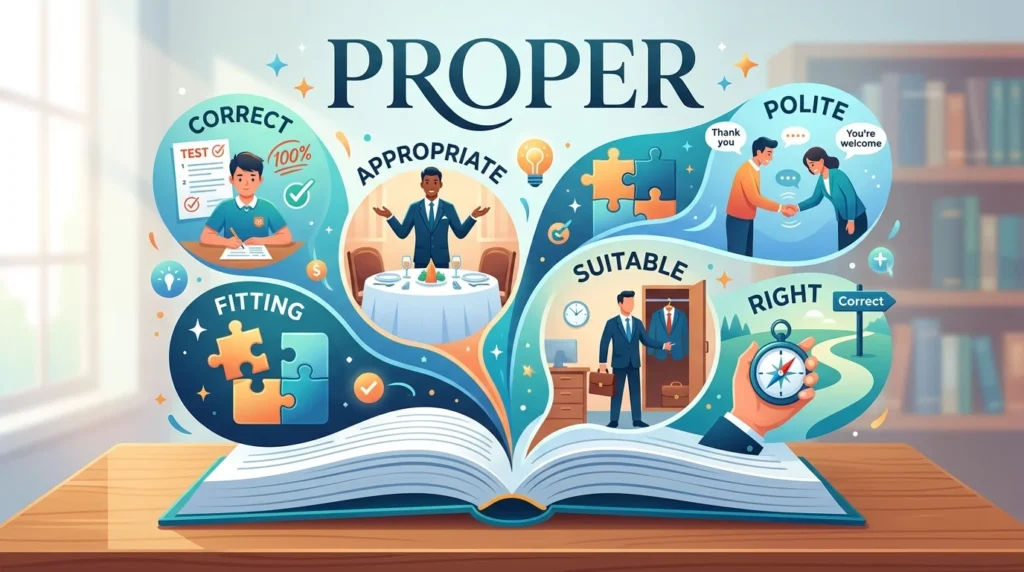
Quick List: Synonyms for Proper
When proper means correct
- Correct
- Accurate
- Right
- Exact
- Precise
- Valid
- Sound
- True
- Legitimate
When proper means appropriate or suitable
- Appropriate
- Suitable
- Fitting
- Apt
- Applicable
- Relevant
- Compatible
- Well-suited
- Acceptable
When proper means expected or socially acceptable
- Respectable
- Decent
- Conventional
- Standard
- Appropriate
- Orderly
- Acceptable
- Prescribed
When proper means formal or official
- Formal
- Official
- Established
- Authorized
- Prescribed
- Standard
When proper means genuine or real
- Genuine
- Authentic
- Actual
- Real
- True
- Legitimate
When proper means the thing itself or a specific area
- Specific
- Actual
- Central
- Main
- Core
- Designated
What Does “Proper” Mean?
Proper is a flexible adjective with several meanings. That is why simply replacing it with a word from a thesaurus can easily change the meaning of a sentence.
It can mean:
- Correct or accurate — “Use the proper spelling.”
- Appropriate or suitable — “Wear proper clothing for the interview.”
- Acceptable or expected — “He showed proper respect.”
- Formal or official — “The proper authorities were contacted.”
- Genuine or real — “We finally had a proper meal.”
- Specific or strictly defined — “The city proper has a population of…”
- Belonging to a particular grammatical category — “London is a proper noun.”
The right alternative depends on which sense you intend.
1. Correct
Correct is one of the closest alternatives to proper when proper means free from error or in accordance with a rule.
- Meaning: Right according to facts, rules, or standards
- Tone: Neutral
- Best for: Instructions, answers, spelling, grammar, procedures
Example:
Make sure you use the correct spelling.
Proper: Make sure you use the proper spelling.
Here, correct is more precise because the sentence is about accuracy.
2. Appropriate
Appropriate means suitable for a particular situation, person, purpose, or setting.
- Meaning: Suitable or fitting
- Tone: Neutral to formal
- Best for: Behavior, clothing, language, decisions, workplace situations
Example:
Please use appropriate language during the meeting.
Proper could work, but appropriate makes the intended meaning clearer.
3. Suitable
Suitable emphasizes whether something is a good fit for a particular purpose.
- Meaning: Right for a specific purpose or situation
- Tone: Neutral
- Best for: Jobs, equipment, locations, methods, candidates, materials
Example:
We need a suitable location for the event.
Proper would sound less specific here.
4. Right
Right is the most natural everyday alternative when proper means correct or appropriate.
- Meaning: Correct, appropriate, or suitable
- Tone: Neutral, conversational
- Best for: Everyday speech
Example:
Is this the right way to do it?
Compare:
Is this the proper way to do it?
Both are grammatical, but right is more conversational while proper can sound more formal or emphasize following an established method.
5. Appropriate vs. Proper
These two words overlap heavily, but they are not identical.
Appropriate focuses on whether something fits the situation.
Proper can suggest that something follows an expected standard, rule, convention, or accepted way of doing things.
Compare:
Wear appropriate clothing for the weather.
This means clothing that fits the conditions.
Wear proper clothing for the ceremony.
This can suggest clothing that meets the expected standard for the event.
6. Fitting
Fitting means appropriate or suitable for a particular situation.
- Tone: Neutral
- Best for: Comments, descriptions, occasions, responses
Example:
Her response was fitting for the occasion.
It is a useful alternative when proper means “appropriate,” especially in writing.
7. Apt
Apt means particularly suitable or appropriate.
- Tone: Formal/literary
- Best for: Descriptions, observations, word choices
Example:
That is an apt description of the situation.
Apt is more specialized than proper and should not be used as a universal replacement.
8. Acceptable
Acceptable means good enough to meet a particular standard or requirement.
- Tone: Neutral to formal
- Best for: Rules, standards, policies, behavior, quality
Example:
This is an acceptable solution.
This differs from proper because acceptable often means something meets a minimum standard rather than being the ideal or prescribed choice.
9. Accurate
Accurate is appropriate when proper refers specifically to factual correctness.
Example:
Please provide the accurate information.
Use accurate for facts, measurements, descriptions, records, and data.
Do not use it for every instance of proper.
proper clothing → ❌ accurate clothing
10. Precise
Precise emphasizes exactness and lack of ambiguity.
Example:
Use the precise measurements provided in the instructions.
Precise is stronger and more specific than proper when the issue is exact measurement or wording.
11. Exact
Exact means completely accurate or identical in every relevant detail.
Example:
Please enter the exact amount.
This is useful when proper means “the specific or correct amount,” but it cannot replace proper in many other contexts.
12. Valid
Valid means legally, logically, or officially acceptable or sound.
Example:
You need a valid identification document.
It is especially useful for arguments, tickets, documents, permits, methods, and claims.
13. Sound
Sound means reasonable, reliable, or based on good judgment.
Example:
That is a sound approach to the problem.
It can replace proper only when the intended meaning is a reliable or sensible method.
14. Legitimate
Legitimate means lawful, genuine, justified, or officially recognized, depending on context.
Example:
The organization has a legitimate reason for requesting the information.
It is not a general synonym for proper, but it can work when legality, validity, or authenticity is important.
15. Relevant
Relevant means directly connected with the matter being discussed.
Example:
Please provide the relevant documents.
This can replace proper only when proper means “appropriate to the matter.”
16. Applicable
Applicable means relevant and able to be used in a particular situation.
Example:
Follow all applicable regulations.
This is especially useful in legal, technical, academic, and professional writing.
17. Compatible
Compatible means able to work, exist, or function well together.
Example:
Make sure the software is compatible with your device.
It is a contextual alternative, not a direct synonym for proper.
18. Well-Suited
Well-suited means particularly appropriate for a purpose or situation.
Example:
She is well-suited to the role.
This is often clearer than proper when describing a person’s suitability.
19. Standard
Standard refers to something established as a normal or accepted level, type, or method.
Example:
Follow the standard procedure.
Standard works particularly well in technical and professional contexts.
20. Conventional
Conventional means based on commonly accepted practices or traditions.
Example:
They chose a conventional approach.
Unlike proper, conventional specifically highlights what is customary or traditional.
21. Prescribed
Prescribed means officially required, specified, or laid down by a rule or authority.
Example:
Take the medication at the prescribed time.
It is useful when proper means “required according to an established instruction.”
22. Established
Established means officially recognized, accepted, or already in use.
Example:
Follow the established procedure.
This is often stronger and more precise than proper in formal writing.
23. Official
Official means authorized, formally recognized, or connected with an authority or organization.
Example:
Use the official application form.
If proper means authorized or formally recognized, official may be the better choice.
24. Formal
Formal refers to something associated with official, serious, conventional, or ceremonial situations.
Example:
The event requires formal clothing.
This is one of the most useful alternatives when proper describes a formal standard of dress, language, or conduct.
However:
proper clothing
does not always mean:
formal clothing.
Proper can simply mean suitable or acceptable.
25. Respectable
Respectable means socially acceptable, decent, or worthy of respect.
Example:
He wanted to maintain a respectable appearance.
This alternative adds a social or moral dimension that may not be present in proper.
26. Decent
Decent can mean acceptable, appropriate, respectable, or reasonably good.
Example:
Wear something decent to the ceremony.
It is common in everyday English but can sound more subjective than proper.
27. Orderly
Orderly means arranged or conducted in an organized, controlled way.
Example:
The workers followed an orderly process.
Use it when proper emphasizes organization rather than correctness.
28. Genuine
Genuine means real, authentic, or sincere.
Example:
She showed genuine concern for the customer.
This is useful when proper means real or sincere rather than fake.
29. Authentic
Authentic means genuine and true to its origin, identity, or nature.
Example:
The restaurant serves authentic Italian food.
It should not replace proper when the intended meaning is “correct” or “appropriate.”
30. Actual
Actual means real or existing in fact.
Example:
The actual problem was much smaller than expected.
In some expressions, proper can emphasize the real or central thing:
The discussion began in proper after a brief introduction.
But actual is not a universal replacement.
31. Real
Real is the everyday alternative for proper when the word means genuine or substantial.
Example:
We finally had a real meal.
In conversational English, real may sound more natural than proper.
32. True
True can mean accurate, genuine, faithful, or in accordance with reality.
Example:
That is a true representation of the situation.
Its exact meaning depends heavily on context.
33. Rightful
Rightful means legally or morally entitled to something.
Example:
The property was returned to its rightful owner.
This is a specialized alternative and should not be used simply because right and proper sometimes overlap.
34. Due
Due can mean owed, deserved, expected, or appropriate according to a rule or situation.
Example:
Please give the matter its due attention.
The phrase due attention is more natural than proper attention in some formal contexts.
35. Specific
Specific means clearly identified or limited to a particular thing.
Example:
The form must be submitted to the specific department listed in the instructions.
This works only when proper means a particular or designated thing.
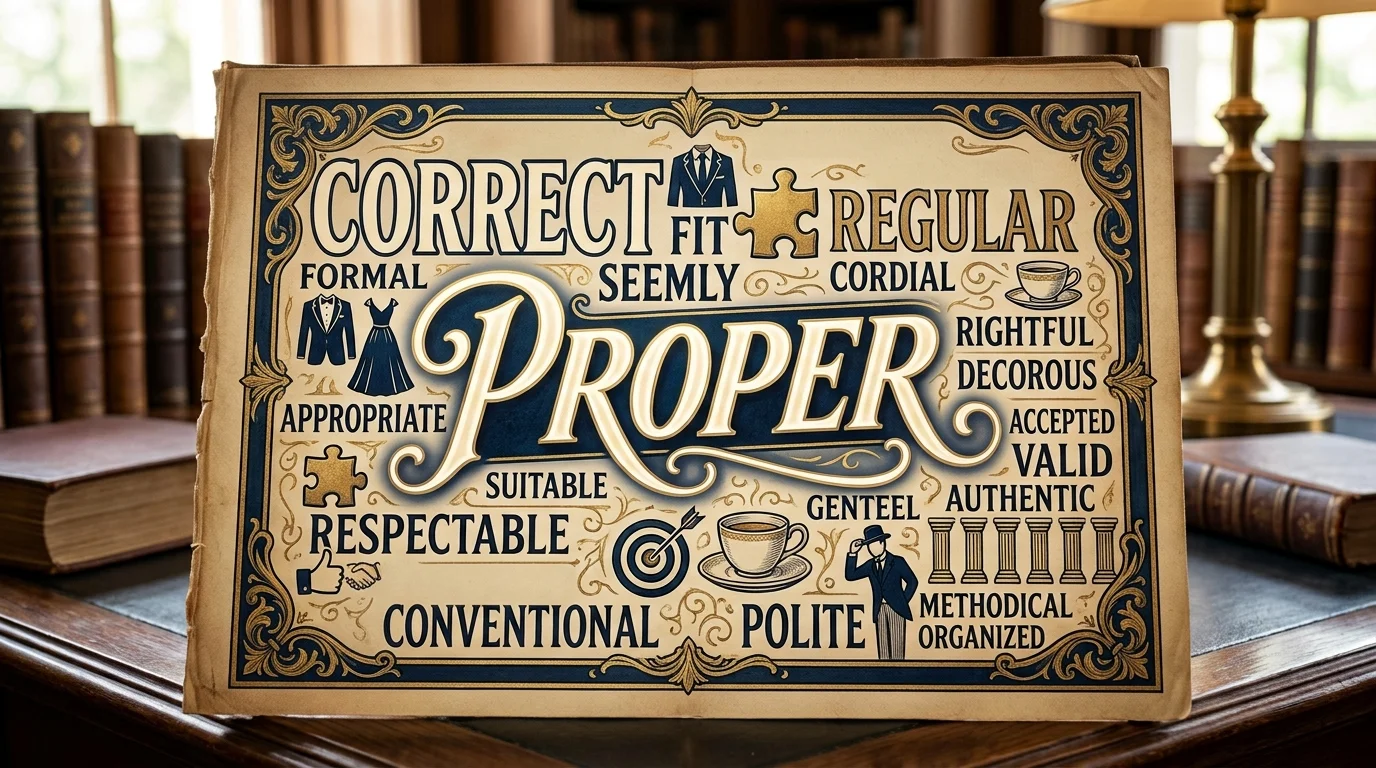
Proper in Different Contexts
Proper Procedure
Common alternatives include:
- correct procedure
- appropriate procedure
- standard procedure
- prescribed procedure
- established procedure
- approved procedure
The best choice depends on the intended meaning.
Follow the proper procedure.
This is broad.
Follow the prescribed procedure.
This suggests an officially specified process.
Follow the standard procedure.
This suggests a normal or established process.
Proper Behavior
Possible alternatives include:
- appropriate behavior
- acceptable behavior
- respectful behavior
- decent behavior
- appropriate conduct
- proper conduct
Students are expected to show proper behavior.
If the emphasis is respect:
Students are expected to show respectful behavior.
If the emphasis is compliance with rules:
Students are expected to follow appropriate conduct standards.
Proper Clothing
Possible alternatives include:
- appropriate clothing
- suitable clothing
- formal clothing
- suitable attire
- appropriate attire
- respectable clothing
The correct choice depends on the setting.
Wear appropriate clothing for the weather.
Wear formal clothing to the ceremony.
Wear suitable clothing for hiking.
These are not interchangeable in every situation.
Proper Way
Possible alternatives include:
- correct way
- appropriate way
- right way
- correct method
- appropriate method
- recommended method
- prescribed method
This is the proper way to install the equipment.
For technical writing, correct method, recommended method, or prescribed method may provide more information.
“Proper” in Academic and Professional Writing
In formal writing, proper can sometimes be too vague.
Consider:
The researchers used the proper method.
What does proper mean?
- the correct method?
- the accepted method?
- the approved method?
- the standard method?
- the most suitable method?
- the prescribed method?
A more precise word often improves the sentence.
Better alternatives by intended meaning
| Intended meaning | Better choice |
|---|---|
| Free from error | Correct |
| Factually accurate | Accurate |
| Exact | Precise / exact |
| Suitable | Appropriate / suitable |
| Officially required | Prescribed |
| Commonly accepted | Standard / conventional |
| Formally authorized | Official / authorized |
| Relevant | Relevant / applicable |
| Reliable | Sound |
| Genuine | Genuine / authentic |
Precision is usually more useful than simply choosing a more sophisticated word.
Proper vs. Correct
These words are close, but correct is narrower.
Correct usually means something is free from error or agrees with a rule or fact.
Proper can mean correct, but it can also mean appropriate, acceptable, formal, genuine, or specific.
Compare:
Use the correct answer.
Use the proper equipment.
The first concerns accuracy. The second usually concerns suitability.
Proper vs. Appropriate
Proper and appropriate are often interchangeable when discussing behavior, language, clothing, or conduct.
But appropriate focuses more directly on fit with the situation.
Use appropriate language in a professional email.
Proper may sound more like an expected standard:
Follow the proper procedure.
Proper vs. Suitable
Suitable focuses strongly on fitness for a particular purpose.
This software is suitable for beginners.
Proper would sound less natural if the intended meaning is simply “well suited.”
Proper vs. Formal
These words are frequently confused.
Formal means associated with an official, serious, ceremonial, or conventional setting.
Proper is broader.
proper clothing
could mean appropriate clothing.
formal clothing
specifically means clothing suitable for a formal setting.
Therefore, formal is not a universal synonym for proper.
Proper vs. Genuine
When proper means “real” or “substantial,” genuine, authentic, or real may work.
We finally had a proper meal.
This often means a substantial, satisfying, or complete meal.
We finally had a genuine meal.
This changes the meaning and may sound unnatural.
In this context, real meal or full meal may be better depending on what you mean.
Comparison Table
| Word | Main meaning | Tone | Strength | Direct replacement for proper? |
|---|---|---|---|---|
| Correct | Free from error | Neutral | Strong | Often |
| Appropriate | Suitable for a situation | Neutral/formal | Strong | Often |
| Suitable | Fit for a purpose | Neutral | Strong | Often |
| Right | Correct or appropriate | Conversational | Medium | Often |
| Accurate | Factually correct | Neutral/formal | Strong | Sometimes |
| Precise | Exact | Formal/technical | Strong | Sometimes |
| Valid | Legally/logically acceptable | Formal | Strong | Sometimes |
| Fitting | Appropriate | Neutral | Medium | Sometimes |
| Apt | Particularly suitable | Formal/literary | Strong | Sometimes |
| Acceptable | Meets a standard | Neutral | Medium | Sometimes |
| Relevant | Connected to the subject | Neutral/formal | Strong | Contextual |
| Applicable | Relevant and usable | Formal | Strong | Contextual |
| Standard | Established or usual | Neutral/formal | Strong | Contextual |
| Conventional | Traditionally accepted | Formal | Medium | Contextual |
| Prescribed | Officially required | Formal | Strong | Contextual |
| Established | Already accepted or recognized | Formal | Medium | Contextual |
| Official | Authorized/formally recognized | Formal | Strong | Contextual |
| Formal | Official or ceremonial | Formal | Strong | Contextual |
| Respectable | Socially acceptable | Neutral | Medium | Contextual |
| Decent | Acceptable/respectable | Conversational | Medium | Contextual |
| Genuine | Real/authentic | Neutral | Strong | Contextual |
| Authentic | True to origin or identity | Neutral/formal | Strong | Contextual |
| Actual | Real/in fact | Neutral | Medium | Contextual |
| Rightful | Legally/morally entitled | Formal | Strong | Specialized |
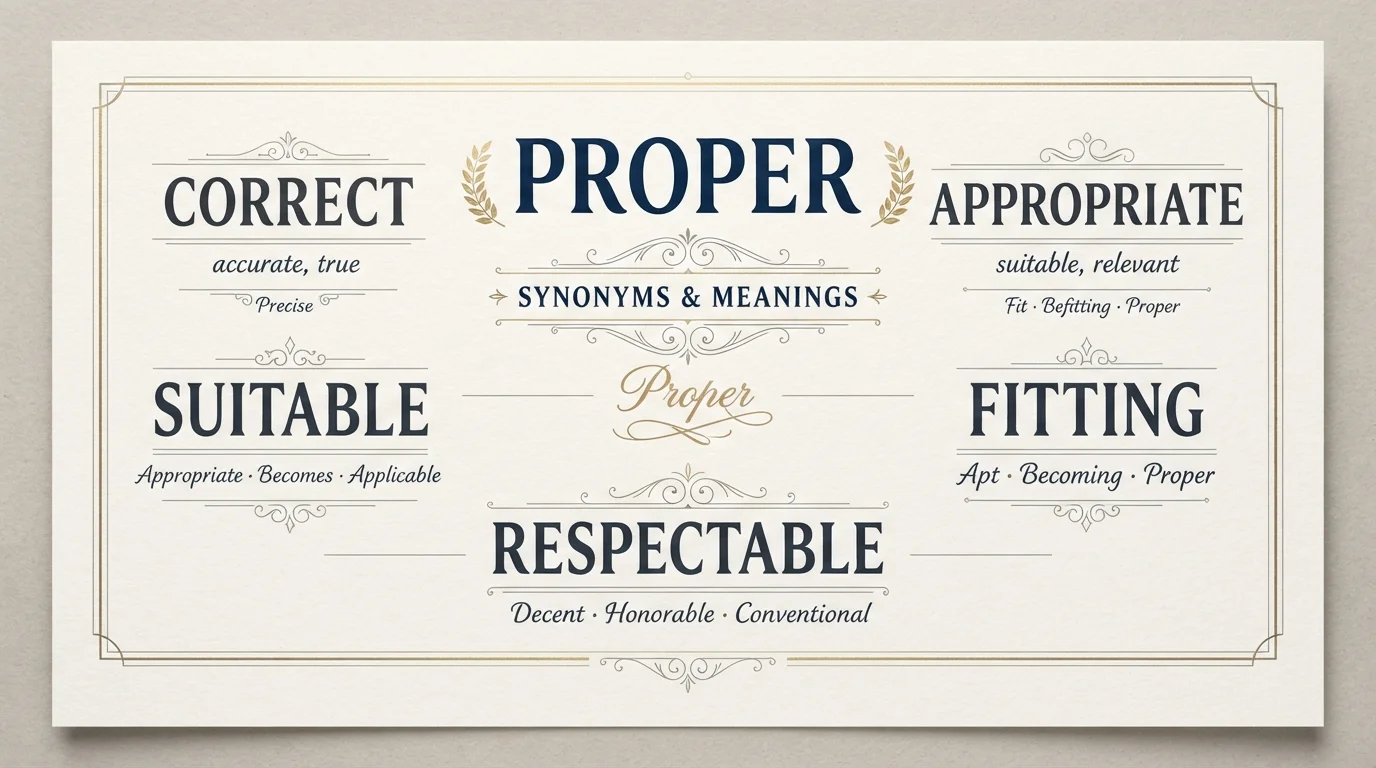
Sentence Transformations
1. Original
Please use the proper spelling.
Better alternative:
Please use the correct spelling.
Why: Correct directly expresses freedom from spelling errors.
2. Original
Wear proper clothing for the interview.
Alternative:
Wear appropriate clothing for the interview.
Why: Appropriate emphasizes suitability for the situation.
3. Original
Follow the proper procedure.
Alternative:
Follow the prescribed procedure.
Why: Use prescribed if the procedure is officially specified.
4. Original
We need the proper equipment.
Alternative:
We need the appropriate equipment.
Why: Appropriate highlights suitability for the task.
5. Original
She gave the proper response.
Alternative:
She gave the appropriate response.
Why: Appropriate makes the situational meaning clearer.
6. Original
Enter the proper amount.
Alternative:
Enter the exact amount.
Why: If the intended meaning is a precise numerical value, exact is more specific.
7. Original
The team followed the proper method.
Alternative:
The team followed the standard method.
Why: Use standard if the method is established and commonly accepted.
8. Original
He provided the proper documents.
Alternative:
He provided the required documents.
Why: Required clearly communicates that the documents were necessary.
9. Original
She wore proper attire for the ceremony.
Alternative:
She wore formal attire for the ceremony.
Why: This works if the ceremony specifically requires formal dress.
10. Original
We contacted the proper authorities.
Alternative:
We contacted the appropriate authorities.
Why: Appropriate clearly identifies the authorities relevant to the situation.
Useful Collocations with “Proper”
Some combinations with proper are especially common:
- proper procedure
- proper use
- proper care
- proper attention
- proper training
- proper preparation
- proper equipment
- proper clothing
- proper behavior
- proper conduct
- proper documentation
- proper treatment
- proper technique
- proper method
- proper authority
- proper channels
- proper context
- proper instructions
- proper identification
- proper maintenance
- proper handling
- proper grammar
- proper spelling
- proper pronunciation
- proper noun
- proper name
- city proper
These expressions show why context matters: a single synonym rarely works naturally across all of them.
Grammar: “Proper” Has Some Special Uses
Proper Noun
In grammar, a proper noun is the name of a particular person, place, organization, or other specific entity.
Examples:
- Maria
- Pakistan
- London
- Microsoft
You should not replace proper with correct in proper noun.
London is a proper noun.
Not:
London is a correct noun.
Proper Name
A proper name identifies a specific person, place, organization, or thing.
The proper name of the organization is listed on the document.
Again, this is a technical grammatical use rather than the ordinary meaning “correct.”
City Proper
City proper refers to the legally or administratively defined city itself, rather than its wider metropolitan area or surrounding suburbs.
This is a specialized geographical expression.
Common Mistakes with Synonyms for “Proper”
1. Replacing proper with correct everywhere
Not every proper thing is simply correct.
proper clothing → appropriate clothing
proper equipment → suitable equipment
2. Using formal when you mean appropriate
Formal and proper overlap, but they are not identical.
Wear appropriate shoes for hiking.
This does not mean:
Wear formal shoes for hiking.
3. Using accurate for suitability
Accurate concerns factual correctness.
accurate information
But:
proper equipment
does not normally mean:
accurate equipment.
4. Using genuine for every instance of proper
Genuine means real or authentic.
genuine concern
It does not mean:
correct procedure.
5. Assuming acceptable means ideal
Something can be acceptable without being the best or most appropriate option.
The solution is acceptable.
This may mean it meets the minimum requirement.
6. Using standard when something is merely correct
Standard emphasizes an established norm or usual practice.
standard procedure
It does not always mean “correct procedure.”
7. Replacing proper noun
Do not change technical grammatical terms simply to avoid repetition.
proper noun is the correct term.
8. Choosing a longer synonym just to sound sophisticated
Please use the appropriate terminology.
may be useful.
But if the sentence simply needs:
Please use the correct terminology.
then correct may be clearer.
Good writing is not about using the most complicated synonym.
When Should You Keep “Proper”?
Sometimes proper is the best word.
Keep it when:
- the exact meaning depends on context
- you mean a broadly accepted standard
- you mean appropriate conduct
- you mean something genuine or substantial in an informal expression
- you are using a fixed expression
- you are using a grammatical term such as proper noun
- replacing it would make the sentence less natural
For example:
You need proper training before using the machine.
Here, proper training naturally suggests adequate, appropriate, and sufficiently thorough training. Replacing it with one narrower synonym may lose part of that meaning.
Which Synonym Should You Choose?
| If you mean… | Choose… |
|---|---|
| Correct according to a fact or rule | Correct |
| Suitable for a situation | Appropriate |
| Good fit for a purpose | Suitable |
| Everyday “correct/right” | Right |
| Factually correct | Accurate |
| Exact and detailed | Precise |
| Completely exact | Exact |
| Legally or logically acceptable | Valid |
| Reasonable or reliable | Sound |
| Relevant to a situation | Relevant |
| Usable under a particular rule | Applicable |
| Established method or norm | Standard |
| Traditional or customary | Conventional |
| Officially required | Prescribed |
| Officially recognized | Official |
| Authorized | Authorized |
| Socially acceptable/respectable | Respectable |
| Appropriate in formal settings | Formal |
| Real or authentic | Genuine |
| True to its origin | Authentic |
| Real or existing in fact | Actual |
| Legally or morally entitled | Rightful |
Editor’s Choice: The Most Useful Alternatives
These are not rankings; they are practical choices for different meanings.
1. Correct
Best when proper means free from error.
2. Appropriate
Best when something fits a particular situation.
3. Suitable
Best when something fits a particular purpose.
4. Standard
Best when you mean an established method or norm.
5. Prescribed
Best when a rule or authority specifically requires something.
6. Formal
Best when the intended meaning relates to official or ceremonial settings.
7. Genuine
Best when proper means real or authentic.
8. Accurate
Best when the issue is factual correctness.