

Main Article
What Does “Path” Mean?
Path has several related meanings.
1. A physical route
A path can be a narrow way for people to walk or travel.
We followed the path through the forest.
2. A route to a destination
Path can refer to a way leading somewhere.
The path to the village was difficult to find.
3. A direction or course
Path can describe a direction that something takes.
The storm changed its path.
4. A method or approach
Path can also mean a way of achieving something.
Education can provide a path to a better career.
5. A person’s life or development
In figurative language, a path can represent someone’s life choices, career, or personal development.
She chose a different path in life.
Because of these meanings, there is no single synonym that works in every sentence.
1. Way
Way is one of the broadest and most natural synonyms for path.
We found a way through the forest.
It can refer to a physical route, a method, a direction, or a means of achieving something.
There is another way to solve the problem.
Best for: everyday speech, general writing, directions, methods, and figurative contexts.
Difference: Way is broader than path. A path often suggests a specific route, while way can describe almost any means of getting somewhere or achieving something.
2. Route
A route is a particular way of traveling from one place to another.
We took a different route to the city.
It is especially useful when talking about transportation, travel, navigation, or planned movement.
Common phrases include:
- travel route
- bus route
- flight route
- alternative route
- direct route
- shortest route
Best for: travel, transportation, maps, navigation, and logistics.
Difference: Route emphasizes the journey between locations, while path can be much narrower or more figurative.
3. Trail
A trail is a path, especially one used for walking through natural areas.
We followed a trail through the mountains.
It is strongly associated with forests, mountains, parks, hiking, and outdoor activities.
Best for: hiking, nature, outdoor recreation, and exploration.
Figurative use:
She left a trail of clues behind her.
4. Road
A road is a prepared route for vehicles, although it can also be used metaphorically.
The road leads to the village.
In figurative writing:
Hard work is often the road to success.
Best for: transportation, travel, directions, and figurative writing.
Difference: A road is generally larger and more suitable for vehicles than a typical path.
5. Track
A track is a marked or established route.
The runners moved quickly around the track.
It can also refer to a narrow route through a rural or undeveloped area.
We drove along a dirt track.
Best for: sports, railways, rural roads, vehicles, and established routes.
It can also have a figurative meaning:
The investigation was on the right track.
6. Footpath
A footpath is a path intended primarily for people walking.
The footpath runs along the river.
It is more specific than path because it identifies the intended user.
Best for: walking routes, parks, countryside, public spaces, and transportation descriptions.
7. Walkway
A walkway is a designated route for pedestrians.
A covered walkway connects the two buildings.
The word is common in urban, architectural, and public-space contexts.
Best for: buildings, campuses, parks, streets, airports, and public infrastructure.
8. Passage
A passage can mean a way through or between places.
The narrow passage led into the courtyard.
It can also mean a section of written text, so context matters.
Best for: architecture, buildings, literature, corridors, and formal descriptions.
Difference: Passage often emphasizes moving through a space rather than following a route toward a destination.
9. Lane
A lane is a narrow road or passage.
We drove down a quiet country lane.
It is particularly useful for narrow roads in rural or residential areas.
Best for: roads, neighborhoods, countryside, and descriptive writing.
10. Avenue
An avenue is generally a broad street or road, especially in a city.
The hotel is located on a major avenue.
It is not a direct synonym for path in most situations, but it can work metaphorically.
Education can be an avenue to success.
Here, avenue means a means or opportunity for achieving something.
11. Passageway
A passageway is a route or space through which people can pass.
The passageway connected the two rooms.
It is more physical and architectural than the figurative path.
Best for: buildings, corridors, entrances, tunnels, and architectural descriptions.
12. Corridor
A corridor is a long passage inside a building or other structure.
The office is located at the end of the corridor.
It can also be used more broadly:
The trade corridor connects several major cities.
Best for: buildings, transportation networks, geography, and infrastructure.
13. Direction
Direction refers to the course or orientation in which someone or something moves.
We were walking in the wrong direction.
It can also describe someone’s general course in life or work.
He decided to change the direction of his career.
Best for: movement, navigation, careers, decisions, and figurative writing.
Difference: Direction focuses on orientation, while path often suggests a specific route.
14. Course
A course is the direction or route followed by something.
The river changed course.
It can also refer to a person’s development or progression.
She chose a different course in life.
Best for: movement, development, careers, education, and formal writing.
Important: Course also means a series of educational lessons, so context determines the meaning.
15. Passage
Passage can describe a way through a particular location.
The explorers discovered a narrow passage through the mountains.
It can also refer to movement from one place or stage to another.
The passage from school to employment can be challenging.
16. Routeway
Routeway refers to a route or established way between places.
It is less common in everyday English than route, so route is usually the more natural choice.
Best for: specialized descriptions, transportation, infrastructure, and technical contexts.
17. Trackway
A trackway is an established route or track, often associated with transportation, walking, or historical routes.
Archaeologists discovered an ancient trackway.
It is much less common than track or path.
Best for: historical, archaeological, geographical, and technical writing.
18. Highway
A highway is a major public road, usually designed for substantial vehicle traffic.
The highway connects the two cities.
It is not normally interchangeable with path in literal contexts.
However, it can be used figuratively:
Technology has opened a highway to new opportunities.
Best for: major roads, transportation, and metaphorical writing.
19. Driveway
A driveway is a private road or paved area leading to a house, garage, or property.
The car was parked in the driveway.
It is a specific type of route, so it should not be used as a general synonym for path.
20. Passage Route
A passage route refers to a route used to travel through or across an area.
The mountain served as an important passage route.
This phrase is more descriptive than simply using path.
21. Journey
A journey refers to travel from one place to another, but it can also describe a long process of personal development.
The journey took several days.
Figuratively:
Learning a new language is a journey.
Best for: travel, personal growth, education, careers, and storytelling.
Difference: A journey describes the experience or process of traveling or progressing, while a path usually describes the route or direction.
22. Course of Action
A course of action is a plan or method for dealing with a situation.
The team considered several courses of action.
This is useful when path means a possible way forward.
We need to choose the best path forward.
can become:
We need to choose the best course of action.
Best for: business, decision-making, strategy, and formal writing.
23. Approach
An approach is a way of dealing with a problem or achieving a goal.
The team developed a new approach to the problem.
This is a strong alternative when path means a method rather than a physical route.
Best for: academic writing, business, problem-solving, and strategy.
24. Method
A method is a particular way of doing something.
This method provides a faster path to the desired result.
When path means a way to accomplish something, method can sometimes replace it.
Best for: academic, scientific, technical, and professional writing.
25. Means
Means refers to a method or way of achieving something.
Education can be a means of improving economic opportunities.
It is useful when path refers to a mechanism for reaching an outcome.
Best for: formal, academic, and professional writing.
26. Avenue
As a figurative synonym, avenue can mean a possible way of achieving a goal.
The program provides an avenue for professional development.
This is common in formal and professional writing.
Best for: opportunities, solutions, research, business, and professional development.
27. Route Forward
Route forward is a phrase describing a possible way to make progress.
The organization must identify a clear route forward.
It is particularly useful in business and strategic writing.
28. Way Forward
Way forward is one of the most common figurative alternatives to path forward.
The team is looking for a way forward.
It means a possible solution, direction, or method for making progress.
Best for: business, politics, negotiations, planning, and general professional writing.
29. Trajectory
A trajectory is the direction or course something follows over time.
The company’s growth trajectory has changed.
It is especially useful when describing development, progress, careers, trends, or movement.
Best for: business, science, economics, careers, and analytical writing.
Difference: Trajectory emphasizes the direction and pattern of movement or development over time.
30. Progression
Progression refers to movement or development from one stage to another.
Her career progression was steady.
It works when path describes development rather than a physical route.
Best for: careers, education, personal development, and formal writing.
31. Track
In figurative language, track can mean a direction, course, or line of development.
He is on the right track.
This phrase means that someone is moving toward the correct result.
Best for: problem-solving, careers, projects, and informal professional communication.
32. Line
Line can describe a direction, route, or course.
The train follows a direct line through the valley.
It can also be metaphorical:
The company is pursuing a new line of development.
Best for: transportation, geometry, strategy, and figurative descriptions.
33. Channel
A channel can mean a route through which something moves or is communicated.
The river provides a natural channel for water.
Figuratively:
The organization created a new channel for communication.
Best for: communication, water, media, business, and systems.

34. Corridor
A corridor can describe a geographical or economic route connecting places.
The transportation corridor links several major cities.
This meaning is common in discussions of infrastructure and trade.
35. Passageway
A passageway is a physical route through which someone can move.
The hidden passageway led to another room.
It is particularly useful in descriptive or literary writing.
36. Course of Progress
The phrase course of progress can describe the direction or development of something over time.
The decision changed the course of the company’s progress.
It is more formal and abstract than path.
37. Lifeline
A lifeline is not a direct synonym for path, but in some contexts it describes something that provides a crucial route, connection, or means of survival.
The road became a lifeline for isolated communities.
Best for: emergency services, infrastructure, communities, and figurative writing.
38. Gateway
A gateway is an entry point or means of accessing something.
Education can serve as a gateway to new opportunities.
It is a useful figurative alternative when path means something that opens access to a goal or opportunity.
39. Bridge
A bridge can figuratively describe something that connects two situations, groups, stages, or opportunities.
Training can serve as a bridge to a new career.
It is not a direct synonym for path, but it can replace path in some figurative contexts.
40. Route to Success
Route to success is a useful phrase when path refers to a way of achieving a goal.
Hard work is not the only route to success.
Other alternatives include:
- path to success
- way to success
- road to success
- avenue to success
- route toward success
- pathway to success
Path vs. Way
Path and way are often interchangeable, but way has a much broader meaning.
We followed the path through the forest.
We found a way through the forest.
Both work, but the first suggests a specific physical route.
In another context:
There are several ways to solve the problem.
Here, path would sound less natural unless used metaphorically.
Use path when you want to emphasize a route or course. Use way when you want a broad, natural term for a route, method, or means.
Path vs. Route
A route is usually a planned or identifiable way between two places.
We chose a shorter route.
A path can be smaller, narrower, less formal, or more figurative.
We walked along a narrow path.
For navigation and transportation, route is usually more precise. For walking trails and figurative development, path is often more natural.
Path vs. Trail
A trail generally suggests a route through nature or an undeveloped area.
We followed the mountain trail.
A path is broader and can exist in parks, gardens, cities, buildings, and figurative contexts.
The garden path leads to the house.
Use trail when the natural or outdoor setting matters.
Path vs. Road
A road generally supports vehicles and is usually larger than a path.
The road connects two towns.
A path is often intended for pedestrians.
The path leads to the lake.
However, both can be metaphorical:
She chose a different path in life.
He was on the road to success.
Path vs. Course
A course emphasizes direction or development.
The river changed course.
A path emphasizes a route or chosen direction.
She chose a new path in her career.
They overlap strongly in figurative writing, but course often sounds more formal or analytical.
Path vs. Journey
A journey describes the process of traveling or progressing.
A path describes the route or direction followed during that process.
His journey was difficult.
He chose a difficult path.
The first emphasizes the experience. The second emphasizes the direction or route.
Figurative Synonyms for Path
When path is used metaphorically, the best alternatives include:
- way
- course
- direction
- approach
- method
- avenue
- journey
- trajectory
- progression
- route
- road
- track
- course of action
- way forward
- route forward
- gateway
Examples
Path to success
Education can be a path to success.
Possible alternatives:
Education can be a route to success.
Education can be an avenue to success.
Education can be a way to achieve success.
Education can provide a gateway to new opportunities.
The best choice depends on the intended tone and meaning.
Physical Synonyms for Path
When path refers to a physical route, consider:
- trail
- walkway
- footpath
- track
- road
- lane
- route
- passage
- passageway
- corridor
- pathway
- trackway
- sidewalk
For example:
The path beside the river was narrow.
could become:
The trail beside the river was narrow.
if it is a natural hiking route.
Or:
The walkway beside the river was narrow.
if it is a constructed pedestrian route.
Formal Synonyms for Path
For academic and professional writing, useful alternatives include:
- course
- route
- approach
- method
- trajectory
- progression
- avenue
- direction
- course of action
- means
- pathway
However, formal writing does not automatically require a complicated synonym. Path itself is perfectly appropriate in many formal contexts.
For example:
The study examines pathways to economic development.
This is natural and professional.
There is no need to replace pathway with an unnecessarily complex term.
Common Phrases with “Path”
Some common expressions use path in ways that have different possible alternatives.
Path to success
She found a path to success.
Alternatives:
- route to success
- road to success
- way to success
- avenue to success
Path forward
We need to find a path forward.
Alternatives:
- way forward
- route forward
- course of action
- direction forward
Career path
He chose a career path in technology.
Alternatives:
- career route
- career direction
- professional trajectory
- career progression
Path of development
The company followed a new path of development.
Alternatives:
- development trajectory
- course of development
- direction of development
- development route
Path through the forest
We found a path through the forest.
Alternatives:
- trail
- track
- footpath
- route
Common Mistakes When Using Synonyms for “Path”
1. Using “route” for every figurative meaning
Although route can be metaphorical, it usually suggests a defined way from one point to another.
We took a different route home.
But:
She chose a different path in life.
sounds more natural when discussing personal choices.
2. Using “trail” outside natural settings
A trail is strongly associated with walking routes, especially outdoors.
We followed a trail through the forest.
Using trail for a formal business strategy may sound unusual unless you intentionally want a metaphor.
3. Confusing “path” with “journey”
A path is the route or direction. A journey is the process of traveling or progressing.
He chose a new path.
He began a new journey.
Both are possible, but the meanings are slightly different.
4. Using “road” for a narrow walking path
A road normally suggests a route designed for vehicles.
The road connects the two towns.
For a narrow pedestrian route, path, footpath, walkway, or trail may be more accurate.
5. Choosing an unnecessarily complicated synonym
Words such as trajectory, avenue, course, and progression can be useful, but they should not replace path simply to make writing sound more sophisticated.
Clear writing is usually better than unnecessarily complex vocabulary.
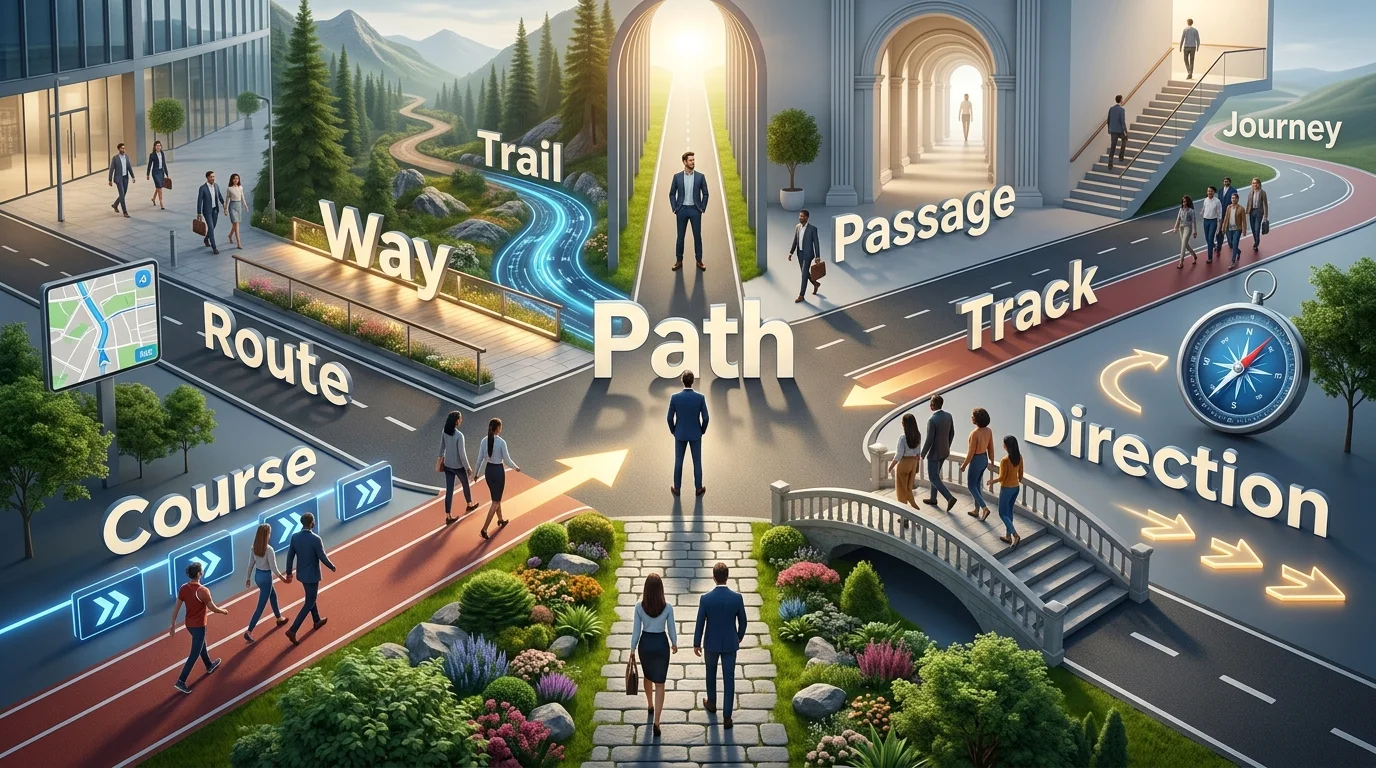
Best Synonyms for “Path” by Context
| Context | Best Alternatives |
|---|---|
| Walking | footpath, walkway, trail |
| Hiking | trail, track, route |
| Driving | road, route, highway |
| Navigation | route, direction, course |
| Life | way, journey, course, direction |
| Career | career path, trajectory, progression |
| Success | route, way, road, avenue |
| Strategy | approach, course, method |
| Problem-solving | approach, method, way |
| Business | route, approach, strategy, direction |
| Development | trajectory, progression, course |
| Architecture | passage, corridor, walkway |
| Nature | trail, track, footpath |
| Transportation | route, road, corridor |
| Opportunity | avenue, gateway, route |
| Decision-making | course of action, approach, way forward |