
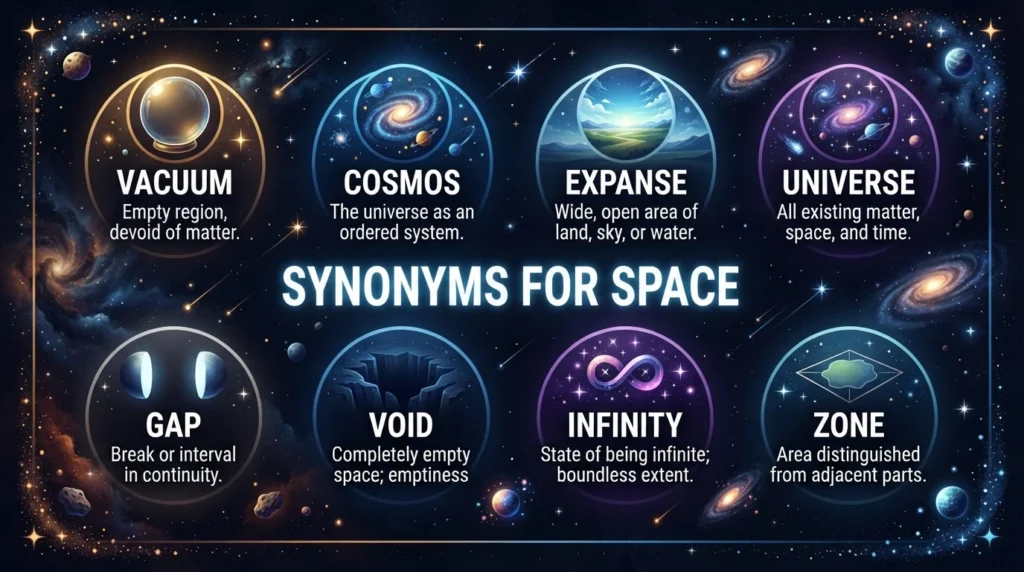
Quick Synonym List
Meaning of synonyms for space | |
|---|---|
Available room | Room, capacity, clearance, storage, accommodation |
A physical area | Area, place, location, spot, zone, section |
An empty interval | Gap, opening, interval, separation, distance |
A large open area | Expanse, stretch, vastness, open area |
An enclosed area | Room, chamber, compartment, enclosure |
Personal synonyms for space | Privacy, distance, breathing room, personal room |
Outer synonyms for space | Cosmos, universe, outer space, interplanetary space |
A workplace or activity area | Workspace, office, studio, facility, venue |
An opportunity or freedom | Scope, latitude, freedom, leeway, breathing room |
Empty synonyms for space | Void, emptiness, vacuum, blank area |
Important: These are not interchangeable in every sentence. A gap between two objects, an area of land, and the cosmos are all associated with synonyms for space, but they describe different concepts.
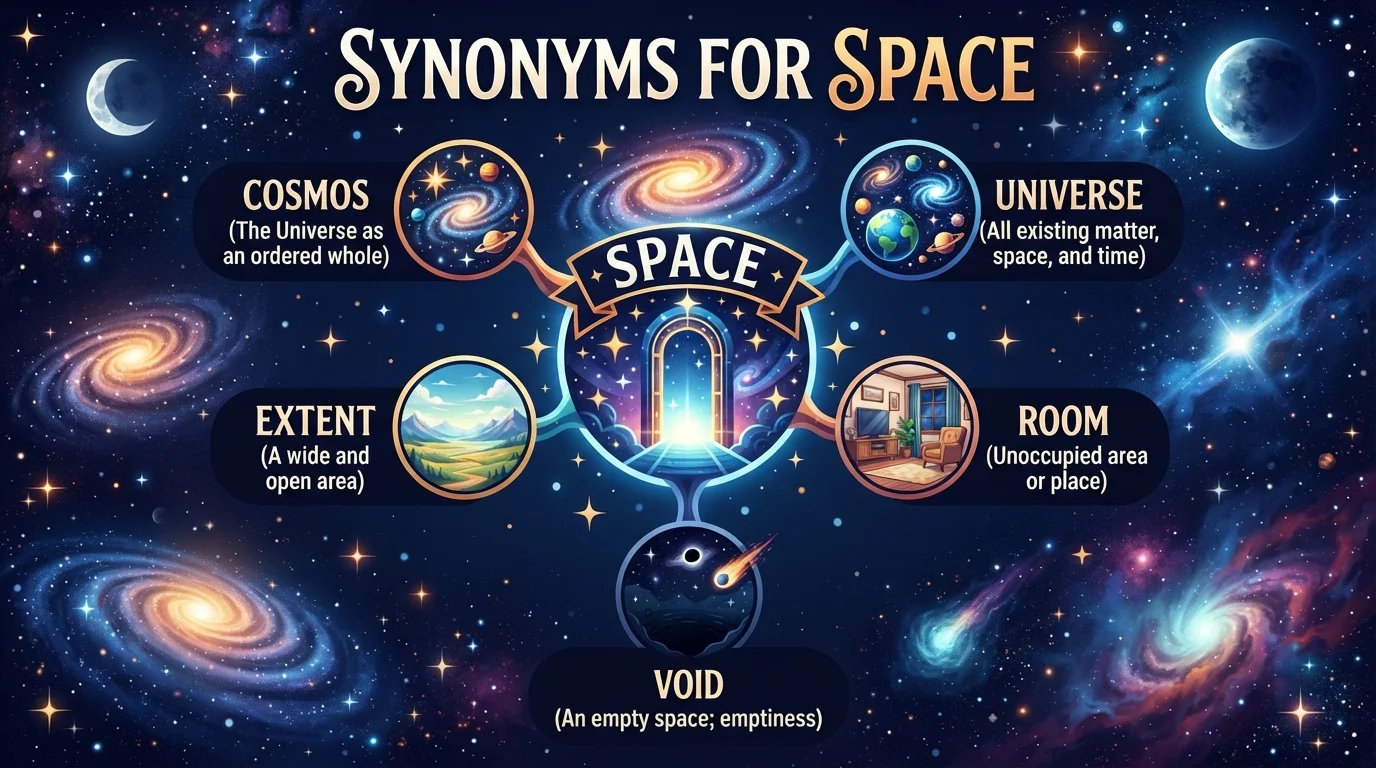
What Does “Space” Mean?
Space is a noun and verb with several distinct meanings. As a noun, it can refer to an empty or available area, the distance between objects, a particular location, the universe beyond Earth, or freedom to act and think.
For example:
“We need more synonyms for spacein the kitchen.” — available room.
“Leave some synonyms for spacebetween the chairs.” — a gap or distance.
“The park provides space for outdoor activities.” — an area.
“Scientists study objects in space.” — the region beyond Earth.
“Give me some space to think.” — privacy, freedom, or breathing room.
As a verb, space means arranging things at intervals: “synonyms for Space the chairs evenly.”
The correct synonym depends on which meaning is intended.
The Best Synonyms for Space
1. Room
Meaning: An amount of available space that can accommodate someone or something.
Tone: Neutral.
Best for: Homes, vehicles, storage, seating, and everyday situations.
Example: There’s enough room in the car for another passenger.
How it differs: Room emphasizes available capacity rather than a particular physical location.
2. Area
Meaning: A particular part of a surface, place, or region.
Tone: Neutral.
Best for: Geography, buildings, workplaces, measurements, and designated locations.
Example: The building includes a separate area for meetings.
Watch out: Area does not necessarily mean empty or available space.
3. Place
Meaning: A particular position, location, or area.
Tone: Neutral.
Best for: Everyday conversation, seating, locations, and designated positions.
Example: We found a quiet place to study.
How it differs: Place identifies a location, while space can emphasize its size or availability.
4. Gap
Meaning: An empty interval or opening between two objects, surfaces, or points.
Tone: Neutral.
Best for: Physical separation, construction, design, and figurative differences.
Example: Leave a small gap between the table and the wall.
Watch out: A gap is generally a relatively specific empty interval, not an entire area.
5. Distance
Meaning: The amount of separation between two points, objects, or people.
Tone: Neutral.
Best for: Measurements, physical separation, travel, and personal boundaries.
Example: Maintain a safe distance between the vehicles.
How it differs: Distance emphasizes how far apart things are, not the area available around them.
6. Opening
Meaning: An empty or unobstructed place that allows entry, passage, or access.
Tone: Neutral.
Best for: Architecture, construction, doors, windows, and physical structures.
Example: The workers created an opening in the wall.
Watch out: An opening generally provides access or passage, whereas a space may simply be empty.
7. Capacity
Meaning: The amount that something can hold or accommodate.
Tone: Professional or technical.
Best for: Storage, buildings, vehicles, venues, and systems.
Example: The warehouse has sufficient capacity for the additional inventory.
How it differs: Capacity focuses on the amount something can contain rather than its physical dimensions alone.
8. Expanse
Meaning: A large, continuous area, often open or unobstructed.
Tone: Descriptive or literary.
Best for: Landscapes, oceans, deserts, skies, and creative writing.
Example: An enormous expanse of grassland stretched toward the mountains.
How it differs: Expanse suggests breadth and openness rather than a small or enclosed space.
9. Territory
Meaning: An area of land or a domain associated with a particular person, group, or authority.
Tone: Neutral to formal.
Best for: Geography, politics, wildlife, and organizational responsibilities.
Example: The animals defended their territory against intruders.
Watch out: Territory often implies control, ownership, or an established domain.
10. Void
Meaning: An empty space or an absence of something.
Tone: Formal, literary, or technical.
Best for: Creative writing, philosophy, physics, and descriptions of emptiness.
Example: The abandoned building seemed to contain a vast, silent void.
How it differs: Void emphasizes emptiness or absence and can have a dramatic or abstract quality.
11. Zone
Meaning: An area designated for a particular purpose or characterized by specific conditions.
Tone: Neutral or technical.
Best for: Planning, safety, geography, workplaces, and public spaces.
Example: The facility includes a designated loading zone.
Watch out: A zone is defined by its function or characteristics, not necessarily by the amount of space available.
12. Compartment
Meaning: A separate enclosed section used for a particular purpose.
Tone: Neutral or technical.
Best for: Vehicles, furniture, storage, machinery, and buildings.
Example: Store your luggage in the overhead compartment.
How it differs: Compartment describes a specific enclosed section rather than space in general.
13. Clearance
Meaning: The amount of unobstructed space needed for movement, access, or safety.
Tone: Technical or professional.
Best for: Construction, vehicles, machinery, and building design.
Example: The garage provides enough clearance for a large vehicle.
How it differs: Clearance refers specifically to free space around or between objects.
14. Breathing Room
Meaning: Additional space, time, or freedom that reduces pressure or restriction.
Tone: Conversational.
Best for: Personal situations, schedules, budgets, and workplaces.
Example: Extending the deadline gave the team some breathing room.
How it differs: This expression is often figurative rather than a reference to physical space.
15. Cosmos
Meaning: The universe considered as an organized whole.
Tone: Scientific, philosophical, or literary.
Best for: Astronomy, cosmology, science communication, and creative writing.
Example: Astronomers continue to investigate the structure of the cosmos.
Watch out: Cosmos refers to the universe as a whole, whereas outer space generally refers to the region beyond Earth’s atmosphere.
Synonyms for Space by Context
Space in a Room or Building
When describing available space inside a building, room, capacity, storage, clearance, and floor area are useful alternatives.
Original | Alternative | Why |
|---|---|---|
We need more space in the kitchen. | We need more room in the kitchen. | Natural for available room. |
The warehouse has limited space. | The warehouse has limited storage capacity. | Emphasizes how much it can hold. |
Leave enough space above the cabinet. | Leave enough clearance above the cabinet. | Specifies unobstructed space. |
The apartment has a large living space. | The apartment has a large living area. | Identifies a particular part of the home. |
Space Between Objects
Use gap, distance, interval, separation, or clearance, depending on the relationship between the objects.
A gap is an empty interval, while distance describes how far apart objects are. Clearance is more technical and often relates to safe movement or access.
For example, “Leave some space between the shelves” can become “Leave a small gap between the shelves.”
Open Space
For large outdoor areas, consider expanse, open area, stretch, clearing, field, or open ground.
A large, continuous area, such as an expanse of grassland or desert.
An open area within a forest or other wooded location.
An unobstructed area available for activities, movement, or public use.
Outer Space
In astronomy, related expressions include outer space, interplanetary space, interstellar space, intergalactic space, cosmos, and universe.
The region beyond Earth’s atmosphere, although its exact boundary is defined differently for different purposes.
The region between planets within a planetary system.
The universe considered as a whole, including matter, energy, space, and time.
These are related astronomical terms, not exact synonyms. For example, interstellar space specifically means the region between stars, while universe includes far more than the empty regions between celestial objects.
Personal Space
Personal space can refer to the physical distance someone prefers to maintain around themselves or, more figuratively, privacy and freedom from demands.
Useful alternatives include privacy, distance, breathing room, independence, freedom, and time alone.
For example:
I need some space to think.
Could become:
I need some time alone to think.
However, “Please respect my personal space” usually concerns physical boundaries and should not automatically be rewritten as a request for privacy.
Space in Writing and Design
In typography and visual design, related terms include whitespace, blank space, spacing, margin, padding, and gap.
Whitespace is an unoccupied area in a design. A margin is space outside a content area, while padding generally refers to space inside the boundary of an element.
These distinctions matter in graphic design, web design, and document formatting.
Space vs. Room vs. Area vs. Gap
The broad term for an area, volume, or separation
There is enough space for another desk.
Available capacity
There is enough room for another desk.
A defined part of a location
This area is reserved for office furniture.
An empty interval between objects
Leave a gap between the desk and the wall.
True Synonyms vs. Related Alternatives
Alternative | Relationship | Can replace space? | Best context |
|---|---|---|---|
Room | Close synonym | Often | Available space |
Area | Near synonym | Sometimes | Defined locations |
Place | Contextual alternative | Sometimes | Particular positions |
Gap | Specific type of space | Sometimes | Empty intervals |
Distance | Related concept | Sometimes | Separation |
Opening | Specific type of space | Sometimes | Access or passage |
Capacity | Related concept | Sometimes | Storage or accommodation |
Expanse | Specific type of space | Sometimes | Large open areas |
Territory | Contextual alternative | Sometimes | Controlled areas |
Void | Contextual alternative | Sometimes | Emptiness |
Zone | Related concept | Sometimes | Designated areas |
Compartment | Specific type of space | Sometimes | Enclosed sections |
Cosmos | Related astronomical term | In limited contexts | Astronomy |
Privacy | Figurative alternative | Sometimes | Personal space |
How to Choose the Right Alternative
What kind of space are you describing?
Suitable alternative
Room
There’s enough room for another chair.
10 Sentence Transformations
Original | Better alternative | Why |
|---|---|---|
We need more space in the office. | We need more room in the office. | Emphasizes available capacity. |
The building has a space for meetings. | The building has a designated meeting area. | Identifies its purpose. |
Leave some space between the chairs. | Leave a gap between the chairs. | Specifies an empty interval. |
The vehicle has limited storage space. | The vehicle has limited storage capacity. | Focuses on how much it can hold. |
A large space stretched before us. | A vast expanse stretched before us. | Creates a descriptive sense of scale. |
Give me some space to think. | Give me some time alone to think. | Clarifies the personal meaning. |
The project needs more space in the schedule. | The project needs more flexibility in the schedule. | Expresses figurative freedom. |
The machine requires additional space above it. | The machine requires additional overhead clearance. | Uses precise technical language. |
The astronauts traveled through space. | The astronauts traveled through outer space. | Makes the astronomical meaning explicit. |
Add more space around the image. | Add more whitespace around the image. | Uses design terminology. |
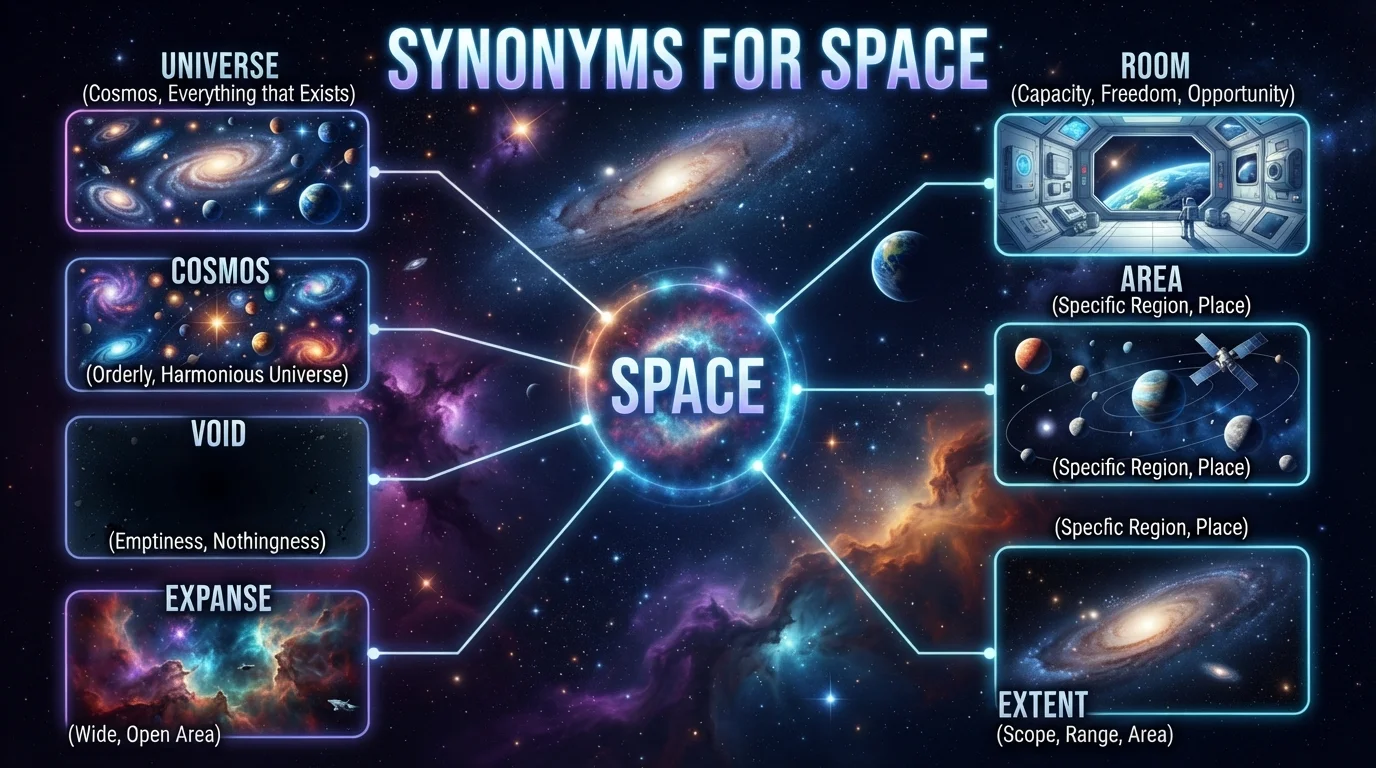
Grammar and Usage
Space can be countable or uncountable, depending on its meaning.
As an uncountable noun, it often refers to available room: “We don’t have enough space.”
As a countable noun, it can refer to a particular location or designated area: “The parking lot has several empty spaces.”
As a verb, space means arranging things at intervals: “Space the plants evenly.”
Common combinations include living space, storage space, office space, parking space, open space, personal space, outer space, floor space, empty space, and public space.
Common Mistakes
Using room for every meaning of space. Room works for available capacity but not as a general substitute for outer space.
Confusing area with available space. An area can be completely occupied.
Using gap for an entire location. A gap generally refers to an interval or opening.
Treating cosmos and outer space as identical. The cosmos refers to the universe as a whole.
Confusing personal space with privacy. Personal space can refer specifically to physical distance.
Using capacity for physical dimensions. Capacity concerns how much something can hold or accommodate.
Using void for ordinary empty areas. Void often sounds technical, abstract, or dramatic.
Replacing space unnecessarily. It is often the most natural and precise word.
When “Space” Is the Better Word
Space is often preferable when referring to a general area, an unspecified amount of room, or several kinds of physical separation at once.
For example, “The new apartment has plenty of space” is natural and clear. Replacing space with capacity would make the sentence sound unnecessarily technical.
Similarly, outer space is an established term. Replacing it with cosmos can change the meaning and scope.