
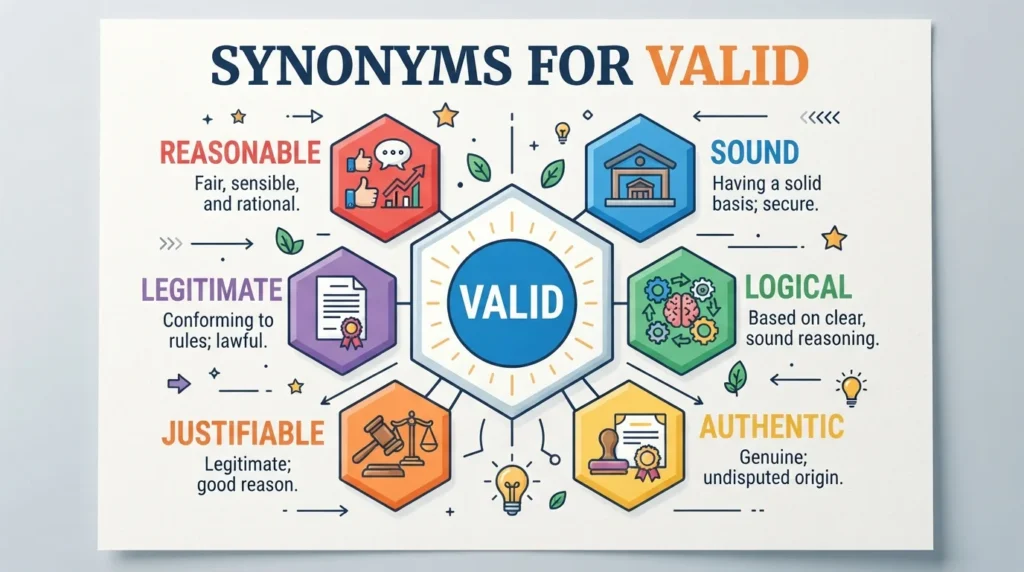
Quick Synonym List
Meaning of valid | Alternatives |
|---|---|
Logically sound | Sound, logical, well-reasoned, coherent, defensible |
Reasonable or justified | Reasonable, justified, well-founded, warranted, substantiated |
Legally valid | Lawful, legally binding, enforceable, legally effective |
Officially accepted | Recognized, authorized, approved, accepted, admissible |
Genuine or legitimate | Legitimate, authentic, genuine, bona fide |
Currently usable | Current, active, unexpired, in force, effective |
Credible or convincing | Credible, convincing, persuasive, supportable |
Technically valid | Correct, well-formed, compliant, acceptable |
Key distinction
Valid has several meanings that should not be confused. A valid argument is logically sound, a valid passport is unexpired and officially accepted, and a valid reason is justified or acceptable. An argument can be logically valid even when its premises are false.
What Does “Valid” Mean?
Valid is an adjective describing something that meets the requirements for acceptance, has sufficient justification, follows the rules of logic, or remains officially effective.
Its meaning changes according to the noun it describes.
A valid argument follows a logical structure in which the conclusion must be true if the premises are true.
A valid reason provides acceptable grounds for an action or decision.
A valid contract meets the applicable legal requirements.
A valid passport is officially recognized and has not expired.
A valid point is relevant or sufficiently well-founded to deserve consideration.
A valid email address meets the required format or verification criteria, depending on the context.
These distinctions are essential when choosing a synonym.
The Best Synonyms for Valid
1. Legitimate
Meaning: Lawful, genuine, or acceptable according to established rules or standards.
Tone: Neutral to formal.
Best for: Concerns, requests, businesses, claims, authority, and official situations.
Example: The customer raised a legitimate concern about the unexpected charge.
How it differs: Legitimate emphasizes authenticity or recognized acceptability. It does not necessarily establish that a claim is factually correct.
2. Acceptable
Meaning: Meeting the minimum requirements or standards for approval.
Tone: Neutral.
Best for: Explanations, documents, answers, behavior, and procedures.
Example: A digital copy is an acceptable form of identification for this application.
Watch out: Something can be acceptable without being ideal, convincing, or legally valid.
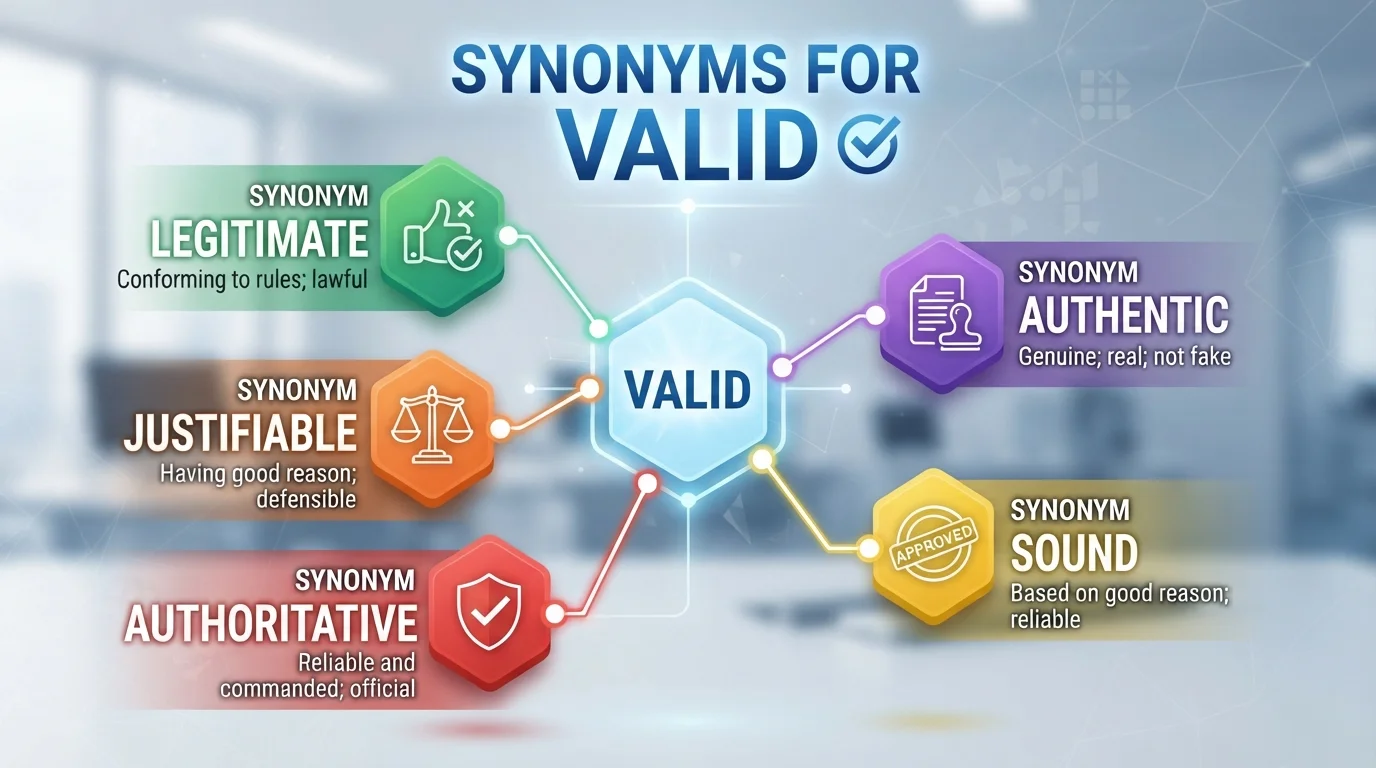
3. Sound
Meaning: Based on reliable reasoning or evidence, or free from serious defects.
Tone: Neutral to formal.
Best for: Reasoning, decisions, arguments, methods, and advice.
Example: The committee presented a sound argument for revising the procedure.
Watch out: In formal logic, sound is more specific than valid: a sound argument is valid and has true premises.
4. Reasonable
Meaning: Sensible, fair, or supported by an appropriate degree of judgment.
Tone: Neutral or professional.
Best for: Requests, explanations, expectations, objections, and decisions.
Example: She offered a reasonable explanation for the delay.
How it differs: Reasonable focuses on whether something makes sense in the circumstances, rather than whether it meets formal rules.
5. Justified
Meaning: Supported by sufficient reasons, evidence, or circumstances.
Tone: Neutral to formal.
Best for: Decisions, concerns, actions, complaints, and conclusions.
Example: The additional safety precautions were justified by the risks.
Watch out: A justified decision is not necessarily a legally valid one.
6. Well-founded
Meaning: Based on strong reasons, evidence, or reliable information.
Tone: Formal or professional.
Best for: Concerns, suspicions, arguments, claims, and criticism.
Example: Her concerns about the project’s costs were well-founded.
How it differs: Well-founded emphasizes the basis for a belief or claim.
7. Credible
Meaning: Believable or worthy of trust.
Tone: Neutral or professional.
Best for: Sources, witnesses, explanations, reports, and claims.
Example: The investigation relied on credible sources.
Watch out: A credible claim is believable, but that does not automatically make it true.
8. Convincing
Meaning: Capable of persuading someone that something is true or reasonable.
Tone: Neutral.
Best for: Explanations, arguments, evidence, and presentations.
Example: The researcher provided a convincing explanation of the results.
How it differs: Convincing describes persuasive force. An argument can be convincing without being logically valid.
9. Lawful
Meaning: Permitted by law or conducted according to legal requirements.
Tone: Formal or legal.
Best for: Actions, procedures, activities, and official authority.
Example: The organization must have a lawful basis for processing personal information.
Watch out: Lawful is not a universal substitute for valid. A lawful action and a valid contract involve different legal questions.
10. Authorized
Meaning: Officially permitted or approved by someone with the required authority.
Tone: Professional or formal.
Best for: Access, transactions, personnel, procedures, and documents.
Example: Only authorized employees can access these records.
How it differs: Authorized emphasizes permission, whereas valid may refer to a wider range of requirements.
11. Binding
Meaning: Creating an obligation that must be followed, particularly in legal agreements.
Tone: Formal or legal.
Best for: Contracts, agreements, commitments, and decisions.
Example: The parties entered into a legally binding agreement.
Watch out: An agreement’s legal validity and enforceability depend on the applicable law and circumstances. These concepts should not automatically be treated as identical.
12. Current
Meaning: Still applicable, up to date, or presently in effect.
Tone: Neutral.
Best for: Licenses, permits, certifications, documents, and information.
Example: Applicants must provide a current driver’s license.
How it differs: Current emphasizes present applicability. It does not necessarily establish that a document meets every other validity requirement.
13. Unexpired
Meaning: Not yet past its expiration date.
Tone: Neutral or administrative.
Best for: Passports, identification, licenses, subscriptions, and certificates.
Example: Travelers must present an unexpired passport.
Watch out: An unexpired document may still be invalid if it has been revoked, canceled, or otherwise disqualified.
14. Effective
Meaning: Producing an intended result or currently operating with legal or official force.
Tone: Neutral to formal.
Best for: Policies, agreements, rules, dates, and procedures.
Example: The revised policy becomes effective on October 1.
How it differs: Effective can mean successful in everyday language or officially operative in legal and administrative contexts.
15. Correct
Meaning: Free from error or meeting specified technical requirements.
Tone: Neutral.
Best for: Answers, calculations, information, formats, and technical inputs.
Example: The application requires a correctly formatted phone number.
Watch out: A logically valid argument is not necessarily factually correct, and a correctly formatted email address may not actually exist.
Synonyms for Valid by Context
Valid Reason
For a valid reason, useful alternatives include legitimate, reasonable, justified, acceptable, well-founded, and warranted.
For example:
She had a valid reason for missing the appointment.
Depending on the intended meaning:
She had a legitimate reason for missing the appointment.
She had a reasonable explanation for missing the appointment.
Her absence was justified by the circumstances.
Legitimate emphasizes acceptability, reasonable emphasizes good judgment, and justified suggests that the circumstances provide sufficient grounds.
Valid Argument
The most suitable alternatives depend on whether you mean formal logic or everyday reasoning.
Alternative | What it emphasizes |
|---|---|
Logically valid | The conclusion necessarily follows from the premises |
Sound | Logical validity plus true premises, in formal logic |
Well-reasoned | Careful and coherent reasoning |
Coherent | Ideas that fit together consistently |
Defensible | A position that can be supported against criticism |
Persuasive | An argument’s ability to convince an audience |
Well-supported | An argument backed by sufficient evidence |
In formal logic, validity concerns the relationship between premises and conclusion, not whether the premises are actually true.
Valid vs. sound arguments
All birds are mammals.
All mammals are reptiles.
Therefore, all birds are reptiles.
The conclusion follows from the premises’ structure, but the premises are false.
All squares are rectangles.
All rectangles have four sides.
Therefore, all squares have four sides.
The reasoning is valid, and both premises are true.
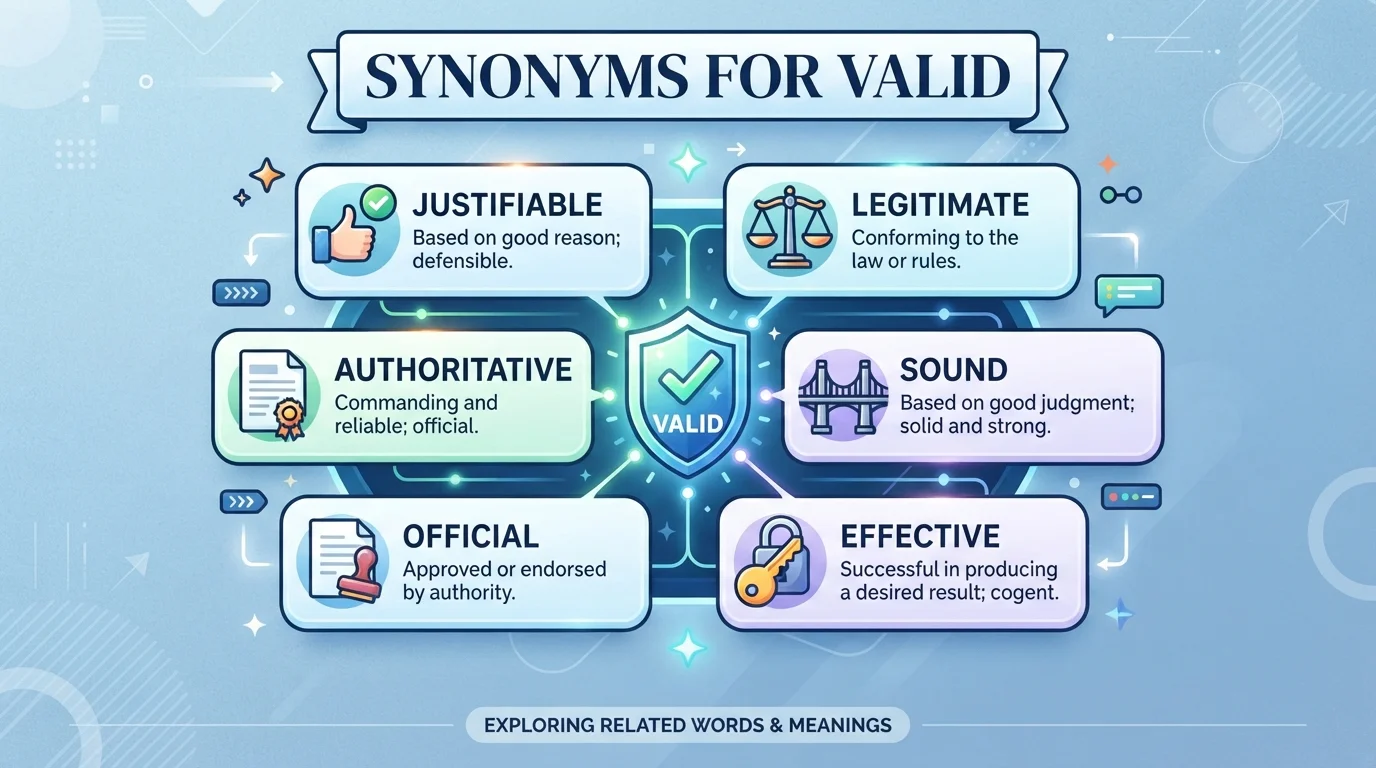
Valid Point
For a valid point, consider reasonable point, fair point, legitimate concern, relevant observation, or well-founded criticism.
For example, “You make a valid point about the deadline” can become “You make a fair point about the deadline.”
Fair point is especially natural in conversation when acknowledging someone else’s observation without necessarily agreeing with their entire argument.
Valid Contract or Agreement
In legal contexts, alternatives and related terms include legally valid, lawful, binding, enforceable, effective, and duly executed.
These terms have distinct meanings. A contract may be validly formed but subject to questions about enforceability, and a duly executed document is not automatically legally valid in every respect.
Use the precise term required by the applicable law and situation.
Valid Passport, License, or Certificate
Useful alternatives include current, unexpired, active, recognized, and in force.
A current license is one that remains applicable. An unexpired passport has not passed its expiration date. An active subscription is currently operating. None of these terms guarantees that every other validity requirement has been met.
Valid Data or Technical Input
For technical writing, use correct, well-formed, compliant, acceptable, verified, or authenticated, according to the requirement being tested.
A well-formed email address follows the expected syntax. A verified email address has undergone a verification process. An authenticated user has had their identity checked by the relevant system. These are different properties.
True Synonyms vs. Related Alternatives
Alternative | Relationship | Can replace valid? | Best context |
|---|---|---|---|
Legitimate | Close synonym | Often | Reasons and concerns |
Acceptable | Near synonym | Sometimes | Standards and requirements |
Sound | For reasoning, with care | Arguments and decisions | |
Reasonable | Near synonym | Often for reasons | Explanations and requests |
Justified | Near synonym | Often for actions | Decisions and concerns |
Well-founded | Contextual alternative | Sometimes | Evidence-based claims |
Credible | Related alternative | Sometimes | Sources and explanations |
Convincing | Related alternative | Sometimes | Persuasive arguments |
Lawful | Contextual alternative | Sometimes | Legal actions |
Authorized | Contextual alternative | Sometimes | Permission and access |
Binding | Specific legal term | Sometimes | Agreements |
Current | Contextual alternative | Sometimes | Documents and licenses |
Unexpired | Narrower term | Sometimes | Time-limited documents |
Correct | Related alternative | Sometimes | Technical inputs |
Verified | Related alternative | Sometimes | Checked information |
Which Synonym Should You Choose?
Choose the meaning you want to express.
Suitable alternative
Legitimate or reasonable
She provided a legitimate explanation for the delay.
10 Sentence Transformations
Original | Better alternative | Why |
|---|---|---|
She has a valid reason for leaving early. | She has a legitimate reason for leaving early. | Emphasizes acceptability. |
His concerns are valid. | His concerns are well-founded. | Emphasizes supporting evidence. |
That’s a valid point. | That’s a fair point. | Sounds natural in conversation. |
The proposal is valid. | The proposal is reasonable. | Emphasizes sensible judgment. |
The argument is valid. | The argument is logically valid. | Makes the technical meaning explicit. |
The evidence supports a valid conclusion. | The evidence supports a well-founded conclusion. | Emphasizes the evidentiary basis. |
You need a valid passport. | You need an unexpired passport. | Specifies the expiration requirement. |
The employee has valid access. | The employee has authorized access. | Identifies permission as the requirement. |
Enter a valid email address. | Enter a correctly formatted email address. | Specifies the formatting requirement. |
The agreement is valid from Monday. | The agreement takes effect on Monday. | Clarifies when it begins operating. |
Grammar and Natural Usage
Valid is an adjective. Its related forms include validity (noun), validate (verb), validation (noun), and invalid (adjective).
Common combinations include valid reason, valid argument, valid point, valid claim, valid contract, valid passport, valid license, valid identification, valid evidence, and valid until.
The verb validate has different meanings. It can mean confirming that something meets requirements, establishing support for a conclusion, or acknowledging someone’s feelings or experience. These meanings should not be confused.
Common Mistakes
Treating valid and true as identical. A logically valid argument may contain false premises.
Using sound as a universal synonym. Its technical meaning in logic is more demanding than validity alone.
Assuming credible means proven. Credibility concerns believability, not certainty.
Confusing legitimate with legal. A legitimate concern need not involve a legal question.
Assuming unexpired means valid. A document may be revoked or otherwise unacceptable before its expiration date.
Using binding and enforceable interchangeably. Legal validity, binding effect, and enforceability can involve different requirements.
Confusing correctly formatted data with verified data. An email address can have correct syntax without belonging to a functioning mailbox.
Replacing valid with convincing in formal logic. Persuasiveness is not the same as logical validity.
When “Valid” Is the Better Word
Keep valid when it expresses a specific technical, legal, administrative, or logical requirement more accurately than a proposed alternative.
For example, “The argument is valid” is appropriate in a logic exercise, while “The argument is convincing” describes a different property. Similarly, “Please provide valid identification” may be preferable to “Please provide current identification” if the requirements include more than an expiration date.