
Quick Answer
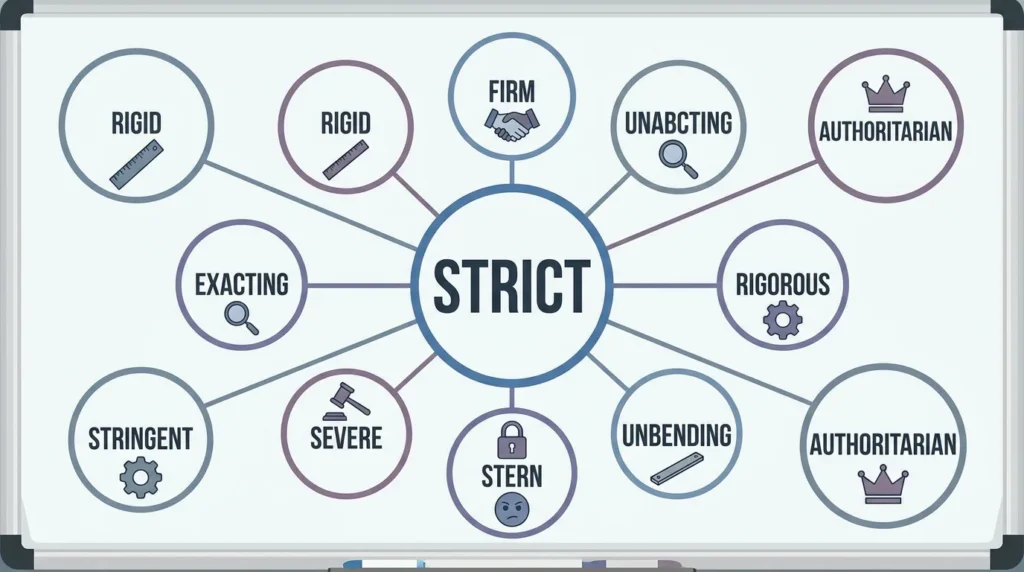
The closest synonyms for strict include:
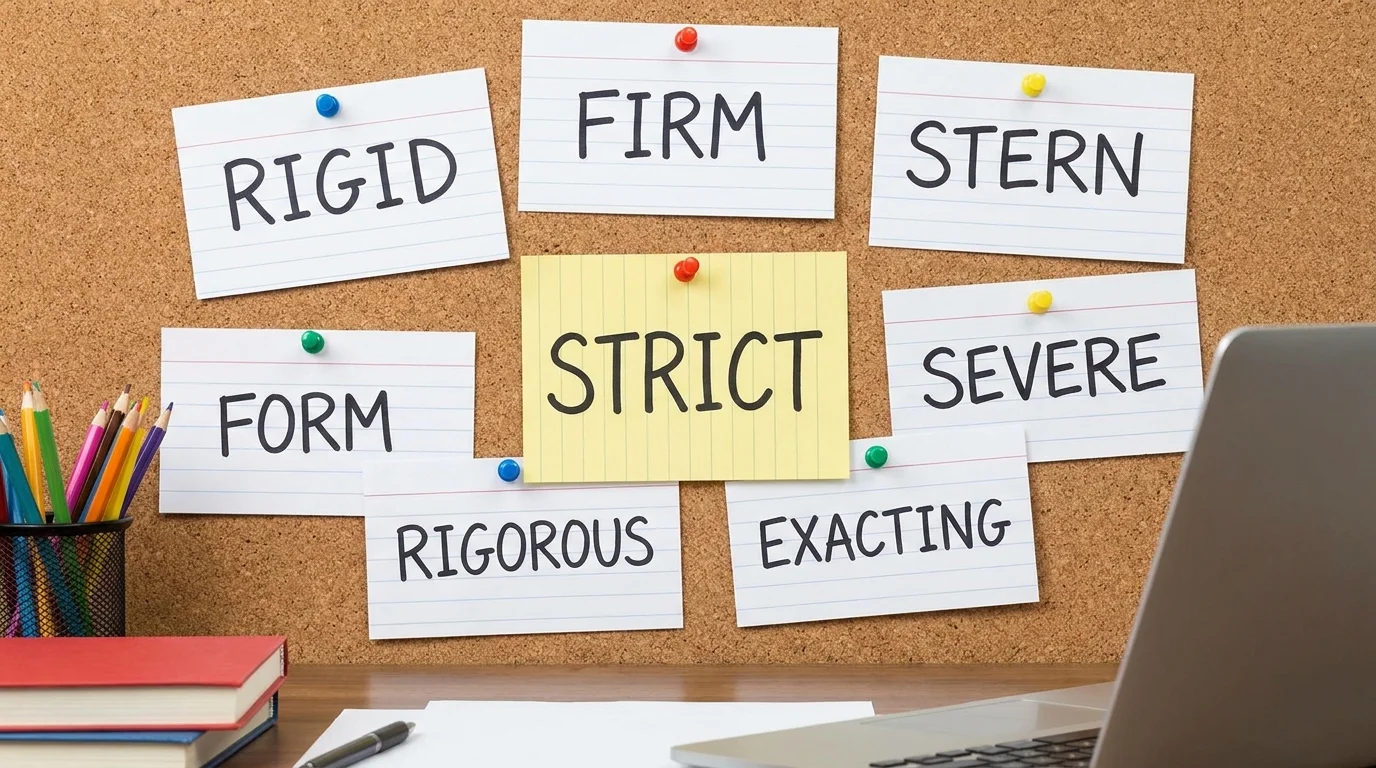
firm, stern, rigid, stringent, rigorous, exacting, severe, uncompromising, disciplined, demanding, authoritative, inflexible, tough, harsh, precise, restrictive, uncompromising, formal, controlled, and meticulous.
The best choice depends on the context:
- Strict person: firm, stern, tough, demanding, authoritative
- Strict rules: stringent, rigorous, rigid, restrictive
- Strict requirements: mandatory, stringent, exacting, non-negotiable
- Strict discipline: firm, severe, rigorous, uncompromising
- Strict standards: rigorous, exacting, high, demanding
- Strict control: tight, rigid, close, restrictive
- Strict interpretation: literal, exact, rigid, narrow
- Strict schedule: rigid, fixed, tightly controlled
- Strict diet: restrictive, controlled, disciplined
- Strictly accurate: exact, precise, rigorous
Quick Synonym List
| Synonym | Best used when you mean |
|---|---|
| firm | Strong and consistent without necessarily being harsh |
| stern | Serious and authoritative |
| rigid | Not flexible or open to exceptions |
| stringent | Very demanding requirements or rules |
| rigorous | Extremely thorough or demanding |
| exacting | Requiring a high level of precision or effort |
| severe | Very harsh or serious |
| uncompromising | Refusing to relax a position or standard |
| inflexible | Unwilling or unable to adapt |
| demanding | Requiring considerable effort or performance |
| authoritative | Showing strong authority |
| disciplined | Controlled and consistently following rules |
| restrictive | Limiting freedom or choice |
| harsh | Unpleasantly severe |
| tough | Firm or difficult, often informally |
| precise | Exact and carefully defined |
| literal | Following the exact meaning or wording |
| formal | Following established procedures or conventions |
| tight | Closely controlled or limited |
| meticulous | Extremely careful about details |
What Does “Strict” Mean?
Strict generally means demanding exact obedience to rules, standards, instructions, or expectations.
The school has strict rules about attendance.
It can also describe a person who expects people to follow rules closely:
Her teacher is very strict.
Another common meaning is precise or exact:
The instructions must be followed in the strictest sense.
So strict has several related senses:
- Firm about rules
- Demanding high standards
- Not allowing exceptions
- Severely controlled
- Exact or literal
The right synonym depends on which sense you intend.
Closest Synonyms for Strict
1. Firm
Firm is often the best alternative when you want a positive or neutral version of strict.
The manager is strict about deadlines.
The manager is firm about deadlines.
Firm suggests consistency and determination without necessarily implying cruelty.
Best for: teachers, parents, managers, leaders, boundaries, decisions, policies.
2. Stern
Stern describes someone who is serious, authoritative, and not easily persuaded.
The principal was strict with the students.
The principal was stern with the students.
Unlike firm, stern can make a person sound intimidating or severe.
Best for: teachers, parents, judges, expressions, warnings, authority figures.
3. Rigid
Rigid emphasizes a lack of flexibility.
The company has strict procedures.
The company has rigid procedures.
This can suggest that exceptions are not permitted.
It often has a negative connotation when describing people or systems.
He has a rigid approach to management.
Best for: rules, schedules, procedures, systems, policies, interpretations.
4. Stringent
Stringent is especially useful for rules, regulations, requirements, and standards that are unusually demanding.
The government introduced strict safety regulations.
The government introduced stringent safety regulations.
It is more formal than strict and is common in professional, legal, academic, and technical writing.
Best for: regulations, requirements, standards, security measures, eligibility criteria.
5. Rigorous
Rigorous means extremely thorough, demanding, or exact.
The researchers followed strict testing procedures.
The researchers followed rigorous testing procedures.
It usually has a positive or neutral connotation.
A rigorous process is demanding because it is designed to maintain quality or accuracy.
Best for: research, testing, analysis, standards, education, methodology.
6. Exacting
Exacting describes requirements or standards that demand a high level of accuracy, skill, or effort.
The job has strict requirements.
The job has exacting requirements.
It emphasizes difficulty rather than simply obedience.
Best for: standards, employers, tasks, craftsmanship, performance, requirements.
7. Severe
Severe means very serious or harsh.
The school has strict disciplinary measures.
The school has severe disciplinary measures.
Be careful with this synonym. Severe is generally stronger and more negative than strict.
Best for: punishment, penalties, consequences, criticism, weather, conditions.
8. Uncompromising
Uncompromising describes someone or something that refuses to relax its position or standards.
She is strict about quality.
She is uncompromising about quality.
It emphasizes refusal to make exceptions.
Best for: principles, standards, leaders, positions, demands, quality expectations.
9. Inflexible
Inflexible means unwilling to change, adapt, or make exceptions.
The deadline is strict.
The deadline is inflexible.
The word usually carries a negative implication because flexibility is often considered desirable.
Best for: schedules, policies, rules, attitudes, deadlines, systems.
10. Demanding
Demanding describes something that requires considerable effort, ability, or compliance.
The coach has strict expectations.
The coach has demanding expectations.
It does not necessarily mean unfair or harsh.
Best for: teachers, coaches, jobs, standards, tasks, expectations.
Strict Synonyms for People
When describing a person, choosing the right synonym is especially important because the emotional tone can change significantly.
Firm
My manager is firm but fair.
Positive or neutral.
Stern
The teacher gave us a stern warning.
Serious and authoritative.
Tough
Our coach is tough but supportive.
Informal and often positive.
Demanding
She is a demanding supervisor.
Focuses on high expectations.
Authoritative
He has an authoritative leadership style.
Focuses on legitimate authority rather than harshness.
Severe
The judge was severe in his criticism.
Much stronger and more negative.
Uncompromising
She is uncompromising about professional standards.
Emphasizes refusal to lower expectations.
Rigid
He has a rigid management style.
Emphasizes lack of flexibility.
Strict Synonyms for Rules
When strict describes rules, the strongest alternatives include:
- stringent
- rigorous
- rigid
- restrictive
- tough
- demanding
- inflexible
- firm
- exact
- closely enforced
Examples
The company has strict security rules.
The company has stringent security rules.
The company has rigorous security requirements.
The company has rigid security procedures.
Each version emphasizes something different.
Stringent = demanding
Rigorous = thorough and carefully enforced
Rigid = inflexible
Restrictive = limiting freedom
Strict Synonyms for Standards
When talking about quality or performance, rigorous and exacting are often better than strict.
The university maintains strict academic standards.
Possible alternatives:
The university maintains rigorous academic standards.
The university maintains exacting academic standards.
The university maintains high academic standards.
Difference
Rigorous emphasizes thoroughness.
Exacting emphasizes difficulty and precision.
High emphasizes the level of performance expected.
Strict Synonyms for Requirements
For requirements, useful alternatives include:
- stringent
- mandatory
- rigorous
- exacting
- essential
- non-negotiable
- compulsory
- inflexible
- specific
- precise
For example:
The application has strict requirements.
Could become:
The application has stringent requirements.
Or:
Several documents are mandatory.
Or:
The application has exacting eligibility criteria.
Don’t use mandatory as a direct synonym for strict in every case. Mandatory means required; it does not necessarily mean difficult or severe.
Strict Synonyms for Control
When strict describes control, these alternatives are useful:
- tight
- rigid
- close
- stringent
- restrictive
- careful
- intensive
- firm
Examples
The facility operates under strict security controls.
The facility operates under tight security controls.
The facility operates under stringent security controls.
Tight is common in business and everyday language.
Stringent sounds more formal.
Rigid emphasizes lack of flexibility.
Strict Synonyms for Discipline
For discipline, consider:
- firm
- stern
- rigorous
- severe
- demanding
- uncompromising
- authoritative
- tough
Compare
The school has strict discipline.
The school has firm discipline.
This sounds controlled but reasonable.
The school has severe discipline.
This sounds much harsher.
The school has rigorous discipline.
This emphasizes consistent standards and enforcement.
Strict Synonyms for a Schedule
A strict schedule usually means there is little room for changes or delays.
The best alternatives are:
- rigid schedule
- fixed schedule
- tight schedule
- inflexible schedule
- set schedule
- closely controlled schedule
Compare
We have a strict schedule.
We have a tight schedule.
Means there is little spare time.
We have a rigid schedule.
Means the schedule cannot easily be changed.
We have a fixed schedule.
Means the schedule has been established and is not expected to change.
Strict Synonyms for a Diet
When describing a strict diet, the most natural alternatives are:
- restrictive
- controlled
- disciplined
- limited
- rigorous
- carefully regulated
She follows a strict diet.
She follows a restrictive diet.
Here, restrictive is often more precise because the important feature is that many foods are limited or prohibited.
Strict vs. Firm
These two are among the closest alternatives.
Strict emphasizes adherence to rules.
Firm emphasizes consistency and determination.
Compare:
The teacher is strict about homework.
The teacher is firm about homework.
The first may suggest that the teacher enforces rules closely. The second suggests that the teacher has a clear position and does not easily give in.
Firm is often the better choice when you want a positive tone.
Strict vs. Stern
Stern is mainly about a person’s manner or demeanor.
The principal is strict.
The principal is stern.
A strict principal enforces rules.
A stern principal appears serious, intimidating, or severe.
Someone can be strict without looking stern.
Strict vs. Rigid
This distinction is particularly important.
Strict = rules are closely followed.
Rigid = there is little or no flexibility.
The company has strict procedures.
This does not necessarily mean the procedures are unreasonable.
The company has rigid procedures.
This suggests employees cannot adapt the procedures even when circumstances change.
Rigid is therefore usually more negative.
Strict vs. Stringent
Stringent is a formal word for requirements, regulations, conditions, or standards that are particularly demanding.
The country has strict environmental laws.
The country has stringent environmental laws.
The second sounds more formal and emphasizes the demanding nature of the regulations.
Use stringent in professional, legal, governmental, and academic contexts.
Strict vs. Rigorous
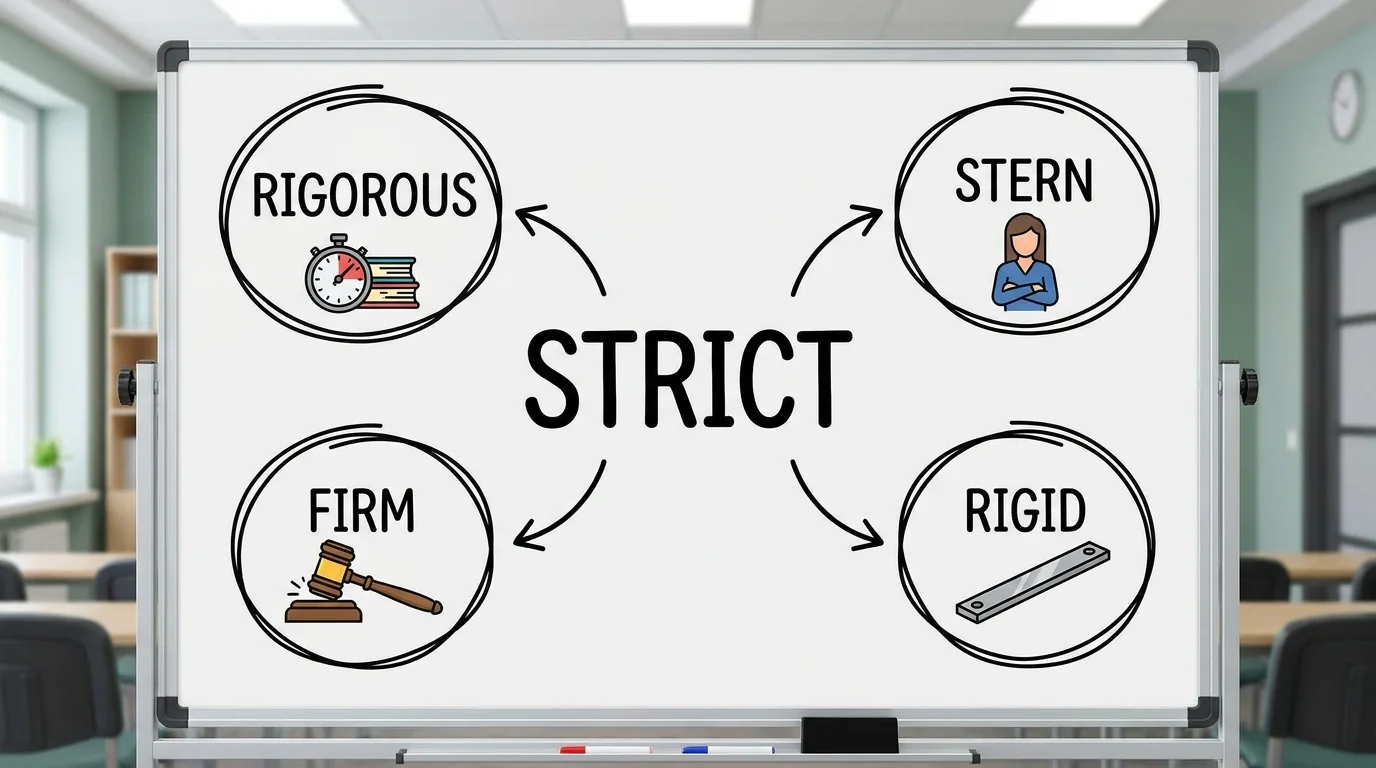
These words overlap but focus on different qualities.
Strict focuses on compliance.
Rigorous focuses on thoroughness, precision, or demanding standards.
The laboratory has strict procedures.
The laboratory uses rigorous procedures.
The first says the procedures must be followed closely.
The second suggests the procedures are carefully designed and thorough.
Strict vs. Harsh
Harsh is considerably more negative.
The teacher is strict.
is relatively neutral.
The teacher is harsh.
suggests that the teacher treats students severely or unpleasantly.
Therefore, don’t automatically replace strict with harsh. If you only mean “firm about rules,” firm is usually safer.
Strict vs. Severe
Severe usually indicates a high degree of seriousness or harshness.
The company has strict penalties.
The company has severe penalties.
The second suggests particularly harsh consequences.
A rule can be strict without the punishment being severe.
Formal and Professional Alternatives
For professional writing, the best alternatives often include:
- stringent
- rigorous
- exacting
- firm
- inflexible
- restrictive
- mandatory
- compulsory
- closely regulated
- tightly controlled
- non-negotiable
Example
Informal:
The company has strict rules about data security.
Professional:
The company maintains stringent data-security requirements.
Academic:
The study followed rigorous methodological standards.
Policy-oriented:
Compliance with these requirements is mandatory.
Casual Alternatives to Strict
In everyday conversation, these words can sound more natural:
- tough
- firm
- hard-line
- no-nonsense
- tight
- demanding
- stern
- unforgiving
Example
My coach is strict.
Casual alternatives:
My coach is tough.
My coach is no-nonsense.
My coach is pretty demanding.
These carry different personalities and tones, so context matters.
Context-Specific Alternatives
| Original phrase | Best alternative |
|---|---|
| strict teacher | firm, stern, demanding |
| strict parent | firm, stern, tough |
| strict boss | demanding, firm, hard-line |
| strict rules | stringent, rigid, restrictive |
| strict regulations | stringent, rigorous |
| strict standards | rigorous, exacting, high |
| strict requirements | stringent, mandatory, exacting |
| strict schedule | rigid, fixed, tight |
| strict diet | restrictive, controlled |
| strict discipline | firm, stern, rigorous |
| strict control | tight, rigid, stringent |
| strict security | tight, stringent |
| strict interpretation | literal, rigid, narrow |
| strict definition | precise, exact |
| strict adherence | faithful, exact, complete |
| strict instructions | precise, explicit, detailed |
| strict policy | rigid, firm, restrictive |
| strict enforcement | rigorous, uncompromising |
Sentence Transformations
Original
The school has strict rules.
Neutral:
The school has firm rules.
Formal:
The school has stringent regulations.
Negative:
The school has rigid rules.
Limiting:
The school has restrictive rules.
Original
She is a strict teacher.
Positive:
She is a firm teacher.
Serious:
She is a stern teacher.
High expectations:
She is a demanding teacher.
Informal:
She is a tough teacher.
Original
The company has strict safety requirements.
Formal:
The company has stringent safety requirements.
Demanding:
The company has exacting safety requirements.
Technical:
The company maintains rigorous safety standards.
Common Mistakes When Choosing a Synonym for Strict
Mistake 1: Treating “strict” and “harsh” as identical
They aren’t.
Strict means rules are closely enforced.
Harsh means unpleasantly severe.
The manager is strict about deadlines.
doesn’t necessarily mean:
The manager is harsh about deadlines.
Mistake 2: Using “rigid” when you only mean consistent
Rigid implies a lack of flexibility.
She is strict but reasonable.
doesn’t necessarily mean:
She is rigid but reasonable.
If the person allows sensible exceptions, firm may be better.
Mistake 3: Using “mandatory” as a general synonym
Mandatory means required.
Wearing a helmet is mandatory.
It does not automatically mean that the rule is strict.
A requirement can be mandatory but easy to satisfy.
Mistake 4: Using “stringent” in casual conversation
My mom has stringent rules about cleaning my room.
This is grammatically correct, but it sounds unusually formal.
My mom is strict about cleaning my room.
is more natural.
Mistake 5: Assuming “severe” always means strict
Severe describes intensity or harshness.
severe punishment
severe weather
severe pain
It is not a universal substitute for strict.
Grammar and Usage
Strict is primarily an adjective.
Common structures include:
Strict + noun
strict rules
strict standards
strict requirements
strict discipline
strict regulations
strict control
strict supervision
Be strict about + noun/gerund
She is strict about punctuality.
He is strict about following instructions.
Be strict with + person/group
The teacher is strict with her students.
Strictly + verb/adjective/adverbial phrase
The rules must be strictly followed.
Strictly speaking, that isn’t correct.
The adverb strictly is particularly common in expressions such as:
- strictly prohibited
- strictly forbidden
- strictly controlled
- strictly enforced
- strictly confidential
- strictly speaking
- strictly limited
- strictly necessary
When Not to Replace “Strict”
Sometimes strict is the most natural and precise word.
Use strict when you simply mean that rules or standards are closely enforced without wanting to suggest that they are:
- harsh
- inflexible
- excessively demanding
- unfair
- restrictive
- technical
For example:
The restaurant has strict hygiene rules.
This is perfectly clear.
Replacing it with:
The restaurant has severe hygiene rules.
changes the meaning.
Replacing it with:
The restaurant has rigid hygiene rules.
suggests inflexibility.
Replacing it with:
The restaurant has stringent hygiene regulations.
makes the sentence more formal.
The original may be best.
A Simple Decision Guide
Choose firm when you want a fair, controlled tone.
Choose stern when you want seriousness or authority.
Choose tough for an informal description of someone demanding.
Choose rigid when flexibility is absent.
Choose stringent for demanding rules or requirements.
Choose rigorous for thorough standards, methods, or procedures.
Choose exacting for very high expectations.
Choose severe when the rules or consequences are unusually harsh.
Choose uncompromising when exceptions are refused.
Choose restrictive when freedom or choice is limited.
Choose mandatory when something is required.
Choose precise when you mean exact rather than demanding