
Quick Answer
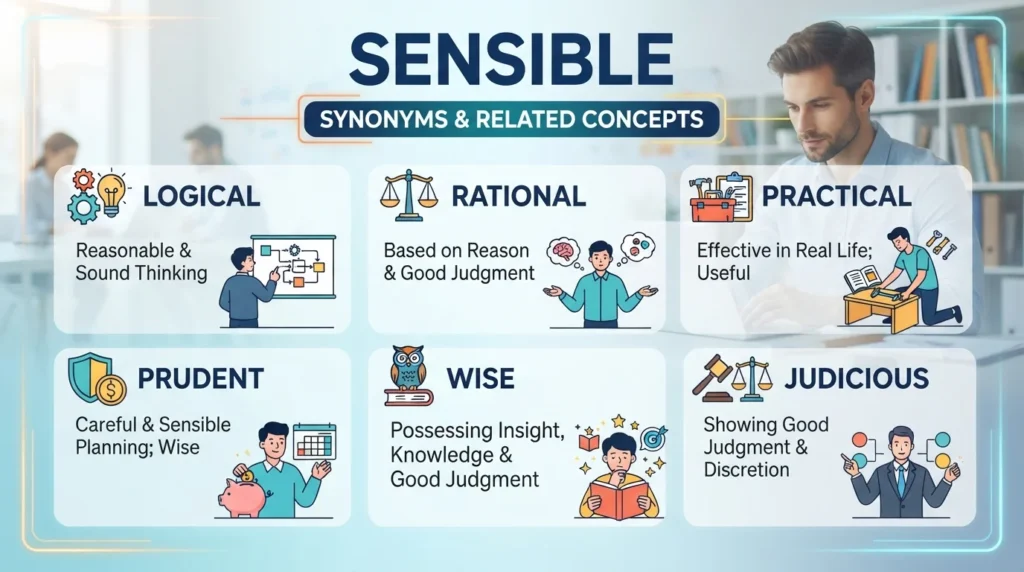
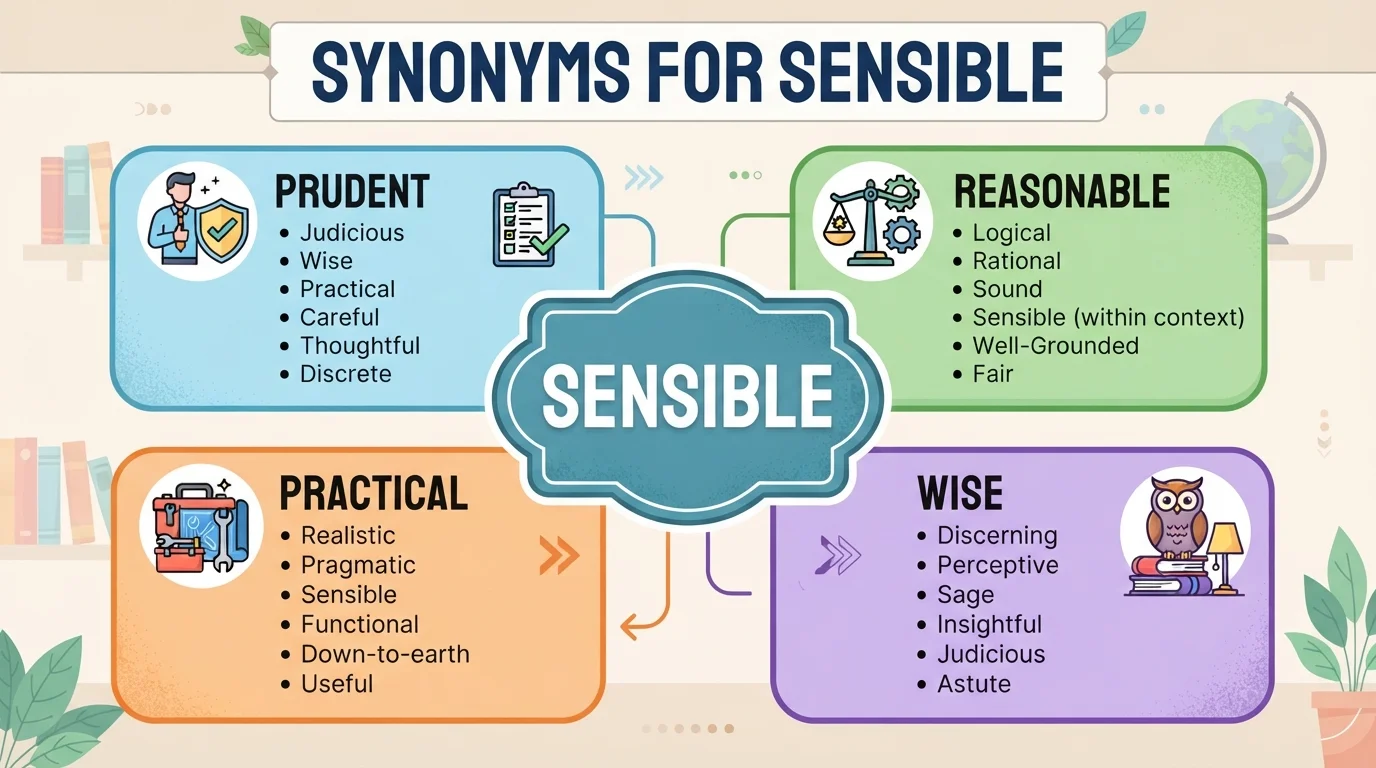
The closest synonyms for sensible include reasonable, practical, wise, prudent, rational, levelheaded, judicious, realistic, and sound. Use reasonable for fair or logical decisions, practical for workable solutions, prudent for careful risk management, and levelheaded for people who remain calm and think clearly under pressure.
Quick Synonym List
Meaning | |
|---|---|
General good judgment | Reasonable, wise, sound, judicious, sensible-minded |
Practical decisions | Practical, realistic, pragmatic, workable, feasible |
Careful judgment | Prudent, cautious, circumspect, thoughtful, measured |
Logical thinking | Rational, logical, clearheaded, analytical, objective |
Calm decision-making | Levelheaded, composed, steady, coolheaded, even-tempered |
Responsible behavior | Responsible, mature, disciplined, conscientious |
Appropriate choices | Suitable, appropriate, fitting, advisable, well-judged |
Informal alternatives | Smart, down-to-earth, no-nonsense, grounded |
Some of these are contextual alternatives rather than direct synonyms. For example, feasible means possible to carry out, while sensible means showing good judgment. A plan can be feasible without being sensible.
What Does Sensible Mean?
Sensible is an adjective with several related meanings. It most commonly describes someone who exercises good judgment or a decision that is practical and reasonable.
“It was sensible to leave early and avoid the traffic.”
It can also describe people who behave responsibly:
“She’s a sensible person who thinks carefully before making decisions.”
In some contexts, sensible describes something appropriate or functional:
“Wear sensible shoes for the long walk.”
Here, sensible means suitable, comfortable, and practical for the activity, rather than fashionable or impressive.
The word can also mean perceptible or noticeable in certain formal or older uses, as in a sensible improvement. That meaning is less common in everyday American English and requires different alternatives, such as noticeable or appreciable.
The Closest Synonyms for Sensible
1. Reasonable
Meaning: Showing fair, sound, or logical judgment.
Tone: Neutral to professional.
Best for: Decisions, requests, expectations, explanations, and people.
Example: “The manager made a reasonable decision based on the available information.
How it differs: Reasonable emphasizes fairness, logic, or what can be justified. Sensible often places more emphasis on practical judgment.
A reasonable request is one that is fair or justified; a sensible request is one that is wise or appropriate under the circumstances.
2. Practical
Meaning: Concerned with what works effectively in real situations.
Tone: Neutral to professional.
Example: “They developed a practical solution to the storage problem.
Practical is particularly useful when a sensible decision is based on real-world constraints, available resources, or ease of use.
However, something can be practical without necessarily being morally right or fair. The words are not universally interchangeable.
3. Wise
Meaning: Showing good judgment, understanding, and awareness of consequences.
Tone: Neutral to positive.
Example: “Saving part of your income is a wise financial habit.”
Wise often suggests deeper insight or experience than sensible. It can describe people, advice, decisions, and long-term choices.
A wise decision may involve ethical or emotional understanding as well as practical judgment.
4. Prudent
Meaning: Showing careful judgment, especially by considering risks and future consequences.
Tone: Formal or professional.
Example: “It would be prudent to review the contract before signing it.”
Prudent is particularly appropriate in financial, legal, business, and risk-management contexts.
It emphasizes caution and foresight more strongly than sensible.
5. Rational
Meaning: Based on reason, evidence, or logical thinking rather than impulse.
Tone: Neutral to formal.
Example: “The team took a rational approach to evaluating the options.”
Rational emphasizes the reasoning process. A rational decision is based on logic, but whether it is sensible also depends on the quality of the information and its practical consequences.
6. Levelheaded
Meaning: Calm and able to make sound decisions, especially during stressful situations.
Tone: Neutral to positive.
Example: “Her levelheaded response helped the team manage the emergency.”
Levelheaded is especially useful for describing people rather than objects or plans.
It combines emotional composure with good judgment.
7. Judicious
Meaning: Showing careful consideration and good judgment.
Tone: Formal.
Example: “The committee made a judicious use of its limited resources.”
Judicious emphasizes thoughtful evaluation and appropriate choices.
It is more formal than sensible and is particularly natural in professional or academic writing.
8. Realistic
Meaning: Based on an accurate understanding of what is possible or likely.
Tone: Neutral.
Example: “They set realistic goals for the first year.”
Realistic is useful when sensible planning involves recognizing limitations and avoiding unrealistic expectations.
A realistic goal is achievable under the circumstances, but it is not automatically a wise or desirable goal.
9. Sound
Meaning: Based on reliable reasoning or good judgment.
Tone: Professional or formal.
Example: “The proposal was based on sound financial principles.”
Sound is particularly useful with nouns such as judgment, advice, reasoning, strategy, and decision.
It is a concise professional alternative to sensible when emphasizing reliability and good reasoning.
10. Thoughtful
Meaning: Showing careful consideration of a situation or the needs of others.
Tone: Neutral to positive.
Example: “She gave a thoughtful response to the difficult question.”
Thoughtful can overlap with sensible when it means carefully considered. However, it can also mean kind or considerate, which is a different sense.
Sensible Synonyms by Context
The most accurate alternative often depends on whether you are describing a person, decision, plan, or action.
A Sensible Person
A sensible person generally thinks before acting, considers consequences, and makes reasonable choices.
Useful alternatives include levelheaded, practical, prudent, responsible, mature, and down-to-earth.
“She’s a sensible manager who stays calm under pressure.”
Possible rewrite:
“She’s a levelheaded manager who stays calm under pressure.”
Levelheaded highlights composure, while responsible emphasizes fulfilling obligations. Down-to-earth suggests a practical, unpretentious personality.
A Sensible Decision
For decisions, consider wise, prudent, reasonable, sound, judicious, and well-judged.
“Postponing the event was a sensible decision.”
“Postponing the event was a prudent decision.”
The second sentence emphasizes caution and consideration of potential risks.
A Sensible Plan
For plans, useful alternatives include practical, realistic, workable, sound, and well-considered.
“We need a sensible plan for reducing expenses.”
“We need a realistic plan for reducing expenses.”
Realistic emphasizes what can actually be achieved. Workable means a plan can function in practice, but it does not necessarily mean the plan is wise.
Sensible Advice
For advice, choose wise, sound, practical, reasonable, or well-considered.
“Her sensible advice helped us avoid unnecessary expenses.”
“Her sound advice helped us avoid unnecessary expenses.”
Sound advice is particularly natural in professional communication.
Sensible Clothing
When sensible describes clothing, footwear, or equipment, it usually means suitable and practical for a particular activity.

Practical
Suitable for the intended activity.
“Wear practical shoes for the hike.”
Suitable for the conditions or occasion.
“Bring appropriate clothing for the weather.”
Comfortable, durable, and functional can also be useful, but they describe specific qualities rather than general good judgment.
Formal and Professional Alternatives
Everyday expression | Professional alternative | Example |
|---|---|---|
A sensible decision | A prudent decision | “A prudent decision would limit unnecessary risk.” |
A sensible approach | A rational approach | “The team adopted a rational approach to the problem.” |
A sensible plan | A realistic plan | “The proposal outlines a realistic implementation plan.” |
Sensible advice | Sound advice | “The consultant provided sound advice.” |
A sensible use of resources | A judicious use of resources | “The department made judicious use of its budget.” |
A sensible response | A measured response | “The organization issued a measured response.” |
A sensible goal | An achievable goal | “The team established achievable targets.” |
Measured is especially useful when describing a calm, restrained response. Achievable means possible to accomplish; it does not by itself establish that a goal is sensible.
True Synonyms vs. Related Alternatives
Alternative | Relationship | Can replace sensible? | Main distinction |
|---|---|---|---|
Reasonable | Close synonym | Often | Emphasizes fairness or justification |
Wise | Close synonym | Often | Suggests insight and good judgment |
Prudent | Near synonym | Often | Emphasizes caution and future consequences |
Practical | Near synonym | In practical contexts | Focuses on real-world usefulness |
Rational | Contextual alternative | When reasoning matters | Emphasizes logic |
Levelheaded | Contextual alternative | Mainly for people | Combines composure and judgment |
Judicious | Formal synonym | Often | Suggests careful evaluation |
Realistic | Related alternative | For goals and plans | Recognizes actual constraints |
Responsible | Related alternative | For behavior and people | Emphasizes obligations |
Feasible | Related alternative | Not generally | Means possible to carry out |
How to Choose the Right Alternative
What are you describing?
Wise · Sound · Well-judged
“Waiting until the weather improved was a wise decision.”
These words emphasize the quality of the decision.
Sentence Transformations
Original | Better alternative | Why |
|---|---|---|
“She made a sensible decision.” | “She made a prudent decision.” | Emphasizes caution and consequences. |
“We need a sensible solution.” | “We need a practical solution.” | Focuses on what will work. |
“He is a sensible person.” | “He is a levelheaded person.” | Highlights calm judgment. |
“That’s a sensible suggestion.” | “That’s a reasonable suggestion.” | Emphasizes fairness and justification. |
“They created a sensible budget.” | “They created a realistic budget.” | Recognizes financial constraints. |
“The manager gave sensible advice.” | “The manager gave sound advice.” | Sounds natural in professional writing. |
“She gave a sensible response.” | “She gave a measured response.” | Emphasizes restraint. |
“Wear sensible shoes.” | “Wear practical shoes.” | Identifies suitability for the activity. |
“He took a sensible approach.” | “He took a rational approach.” | Emphasizes logical thinking. |
“It was sensible to check the figures.” | “It was wise to check the figures.” | Emphasizes good judgment. |
These alternatives work when the context supports the stated meaning; they are not automatic replacements in every sentence.
Sensible vs. Reasonable vs. Practical vs. Prudent
Word | Main emphasis | Example |
|---|---|---|
Sensible | General good judgment | “It was sensible to leave early.” |
Reasonable | Fairness or logical justification | “That’s a reasonable request.” |
Practical | Real-world usefulness | “We need a practical solution.” |
Prudent | Caution and future consequences | “Keeping emergency savings is prudent.” |
Wise | Understanding and judgment | “She made a wise choice.” |
Rational | Logic and evidence | “They reached a rational conclusion.” |
A choice can be practical without being prudent. For example, a shortcut might save time but create unnecessary risks. Likewise, a cautious decision may be prudent without being the most convenient option.
Grammar and Natural Usage
Sensible is an adjective. Its comparative and superlative forms are more sensible and most sensible.
“This option is more sensible than the original proposal.”
“That seems like the most sensible approach.”
The related noun is sensibility, although it has additional meanings involving sensitivity and aesthetic appreciation. Good sense is often a more natural expression when referring specifically to practical judgment.
“She showed good sense by asking for advice.”
The adverb is sensibly.
“They sensibly postponed the trip because of the weather.”
Common combinations include sensible decision, sensible approach, sensible advice, sensible precautions, sensible shoes, and sensible choice.
Common Mistakes
Confusing sensible with sensitive. Sensible means showing good judgment; sensitive can mean easily affected, emotionally responsive, or aware of others’ feelings.
Using feasible as a direct synonym. A feasible plan is possible to carry out, but it may still be unwise.
Treating rational and sensible as identical. Rational describes reasoning; sensible also involves practical judgment and context.
Using cautious for every sensible person. Sensible people may take calculated risks rather than always choosing caution.
Replacing sensible with intelligent. Intelligence describes mental ability, while sensible describes the exercise of good judgment.
Overusing formal alternatives. Judicious and circumspect may be appropriate in formal writing but can sound unnecessarily elaborate in casual conversation.
When Sensible Is the Better Word
Sensible is often preferable when you want to communicate practical good judgment without narrowing the meaning to logic, caution, or feasibility.
“Let’s make a sensible decision.”
This is natural and broad enough to include cost, safety, fairness, and convenience.
Similarly, sensible shoes is a familiar expression that combines practicality, comfort, and suitability. Replacing it with a more formal adjective may make the sentence less natural.