
Quick Answer
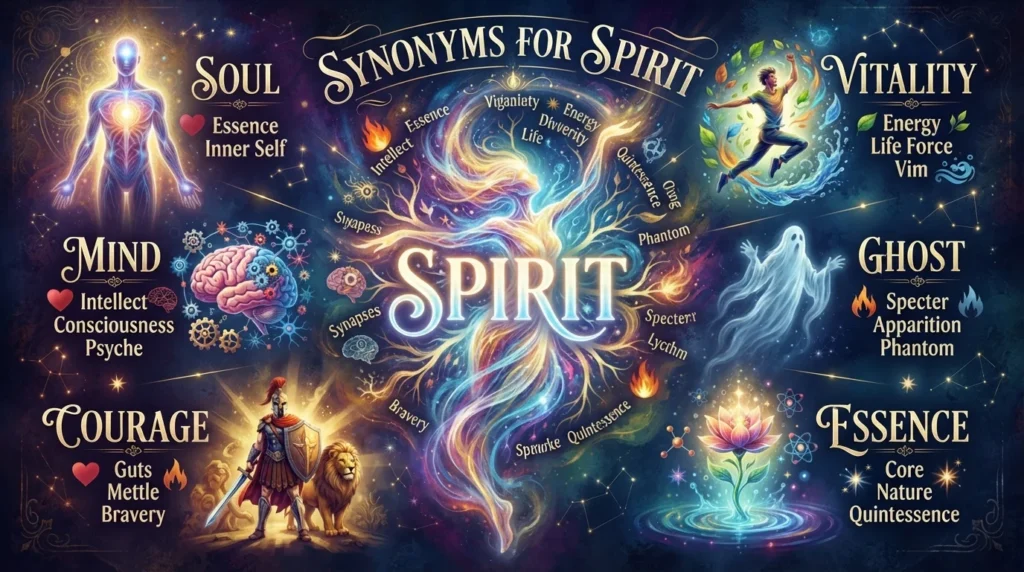
Common synonyms for spirit include soul, essence, character, enthusiasm, energy, vitality, courage, determination, morale, and attitude. Use enthusiasm for excitement, morale for group confidence, determination for persistence, and essence for the central meaning of something. In supernatural contexts, spirit may mean ghost, apparition, or specter.
Quick Synonym List
Here are more than 40 synonyms and related alternatives, grouped by meaning rather than presented as interchangeable words.
Meaning of spirit | |
|---|---|
Enthusiasm and excitement | Enthusiasm, excitement, eagerness, passion, zeal, zest, fervor |
Energy and liveliness | Energy, vitality, vigor, liveliness, dynamism, animation |
Courage, bravery, resolve, determination, grit, fortitude, tenacity | |
Mood and attitude | Mood, attitude, outlook, disposition, frame of mind |
Group confidence | Morale, solidarity, unity, camaraderie, enthusiasm |
Inner character | Soul, character, personality, temperament, nature |
Essential meaning | Essence, core, heart, substance, underlying meaning |
Supernatural being | Ghost, apparition, specter, phantom, supernatural entity |
Independence, individuality, self-reliance, autonomy | |
Informal expressions | Drive, spark, fire, heart, get-up-and-go |
These alternatives belong to different senses of spirit. For example, morale works in “team spirit,” but it cannot replace spirit in “the spirit of the law.”
What Does Spirit Mean?
Spirit is primarily a noun with several distinct meanings.
Meaning | Example | Suitable alternative |
|---|---|---|
Enthusiasm | “She approached the project with great spirit.” | Enthusiasm |
Courage | “He showed remarkable spirit during the competition.” | Determination |
Mood | “Everyone was in high spirits.” | Good mood |
Group attitude | “The team showed excellent spirit.” | Morale |
Inner character | “Her generous spirit inspired others.” | Nature |
Essential meaning | “Respect the spirit of the agreement.” | Underlying intention |
Supernatural being | “The villagers believed a spirit haunted the house.” | Ghost |
Spirit also refers to alcoholic drinks, especially distilled beverages, but that meaning belongs to a separate vocabulary category and is not interchangeable with the emotional or philosophical meanings discussed here.
Closest Synonyms for Spirit
1. Soul
Meaning: The spiritual or immaterial aspect of a person, or their deepest feelings and character.
Tone: Neutral to literary, depending on context.
Example: “Her music seemed to come directly from her soul.”
How it differs: Soul emphasizes someone’s inner being, emotional depth, or spiritual identity. Spirit can express these ideas but also has broader meanings involving enthusiasm, courage, and attitude.
Best for: Literature, philosophy, emotional expression, and discussions of inner character.
2. Essence
Meaning: The fundamental nature or most important quality of something.
Tone: Neutral to formal.
Example: “The essence of the agreement was mutual respect.”
Essence is especially useful when spirit means the central meaning or underlying character of an idea, document, or activity.
It does not normally replace spirit when referring to enthusiasm or courage.
3. Character
Meaning: The qualities that distinguish a person, group, or thing.
Tone: Neutral.
Example: “Her generous character made her popular among her colleagues.”
Character is appropriate when spirit describes someone’s inner qualities or moral nature.
However, character does not automatically suggest energy or enthusiasm.
4. Enthusiasm
Meaning: Strong interest, excitement, or eagerness.
Tone: Neutral and positive.
Example: “The students showed great enthusiasm for the science project.”
Enthusiasm is one of the most useful alternatives when spirit refers to an energetic, positive attitude.
It is more specific than spirit because it focuses on excitement and interest rather than courage or inner character.
5. Energy
Meaning: Liveliness, activity, or the ability to act vigorously.
Tone: Neutral.
Example: “She brought fresh energy to the organization.”
Energy works when spirit emphasizes liveliness and active engagement.
It is not always interchangeable. A person can have strong determination despite having little physical energy.
6. Vitality
Meaning: Physical or mental energy, liveliness, and vigor.
Tone: Neutral to formal.
Example: “The festival brought new vitality to the neighborhood.”
Vitality emphasizes liveliness and a strong capacity for activity.
It is especially natural when describing people, communities, cultures, and creative work.
7. Courage
Meaning: The ability to face fear, danger, or difficulty.
Tone: Neutral and positive.
Example: “She showed remarkable courage during the emergency.”
Courage is a suitable alternative when spirit means bravery or strength in difficult circumstances.
It is narrower than spirit because it focuses specifically on facing fear or hardship.
8. Determination
Meaning: A firm decision to achieve something despite difficulties.
Tone: Neutral and positive.
Example: “His determination helped him complete the demanding training program.”
Determination is particularly useful for expressions such as fighting spirit or a spirit of perseverance.
It emphasizes persistence and commitment rather than enthusiasm alone.
9. Morale
Meaning: The confidence, enthusiasm, and emotional condition of a person or group, especially when facing challenges.
Tone: Neutral to professional.
Example: “Regular communication helped improve employee morale.”
Morale is particularly appropriate in workplaces, schools, sports teams, and organizations.
It overlaps with team spirit, but the two expressions are not identical. Team spirit also emphasizes cooperation and shared identity.
10. Attitude
Meaning: A person’s way of thinking or feeling about something.
Tone: Neutral.
Example: “Her positive attitude helped the team remain focused.”
Attitude is useful when spirit describes someone’s approach to a situation.
Unlike spirit, attitude can be positive, negative, indifferent, or critical.
Synonyms for Spirit When You Mean Enthusiasm
When spirit describes excitement or eagerness, the following alternatives are especially useful.
Passion
Meaning: Strong enthusiasm or deep emotional commitment.
Example: “Her passion for teaching inspired her students.”
Passion suggests a deeper or more lasting emotional investment than ordinary enthusiasm. It works well for interests, careers, creative pursuits, and personal ambitions.
Zeal
Meaning: Great energy and enthusiasm in pursuing a goal or cause.
Example: “The volunteers approached their work with remarkable zeal.”
Zeal is more formal than enthusiasm. It can be positive, but excessive zeal may suggest an overly intense or uncompromising attitude.
Zest
Meaning: Lively enthusiasm and enjoyment.
Example: “She approached every new experience with zest.”
Zest is especially natural in the expression zest for life. It suggests enjoyment, energy, and eagerness.
Fervor
Meaning: Intense enthusiasm or strongly felt emotion.
Example: “The audience responded to the performance with tremendous fervor.
Fervor is stronger and more emotionally intense than enthusiasm. It is often used in discussions of deeply held beliefs, public enthusiasm, and passionate support.
Drive
Meaning: Strong internal motivation to achieve something.
Example: “Her drive to succeed helped her overcome numerous setbacks.”
Drive emphasizes ambition and motivation rather than excitement. It is particularly useful in professional writing and descriptions of personal achievement.
Synonyms for Spirit When You Mean Courage or Determination
A person with fighting spirit is willing to persist despite difficulty. Depending on the situation, you can use the following words.
Alternative | Specific meaning | Example |
|---|---|---|
Resolve | Firm determination | “She maintained her resolve despite the setbacks.” |
Grit | Courage and persistence during difficulty | “Completing the expedition required considerable grit.” |
Fortitude | Mental strength in hardship | “He faced the situation with fortitude.” |
Tenacity | Refusal to give up | “Her tenacity helped her finish the project.” |
Bravery | Willingness to face danger or fear | “The firefighters showed extraordinary bravery.” |
Resilience | Ability to recover or adapt after difficulties | “The community demonstrated resilience after the storm.” |
Perseverance | Continued effort despite obstacles | “His perseverance eventually paid off.” |
These words express different aspects of strength. Bravery emphasizes facing danger, perseverance emphasizes continued effort, and resilience emphasizes recovering or adapting after adversity.
A person may possess all three qualities, but the words are not interchangeable.
Synonyms for Team Spirit and Group Morale
Team spirit describes a shared attitude of enthusiasm, cooperation, and commitment to a group. It is common in sports, workplaces, schools, and volunteer organizations.
Five useful alternatives for team spirit
Morale
The group’s confidence and enthusiasm.
“The successful launch boosted team morale.”
Camaraderie
Mutual trust and friendship among group members.
“The long project created a strong sense of camaraderie.”
Solidarity
Unity and mutual support based on shared interests or goals.
“The employees showed solidarity during a difficult period.”
Unity
The condition of working or acting together.
“The team’s unity helped it overcome several challenges.”
Esprit de corps
Shared pride, loyalty, and enthusiasm among members of a group.
“The rescue team developed a strong esprit de corps.”
Esprit de corps is a borrowed French expression used in English, especially in military and organizational contexts. It is more formal than team spirit and may be unfamiliar to general readers.
Synonyms for Spirit When You Mean Mood
In expressions such as in good spirits, in high spirits, or in low spirits, the word refers to someone’s emotional condition.
Original expression | Natural alternative | Meaning |
|---|---|---|
In good spirits | In a good mood | Feeling cheerful or positive |
In high spirits | Cheerful, upbeat, exuberant | Feeling especially happy or energetic |
In low spirits | Downhearted, discouraged | Feeling unhappy or lacking enthusiasm |
Lift someone’s spirits | Cheer someone up | Improve someone’s mood |
Keep your spirits up | Stay positive | Maintain hope or a positive attitude |
Dampened spirits | Reduced enthusiasm | Less excitement or confidence |
Disposition is another alternative when discussing someone’s usual mood or temperament.
“He has a cheerful disposition.”
Unlike mood, which may change throughout the day, disposition usually describes a more consistent tendency.
Synonyms for Spirit When You Mean Essence or Underlying Meaning
The expression the spirit of something often refers to its central purpose, underlying intention, or defining character.
Core
Meaning: The central or most important part of something.
Example: “Trust is at the core of their working relationship.”
Core is useful when identifying the central principle or feature of an idea.
Heart
Meaning: The central or most meaningful part of something.
Example: “Community involvement lies at the heart of the project.”
Heart is slightly more expressive than core. It often emphasizes emotional or fundamental importance.
Substance
Meaning: The essential content or meaning of something.
Example: “The revisions changed the wording but not the substance of the agreement.”
Substance is particularly useful in formal writing when distinguishing the actual content of something from its appearance or presentation.
Underlying Intention
Meaning: The purpose or intention behind an action, statement, or agreement.
Example: “The proposal follows the underlying intention of the original agreement.”
This phrase is particularly useful when discussing the spirit of the law or the spirit of an agreement.
The spirit of a law generally refers to its underlying purpose rather than only its literal wording. In legal contexts, however, the relationship between purpose and text depends on the applicable law and interpretive approach.
Synonyms for Spirit as a Supernatural Being
When spirit refers to a supernatural or nonphysical being, it belongs to a completely different word sense.
The supposed spirit of a dead person, often believed to appear to the living.
“The old mansion was rumored to be haunted by a ghost.”
A ghostlike figure or unusual appearance, particularly one that appears unexpectedly.
“She claimed to have seen an apparition near the staircase.”

Specter or phantom
Literary alternatives for a ghost or ghostlike presence.
“A shadowy specter appeared in the doorway.”
Other context-dependent alternatives include supernatural being, entity, and presence. These are broader terms, not direct synonyms for a ghost.
Spirit vs. Soul vs. Essence
These three words overlap in philosophical, emotional, and literary writing, but they emphasize different ideas.
Word | Main meaning | Typical use |
|---|---|---|
Spirit | Inner character, attitude, energy, or nonphysical being | “Her adventurous spirit inspired everyone.” |
Soul | Inner being, emotional depth, or spiritual identity | “The music touched his soul.” |
Essence | Fundamental nature or defining quality | “The essence of the story is forgiveness.” |
Character | Distinctive qualities or moral nature | “Her character remained unchanged.” |
Vitality | Liveliness and energy | “The city has remarkable vitality.” |
Soul often carries a stronger spiritual or emotional meaning. Essence is more abstract and focuses on what makes something fundamentally what it is.
Spirit is broader and can describe both a person’s inner nature and their outward enthusiasm or determination.
True Synonyms vs. Related Alternatives
The following table helps distinguish close synonyms from words that work only in particular contexts.
Alternative | Relationship | Can replace spirit? | Tone | Best context |
|---|---|---|---|---|
Enthusiasm | Contextual synonym | When expressing excitement | Neutral | Activities and participation |
Morale | Contextual synonym | When describing confidence | Professional | Groups and workplaces |
Soul | Near synonym | In spiritual or inner-character contexts | Neutral to literary | Inner being |
Essence | Contextual synonym | When expressing fundamental nature | Formal | Ideas and principles |
Courage | Contextual alternative | When describing bravery | Neutral | Difficult situations |
Determination | Contextual alternative | When describing persistence | Neutral | Goals and challenges |
Energy | Contextual alternative | When describing liveliness | Neutral | People and activities |
Attitude | Contextual synonym | When describing outlook | Neutral | Behavior |
Ghost | Contextual synonym | When referring to a deceased person’s supposed spirit | Neutral | Supernatural stories |
Camaraderie | Related alternative | In some team contexts | Neutral | Group relationships |
Comparing the Strongest Alternatives
Word | Meaning | Tone | Strength | Best use | Interchangeable? |
|---|---|---|---|---|---|
Enthusiasm | Eager interest | Positive | Moderate to strong | Excitement | Sometimes |
Passion | Deep emotional commitment | Strong | Strong | Interests and ambitions | Sometimes |
Vitality | Liveliness and energy | Positive | Moderate | People and communities | Sometimes |
Resolve | Firm determination | Serious | Strong | Difficult challenges | Sometimes |
Morale | Confidence and enthusiasm | Professional | Variable | Groups | Sometimes |
Character | Distinctive inner qualities | Neutral | Not applicable | Personality | Sometimes |
Essence | Fundamental nature | Formal | Not applicable | Ideas and meanings | Sometimes |
Ghost | Supposed spirit of a dead person | Neutral | Not applicable | Supernatural contexts | Often |
How to Choose the Right Alternative
What do you mean by “spirit”?
Enthusiasm · Passion · Zest
“She approached the project with enthusiasm.”
Choose passion for deep commitment and zest for lively enjoyment.
Sentence Transformations
1. Enthusiasm
Original: “The students showed great spirit during the competition.”
Better alternative: “The students showed great enthusiasm during the competition.”
Why: Enthusiasm emphasizes excitement and eager participation.
2. Determination
Original: “She never lost her fighting spirit.”
Better alternative: “She never lost her determination.”
Why: Determination emphasizes persistence despite difficulty.
3. Workplace morale
Original: “The announcement improved the team’s spirit.”
Better alternative: “The announcement improved the team’s morale.”
Why: Morale is more precise when describing a group’s confidence and enthusiasm.
4. Inner character
Original: “His generous spirit impressed everyone.”
Better alternative: “His generous nature impressed everyone.”
Why: Nature describes a person’s underlying character.
5. Essential meaning
Original: “The revisions preserved the spirit of the original proposal.”
Better alternative: “The revisions preserved the underlying intention of the original proposal.”
Why: The alternative identifies the proposal’s intended purpose.
6. Emotional condition
Original: “She was in high spirits after receiving the news.”
Better alternative: “She was delighted after receiving the news.”
Why: Delighted directly communicates her emotional response.
7. Courage
Original: “The rescue workers demonstrated extraordinary spirit.”
Better alternative: “The rescue workers demonstrated extraordinary courage.”
Why: Courage specifically describes bravery in dangerous circumstances.
8. Group relationships
Original: “The volunteers developed a strong team spirit.”
Better alternative: “The volunteers developed a strong sense of camaraderie.”
Why: Camaraderie emphasizes friendship and mutual trust.
9. Energy
Original: “The new director brought fresh spirit to the organization.”
Better alternative: “The new director brought fresh energy to the organization.”
Why: Energy emphasizes renewed activity and enthusiasm.
10. Supernatural meaning
Original: “The story describes a mysterious spirit in the old house.”
Better alternative: “The story describes a mysterious apparition in the old house.”
Why: Apparition emphasizes the appearance of a ghostlike figure.
Grammar and Natural Usage
Spirit as a Countable and Uncountable Noun
Spirit can be countable or uncountable, depending on its meaning.
As an uncountable noun, it can describe enthusiasm or a general attitude:
“The team showed tremendous spirit.”
As a countable noun, it can refer to a supernatural being or a particular kind of person:
“The story features three mysterious spirits.”
“She is a free spirit.”
The plural spirits also appears in expressions describing someone’s mood.
“He was in good spirits.”
Common Expressions With Spirit
Expression | Meaning | Example |
|---|---|---|
Team spirit | Shared enthusiasm and cooperation | “The coach encouraged team spirit.” |
Fighting spirit | Determination to continue despite difficulty | “The players maintained their fighting spirit.” |
In good spirits | Cheerful or positive | “She was in good spirits after the visit.” |
In low spirits | Sad or discouraged | “He was in low spirits after the setback.” |
Spirit of adventure | Willingness to explore or try new experiences | “Their spirit of adventure led them overseas.” |
Free spirit | An independent, unconventional person | “Her friends describe her as a free spirit.” |
Spirit of the law | Underlying purpose of a law | “They debated the spirit of the law.” |
Spirit vs. Spiritual
Spirit is usually a noun, while spiritual is an adjective.
“The ceremony reflected the community’s spirit.”
“The ceremony held spiritual significance for many participants.”
Spiritual relates to religion, the soul, or nonmaterial aspects of human experience. It does not generally replace spirited, which means lively, enthusiastic, or courageous.
Common Mistakes
1. Using soul for every meaning of spirit
Soul is useful in spiritual or emotional contexts, but it is not a natural replacement for team spirit or the spirit of the agreement.
2. Confusing morale with morality
Morale means confidence and enthusiasm, particularly within a group.
Morality concerns principles of right and wrong.
“The team’s morale improved.”
“The discussion raised questions about morality.”
3. Treating enthusiasm and determination as identical
Enthusiasm involves excitement or eager interest. Determination involves persistence and commitment.
Someone can be determined to complete an unpleasant task without feeling enthusiastic about it.
4. Using essence for emotional energy
Essence describes fundamental nature or meaning. It does not normally describe someone’s enthusiasm.
Use “She brought energy to the team,” not “She brought essence to the team.”
5. Confusing resilience with courage
Resilience emphasizes recovery or adaptation after difficulty. Courage emphasizes facing fear or danger.
Both can contribute to a strong spirit, but they describe different qualities.
6. Using ghost in philosophical contexts
Ghost commonly refers to the supposed spirit of a deceased person. It is generally unsuitable when discussing a person’s inner character or spiritual identity.
7. Assuming high spirits means strong determination
In high spirits means cheerful or enthusiastic. It does not necessarily mean someone is determined or courageous.
8. Replacing spirit in established expressions
Expressions such as team spirit, free spirit, and the spirit of the law have recognizable meanings. Replacing one word without considering the whole expression may make the sentence unnatural or misleading.
When Spirit Is the Better Word
Spirit is particularly useful when you want to communicate several related qualities at once.
For example:
“The team showed remarkable spirit throughout the tournament.”
This may include courage, enthusiasm, cooperation, and determination. Replacing spirit with only enthusiasm would narrow the meaning.
Similarly, the spirit of an agreement can express its underlying purpose and the attitude in which it was made. Essence may work in some contexts, but it does not always capture the same idea.
In creative writing, spirit can also create a sense of emotional depth that more specific alternatives may lack.
Use a synonym when it clarifies your meaning. Keep spirit when its breadth or familiar phrasing is useful.