
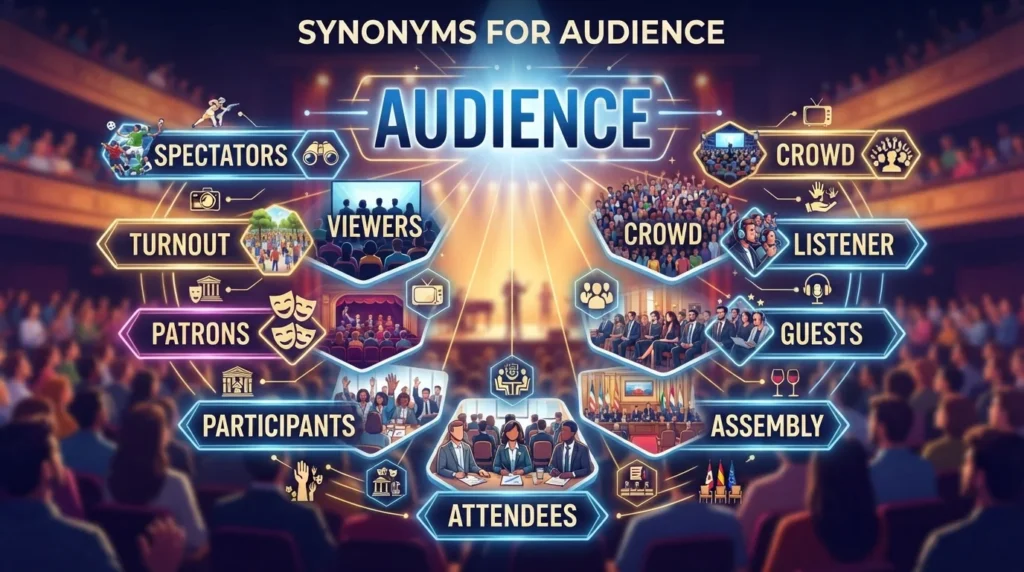
Quick Synonym List
People watching something
- viewers
- spectators
- onlookers
- observers
- watchers
- audience members
People listening
- listeners
- hearers
- radio listeners
- attendees
- audience members
People reading
- readers
- subscribers
- readership
- followers
- visitors
People attending an event
- attendees
- guests
- participants
- spectators
- crowd
- audience members
People reached by content
- followers
- readers
- viewers
- listeners
- subscribers
- users
- consumers
- public
Business and marketing
- target market
- customers
- consumers
- clients
- buyers
- prospects
- customer base
- market
- demographic
- target group
Formal or academic contexts
- readership
- participants
- respondents
- stakeholders
- public
- constituency
- demographic group
- target population
Key distinction: Audience is a broad word for a group of people who receive, watch, hear, read, or attend something. A crowd emphasizes the physical gathering, a target market emphasizes potential customers, and a demographic emphasizes shared characteristics. These words are related but are not interchangeable in every sentence.
What Does “Audience” Mean?
Audience is a noun referring to a group of people who watch, listen to, read, or otherwise receive something.
It can describe people attending a live performance:
The audience applauded at the end of the concert.
It can describe people watching a video:
The show attracted a large online audience.
It can describe people reading something:
The article is written for a general audience.
It can also describe a group targeted by communication, advertising, education, or marketing:
The campaign was designed for a younger audience.
The meaning changes slightly depending on the situation. That is why the best synonym for audience depends on what the people are doing and how they are connected to the content or event.
The Best Synonyms for Audience
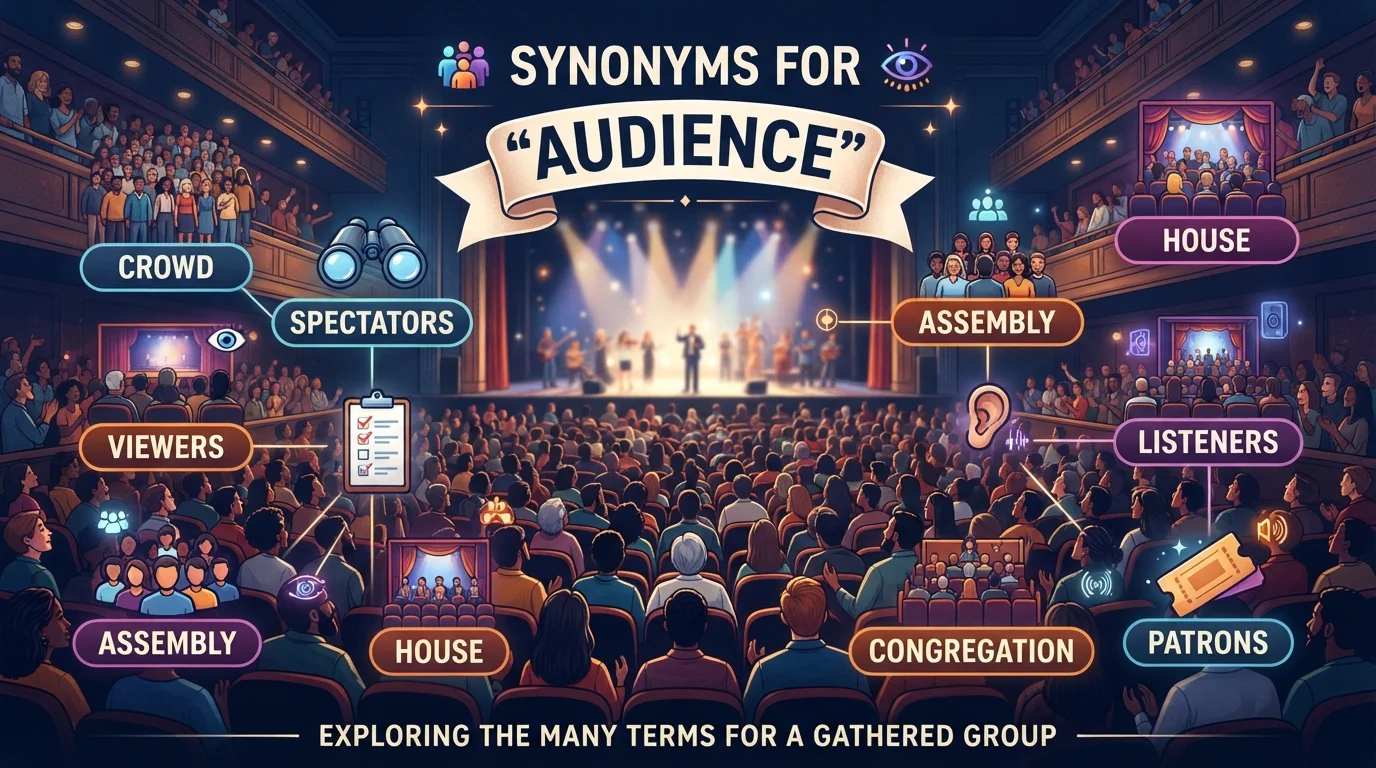
1. Viewers
Viewers are people who watch something, especially television programs, films, videos, livestreams, or online content.
Tone: Neutral and professional.
Best for: Video, television, streaming, social media, and visual content.
Example:
The documentary attracted thousands of viewers.
How it differs: Viewers specifically emphasizes watching. It is therefore more precise than audience when the medium is visual.
The audience enjoyed the documentary.
The viewers watched the documentary online.
Both work, but viewers tells us more about how the audience experienced the content.
2. Listeners
Listeners are people who hear or pay attention to audio content.
Best for: Podcasts, radio, speeches, music, audiobooks, and recorded discussions.
Example:
The podcast has more than 50,000 regular listeners.
How it differs: Use listeners when hearing or listening is the defining activity.
3. Readers
Readers are people who read written material.
Best for: Books, articles, newspapers, blogs, reports, newsletters, and websites.
Example:
The article was written for general readers.
How it differs: Readers is more specific than audience because it identifies the medium.
4. Spectators
Spectators are people who watch an event, especially a sporting event or performance.
Best for: Sports, competitions, races, performances, and public events.
Example:
Thousands of spectators watched the final match.
How it differs: Spectator usually implies watching an event rather than consuming general content.
5. Attendees
Attendees are people who attend an event, meeting, conference, seminar, or gathering.
Best for: Conferences, workshops, meetings, exhibitions, and formal events.
Example:
Conference attendees received a copy of the report.
How it differs: An attendee must be physically or virtually present at an event. An audience can consume content without attending an event.
6. Audience Members
Audience members are individual people who make up an audience.
Best for: Formal writing when you want to avoid repeating audience.
Example:
Several audience members asked questions after the presentation.
This expression is especially useful when referring to individuals within a larger audience.
7. Crowd
A crowd is a large group of people gathered in one place.
Tone: Neutral.
Best for: Concerts, sporting events, demonstrations, festivals, and public gatherings.
Example:
The crowd cheered when the singer appeared on stage.
How it differs: Crowd emphasizes the physical gathering, while audience emphasizes people watching or listening.
A crowd can be present without actually being an audience.
8. Public
The public refers to people generally or to the members of society as a whole.
Best for: Government, public communication, media, announcements, and general information.
Example:
The report was released to the public.
How it differs: Public is much broader than audience. A specific audience is usually a defined group receiving particular communication.
9. Followers
Followers are people who regularly follow a person, organization, brand, or account.
Best for: Social media, influencers, creators, public figures, newsletters, and online communities.
Example:
The creator has built a loyal following of thousands of followers.
How it differs: A follower relationship is usually ongoing. Someone may watch one video without becoming a follower.
10. Subscribers
Subscribers are people who have signed up to receive content or services.
Best for: Newsletters, magazines, newspapers, YouTube channels, podcasts, streaming services, and memberships.
Example:
The newsletter now has more than 10,000 subscribers.
How it differs: Subscribers implies an active subscription. Not every member of an audience is a subscriber.
11. Participants
Participants are people who actively take part in an activity rather than simply watching or listening.
Best for: Workshops, discussions, studies, competitions, training, and interactive events.
Example:
Workshop participants worked together on the final exercise.
How it differs: Participants are active contributors. Audience members may simply observe.
12. Guests
Guests are people invited to attend an event, program, or occasion.
Best for: Parties, ceremonies, interviews, broadcasts, and special events.
Example:
The host welcomed the guests before the ceremony began.
How it differs: Guest emphasizes invitation or hospitality rather than the act of watching or listening.
Audience Synonyms by Context
Audience for a Speech
For a speech, useful alternatives include:
- listeners
- attendees
- audience members
- crowd
- spectators
- delegates
- guests
- participants
Example:
The speaker addressed a large audience.
The speaker addressed a large group of listeners.
The speaker addressed the conference attendees.
The speaker addressed the assembled crowd.
The best choice depends on the setting.
If it is a formal conference, attendees may be appropriate. If it is a public outdoor event, crowd may fit better.
Audience for a Presentation
For a business or academic presentation, consider:
- attendees
- participants
- listeners
- viewers
- colleagues
- delegates
- stakeholders
Example:
The presentation was designed for a professional audience.
More specific:
The presentation was designed for business professionals.
Or:
The presentation was designed for conference attendees.
The second and third versions provide more information than simply replacing audience.
Audience for a Book
For written content, natural alternatives include:
- readers
- readership
- target readers
- subscribers
- book buyers
- literary audience
Example:
The book has a young adult audience.
Possible rewrite:
The book has a young adult readership.
Readership is especially useful when discussing the collective group of people who read a particular publication, author, or type of writing.
Audience for a Website
Depending on the purpose, use:
- visitors
- users
- readers
- followers
- customers
- subscribers
- target audience
- online audience
Example:
The website attracts a global audience.
The website attracts visitors from around the world.
The website serves an international readership.
The website has a global user base.
These alternatives emphasize different relationships with the website.
Audience for Social Media
Social media audiences may be described as:
- followers
- viewers
- subscribers
- users
- fans
- community
- online audience
- social media audience
Example:
The creator has a large audience on Instagram.
Depending on the exact meaning:
The creator has a large following on Instagram.
Following is often more natural when referring to the collective group of people who regularly follow a creator.
Audience in Marketing
Marketing uses audience in a more specialized way.
Common alternatives include:
- target market
- consumers
- customers
- buyers
- prospects
- market segment
- demographic
- customer base
- target group
- consumer group
Target Market
A target market is the group of customers a business intends to serve.
The company’s target market is young professionals.
This is not exactly the same as audience. An advertising audience may include people who see an advertisement but never become customers.
Consumers
Consumers are people who use or purchase goods and services.
The campaign was designed to appeal to younger consumers.
Use this when the commercial relationship matters.
Customers
Customers are people who purchase from a business.
The company surveyed its customers.
A customer base is narrower than a general audience because customers have already bought something.
Prospects
Prospects are potential customers who may be interested in buying.
The campaign generated leads among potential customers and prospects.
This is useful in sales and marketing contexts.
Audience in Advertising
Advertising often distinguishes among several related groups:
| Term | Meaning |
|---|---|
| Audience | People exposed to or receiving the message |
| Target audience | People the message is specifically designed to reach |
| Target market | Potential customers the business wants to serve |
| Consumers | People who use goods or services |
| Customers | People who purchase from the business |
| Prospects | Potential customers |
| Demographic | A group defined by shared characteristics |
These distinctions matter because an advertising audience is not necessarily identical to a company’s customer base.
Audience in Research
In academic and scientific writing, alternatives may include:
- participants
- respondents
- subjects
- study population
- sample
- target population
- research group
- cohort
However, these terms are not true synonyms.
Participants
People actively taking part in a study.
The researchers interviewed 200 participants.
Respondents
People who provide answers to a survey or questionnaire.
Survey respondents reported high satisfaction levels.
Sample
A selected subset of a larger population.
The researchers surveyed a sample of 500 adults.
Target Population
The larger group to which researchers intend to generalize their findings.
The target population consisted of adults aged 18 to 65.
Using audience in a research context may be appropriate when discussing who will read or hear the research, but it should not replace technical terms such as sample or population.
Audience in Media
Different media use different terms for their audiences.
| Medium | Natural term |
|---|---|
| Television | Viewers |
| Film | Viewers |
| YouTube | Viewers / subscribers |
| Podcast | Listeners / subscribers |
| Radio | Listeners |
| Newspaper | Readers / readership |
| Magazine | Readers / readership |
| Blog | Readers / visitors |
| Social media | Followers / users |
| Concert | Audience / spectators |
| Sports event | Spectators / fans |
| Conference | Attendees / delegates |
| Webinar | Attendees / participants |
| Theater | Audience / theatergoers |
This is one of the easiest ways to choose a precise alternative.
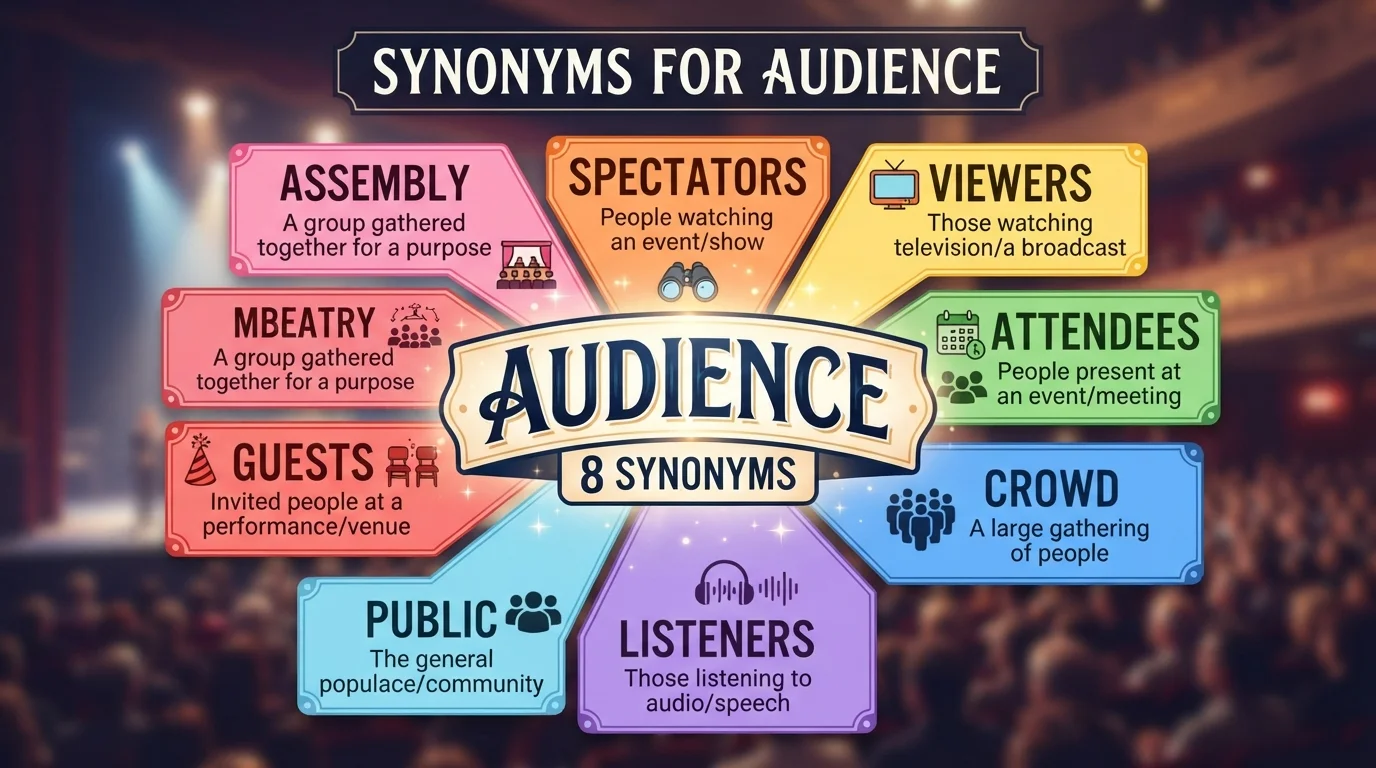
Audience vs. Crowd
Audience and crowd overlap but are not identical.
An audience is a group watching or listening to something.
A crowd is a group of people gathered together.
Compare:
The audience listened quietly to the speaker.
This tells us what the group was doing.
A crowd gathered outside the building.
This tells us that people gathered but does not tell us that they were watching or listening to anything.
A crowd can become an audience when it focuses on a performance, speech, or event.
Audience vs. Viewers
Viewers are specifically people watching visual content.
The program attracted a large audience.
The program attracted millions of viewers.
The second sentence is more specific because it identifies television or video consumption.
Use viewers for television, video, films, livestreams, and visual media.
Audience vs. Readers
Readers are people consuming written content.
The article was written for a general audience.
The article was written for general readers.
Both are possible, but readers makes the medium explicit.
Readership is a collective noun:
The magazine has a large international readership.
Audience vs. Listeners
Listeners are people receiving audio content.
The podcast has a growing audience.
The podcast has a growing number of listeners.
The second version is more precise because podcasts are primarily audio content.
Audience vs. Attendees
Attendees are people who attend an event.
The conference attracted an international audience.
The conference attracted international attendees.
Attendees focuses on attendance. Audience focuses on the people receiving the presentation or program.
Not every attendee necessarily pays attention to every presentation.
Audience vs. Participants
This distinction is especially important.
Audience members generally watch or listen.
Participants actively take part.
For example:
The audience watched the workshop demonstration.
The participants completed the workshop exercises.
The same event can contain both an audience and participants.
Audience vs. Public
The public means people generally, often without a narrowly defined boundary.
The information was made available to the public.
An audience is usually more specific:
The presentation was designed for a technical audience.
Use public when the communication is open to society generally. Use audience when a particular group is being addressed or reached.
Audience vs. Demographic
A demographic is a group defined by characteristics such as age, gender, income, education, location, or other measurable traits.
The campaign targets a younger demographic.
An audience is defined by its relationship to the content or communication.
The campaign targets a younger audience.
A demographic can be part of an audience, but the terms describe different things.
Audience vs. Target Audience
A target audience is a specific group that a creator, organization, educator, or advertiser intends to reach.
The article is written for a general audience.
The article is written for a target audience of college students.
Audience is broader. Target audience emphasizes deliberate selection.
Formal Alternatives to Audience
For formal or professional writing, consider:
- readership
- attendees
- participants
- delegates
- stakeholders
- constituents
- consumers
- target population
- demographic group
- public
- clientele
The appropriate choice depends on the relationship between the people and the communication.
Example
Informal:
The audience liked the presentation.
Professional:
The attendees responded positively to the presentation.
Academic:
The participants evaluated the presentation.
Marketing:
The target audience responded positively to the campaign.
Each version provides a slightly different meaning.
Audience Synonyms for Business Writing
In business communication, avoid replacing audience automatically. Instead, identify the group being discussed.
| If you mean… | Use… |
|---|---|
| People watching a presentation | Attendees |
| People buying products | Customers |
| Potential buyers | Prospects |
| People using products | Consumers |
| People receiving a message | Audience |
| People with an ongoing relationship with a brand | Customer base / followers |
| People who receive newsletters | Subscribers |
| People affected by a decision | Stakeholders |
| A group defined by demographics | Demographic group |
Audience Synonyms for Content Writing
For blogs and websites, useful alternatives include:
- readers
- visitors
- users
- subscribers
- followers
- readership
- target readers
- online audience
- target group
Example
Know your audience before writing the article.
More specific:
Know your readers before writing the article.
Or:
Identify your target readers before writing the article.
Readers works especially well when the content is primarily written text.
Audience Synonyms for Presentations
For presentations, consider:
- attendees
- listeners
- participants
- delegates
- colleagues
- stakeholders
- viewers
For an online presentation:
The webinar attracted 500 attendees.
For an interactive workshop:
The workshop participants completed the exercises.
For a recorded presentation:
The video attracted thousands of viewers.
Audience Synonyms for Speeches
Useful alternatives include:
- listeners
- attendees
- audience members
- crowd
- guests
- delegates
- spectators
The best choice depends on the event.
The speaker addressed the audience.
The speaker addressed the delegates at the conference.
The speaker addressed the crowd outside city hall.
The second and third versions provide more specific information.
Audience Synonyms for Entertainment
For entertainment, use:
- viewers
- spectators
- listeners
- fans
- followers
- theatergoers
- concertgoers
- crowd
Examples:
The film attracted millions of viewers.
The concert excited thousands of fans.
The performance received a standing ovation from the audience.
The theater welcomed hundreds of theatergoers.
These terms emphasize different relationships with the entertainment.
Comparison Table
| Word/Phrase | Main meaning | Tone | Best use | Interchangeable? |
|---|---|---|---|---|
| Audience | People receiving or watching something | Neutral | General use | Yes, broadly |
| Viewers | People watching | Neutral | Video/TV | Sometimes |
| Listeners | People listening | Neutral | Audio/radio | Sometimes |
| Readers | People reading | Neutral | Written content | Sometimes |
| Spectators | People watching an event | Neutral | Sports/events | Sometimes |
| Attendees | People attending an event | Professional | Conferences/events | Sometimes |
| Crowd | People gathered together | Neutral | Public gatherings | Sometimes |
| Followers | People regularly following someone | Informal/neutral | Social media | Sometimes |
| Subscribers | People signed up for content | Professional/neutral | Newsletters/media | Sometimes |
| Participants | People actively taking part | Professional | Workshops/research | No, usually |
| Customers | People who buy | Business | Commerce | No |
| Consumers | People who use goods/services | Professional | Marketing | No |
| Prospects | Potential customers | Business | Sales | No |
| Readership | Collective readers | Formal | Publications | Sometimes |
| Populace | People collectively | Formal | Public/historical writing | Sometimes |
| Public | People generally | Neutral/formal | Public communication | Sometimes |
| Demographic | Group sharing characteristics | Professional | Research/marketing | No |
| Target market | Intended customer group | Business | Marketing | No |
| Community | Connected group | Neutral | Social/local contexts | Sometimes |
| Stakeholders | People with an interest or stake | Professional | Business/projects | No |
How to Choose the Right Synonym
Ask what the group is actually doing.
Watching video
Use viewers.
The video attracted millions of viewers.
Listening to audio
Use listeners.
The podcast has a loyal base of listeners.
Reading content
Use readers or readership.
The article has a broad readership.
Watching a live event
Use spectators or audience.
Thousands of spectators watched the race.
Attending a conference
Use attendees or delegates.
Conference attendees received digital copies of the report.
Actively participating
Use participants.
Participants completed a short survey.
Buying products
Use customers or buyers.
The company surveyed its customers.
Potentially buying products
Use prospects or target market.
The campaign reached thousands of potential prospects.
Following a creator
Use followers or subscribers.
The creator has two million followers.
Referring to a broad public
Use the public.
The findings were presented to the public.
Referring to a specific demographic
Use demographic group.
The study examined several demographic groups.
Sentence Transformations
1. General content
Original:
The article was written for a general audience.
Alternative:
The article was written for general readers.
Why: Readers specifies that the audience is consuming written content.
2. Video
Original:
The channel has a large audience.
Alternative:
The channel has a large number of viewers.
Why: Viewers is more precise for video content.
3. Podcast
Original:
The podcast has a growing audience.
Alternative:
The podcast has a growing number of listeners.
Why: Listeners identifies the audio relationship.
4. Conference
Original:
The audience received a conference program.
Alternative:
Conference attendees received a program.
Why: Attendees identifies people who were present at the event.
5. Research
Original:
The researchers studied their audience.
Alternative:
The researchers studied their participants.
Why: Participants is appropriate when people actively take part in a study.
6. Marketing
Original:
The company wants to reach a younger audience.
Alternative:
The company wants to reach a younger target market.
Why: Target market emphasizes potential customers rather than people simply exposed to the message.
7. Social media
Original:
The creator has a large audience online.
Alternative:
The creator has a large following online.
Why: Following emphasizes an ongoing relationship with the creator.
8. Public event
Original:
A large audience gathered outside.
Alternative:
A large crowd gathered outside.
Why: Crowd emphasizes the physical gathering. It does not imply that the people were watching or listening.
9. Customers
Original:
The campaign was designed for a specific audience.
Alternative:
The campaign was designed for a specific customer group.
Why: The alternative makes the commercial relationship explicit.
10. Formal writing
Original:
The audience responded positively to the proposal.
Alternative:
The attendees responded positively to the proposal.
Why: Attendees is more specific if the people were present at a formal event.
Common Collocations With Audience
Some combinations are much more natural than others.
Common expressions include:
- target audience
- general audience
- specific audience
- wider audience
- broader audience
- large audience
- small audience
- live audience
- online audience
- international audience
- global audience
- younger audience
- adult audience
- professional audience
- academic audience
- audience members
- audience engagement
- audience growth
- audience reach
- audience response
- audience retention
- audience demographics
Common verbs include:
- reach an audience
- attract an audience
- engage an audience
- address an audience
- build an audience
- grow an audience
- understand an audience
- identify an audience
- target an audience
- entertain an audience
- inform an audience
- educate an audience
Common Mistakes
1. Using crowd as a universal synonym
A crowd is simply a group gathered together. It does not necessarily watch or listen to anything.
2. Using customers for every target audience
A target audience may include people who have never purchased the product.
3. Using demographic as a synonym for audience
A demographic is a group defined by characteristics. An audience is defined by its relationship with content or communication.
4. Confusing attendees with participants
Attendees are present at an event. Participants actively take part.
5. Using viewers for written content
Use readers for articles, books, reports, and other written material.
6. Using listeners for visual media
A podcast has listeners; a video has viewers.
7. Assuming followers and audience mean exactly the same thing
A follower has an ongoing connection to a creator or account. An audience member may encounter content only once.
8. Using public when a specific audience is intended
The public is broad. A target audience is usually more narrowly defined.
9. Confusing readership with readers
Readers refers to individuals. Readership refers collectively to the people who read a publication or type of content.
10. Replacing audience simply to avoid repetition
Sometimes audience is the most accurate word. A forced synonym can make the sentence less precise.
When “Audience” Is the Better Word
There are many situations where audience is more useful than a synonym because it does not unnecessarily specify how people interact with the content.
For example:
The campaign reached a large audience.
This could include people who saw an advertisement, heard it, read it, or encountered it through different media.
Replacing audience with viewers would unnecessarily suggest that everyone watched something.
Similarly:
The speaker understood the audience.
This is broader than:
The speaker understood the listeners.
The original could include people watching, listening, or participating in a live presentation.
Use audience when the broader relationship matters more than the specific medium.