
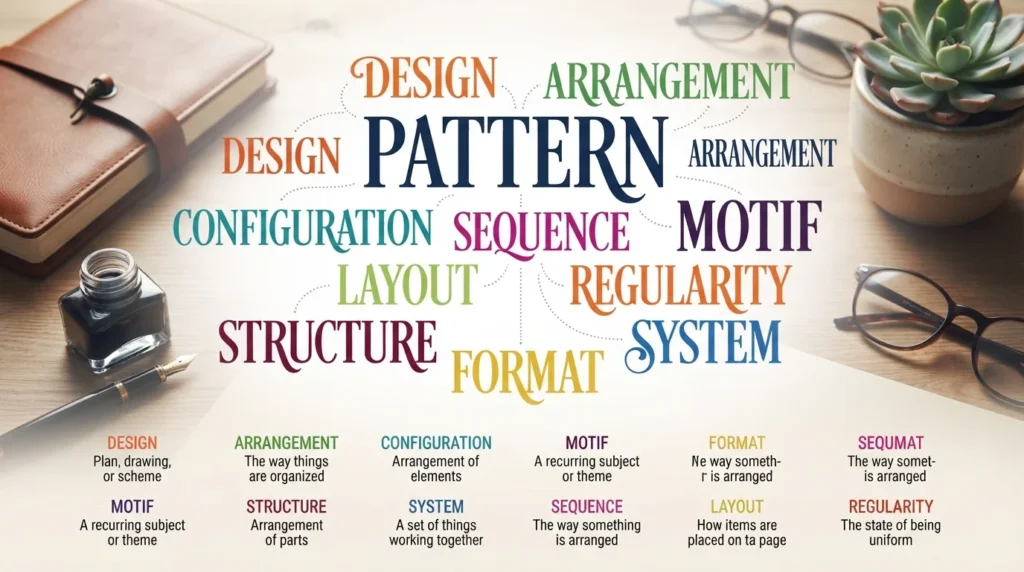
Pattern for Synonyms at a Glance
| Synonym | Meaning | Tone | Best use |
|---|---|---|---|
| Design | An arranged visual form | Neutral | Clothing, graphics, decoration |
| Motif | A repeated decorative or artistic element | Formal/artistic | Art, literature, textiles |
| A decorative design on fabric or material | Neutral | Clothing, fashion | |
| Decorative scheme | Planned visual arrangement | Formal | Interiors, design |
| Arrangement | The way things are positioned | Neutral | Objects, information |
| Configuration | Particular arrangement or setup | Formal/technical | Systems, equipment |
| Structure | The way parts are organized | Neutral/formal | Writing, systems, organizations |
| Form | Shape or arrangement | Neutral/formal | Art, design, physical objects |
| Layout | Arrangement of elements in a space | Neutral | Pages, websites, rooms |
| Template | Standard form used as a guide | Neutral | Documents, processes, design |
| Blueprint | Detailed plan or model | Formal | Projects, construction, strategy |
| Model | Example or representation to follow | Neutral | Systems, behavior, design |
| Framework | Basic structure for organizing something | Formal | Ideas, systems, plans |
| Sequence | Order in which things occur | Neutral/technical | Events, numbers, processes |
| Series | Related things occurring in order | Neutral | Events, measurements, data |
| Cycle | Pattern that repeats over time | Neutral | Seasons, economies, behavior |
| Trend | General direction of change | Neutral | Data, society, markets |
| Tendency | Repeated inclination toward something | Neutral/formal | Behavior, statistics |
| Routine | Regular way of doing things | Neutral | Daily behavior, work |
| Habit | Repeated personal behavior | Neutral | Individuals |
| Practice | Regular or customary way of doing something | Neutral/formal | Work, organizations |
| Recurring theme | Idea appearing repeatedly | Neutral | Writing, art, discussion |
| Regularity | Repeated or consistent arrangement | Formal | Science, mathematics |
| Rhythm | Repeated movement or timing | Neutral/artistic | Music, speech, behavior |
| Progression | Pattern of development or change | Formal | Data, ideas, processes |
| Relationship | Connection between variables or elements | Neutral | Data, analysis |
| Correlation | Statistical relationship between variables | Technical | Research, statistics |
| Distribution | Way something is spread | Technical | Data, populations |
| Sequence | Ordered series of elements | Technical | Mathematics, biology |
| Template | Reusable structure | Neutral | Documents, design, software |
| Prototype | Early model of something | Technical | Product development |
| Archetype | Typical or original example | Literary/formal | Stories, characters, concepts |
| Paradigm | Model or established way of thinking | Formal | Academic, professional |
| Blueprint | Detailed plan for creating something | Formal | Projects, systems |
| Fingerprint | Distinctive identifying pattern | Figurative/technical | Data, behavior, evidence |
| Signature | Distinctive recurring feature | Neutral/formal | Style, behavior, data |
| Formula | Established method or arrangement | Neutral/formal | Mathematics, writing, processes |
| Schema | Organized conceptual structure | Technical | Computing, psychology, research |
| Grid | Regular network or arrangement | Technical/design | Layouts, graphics, maps |
| Mold | Form or model used to shape something | Neutral | Manufacturing, figurative use |
Not all of these are direct synonyms. Several are contextual alternatives that work only for particular meanings of pattern.
What Does “Pattern” Mean?
synonyms for pattern is a noun with several related meanings. At its core, it describes an arrangement, form, behavior, or sequence that can be recognized or repeated.
It can refer to:
- a repeated visual design,
- a recurring behavior or event,
- a recognizable trend,
- an arrangement or structure,
- a model or template,
- an ordered sequence,
- a regular relationship in data or science.
Examples
- The fabric has a floral pattern.
- We noticed a pattern in her behavior.
- Sales follow a seasonal pattern.
- The data shows a clear pattern.
- Use this document as a pattern for future reports.
- The numbers form a repeating pattern.
The meaning changes with the context, so replacing pattern requires identifying the intended sense first.
1. Pattern Meaning “Visual Design”
When synonyms for pattern means a repeated visual design, the closest alternatives include design, motif, print, decoration, and ornamentation.
Design
Design is the broadest everyday alternative.
The shirt has a colorful design.
Use design when you mean the overall visual arrangement rather than specifically a repeating pattern.
Difference:
- pattern → repeated visual arrangement
- design → overall planned visual appearance
A design does not have to repeat.
Motif
A motif is a distinctive repeated element in art, decoration, literature, or music.
The artist used a floral motif throughout the painting.
Best for: art, architecture, literature, textiles, decorative design.
Tone: Formal/artistic.
A motif is usually a specific recurring element, not necessarily the entire pattern.
In fashion and textiles, print can mean a decorative design applied to fabric.
She wore a dress with a floral print.
Best for: clothing, fabric, wallpaper, fashion.
Difference: Print often describes how a design appears on material, while pattern describes the arrangement itself.
Ornamentation
Ornamentation means decorative elements added to something.
The building features elaborate ornamentation.
It is more formal and does not necessarily imply repetition.
2. synonyms for pattern Meaning “Repeated Behavior”
When pattern refers to behavior that happens repeatedly, useful alternatives include habit, routine, tendency, practice, cycle, and recurring behavior.
Habit
A habit is a behavior that someone regularly repeats.
He has developed a pattern of checking his phone before bed.
More specifically:
He has developed a habit of checking his phone before bed.
Best for: individual behavior.
Difference: A habit usually involves a person’s repeated action. A pattern can describe behavior without implying that the behavior is a personal habit.
Routine
A routine is a regular sequence of actions.
Her morning routine follows the same pattern every day.
Use routine when repetition is organized and predictable.
Tendency
A tendency is a tendency or inclination to behave or develop in a particular way.
The data reveals a pattern of declining sales.
The data reveals a tendency toward declining sales.
Difference: Tendency emphasizes direction or inclination, while pattern emphasizes a recognizable recurring arrangement.
Practice
Practice can mean a customary or established way of doing something.
The company has a pattern of reviewing applications weekly.
The company has a practice of reviewing applications weekly.
This works when the repeated behavior is intentional or established.
Recurring behavior
Recurring behavior is a direct phrase-level alternative when clarity matters.
The therapist noticed a pattern of avoidance.
The therapist noticed recurring avoidance behavior.
The second is more explicit but less concise.
3. Pattern Meaning
“Trend or General Direction”
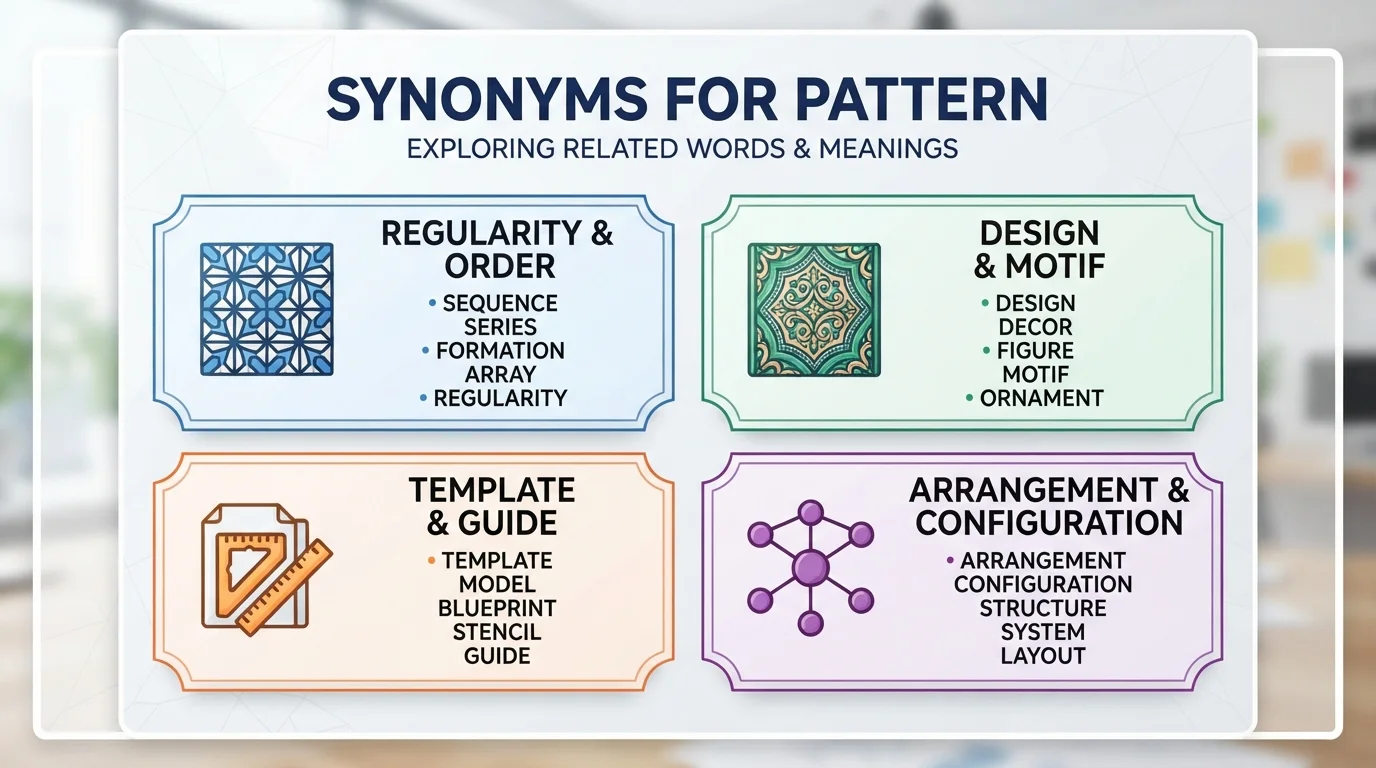
When pattern means a recognizable direction in events or data, consider trend, tendency, development, progression, or trajectory.
Trend
A trend is a general direction in which something is changing or developing.
The data shows a pattern of increasing demand.
The data shows an upward trend in demand.
Best for: statistics, business, economics, social changes, markets.
Important: A trend and a pattern are not identical.
- synonyms for pattern → recognizable arrangement or recurrence
- trend → direction of change
Progression
Progression describes development through a sequence or stages.
Researchers observed a clear pattern in the disease’s progression.
Here, progression refers to development over time rather than simply repetition.
Trajectory
Trajectory describes the direction or course of development.
The company has established a strong growth trajectory.
It is useful in business, science, education, and analytics.
4. Pattern Meaning “Structure or Arrangement”
Sometimes pattern means the way parts are organized.
Structure
Structure refers to the way parts are arranged and connected.
The report follows a clear pattern.
The report has a clear structure.
Best for: writing, organizations, systems, arguments, processes.
Difference: Structure focuses on organization; pattern focuses on recognizable arrangement or repetition.
Arrangement
Arrangement means the way things are positioned or organized.
The flowers were placed in a circular pattern.
The flowers were placed in a circular arrangement.
This is a strong contextual alternative when physical positioning is the main idea.
Configuration
Configuration means the particular arrangement or setup of parts.
The system uses a different network configuration.
Tone: Formal/technical.
Use it for computers, machines, systems, equipment, and technical setups.
Layout
Layout means the arrangement of elements in a particular space.
The website uses a simple pattern of images and text.
The website uses a simple layout of images and text.
Best for: websites, documents, magazines, rooms, graphics, interfaces.
5. Pattern Meaning “Model to Follow”
Pattern can also mean a model, example, or form used as a guide.
Template
A template is a standard structure that can be reused.
Use the previous report as a pattern for the new one.
Use the previous report as a template for the new one.
Best for: documents, presentations, forms, websites, workflows.
Blueprint
A blueprint is a detailed plan or model for how something should be created.
The proposal became a pattern for future projects.
The proposal became a blueprint for future projects.
Tone: Professional/formal.
Blueprint is stronger than pattern when the example provides a detailed plan.
Model
A model is an example, representation, or system that can be studied or followed.
The program provides a pattern for future initiatives.
The program provides a model for future initiatives.
Best for: strategies, systems, programs, behavior, academic writing.
Framework
A framework is a basic structure used to organize ideas or guide action.
The researchers developed a pattern for analyzing the results.
The researchers developed a framework for analyzing the results.
A framework provides structure, rather than simply repeating a pattern.
Archetype
An archetype is a typical or original example of a particular kind.
The character follows a familiar pattern.
The character fits a familiar archetype.
Best for: literature, storytelling, psychology, cultural analysis.
Paradigm
A paradigm is a model, example, or established way of thinking.
The discovery changed the accepted pattern of scientific thinking.
In a more specialized context:
The discovery changed the accepted paradigm.
Tone: Formal/academic.
Don’t use paradigm as a fancy replacement for every use of pattern.
6. Pattern Meaning “Sequence”
When pattern describes the order in which things occur, sequence, series, progression, and cycle may be better.
Sequence
A sequence is a set of things arranged in a particular order.
The numbers follow a repeating pattern.
The numbers follow a repeating sequence.
Best for: mathematics, computing, biology, instructions, events.
Series
A series is a group of related things occurring or arranged in order.
The experiment revealed a pattern of changes.
Depending on context:
The experiment revealed a series of changes.
Series emphasizes the collection or succession rather than the underlying regularity.
Cycle
A cycle is a sequence that repeats.
The economy follows a recurring pattern.
The economy follows a recurring cycle.
Best for: seasons, economies, life processes, machines, repeated events.
7. Pattern in Data and Research
In scientific, statistical, and analytical writing, pattern often means a recognizable regularity, relationship, or distribution.
Useful alternatives include:
- regularity
- trend
- correlation
- relationship
- distribution
- sequence
- recurrence
- association
- structure
- configuration
Regularity
Regularity describes consistency or repeated order.
Researchers found a clear regularity in the data.
This is particularly useful when something happens according to a predictable rule.
Correlation
Correlation describes a statistical relationship between variables.
The researchers found a pattern between income and education.
If statistical evidence specifically establishes a relationship, correlation may be more precise.
Watch out: A visible pattern does not automatically establish statistical correlation or causation.
Distribution
Distribution describes how values, objects, or observations are spread across categories or space.
The map shows a distinct pattern of population density.
The map shows a distinct distribution of population density.
Use distribution when the focus is on where or how something is spread.
8. Pattern in Mathematics
In mathematics, pattern often refers to a repeated or predictable relationship.
Possible alternatives include:
- sequence
- progression
- regularity
- rule
- series
- recurrence
- formula
- relationship
Example
Find the pattern in the numbers.
Depending on the exercise, a more precise instruction might be:
Find the sequence in the numbers.
Or:
Identify the rule governing the sequence.
The best word depends on whether you are describing the ordered values or the rule behind them.
Pattern vs. Trend vs. Cycle vs. Tendency
These words are closely related but serve different purposes.
| Word | Core idea | Example |
|---|---|---|
| Pattern | Recognizable arrangement or recurrence | a pattern of behavior |
| Trend | General direction of change | an upward trend |
| Cycle | Repeating sequence | a business cycle |
| Tendency | Inclination toward a result | a tendency to increase |
| Routine | Regular way of doing things | a morning routine |
| Habit | Repeated personal behavior | a bad habit |
| Regularity | Consistent repeated order | a statistical regularity |
Simple rule
Pattern = recognizable repetition or arrangement
Trend = direction
Cycle = repetition over stages
Tendency = inclination
Routine = regular procedure
Habit = repeated behavior
Pattern vs. Design vs. Motif
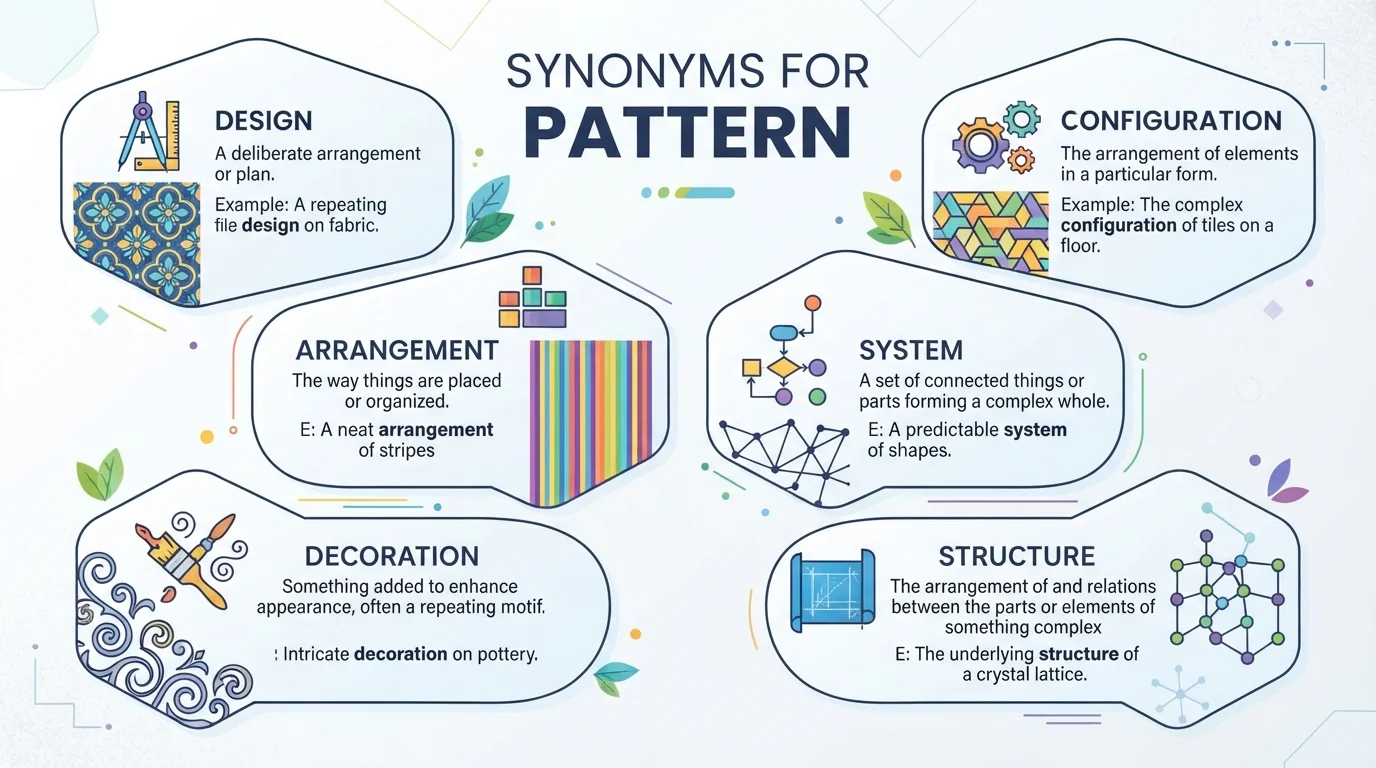
These three are especially common in visual contexts.
Pattern
A repeated arrangement.
The wallpaper has a geometric pattern.
Design
The overall planned visual appearance.
The wallpaper has an attractive design.
Motif
A recurring decorative element.
The wallpaper uses a floral motif.
A single design may contain several motifs and patterns.
Pattern vs. Template vs. Blueprint vs. Model
When pattern means something used as a guide:
| Word | Main idea | Best context |
|---|---|---|
| Pattern | Example or recurring form | General |
| Template | Reusable standard structure | Documents/processes |
| Blueprint | Detailed plan | Projects/systems |
| Model | Example or representation | Systems/strategies |
| Framework | Organizing structure | Ideas/analysis |
| Prototype | Early working version | Products/design |
These words should not be swapped automatically.
Comparison Table: 40+ Alternatives to “Pattern”
| Word/Phrase | Meaning | Tone | Best use | Direct replacement? |
|---|---|---|---|---|
| Design | Visual arrangement | Neutral | Art, clothing, graphics | Sometimes |
| Motif | Repeated element | Artistic/formal | Art, literature | Contextual |
| Decorative design | Neutral | Fashion, textiles | Contextual | |
| Arrangement | Positioning of parts | Neutral | Objects, layouts | Often |
| Configuration | Particular setup | Technical | Systems | Contextual |
| Structure | Organization of parts | Neutral/formal | Writing, systems | Sometimes |
| Layout | Spatial arrangement | Neutral | Websites, documents | Contextual |
| Form | Shape or arrangement | Neutral | Design, art | Sometimes |
| Template | Reusable structure | Neutral | Documents | Contextual |
| Blueprint | Detailed plan | Formal | Projects | Contextual |
| Model | Example or representation | Neutral | Systems, strategies | Often contextual |
| Framework | Basic organizing structure | Formal | Analysis, planning | Contextual |
| Sequence | Ordered elements | Neutral/technical | Math, events | Often |
| Series | Related items in order | Neutral | Data, events | Sometimes |
| Cycle | Repeating sequence | Neutral | Seasons, economics | Contextual |
| Trend | Direction of change | Neutral | Data, markets | Contextual |
| Tendency | Inclination | Neutral/formal | Behavior, analysis | Contextual |
| Routine | Regular procedure | Neutral | Daily activity | Contextual |
| Habit | Repeated behavior | Neutral | Personal behavior | Contextual |
| Practice | Established way of acting | Neutral/formal | Work, organizations | Contextual |
| Regularity | Consistent repetition | Formal | Science, math | Contextual |
| Rhythm | Repeated timing/movement | Artistic | Music, speech | Contextual |
| Progression | Ordered development | Formal | Processes, data | Contextual |
| Correlation | Statistical relationship | Technical | Research | No |
| Distribution | Way something is spread | Technical | Data, populations | Contextual |
| Recurrence | Happening again | Formal | Events, conditions | Contextual |
| Association | Connected relationship | Formal | Research, ideas | Contextual |
| Archetype | Typical example | Literary/formal | Stories, concepts | No |
| Paradigm | Model/established framework | Formal | Academic writing | No |
| Prototype | Early model | Technical | Product design | No |
| Schema | Organized conceptual structure | Technical | Computing, research | Contextual |
| Grid | Regular network | Technical/design | Graphics, maps | Contextual |
| Formula | Established method/rule | Formal | Math, processes | Contextual |
| Rule | Principle governing repetition | Neutral | Math, systems | Contextual |
| Sequence of events | Ordered recurring events | Neutral | Narratives, analysis | Phrase |
| Recurring theme | Repeated central idea | Neutral | Writing, art | Phrase |
| Recurring behavior | Repeated action | Neutral | Psychology, analysis | Phrase |
| Behavioral tendency | Repeated inclination | Formal | Research | Phrase |
| Visual motif | Repeated visual element | Artistic | Design, art | Phrase |
10 Sentence Transformations
1. Visual pattern
Original:
The fabric has a colorful pattern.
Alternative:
The fabric has a colorful print.
Why: Print is natural when referring to a decorative design printed on fabric.
2. Behavioral pattern
Original:
Researchers identified a pattern in the participants’ behavior.
Alternative:
Researchers identified a recurring behavioral tendency among the participants.
Why: The alternative makes the behavioral meaning more explicit.
3. Data pattern
Original:
The researchers discovered a pattern in the data.
Alternative:
The researchers discovered a clear regularity in the data.
Why: Regularity emphasizes repeated consistency.
4. Market pattern
Original:
The company noticed a pattern of seasonal demand.
Alternative:
The company noticed a seasonal trend in demand.
Why: Trend works when the main point is the direction of demand over time.
5. Document pattern
Original:
Use this report as a pattern for future reports.
Alternative:
Use this report as a template for future reports.
Why: Template is more natural when the document will be reused as a structural guide.
6. Repeating pattern
Original:
The seasons follow a repeating pattern.
Alternative:
The seasons follow a repeating cycle.
Why: Cycle specifically describes a sequence that returns to its starting point.
7. Website pattern
Original:
The page follows the same pattern as the other pages.
Alternative:
The page follows the same layout as the other pages.
Why: Layout is more precise if the similarity concerns the arrangement of visual elements.
8. Mathematical pattern
Original:
Find the pattern in this sequence.
Alternative:
Identify the rule governing this sequence.
Why: Rule is more precise when the goal is to identify the principle that generates the sequence.
9. Artistic pattern
Original:
The artist repeated the same pattern throughout the painting.
Alternative:
The artist repeated the same motif throughout the painting.
Why: Motif specifically describes a recurring artistic element.
10. Established pattern
Original:
The organization follows a familiar pattern of decision-making.
Alternative:
The organization follows an established practice of decision-making.
Why: Practice works when the repeated behavior is a customary organizational method.
Common Collocations with “Pattern”
Knowing common combinations can help you choose a more precise alternative.
Behavior
- pattern of behavior
- behavioral pattern
- recurring pattern
- familiar pattern
- destructive pattern
- established pattern
- repeated pattern
- predictable pattern
Data and research
- pattern in the data
- pattern of results
- pattern of change
- distribution pattern
- statistical pattern
- recurring pattern
- underlying pattern
- emerging pattern
Visual design
- geometric pattern
- floral pattern
- decorative pattern
- repeating pattern
- color pattern
- fabric pattern
- design pattern
- intricate pattern
Time and events
- seasonal pattern
- weather pattern
- migration pattern
- sleep pattern
- spending pattern
- growth pattern
- traffic pattern
- voting pattern
Common Mistakes When Using Pattern Synonyms
1. Calling every pattern a trend
A trend describes direction, while a pattern can describe many other forms of repetition or arrangement.
✓ a pattern of recurring errors
✓ an upward trend in errors
These express different ideas.
2. Using “habit” for group or system behavior
A habit normally refers to repeated behavior by a person or group.
He has a habit of arriving late.
But:
The weather has a habit of changing suddenly.
This is possible figuratively, but pattern may be more precise in formal writing.
3. Using “correlation” for any visible pattern
A pattern in data does not automatically establish a statistical correlation.
Use correlation only when the relationship is specifically statistical.
4. Treating “design” and “pattern” as exact synonyms
A design can be unique and non-repeating.
The building has an innovative design.
You would not necessarily call the entire design a pattern.
5. Using “template” when you mean repeated behavior
A template is a reusable structure or model.
document template ✓
But:
template of customer behavior ✗
In that context, pattern or behavioral pattern is more appropriate.
6. Using “cycle” when there is no return or repetition
A cycle normally involves recurrence.
If something simply progresses in one direction, progression or trend may be better.
7. Assuming “motif” means any pattern
A motif is usually a distinctive recurring element, particularly in art, literature, architecture, or decoration.
It is narrower than pattern.
8. Replacing “pattern” with a more technical word without need
Words such as configuration, schema, paradigm, and correlation have specialized meanings.
They should add precision, not merely make the writing sound more advanced.
When Not to Replace “Pattern”
Sometimes pattern is the best word.
Keep it when you mean a recognizable arrangement or recurrence and no narrower word adds useful information.
For example:
We noticed a pattern in the responses.
This is clear and natural.
Replacing it with:
We noticed a configuration in the responses.
would usually change the meaning or make the sentence awkward.
Likewise:
The wallpaper has a beautiful pattern.
is often better than using motif, ornamentation, or visual configuration unless you need a more specific meaning.
Good writing is not about avoiding repetition at all costs. It is about choosing the word that communicates the intended idea most clearly.
Which Synonym for “Pattern” Should You Choose?
Use this quick guide:
For a visual design
Choose design, motif, print, or ornamentation.
For repeated behavior
Choose habit, routine, practice, or behavioral pattern.
For a direction of change
Choose trend, trajectory, or progression.
For repeated events
Choose cycle, recurrence, or sequence.
For organization
Choose structure, arrangement, layout, or configuration.
For a reusable example
Choose template, model, blueprint, or framework.
For mathematics
Choose sequence, rule, progression, or formula, depending on the exact relationship.
For research and data
Choose regularity, trend, correlation, distribution, or association when those technical meanings are actually intended.
For art and literature
Choose motif, theme, archetype, or recurring element.
Editor’s Choice: 5 Practical Alternatives
These are editorial recommendations based on usefulness and meaning, not an objective ranking.
Design
Best when pattern refers to the visual appearance of an object or material.
Trend
Best when the pattern describes a general direction of change.
Structure
Best when the focus is on how parts are organized.
Sequence
Best when elements occur in a particular order.
Template
Best when something serves as a reusable example or guide.
For everyday writing, pattern itself is often the most flexible choice.