
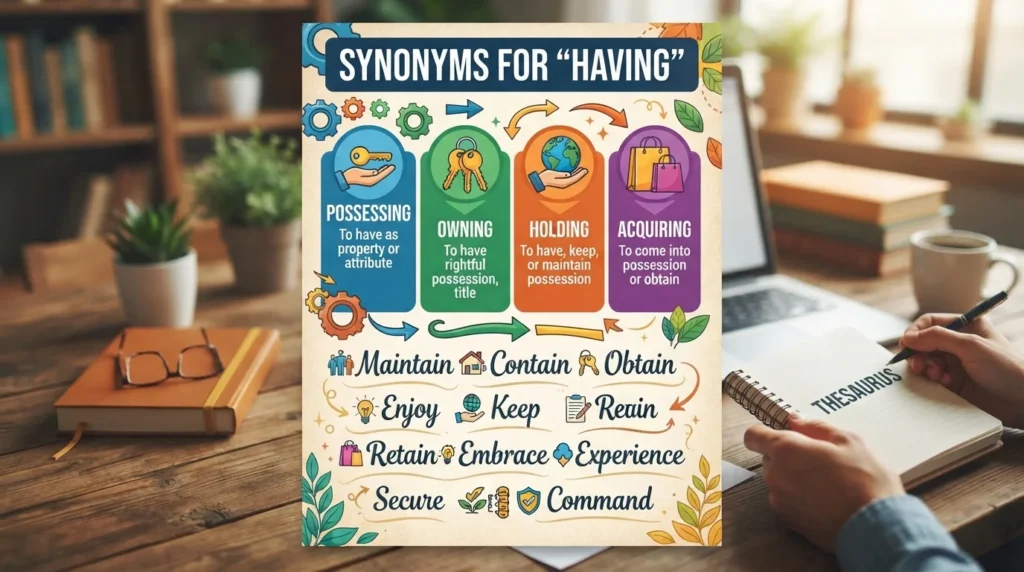
Quick Synonym Reference
When “having” means possessing
- Possessing
- Owning
- Holding
- Keeping
- Controlling
- Retaining
- Having in one’s possession
When “having” means containing or including
- Containing
- Including
- Featuring
- Comprising
- Consisting of
- Incorporating
- Encompassing
- Enclosing
When “having” means experiencing
- Experiencing
- Undergoing
- Encountering
- Facing
- Enduring
- Suffering
- Dealing with
- Going through
When “having” means receiving or obtaining
- Receiving
- Getting
- Obtaining
- Acquiring
- Securing
- Gaining
- Earning
- Being given
When “having” means eating or drinking
- Eating
- Drinking
- Consuming
- Enjoying
- Taking
- Ordering
When “having” means organizing or participating in an event
- Holding
- Organizing
- Hosting
- Conducting
- Attending
- Participating in
- Taking part in
When “having” means showing a quality or characteristic
- Showing
- Displaying
- Possessing
- Exhibiting
- Demonstrating
- Characterized by
- Marked by
When “having” means relationships or connections
- Maintaining
- Sharing
- Enjoying
- Being in
- Keeping
- Establishing
What Does “Having” Mean?
Having is the present participle or gerund form of have.
Because have has many meanings, having can express several different ideas.
Compare:
“She is having a car.”
This is generally unnatural in standard English if the intended meaning is permanent possession. We normally say:
“She has a car.”
But:
“She is having lunch.”
is perfectly natural because having here means eating.
Likewise:
“He is having difficulty.”
means experiencing difficulty.
And:
“The building is having a new roof installed.”
can express an arranged or ongoing process.
This makes having one of those words where context matters more than a simple thesaurus replacement.
The Closest Synonyms for “Having”
Possessing
Possessing means having something in one’s ownership or control.
“She is possessing valuable property.”
The grammar here sounds unnatural in ordinary English. A more natural sentence is:
“She possesses valuable property.”
Possessing works better in participial constructions:
“Possessing strong technical skills, she was well qualified for the position.”
Tone: Formal
Best for: Formal writing, qualifications, characteristics, assets
Owning
Owning means legally or personally having something as property.
“Owning a home can be expensive.”
Use owning when ownership is specifically meant.
It is not a general replacement for having:
“She is having a headache.”
You cannot replace this with:
“She is owning a headache.” ❌
Holding
Holding can mean physically having something, possessing something, or maintaining a position or record.
“He was holding a copy of the contract.”
It can also mean organizing an event:
“The company is holding a meeting.”
Here, holding is not about possession. It means conducting or organizing the event.
Keeping
Keeping means continuing to possess, store, or retain something.
“She is keeping the documents for future reference.”
It emphasizes continued possession rather than simple ownership.
Synonyms for “Having” When It Means Possessing
When having means to possess or own something, the most useful alternatives are:
- Possessing
- Owning
- Holding
- Keeping
- Retaining
- Controlling
- Maintaining possession of
- Having in one’s possession
Examples
“He has several properties.”
→ “He owns several properties.”
“She has the original documents.”
→ “She is holding the original documents.”
“The company has the rights to the product.”
→ “The company holds the rights to the product.”
Important distinction
Own usually implies ownership.
Possess can emphasize possession or characteristics.
Hold can mean physical possession, legal rights, or a position.
Keep emphasizes continued possession.
Synonyms for “Having” When It Means Experiencing
This is one of the most common meanings of having.
“She is having problems with her computer.”
Here, having means experiencing.
Experiencing
“She is experiencing problems with her computer.”
This is a natural formal alternative.
Undergoing
“The company is undergoing significant changes.”
Use undergoing for a process or situation that someone or something is going through.
Encountering
“The team is encountering several difficulties.”
This emphasizes coming across a problem or obstacle.
Facing
“The company is facing financial difficulties.”
This often suggests a challenge that needs to be dealt with.
Dealing with
“The team is dealing with several technical problems.”
This emphasizes actively managing a problem.
Going through
“The family is going through a difficult period.”
This is conversational and often emphasizes the process of experiencing something.
Enduring
“The workers are enduring difficult conditions.”
This suggests experiencing something unpleasant over time.
Suffering
“The patient is suffering from severe pain.”
This is stronger and specifically implies distress or harm.
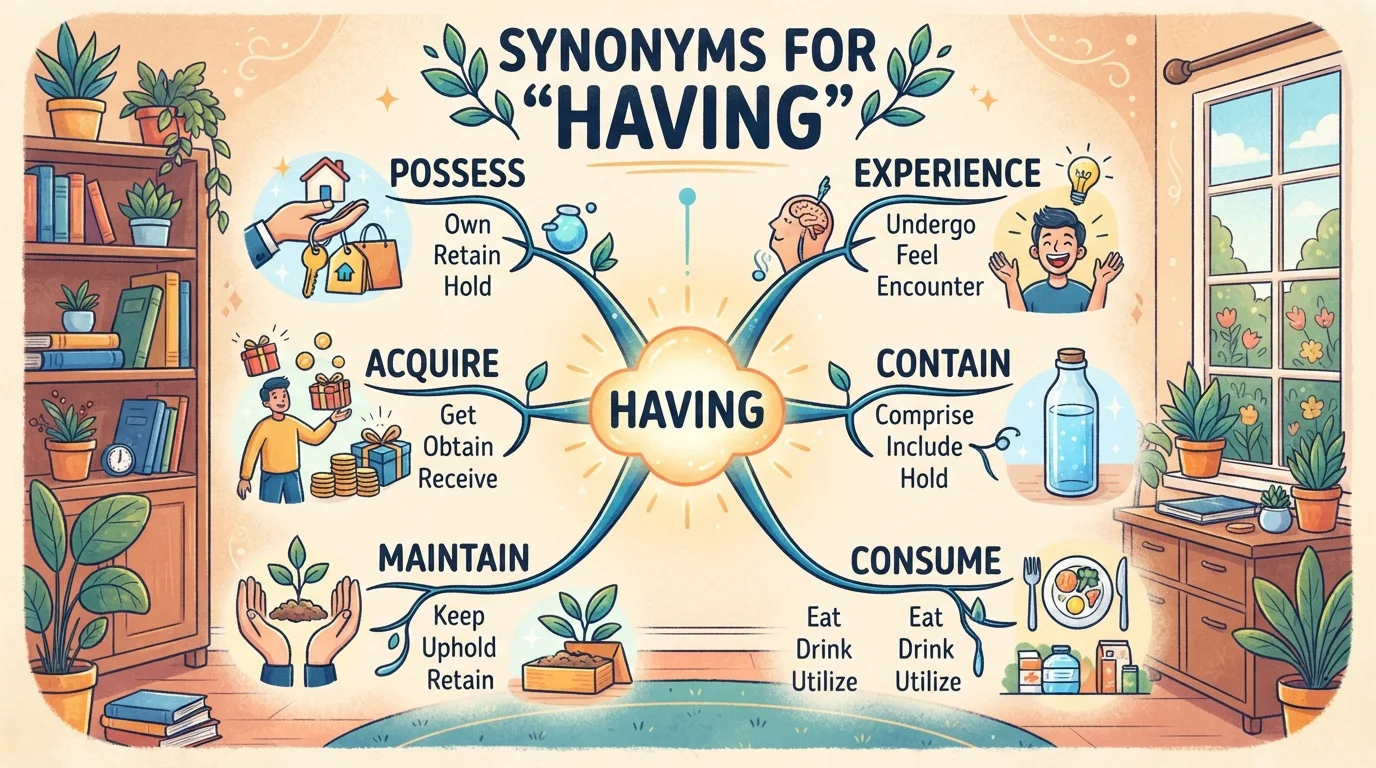
Synonyms for “Having” When It Means Experiencing an Emotion
Consider:
“She is having doubts.”
Possible alternatives include:
- Experiencing doubts
- Feeling uncertain
- Entertaining doubts
- Expressing doubts
- Harboring doubts
The best choice depends on the intended meaning.
Having concerns
“The employees are having concerns about the change.”
Better:
“The employees have concerns about the change.”
Or:
“The employees are expressing concerns about the change.”
Having doubts
“He is having doubts about the plan.”
Possible alternatives:
“He is questioning the plan.”
“He has reservations about the plan.”
Having feelings
“She has strong feelings about the issue.”
Possible alternative:
“She feels strongly about the issue.”
This is often more natural than forcing a synonym for having.
Synonyms for “Having” When It Means Containing or Including
Sometimes having describes what something contains.
“A house having three bedrooms…”
More natural:
“A house with three bedrooms…”
Or:
“A three-bedroom house…”
Useful alternatives include:
- Containing
- Including
- Featuring
- Comprising
- Incorporating
- Encompassing
- Consisting of
- Equipped with
- Characterized by
- Marked by
Containing
“The package is having several components.”
Better:
“The package contains several components.”
Containing emphasizes what is physically or conceptually inside something.
Including
“The course has several advanced modules.”
→ “The course includes several advanced modules.”
Including is particularly useful when listing components.
Featuring
“The hotel has a rooftop pool.”
→ “The hotel features a rooftop pool.”
Featuring is useful for descriptions, advertising, products, places, and creative works.
Comprising
“The committee has five members.”
→ “The committee comprises five members.”
Comprising is formal and means consisting of.
Incorporating
“The design has several modern elements.”
→ “The design incorporates several modern elements.”
This emphasizes that elements have been integrated into a whole.
Having vs. Including
These words overlap when having describes components.
“The package has a charger and a manual.”
“The package includes a charger and a manual.”
Includes is more precise when you are listing what is part of something.
For product descriptions, reports, and formal writing, includes can often make the sentence clearer.
Having vs. Featuring
Featuring suggests that something is a notable or highlighted part of a product, place, event, or work.
“The hotel has an indoor pool.”
Neutral.
“The hotel features an indoor pool.”
The second sounds more descriptive or promotional.
Do not use featuring simply because you want a more sophisticated synonym.
Having vs. Containing
Containing focuses on what is inside something.
“The box contains six bottles.”
Having is broader:
“The box has six bottles.”
Both can work, but contains is more precise when physical contents are the point.
Synonyms for “Having” When It Means Eating or Drinking
In expressions such as:
“I’m having lunch.”
Having can mean eating.
Possible alternatives include:
- Eating
- Drinking
- Consuming
- Enjoying
- Taking
- Ordering
Having lunch
“I’m having lunch.”
→ “I’m eating lunch.”
Having dinner
“We’re having dinner at eight.”
→ “We’re eating dinner at eight.”
Having a drink
“We’re having a drink after work.”
→ “We’re getting a drink after work.”
Having coffee
“I’m having coffee.”
→ “I’m drinking coffee.”
Important: having often sounds more natural than the alternatives because it is idiomatic English.
Synonyms for “Having” When It Means Receiving or Getting
Sometimes have means receive, obtain, or get.
“I had an email from the manager.”
Possible alternatives:
- Received
- Got
- Obtained
- Acquired
- Gained
- Secured
Received
“I received an email from the manager.”
This is more precise and formal than:
“I had an email from the manager.”
Got
“I got a message from her.”
This is natural and conversational.
Obtained
“The researcher obtained permission.”
This is formal and emphasizes successful acquisition.
Secured
“The company secured funding.”
This suggests obtaining something through effort or negotiation.
Synonyms for “Having” When It Means Holding an Event
Consider:
“The company is having a meeting.”
Natural alternatives include:
- Holding
- Organizing
- Hosting
- Conducting
- Running
- Arranging
Holding
“The company is holding a meeting.”
This is a common professional alternative.
Organizing
“The company is organizing a conference.”
This emphasizes preparation and coordination.
Hosting
“The company is hosting a conference.”
This emphasizes providing or welcoming participants at the event.
Conducting
“The committee is conducting an investigation.”
This is formal and emphasizes carrying out an organized activity.
Synonyms for “Having” When It Means Participating
In expressions such as:
“We are having a meeting.”
the meaning may actually be participating in a meeting.
Possible alternatives:
- Attending
- Participating in
- Taking part in
- Joining
- Engaging in
But these are not always direct replacements.
Having a meeting
“We are having a meeting at 2.”
Attending a meeting
“We are attending a meeting at 2.”
The second emphasizes being present rather than organizing or conducting the meeting.
Participating in a meeting
“We are participating in a meeting at 2.”
This emphasizes active involvement.
Synonyms for “Having” When It Means Possessing a Quality
Have frequently describes qualities, characteristics, features, or abilities.
“She has excellent communication skills.”
Possible alternatives:
- Possessing
- Demonstrating
- Showing
- Displaying
- Exhibiting
- Characterized by
- Marked by
Possessing
“Candidates possessing strong communication skills may be preferred.”
Formal.
Demonstrating
“Candidates demonstrating strong communication skills may be preferred.”
This changes the meaning slightly: demonstrating suggests that the ability has been shown in practice.
Characterized by
“The organization is characterized by strong communication.”
This is more formal and describes a defining feature.
Synonyms for “Having” in Descriptions
For descriptions of objects, places, people, and systems, these alternatives are useful:
| Having | Possible Alternative | Meaning |
|---|---|---|
| Having three bedrooms | With three bedrooms | Possessing/including |
| Having a modern design | Featuring a modern design | Highlighting a feature |
| Having several parts | Consisting of several parts | Made up of |
| Having useful features | Offering useful features | Providing |
| Having strong skills | Possessing strong skills | Possessing ability |
| Having many options | Offering many options | Providing choices |
| Having a large capacity | Providing large capacity | Offering capacity |
| Having a problem | Experiencing a problem | Going through a difficulty |
With is especially useful because it can often replace a cumbersome having + noun construction.
“A house having three bedrooms”
→
“A house with three bedrooms.”
This is usually cleaner.
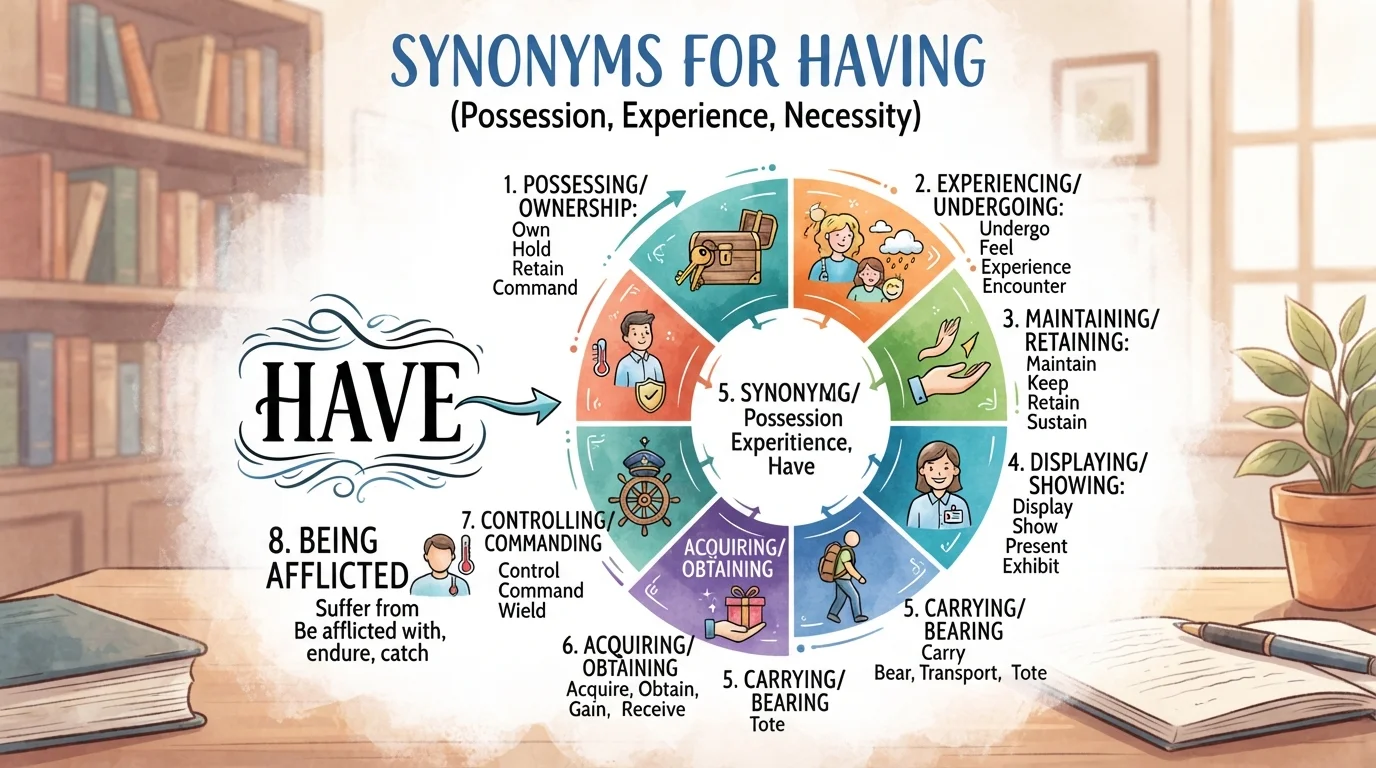
“Having” as a Phrase-Level Word
Sometimes the best alternative is not another -ing word.
For example:
“Having enough experience, she applied for the position.”
Possible alternatives:
“Because she had enough experience, she applied for the position.”
Or:
“With enough experience, she was able to apply for the position.”
Here, simply replacing having with another participle may make the sentence less natural.
“Having” in Perfect Participial Constructions
Having + past participle can show that one action happened before another.
“Having completed the report, she left the office.”
This does not mean possession.
Possible alternatives include:
- After completing
- After she completed
- Once she had completed
- Upon completing
Example
“Having finished the project, they celebrated.”
→
“After finishing the project, they celebrated.”
The second version is often more direct for general readers.
“Having” in Causative Structures
Have + object + past participle can mean arranging for something to be done.
“She is having her car repaired.”
Possible alternative:
“She is getting her car repaired.”
Here, getting is a natural conversational alternative.
But:
“She is repairing her car.”
has a different meaning: she is doing the repair herself.
This distinction is important.
True Synonyms vs. Related Alternatives
| Alternative | Relationship | Can Replace “Having”? | Tone | Best Context |
|---|---|---|---|---|
| Possessing | Close synonym | Sometimes | Formal | Assets, qualities |
| Owning | Narrower synonym | Sometimes | Neutral | Property |
| Holding | Contextual synonym | Sometimes | Neutral/formal | Objects, rights, events |
| Keeping | Contextual synonym | Sometimes | Neutral | Continued possession |
| Experiencing | Close contextual alternative | Sometimes | Neutral/formal | Problems, emotions |
| Undergoing | Contextual alternative | Sometimes | Formal | Processes, changes |
| Encountering | Near synonym | Sometimes | Formal | Problems, situations |
| Facing | Contextual alternative | Sometimes | Neutral | Challenges |
| Containing | Close alternative | Sometimes | Neutral/formal | Contents |
| Including | Close alternative | Sometimes | Neutral/formal | Components |
| Featuring | Contextual alternative | Sometimes | Neutral/promotional | Products, places |
| Comprising | Formal alternative | Sometimes | Formal | Components |
| Receiving | Contextual alternative | Sometimes | Neutral/formal | Messages, payments |
| Obtaining | Contextual alternative | Sometimes | Formal | Information, permission |
| Eating | Contextual synonym | Sometimes | Neutral | Meals |
| Drinking | Contextual synonym | Sometimes | Neutral | Beverages |
| Hosting | Contextual alternative | Sometimes | Professional | Events |
| Organizing | Contextual alternative | Sometimes | Neutral/formal | Events |
| Attending | Related alternative | Rarely | Neutral | Events |
| Showing | Contextual alternative | Sometimes | Neutral | Qualities |
| Demonstrating | Contextual alternative | Sometimes | Formal | Skills, qualities |
| With | Phrase-level alternative | Often | Neutral | Descriptions |
Comparison Table: Which Alternative Should You Use?
| If “having” means… | Better alternative | Example |
|---|---|---|
| Owning property | Owning | “She owns a house.” |
| Possessing an ability | Possessing | “He possesses strong analytical skills.” |
| Physically holding | Holding | “She is holding the document.” |
| Keeping something | Retaining | “The company is retaining the records.” |
| Experiencing a problem | Experiencing | “They are experiencing delays.” |
| Facing a difficulty | Facing | “The company is facing challenges.” |
| Going through a process | Undergoing | “The system is undergoing testing.” |
| Containing something | Containing | “The box contains six items.” |
| Listing components | Including | “The package includes a charger.” |
| Highlighting a feature | Featuring | “The hotel features a spa.” |
| Made up of parts | Comprising | “The team comprises ten members.” |
| Receiving something | Receiving | “She received an email.” |
| Getting something | Getting | “He got a new position.” |
| Eating | Eating | “We are eating lunch.” |
| Drinking | Drinking | “She is drinking coffee.” |
| Organizing an event | Hosting/organizing | “They are hosting a conference.” |
| Conducting an activity | Conducting | “The team is conducting research.” |
| Showing a quality | Demonstrating | “She demonstrates confidence.” |
| Describing features | With | “A house with three bedrooms.” |
Formal Synonyms for Having
For academic, professional, and formal writing, useful alternatives include:
- Possessing
- Holding
- Retaining
- Containing
- Including
- Comprising
- Incorporating
- Encompassing
- Experiencing
- Undergoing
- Demonstrating
- Exhibiting
- Characterized by
- Marked by
- Receiving
- Obtaining
Example
Informal:
“The study has several limitations.”
Formal:
“The study has several limitations.”
Notice that has is already perfectly appropriate.
A more elaborate alternative might be:
“The study contains several limitations.”
But this is not necessarily better.
The best formal writing often keeps have/has when it is already clear.
Casual Alternatives for Having
In casual English, these may work depending on the meaning:
- Getting
- Having
- Holding
- Keeping
- Going through
- Eating
- Drinking
- With
- Got
Examples
“I’m having lunch.”
“I’m eating lunch.”
“She’s having a difficult day.”
“She’s having a rough day.”
“He has a new phone.”
“He got a new phone.”
The informal alternative can change the meaning slightly, so context still matters.
Professional and Business Alternatives
In workplace writing, these alternatives can make the intended meaning more precise:
Having problems
→ Experiencing problems
“The company is experiencing technical problems.”
Having challenges
→ Facing challenges
“The team is facing several challenges.”
Having a meeting
→ Holding a meeting
“The committee is holding a meeting tomorrow.”
Having an event
→ Hosting an event
“The organization is hosting an annual conference.”
Having features
→ Featuring
“The software features advanced reporting tools.”
Having responsibility
→ Being responsible for
“She is responsible for client communication.”
Academic Alternatives for Having
Academic writing often benefits from replacing vague having with a more precise verb.
Example 1
“Students having access to reliable data…”
Better:
“Students with access to reliable data…”
Or:
“Students who have access to reliable data…”
Example 2
“Participants having prior experience…”
Better:
“Participants with prior experience…”
Example 3
“The study has several limitations.”
Keep has unless a more specific verb genuinely improves the sentence.
Example 4
“Participants having difficulties completing the task…”
Better:
“Participants experiencing difficulties completing the task…”
This identifies the exact relationship rather than mechanically replacing the word.
Sentence Transformations
1. Possession
Original:
“She is having a large collection of books.”
Better Alternative:
“She has a large collection of books.”
Why:
For ordinary possession, simple has is more natural than progressive is having.
2. Ownership
Original:
“He is having two houses.”
Better Alternative:
“He owns two houses.”
Why:
Owns precisely expresses legal or personal ownership.
3. Experiencing a problem
Original:
“The company is having technical difficulties.”
Better Alternative:
“The company is experiencing technical difficulties.”
Why:
Experiencing is more precise and professional.
4. Facing a challenge
Original:
“The team is having several challenges.”
Better Alternative:
“The team is facing several challenges.”
Why:
Facing emphasizes that the challenges are obstacles the team must address.
5. Including features
Original:
“The package has a charger and a manual.”
Better Alternative:
“The package includes a charger and a manual.”
Why:
Includes clearly identifies the contents or components.
6. Highlighting a feature
Original:
“The hotel has a rooftop restaurant.”
Better Alternative:
“The hotel features a rooftop restaurant.”
Why:
Features emphasizes the restaurant as a notable characteristic.
7. Eating
Original:
“We are having lunch.”
Better Alternative:
“We are eating lunch.”
Why:
Eating makes the action explicit, although having lunch is often more natural in everyday English.
8. Receiving
Original:
“She is having a message from the manager.”
Better Alternative:
“She received a message from the manager.”
Why:
Received is more precise when the meaning is that a message arrived.
9. Organizing an event
Original:
“The company is having a conference next month.”
Better Alternative:
“The company is hosting a conference next month.”
Why:
Hosting clearly indicates that the company is organizing or providing the event.
10. Describing a property
Original:
“They bought a house having four bedrooms.”
Better Alternative:
“They bought a house with four bedrooms.”
Why:
With creates a much more natural noun phrase.
Common Collocations With Having
Because having comes from have, it appears in many fixed expressions.
Having + noun
- having a problem
- having difficulty
- having trouble
- having an issue
- having an opportunity
- having a chance
- having experience
- having knowledge
- having access
- having control
- having responsibility
- having authority
- having confidence
- having doubts
- having concerns
- having an opinion
- having an effect
- having an impact
- having a conversation
- having a meeting
- having lunch
- having dinner
- having coffee
- having fun
- having time
- having permission
Examples
“We are having difficulty finding the information.”
“She is having a conversation with her manager.”
“They are having lunch.”
“The project is having a significant impact.”
In many of these expressions, having is already the most natural choice.
When “Having” Is Better Than a Synonym
Avoid replacing having simply because you want a more sophisticated word.
Consider:
“The report has three sections.”
This is clear and natural.
Changing it to:
“The report comprises three sections.”
is possible, but more formal.
Likewise:
“We are having lunch.”
is completely natural.
Replacing it with:
“We are consuming lunch.”
would sound unnatural.
The same applies to:
“She is having a good time.”
You would not normally replace having with possessing or experiencing:
“She is experiencing a good time.” ❌
Instead, you might say:
“She is enjoying herself.”
The lesson is simple: choose a synonym for the meaning, not for the word itself.
Common Mistakes
Mistake 1: Replacing “having” with “possessing” everywhere
Possessing is much narrower and more formal.
“She is having lunch.”
cannot become:
“She is possessing lunch.”
Mistake 2: Using “owning” when ownership is not involved
“He is having a problem.”
does not mean:
“He is owning a problem.”
Use experiencing or facing instead.
Mistake 3: Using “experiencing” for possession
“She has a car.”
does not normally become:
“She is experiencing a car.”
Experiencing is appropriate for events, conditions, sensations, and situations.
Mistake 4: Using “featuring” for every characteristic
Featuring often highlights a notable characteristic.
“The hotel features a rooftop pool.”
But:
“The person features blue eyes.”
is unnatural in ordinary English.
Use:
“The person has blue eyes.”
Mistake 5: Confusing “having” with “holding”
“She has a meeting.”
can become:
“She is holding a meeting.”
if she is organizing or conducting it.
But:
“She is holding a meeting”
does not simply mean that she is attending one.
Mistake 6: Using “comprising” incorrectly
Comprise means consist of / include as parts.
“The team comprises ten members.”
A common traditional usage is:
“The team is comprised of ten members.”
This construction is widely used, but comprises and consists of are often the cleaner choices in formal writing.
Mistake 7: Replacing “having” without changing the grammar
Some synonyms require different sentence structures.
“A building having five floors”
is better as:
“A five-story building.”
or:
“A building with five floors.”
The goal is natural English, not one-for-one word replacement.
Having vs. Possessing
Having is broad and neutral.
Possessing is more formal and specifically emphasizes possession.
“She has excellent communication skills.”
“She possesses excellent communication skills.”
Both are grammatical, but the second sounds more formal.
In a résumé or formal assessment, possesses can work well. In everyday English, has is usually more natural.
Having vs. Experiencing
Use experiencing when having refers to going through a situation, condition, problem, or event.
“The company is having problems.”
→
“The company is experiencing problems.”
This is a particularly useful replacement in professional writing.
However:
“The company has three offices.”
does not mean:
“The company is experiencing three offices.”
Having vs. Undergoing
Undergoing is more specific than experiencing and usually describes a process or change.
“The building is undergoing renovation.”
“The patient is undergoing treatment.”
“The company is undergoing restructuring.”
These are more precise than simply saying something is “having” a change or process.
Having vs. Containing
Use containing when something has something physically or conceptually inside it.
“The bottle contains water.”
“The report contains several errors.”
Having is broader:
“The bottle has water.”
“The report has several errors.”
Both can work, but contains makes the relationship more explicit.
Having vs. Including
Use including when you want to identify something as one of the components or members of a larger group.
“The course has ten modules.”
“The course includes ten modules.”
The second is often more informative because it emphasizes the modules as components of the course.
Having vs. With
One of the most useful ways to avoid repetitive having is to use with.
Instead of:
“A building having three floors…”
write:
“A three-story building.”
Or:
“A building with three floors.”
Instead of:
“A company having extensive experience…”
write:
“A company with extensive experience.”
This often produces cleaner, more natural prose.
Decision Guide
Use possessing when:
You mean formal possession or a quality/ability someone has.
Use owning when:
You specifically mean ownership.
Use holding when:
Someone physically has something, possesses rights, or conducts an event.
Use experiencing when:
Someone or something is going through a problem, condition, or situation.
Use undergoing when:
Something is passing through a process, treatment, change, or transformation.
Use facing when:
Someone is dealing with a challenge or difficulty.
Use containing when:
Something has contents inside it.
Use including when:
You are identifying components, examples, or members.
Use featuring when:
You want to highlight a notable feature.
Use comprising when:
You mean consisting of particular parts.
Use receiving when:
Something has been delivered, sent, or given to someone.
Use eating/drinking when:
Having refers specifically to consuming food or beverages.
Use hosting when:
Someone organizes or presents an event.
Use with when:
You want a concise noun phrase describing a feature or characteristic.
Editor’s Choice
Possessing
A useful formal alternative when having means owning or displaying a quality.
Experiencing
One of the strongest professional alternatives when having refers to problems, conditions, or situations.
Including
A precise alternative when having introduces components or items within a larger whole.
Featuring
Useful for describing notable characteristics of products, places, services, and creative works.
With
Often the simplest way to make a sentence more concise:
“A house with three bedrooms.”
rather than:
“A house having three bedrooms.”