
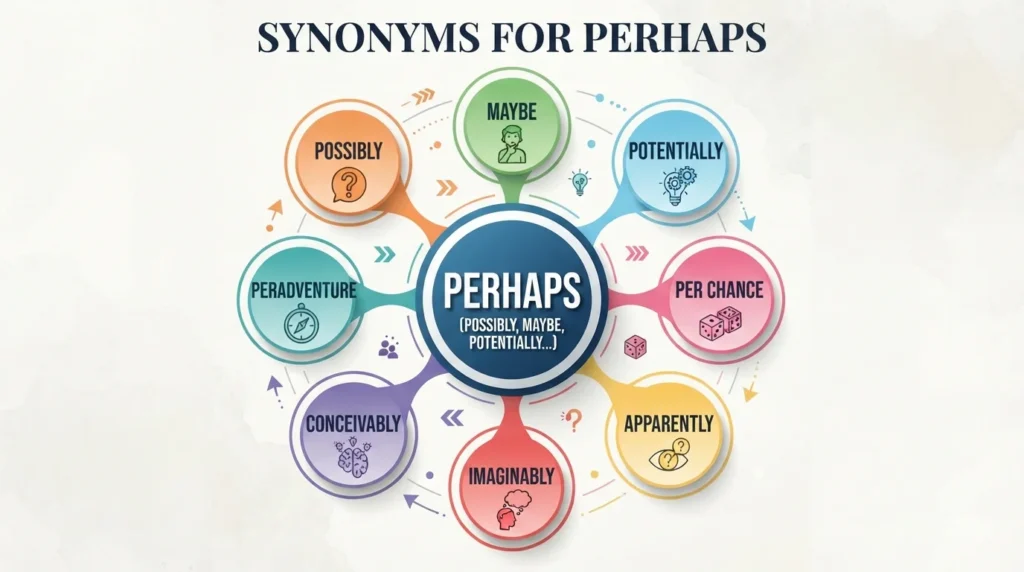
Quick Synonym List
Closest alternatives
- Maybe
- Possibly
- Potentially
- Conceivably
- Perchance
Formal alternatives
- Possibly
- Potentially
- Conceivably
- Plausibly
- It is possible that
- It may be that
- It might be that
- There is a possibility that
Neutral and everyday alternatives
- Maybe
- Possibly
- It could be
- It may be
- It might be
- There is a chance
- There’s a possibility
- It’s possible
Stronger possibility
- Probably
- Likely
- In all likelihood
- Chances are
- It is likely that
Weaker or more hypothetical possibility
- Conceivably
- Potentially
- Perchance
- It could be
- It might be
- It is not impossible that
Phrase-level alternatives
- It may be that
- It might be that
- It could be that
- It is possible that
- There is a possibility that
- There is a chance that
- For all we know
- Who knows?
- It remains possible that
What Does “Perhaps” Mean?
Perhaps is an adverb used to express possibility or uncertainty.
It usually means that something is possible, but the speaker or writer is not certain that it is true.
“Perhaps she will come later.”
This means she may come later, but we do not know for sure.
Perhaps can appear at the beginning, middle, or end of a sentence:
“Perhaps we should leave now.”
“We should perhaps leave now.”
“We should leave now, perhaps.”
The word is especially useful when you want to make a statement less definite or soften a suggestion.
“Perhaps we should reconsider the proposal.”
Here, perhaps does more than express uncertainty. It also makes the suggestion sound less direct.
The Closest Synonyms for Perhaps
Maybe
Relationship: Very close synonym
Tone: Neutral, everyday, conversational
Meaning: Possibly; it may happen or be true.
“Maybe we should wait.”
Perhaps and maybe often mean exactly the same thing.
Compare:
“Perhaps he is right.”
“Maybe he is right.”
The main difference is tone. Maybe is generally more conversational, while perhaps can sound slightly more polished or formal.
Possibly
Relationship: Very close synonym
Tone: Neutral to formal
Meaning: It is possible, although not certain.
“She could possibly arrive tomorrow.”
“Possibly, he misunderstood the instructions.”
Possibly is particularly useful in formal, academic, and professional writing.
However, possibly can sometimes emphasize possibility more explicitly than perhaps.
Potentially
Relationship: Contextual alternative
Tone: Professional, formal, academic
Meaning: Having the possibility of becoming, happening, or developing into something.
“The change could potentially reduce costs.”
Potentially often refers to a possible future result rather than simply uncertainty about a fact.
Compare:
“Perhaps the plan will work.”
“The plan could potentially reduce costs.”
The second sentence focuses on a possible outcome.
Conceivably
Relationship: Near synonym
Tone: Formal
Meaning: It is possible to imagine or accept something as possible.
“The project could conceivably be completed by June.”
Conceivably often suggests that something is possible even if it seems unlikely or requires some imagination.
It is stronger and more formal in style than everyday perhaps.
Perchance
Relationship: Literary synonym
Tone: Archaic, literary, poetic
Meaning: Perhaps; possibly.
“Perchance we shall meet again.”
This word is grammatically similar to perhaps, but it is uncommon in ordinary modern English.
Use it mainly for literary, historical, poetic, or deliberately old-fashioned writing.
Formal Alternatives to Perhaps
It is possible that
This is a clear formal alternative.
“It is possible that the results will change.”
It works particularly well in academic and professional writing.
It may be that
“It may be that the company needs more time.”
This construction expresses uncertainty without sounding overly casual.
It might be that
“It might be that the original estimate was incorrect.”
This is natural when presenting a possible explanation.
There is a possibility that
“There is a possibility that the meeting will be postponed.”
This is more explicit and often more formal than perhaps.
Plausibly
Plausibly means that something is reasonably possible or believable.
“The results could plausibly be explained by a measurement error.”
It should not automatically replace perhaps. Plausibly usually suggests that the possibility has some logical or evidential support.
Conceivably
“The policy could conceivably have unintended effects.”
This is useful when discussing a possible scenario, especially one that is not certain or obvious.
Neutral and Everyday Alternatives
Maybe
The most natural everyday alternative to perhaps.
“Maybe I’ll call her tomorrow.”
Possibly
Works in both conversation and writing.
“Possibly we misunderstood the question.”
It could be
A natural phrase for expressing uncertainty.
“It could be a mistake.”
It may be
Common in both speech and writing.
“It may be the right solution.”
It might be
Often sounds slightly more tentative.
“It might be too late.”
It’s possible
Simple and clear.
“It’s possible that they already left.”
There’s a chance
More conversational.
“There’s a chance we’ll finish today.”
This can suggest a possibility without specifying how likely it is.
Who knows?
Very informal.
“Who knows? Maybe she’ll change her mind.”
This is not a direct replacement for perhaps in formal writing.
Alternatives That Express a Stronger Possibility
Not every uncertainty word means exactly the same thing.
Probably
Probably generally indicates a stronger likelihood than perhaps.
“Perhaps she will come.”
“She will probably come.”
The first leaves the possibility more open. The second suggests that the speaker considers her arrival more likely than not.
Likely
“She is likely to arrive soon.”
Likely indicates a relatively strong expectation.
In all likelihood
A formal phrase meaning that something is probably true or will probably happen.
“In all likelihood, the project will be completed this month.”
Chances are
A conversational expression suggesting that something is probably true or likely to happen.
“Chances are, they’ll agree.”
These are not exact synonyms for perhaps. They express a different degree of certainty.
Alternatives That Express Weaker or More Hypothetical Possibility
Conceivably
“The decision could conceivably affect future negotiations.”
This presents something as possible without saying that it is likely.
It could be
“It could be the result of a technical problem.”
The phrase leaves several explanations open.
It might be
“It might be a temporary issue.”
This is often tentative.
It is not impossible that
“It is not impossible that the situation could change.”
This emphasizes that something cannot be ruled out, but it can sound cautious or indirect.
For all we know
“For all we know, they may already have arrived.”
This means that the speaker does not have enough information to know whether something is true.
It is not a direct synonym for perhaps, but it can perform a similar uncertainty-marking function.
Perhaps as a Polite or Softening Word
One important feature of perhaps is that it can soften suggestions.
Compare:
“We should change the schedule.”
“Perhaps we should change the schedule.”
The second version sounds less forceful.
Other expressions can perform a similar function:
- Maybe we should…
- It might be worth…
- It could be useful to…
- We could consider…
- It may be better to…
- Perhaps we could…
- It might make sense to…
Perhaps we could…
This is especially useful in professional communication.
“Perhaps we could discuss the issue tomorrow.”
It suggests an idea without presenting it as an instruction.
Maybe we should…
More conversational:
“Maybe we should check the figures again.”
It might be worth…
This focuses on whether an action is worth considering.
“It might be worth reviewing the contract.”
This is not a direct synonym for perhaps, but it is a useful phrase-level alternative when perhaps is being used to soften a recommendation.
Perhaps in Questions
Perhaps can make a question or suggestion sound more tentative.
“Perhaps we should ask them?”
Other options include:
- Maybe we should ask them?
- Could we perhaps ask them?
- Might we ask them?
- Would it perhaps be better to wait?
- Could it be that we misunderstood?
The best alternative depends on whether you are expressing uncertainty, making a suggestion, or asking for confirmation.
Perhaps in Academic Writing
In academic writing, perhaps, possibly, potentially, conceivably, and it is possible that can all be useful, but they are not interchangeable in every sentence.
Perhaps
“Perhaps the difference can be explained by sample size.”
Useful for cautious interpretation.
Possibly
“The variation could possibly be related to environmental conditions.”
Useful for expressing a possible explanation.
Potentially
“The intervention could potentially improve outcomes.”
Useful when discussing possible effects or consequences.
Conceivably
“The observed pattern could conceivably result from measurement error.”
Useful for a logically possible explanation.
It is possible that
“It is possible that the results reflect differences in methodology.”
Clear and appropriately cautious.
Academic writing often benefits from stating why something is possible rather than relying on uncertainty words alone.
Instead of:
“Perhaps this explains the difference.”
A more informative sentence might be:
“The difference may be explained by variations in the sampling method.”
The second version identifies the proposed explanation directly.
Perhaps in Professional and Business Writing
Perhaps works well in professional communication when making a suggestion politely.
“Perhaps we could schedule a follow-up meeting.”
Other choices include:
- Maybe we could…
- We could consider…
- It may be useful to…
- It might be worth…
- It may be better to…
- One possibility is…
- Another option would be…
Example
Instead of:
“Perhaps we should revise the proposal.”
You could write:
“We could consider revising the proposal.”
This sounds professional while making the suggestion clear.
For a formal report, you might use:
“One possibility is to revise the proposal.”
Perhaps in Emails
The best alternative depends on how formal the email is.
Polite and neutral
“Perhaps we could discuss this tomorrow.”
Conversational
“Maybe we could discuss this tomorrow.”
Professional
“It might be useful to discuss this tomorrow.”
More direct
“I suggest that we discuss this tomorrow.”
The last sentence removes much of the uncertainty and softening.
Perhaps in Creative Writing
Perhaps can create uncertainty, suspense, hesitation, or reflection.
“Perhaps he had known all along.”
Possible alternatives include:
- Maybe
- Possibly
- Perhaps
- It could be that…
- It might be that…
- Conceivably
- Who knows?
- For all she knew…
Creative writing gives you more freedom to choose an expression based on the character’s voice.
“Maybe he knew.”
sounds conversational.
“Perhaps he knew.”
sounds more reflective.
“Could it be that he knew?”
creates a more dramatic or questioning effect.
Perhaps vs. Maybe
These are the two closest everyday alternatives.
| Word | Tone | Meaning | Common Use |
|---|---|---|---|
| Perhaps | Neutral to slightly formal | Possible, but uncertain | Writing and speech |
| Maybe | Neutral, conversational | Possible, but uncertain | Everyday speech and writing |
In many sentences, they are interchangeable:
“Perhaps she is busy.”
“Maybe she is busy.”
The biggest difference is usually register, not meaning.
Perhaps is often preferred when you want a slightly more polished tone.
Maybe is more natural in casual conversation.
Perhaps vs. Possibly
These words are also very close.
| Word | Main Effect |
|---|---|
| Perhaps | General uncertainty |
| Possibly | Explicit possibility |
Compare:
“Perhaps he forgot.”
“He could possibly have forgotten.”
Both suggest uncertainty, but possibly often fits analytical or formal statements more naturally.
Perhaps vs. Potentially
These should not be treated as exact synonyms.
Perhaps expresses uncertainty:
“Perhaps the plan will succeed.”
Potentially emphasizes a possible effect or future outcome:
“The plan could potentially save money.”
A useful rule:
- Perhaps = maybe this is true or may happen.
- Potentially = this has the potential to happen or produce a result.
Perhaps vs. Probably
These words differ in certainty.
“Perhaps it will rain.”
This means rain is possible.
“It will probably rain.”
This suggests rain is more likely.
Therefore, replacing perhaps with probably can significantly change the speaker’s level of confidence.
Perhaps vs. Likely
Likely indicates a relatively strong expectation.
“Perhaps they will agree.”
“They are likely to agree.”
The second sentence communicates greater confidence.
Perhaps vs. Conceivably
Both express possibility, but conceivably often means that something is possible to imagine or logically possible.
“Perhaps the plan will fail.”
“The plan could conceivably fail.”
The second sounds more analytical and formal.
True Synonyms vs. Related Alternatives
| Alternative | Relationship | Can Replace “Perhaps”? | Tone | Best Context |
|---|---|---|---|---|
| Maybe | Very close synonym | Yes | Conversational | Everyday speech |
| Possibly | Very close synonym | Usually | Neutral/formal | General and professional |
| Potentially | Near/contextual synonym | Sometimes | Professional | Possible outcomes |
| Conceivably | Near synonym | Sometimes | Formal | Hypothetical possibilities |
| Perchance | Literary synonym | Yes, stylistically | Archaic | Literature |
| Probably | Different degree | Sometimes | Neutral | Stronger likelihood |
| Likely | Different degree | No, not usually | Neutral/formal | Strong likelihood |
| Plausibly | Contextual | Sometimes | Formal | Reasoned possibilities |
| It may be | Phrase-level alternative | Yes | Neutral/formal | General writing |
| It might be | Phrase-level alternative | Yes | Neutral | Tentative statements |
| It could be | Phrase-level alternative | Yes | Neutral | Possibility |
| It is possible that | Phrase-level alternative | Yes | Formal | Academic/professional |
| There is a chance | Contextual | Sometimes | Neutral/conversational | Possible events |
| Who knows? | Related expression | No | Informal | Uncertainty |
| For all we know | Related expression | No | Conversational | Lack of information |
Comparison: Which Word Should You Choose?
| Word/Phrase | Meaning | Tone | Strength | Best Use | Interchangeable? |
|---|---|---|---|---|---|
| Perhaps | Possible | Neutral/slightly formal | Uncertain | General writing | — |
| Maybe | Possible | Conversational | Uncertain | Everyday communication | Often |
| Possibly | Possible | Neutral/formal | Uncertain | Professional/academic | Often |
| Potentially | Possible future result | Formal/professional | Variable | Outcomes | Sometimes |
| Conceivably | Logically possible | Formal | Usually tentative | Hypothetical analysis | Sometimes |
| Probably | More likely than not | Neutral | Stronger | Predictions | No |
| Likely | Expected | Neutral/formal | Stronger | Forecasts | No |
| Perchance | Possible | Literary/archaic | Uncertain | Creative writing | Stylistically |
| It might be | Possible | Neutral | Tentative | Explanations | Often |
| It is possible that | Possible | Formal | Uncertain | Academic writing | Often |
Sentence Transformations
1. Everyday conversation
Original:
“Perhaps we should leave now.”
Alternative:
“Maybe we should leave now.”
Why:
Maybe sounds more natural and conversational.
2. Formal writing
Original:
“Perhaps the results were affected by the sample size.”
Alternative:
“It is possible that the results were affected by the sample size.”
Why:
The alternative makes the uncertainty explicit and suits formal writing.
3. Professional suggestion
Original:
“Perhaps we could schedule another meeting.”
Alternative:
“We could consider scheduling another meeting.”
Why:
This keeps the suggestion polite while making the proposed action clearer.
4. Stronger likelihood
Original:
“Perhaps she will accept the offer.”
Alternative:
“She will probably accept the offer.”
Why:
Probably communicates greater confidence than perhaps.
5. Possible outcome
Original:
“Perhaps the new system will reduce costs.”
Alternative:
“The new system could potentially reduce costs.”
Why:
Potentially focuses on the possible effect of the system.
6. Formal analysis
Original:
“Perhaps the error was caused by faulty equipment.”
Alternative:
“The error could conceivably have been caused by faulty equipment.”
Why:
Conceivably gives the sentence a more analytical and tentative tone.
7. Informal uncertainty
Original:
“Perhaps he forgot.”
Alternative:
“Maybe he forgot.”
Why:
Maybe is the more natural choice in casual speech.
8. Cautious professional advice
Original:
“Perhaps we should review the contract.”
Alternative:
“It might be worth reviewing the contract.”
Why:
The alternative turns perhaps into a polite recommendation about an action.
9. Possible explanation
Original:
“Perhaps the data are incomplete.”
Alternative:
“The data may be incomplete.”
Why:
May be is concise and natural in analytical writing.
10. Very formal possibility
Original:
“Perhaps the policy will change.”
Alternative:
“There is a possibility that the policy will change.”
Why:
The alternative is more explicit and formal, although also more wordy.
Common Collocations With Perhaps
Perhaps commonly appears with:
- perhaps because
- perhaps due to
- perhaps not
- perhaps so
- perhaps the best
- perhaps the most
- perhaps the only
- perhaps the first
- perhaps later
- perhaps tomorrow
- perhaps someday
- perhaps we should
- perhaps we could
- perhaps it is
- perhaps it was
- perhaps there is
- perhaps there are
Examples:
“Perhaps we should wait.”
“Perhaps the simplest solution is to start again.”
“Perhaps not.”
“Perhaps there is another explanation.”
Grammar and Placement of Perhaps
Perhaps is an adverb, and it is relatively flexible in sentence position.
At the beginning
“Perhaps she misunderstood.”
This is very common.
In the middle
“She perhaps misunderstood the instructions.”
This is grammatically possible, although it can sound less natural than placing perhaps elsewhere.
Before the main verb
“She perhaps misunderstood the instructions.”
After a modal or auxiliary
“She may perhaps have misunderstood the instructions.”
This is grammatically possible but can sound overly cautious. Usually, one uncertainty marker is enough:
“She may have misunderstood the instructions.”
At the end
“She misunderstood the instructions, perhaps.”
This is possible but less common and can sound reflective or stylistically marked.
“Perhaps” With Modal Verbs
Avoid unnecessary stacking of uncertainty words.
For example:
“Perhaps he might come.”
This is grammatically possible, but it can sound redundant because both perhaps and might express possibility.
Usually choose one:
“Perhaps he will come.”
or:
“He might come.”
Similarly:
“Perhaps it could be true.”
can often become:
“It could be true.”
The best choice depends on the intended tone, but unnecessary repetition of uncertainty can make writing weaker.
Common Mistakes
Mistake 1: Treating “probably” as an exact synonym
Probably indicates a stronger likelihood than perhaps.
“Perhaps she will agree.”
does not communicate the same confidence as:
“She will probably agree.”
Mistake 2: Using “potentially” everywhere
Potentially often concerns possible outcomes or effects.
“The policy could potentially reduce costs.”
It is not always a natural replacement for:
“Perhaps he is at home.”
Mistake 3: Assuming “maybe” is always less correct
Maybe is standard English. It is not grammatically inferior to perhaps.
The main difference is usually register and style.
Mistake 4: Overusing uncertainty words
Writing:
“Perhaps it might possibly be the case that…”
creates unnecessary vagueness.
A clearer sentence might be:
“It might be the case that…”
or simply:
“Perhaps…”
Mistake 5: Using “perchance” in normal business writing
Perchance is understandable but strongly literary or archaic.
Use perhaps or possibly instead.
Mistake 6: Confusing possibility with probability
Perhaps means something is possible. It does not necessarily mean it is likely.
Mistake 7: Replacing “perhaps” with “likely” without changing grammar
“Perhaps she will arrive.”
cannot simply become:
“Likely she will arrive.”
Natural English would be:
“She is likely to arrive.”
Mistake 8: Using “who knows?” in formal writing
Who knows? is conversational and expressive.
“Who knows? Perhaps the plan will work.”
It is not normally appropriate in a formal academic report.
When Not to Replace “Perhaps”
Sometimes perhaps is the best word.
Use it when you want a simple, concise marker of uncertainty:
“Perhaps there is another explanation.”
Use maybe when the setting is conversational:
“Maybe we should wait.”
Use possibly when you want a slightly more formal or analytical tone:
“Possibly, the results were affected by external factors.”
Do not replace perhaps simply to avoid repetition. A synonym is useful only if it improves meaning, tone, rhythm, or precision.
How to Choose the Right Alternative
| If you want to… | Use… |
|---|---|
| Sound natural and conversational | Maybe |
| Express simple possibility | Perhaps |
| Sound neutral or formal | Possibly |
| Discuss a possible future effect | Potentially |
| Present a logically possible scenario | Conceivably |
| Suggest something politely | Perhaps / Maybe |
| Make a professional recommendation | It might be worth… |
| Sound more confident | Probably / likely |
| Write formally | It is possible that… |
| Sound literary | Perchance |
| Emphasize lack of information | For all we know |
| Be highly informal | Who knows? |
Editor’s Choice
For most readers, these are the most useful alternatives because they cover different needs rather than simply providing longer thesaurus lists.
Maybe
The most natural everyday substitute for perhaps.
Possibly
A flexible choice for neutral, professional, and formal writing.
It may be
A concise alternative that works particularly well in analytical writing.
It might be
Useful for tentative explanations and possibilities.
Potentially
Best when discussing a possible future result, benefit, risk, or effect.
These are not interchangeable in every sentence. The right choice depends on what kind of uncertainty you want to communicate.