

Quick Synonym List
The word unfortunate can describe bad luck, disappointing circumstances, harmful consequences, or serious misfortune. These alternatives are grouped by meaning rather than treated as interchangeable synonyms.
Meaning | |
|---|---|
Closest alternatives | Unlucky, luckless, ill-fated, ill-starred, hapless |
Regrettable events | Regrettable, disappointing, lamentable, deplorable, regretted |
Unfavorable circumstances | Adverse, unfavorable, undesirable, inauspicious, disadvantageous |
Unpleasant experiences | Unpleasant, upsetting, distressing, troubling, disheartening |
Serious misfortune | Tragic, disastrous, catastrophic, devastating, calamitous |
Bad timing or outcomes | Untimely, ill-timed, inconvenient, unsuccessful, ill-advised |
People experiencing hardship | Unlucky, unfortunate, disadvantaged, underprivileged, afflicted |
Informal expressions | Out of luck, down on your luck, having a rough time, dealt a bad hand |
Key distinction
Unfortunate is a broad, relatively restrained word. It can describe anything from a minor inconvenience to a serious tragedy. Its alternatives are often more specific or emotionally intense, so the strongest word is not always the most accurate.
What Does “Unfortunate” Mean?
Unfortunate is an adjective describing something that involves bad luck, produces an undesirable result, or causes regret, disappointment, or distress.
It has three major uses.
1. Experiencing bad luck
“The unfortunate traveler missed the last train.”
Here, unfortunate suggests that the traveler experienced an unlucky event.
2. Describing an undesirable event or outcome
“It was an unfortunate mistake that delayed the project.”
Here, the word emphasizes a negative or regrettable result.
3. Expressing sympathy or disappointment
“It’s unfortunate that the event had to be canceled.”
Here, unfortunate communicates regret without necessarily assigning blame.
The word can also describe people experiencing difficult circumstances, although alternatives such as disadvantaged or affected may be more precise when discussing specific social or economic conditions.
The Best Synonyms for Unfortunate
1. Unlucky
Meaning: Experiencing bad luck or an unfavorable event largely outside one’s control.
Tone: Neutral or conversational.
Best for: Everyday setbacks, accidents, missed opportunities, and unexpected problems.
Example: She was unlucky to miss the train by only a few seconds.
How it differs: Unlucky focuses directly on chance. Unfortunate can also describe regrettable decisions or undesirable circumstances that have little to do with luck.
Watch out: Calling a preventable mistake unlucky may imply that no one was responsible.
2. Regrettable
Meaning: Causing regret, disappointment, or a sense that something should not have happened.
Tone: Formal or professional.
Best for: Mistakes, decisions, incidents, delays, and official statements.
Example: The cancellation was regrettable, particularly for those who had traveled to attend.
How it differs: Regrettable focuses on the reaction to an event rather than bad luck.
It is especially useful in business correspondence, public announcements, and formal writing.
3. Disappointing
Meaning: Failing to meet expectations or hopes.
Tone: Neutral.
Best for: Results, performance, decisions, experiences, and missed opportunities.
Example: The team’s disappointing performance surprised its supporters.
How it differs: Disappointing emphasizes unmet expectations. An unfortunate event may be unexpected or harmful without involving any particular expectation.
4. Adverse
Meaning: Harmful, unfavorable, or working against someone’s interests.
Tone: Formal, professional, or technical.
Best for: Conditions, consequences, circumstances, weather, and effects.
Example: Adverse weather conditions forced the organizers to postpone the event.
How it differs: Adverse emphasizes harmful or unfavorable effects rather than sympathy or regret.
Watch out: Adverse is not interchangeable with averse, which means strongly opposed or unwilling.
5. Unfavorable
Meaning: Not beneficial, suitable, or supportive of a desired outcome.
Tone: Neutral or professional.
Best for: Conditions, decisions, comparisons, reviews, and circumstances.
Example: The business faced unfavorable market conditions during its first year.
How it differs: Unfavorable is more objective and less emotionally expressive than unfortunate.
6. Ill-Fated
Meaning: Destined or seemingly destined to end unsuccessfully or unhappily.
Tone: Literary, journalistic, or dramatic.
Best for: Failed projects, troubled journeys, relationships, and historical events.
Example: The expedition became an ill-fated attempt to cross the mountains before winter.
How it differs: Ill-fated often suggests that a negative outcome was unavoidable or that events seemed to be moving toward failure.
It is generally too dramatic for ordinary minor inconveniences.
7. Luckless
Meaning: Having little luck or repeatedly experiencing misfortune.
Tone: Literary or descriptive.
Best for: Stories, character descriptions, and repeated setbacks.
Example: The luckless traveler lost his luggage and missed his connecting flight.
How it differs: Luckless often describes a person or group with a pattern of bad luck rather than a single unfortunate incident.
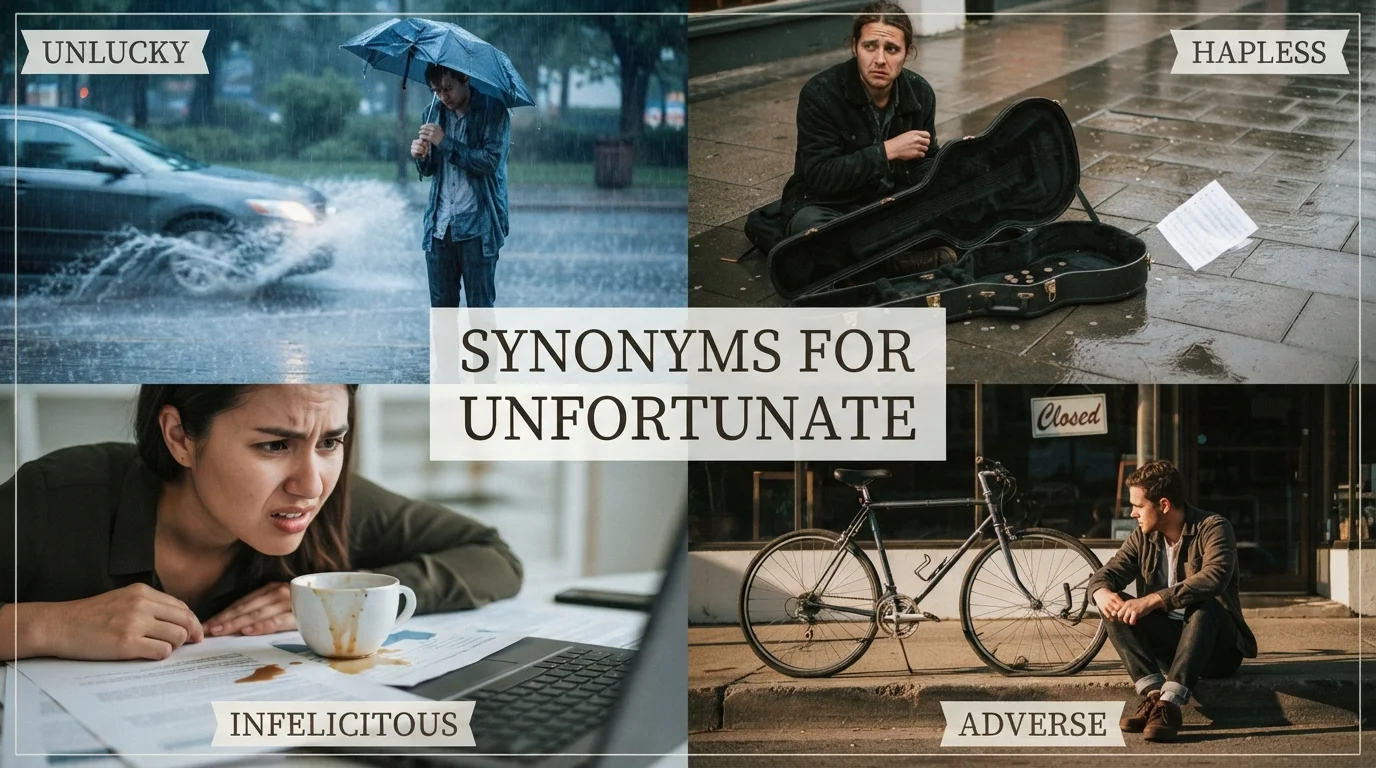
8. Hapless
Meaning: Unlucky, helpless, or repeatedly caught in difficult or embarrassing situations.
Tone: Literary, journalistic, or sometimes humorous.
Best for: Character descriptions, narratives, and accounts of repeated mishaps.
Example: The hapless assistant accidentally deleted the presentation minutes before the meeting.
Watch out: Hapless can sound mocking or condescending when used to describe real people experiencing serious hardship.
9. Lamentable
Meaning: Deserving regret, sorrow, or strong disapproval.
Tone: Formal or literary.
Best for: Serious mistakes, poor decisions, failures, and troubling conditions.
Example: The report described a lamentable failure to maintain basic safety standards.
How it differs: Lamentable often carries stronger criticism than unfortunate.
Use it carefully when the purpose is to express sympathy rather than disapproval.
10. Deplorable
Meaning: Extremely bad, unacceptable, or deserving strong condemnation.
Tone: Strongly critical and formal.
Best for: Serious misconduct, unacceptable conditions, and severe failures.
Example: The inspectors documented deplorable living conditions in the abandoned building.
Watch out: Deplorable is not a neutral substitute for unfortunate. It expresses strong negative judgment.
11. Unpleasant
Meaning: Causing discomfort, dissatisfaction, or an undesirable experience.
Tone: Neutral.
Best for: Experiences, conversations, situations, sensations, and minor incidents.
Example: The passengers had an unpleasant experience because of the lengthy delay.
How it differs: Unpleasant emphasizes discomfort rather than bad luck or serious consequences.
12. Distressing
Meaning: Causing significant worry, sadness, or emotional discomfort.
Tone: Neutral to serious.
Best for: News, experiences, events, and difficult personal situations.
Example: The sudden loss of their home was deeply distressing for the family.
How it differs: Distressing focuses on the emotional effect of an event.
It is more specific than unfortunate and should reflect the actual seriousness of the situation.
13. Troubling
Meaning: Causing concern, worry, or uneasiness.
Tone: Neutral or professional.
Best for: Developments, behavior, information, trends, and situations.
Example: The audit revealed a troubling pattern of missing financial records.
How it differs: Troubling suggests that something raises concerns, even if its ultimate consequences are not yet known.
14. Tragic
Meaning: Involving profound suffering, serious loss, or devastating consequences.
Tone: Serious and emotionally strong.
Best for: Deaths, disasters, severe accidents, and events involving profound human suffering.
Example: The community came together after the tragic accident.
Watch out: Avoid using tragic for routine disappointments. It is substantially stronger than unfortunate.
15. Disastrous
Meaning: Causing severe damage, failure, or extremely negative consequences.
Tone: Strong and emphatic.
Best for: Major failures, accidents, business losses, and serious mistakes.
Example: The decision to ignore the warnings had disastrous consequences.
How it differs: Disastrous emphasizes the severity of the outcome, whereas unfortunate can describe relatively minor setbacks.
16. Devastating
Meaning: Causing overwhelming emotional pain, destruction, or serious harm.
Tone: Very strong and emotional.
Best for: Major losses, natural disasters, serious personal setbacks, and events involving substantial damage.
Example: The flood had a devastating effect on the surrounding communities.
Watch out: Devastating emphasizes the impact of an event. It is inappropriate for most minor inconveniences.
17. Inauspicious
Meaning: Suggesting that something is unlikely to succeed or have a favorable outcome.
Tone: Formal or literary.
Best for: Beginnings, early signs, first impressions, and events that appear unfavorable.
Example: The company made an inauspicious start when its first product launch was delayed.
How it differs: Inauspicious emphasizes unfavorable signs at the beginning of an undertaking, rather than misfortune in general.
18. Ill-Timed
Meaning: Happening at an inconvenient or inappropriate moment.
Tone: Neutral to professional.
Best for: Comments, interruptions, announcements, decisions, and unexpected events.
Example: The ill-timed announcement distracted the team during an important negotiation.
How it differs: Ill-timed identifies bad timing as the reason something was unfortunate.
19. Undesirable
Meaning: Not wanted or likely to produce an unfavorable result.
Tone: Neutral, professional, or technical.
Best for: Consequences, conditions, effects, behaviors, and outcomes.
Example: The new procedure produced several undesirable side effects.
How it differs: Undesirable describes something unwanted without necessarily expressing regret or sympathy.
20. Disheartening
Meaning: Causing someone to lose confidence, enthusiasm, or hope.
Tone: Neutral to emotional.
Best for: Repeated setbacks, disappointing results, failures, and discouraging experiences.
Example: It was disheartening to see months of preparation end in cancellation.
How it differs: Disheartening describes the emotional impact of disappointment rather than the event’s objective severity.
Synonyms for Unfortunate by Context
Unfortunate Event or Incident
When describing an unfortunate event, the most suitable alternative depends on its seriousness and consequences.
Alternative | Best use | Example |
|---|---|---|
Regrettable | An event that causes regret | The delay was regrettable. |
Unpleasant | An uncomfortable experience | They had an unpleasant encounter. |
Distressing | An emotionally upsetting event | The incident was distressing. |
Tragic | Profound suffering or loss | It was a tragic accident. |
Disastrous | Severe damage or failure | The launch was disastrous. |
Ill-timed | Something happening at a bad moment | It was an ill-timed interruption. |
For routine problems, regrettable or unpleasant is often sufficient. More intense alternatives should reflect the actual circumstances.
Unfortunate Circumstances
Use adverse, unfavorable, difficult, challenging, undesirable, or distressing when describing circumstances.
For example:
The project was delayed by unfortunate circumstances.
A more specific alternative is:
The project was delayed by adverse weather conditions.
Adverse identifies the conditions as harmful to the project without implying that anyone was responsible.
Unfortunate Mistake
For mistakes, useful alternatives include regrettable, costly, serious, consequential, careless, and ill-advised.
These words are not interchangeable. A costly mistake produces substantial losses, a careless mistake results from insufficient attention, and an ill-advised decision reflects poor judgment.
For professional communication, regrettable error is often appropriate when acknowledging a mistake without making unsupported assumptions about its cause.
Unfortunate Person
When unfortunate describes someone experiencing hardship, choose language that accurately identifies their circumstances.
Unlucky works for chance events, disadvantaged for limited access to resources or opportunities, and affected for people experiencing the consequences of a particular event.
For example, instead of “The unfortunate families needed assistance,” write “The families affected by the flooding needed assistance.”
The second version is more specific and avoids defining people by their misfortune.
Unfortunate Outcome
For a negative result, consider disappointing, unfavorable, undesirable, unsuccessful, regrettable, or disastrous.
An unsuccessful outcome means the intended goal was not achieved. A disappointing outcome failed to meet expectations. A disastrous outcome involved exceptionally severe consequences.
Unfortunate vs. Unlucky vs. Regrettable vs. Tragic
A broad description of bad luck or an undesirable situation
It was unfortunate that the concert had to be canceled.
Emphasizes chance or bad luck
She was unlucky to arrive just after the train departed.
Expresses regret about something that happened
The administrative error was regrettable.
Describes profound suffering or serious loss
The tragic accident affected the entire community.
True Synonyms vs. Related Alternatives
Alternative | Relationship | Can replace unfortunate? | Best context |
|---|---|---|---|
Unlucky | Close synonym | Often | Bad luck |
Luckless | Near synonym | Sometimes | Repeated misfortune |
Ill-fated | Stronger alternative | Sometimes | Unsuccessful ventures |
Regrettable | Close synonym | Often | Mistakes and incidents |
Disappointing | Contextual alternative | Sometimes | Unmet expectations |
Adverse | Contextual alternative | Sometimes | Harmful conditions |
Unfavorable | Near synonym | Often | Conditions and outcomes |
Unpleasant | Contextual alternative | Sometimes | Uncomfortable experiences |
Distressing | Stronger alternative | Sometimes | Emotional hardship |
Tragic | Much stronger alternative | Only for serious events | Profound loss |
Disastrous | Much stronger alternative | Only for severe outcomes | Major failures |
Ill-timed | Specific alternative | Only for bad timing | Interruptions and announcements |
Disadvantaged | Related term | Only for unequal circumstances | Access and opportunity |
How to Choose the Right Alternative
What meaning do you want to express?
Suggested alternative

Unlucky
He was unlucky to miss the final train.
10 Sentence Transformations
Original | Better alternative | Why |
|---|---|---|
She was unfortunate to miss the train. | She was unlucky to miss the train. | Emphasizes bad luck. |
The delay was unfortunate. | The delay was regrettable. | More suitable for formal communication. |
The results were unfortunate. | The results were disappointing. | Identifies unmet expectations. |
The project faced unfortunate conditions. | The project faced adverse conditions. | Emphasizes harmful circumstances. |
It was an unfortunate experience. | It was an unpleasant experience. | Appropriate for ordinary discomfort. |
The news was unfortunate. | The news was distressing. | Describes its emotional impact. |
The accident was unfortunate. | The accident was tragic. | Appropriate when it involved profound suffering or loss. |
The decision had unfortunate consequences. | The decision had disastrous consequences. | Emphasizes severe damage, when supported. |
The announcement was unfortunate. | The announcement was ill-timed. | Identifies timing as the problem. |
The unfortunate families needed help. | The families affected by the disaster needed help. | Describes their circumstances more precisely. |
Grammar and Usage
Unfortunate is an adjective. Its related forms include unfortunately (adverb), misfortune (noun), and fortunate (its direct antonym).
Common combinations include unfortunate incident, unfortunate circumstances, unfortunate mistake, unfortunate outcome, unfortunate situation, unfortunate timing, and unfortunate consequences.
Unfortunate vs. Unfortunately
Unfortunate describes a person, event, or situation:
The cancellation was unfortunate.
Unfortunately comments on an entire situation or introduces unwelcome information:
Unfortunately, the event has been canceled.
In professional emails, unfortunately is useful for delivering disappointing news, but repeated use can make a message sound impersonal. A direct explanation is sometimes more helpful.
Comparative and Superlative Forms
The standard comparative and superlative forms are more unfortunate and most unfortunate.
The second incident was even more unfortunate than the first.
However, a more precise adjective such as costlier, more serious, or more distressing may communicate the actual difference more clearly.
Common Mistakes
Using tragic for minor inconveniences. Tragic suggests profound suffering or serious loss.
Assuming unfortunate always means unlucky. An unfortunate decision may result from poor judgment rather than chance.
Confusing adverse with averse. Adverse means unfavorable or harmful; averse means opposed or unwilling.
Using regrettable when no regret is implied. Unlucky or unfavorable may be more appropriate.
Calling people unfortunate unnecessarily. Describe the circumstances affecting them when possible.
Using disastrous without sufficient severity. An ordinary disappointment is not necessarily a disaster.
Treating disadvantaged as a universal synonym. It refers to limited opportunities or resources, not every instance of bad luck.
Overusing unfortunate in apologies. Explain the problem and the steps being taken rather than relying on vague expressions of regret.
When “Unfortunate” Is the Better Word
Unfortunate is useful because it expresses sympathy, regret, or disappointment without necessarily exaggerating the seriousness of an event or assigning responsibility.
For example:
It’s unfortunate that the meeting had to be postponed.
This is clear and appropriate. Replacing unfortunate with tragic would be excessive, while unlucky might incorrectly suggest that chance was responsible.
In formal writing, unfortunate can also be useful when the exact cause of an undesirable outcome is uncertain.