
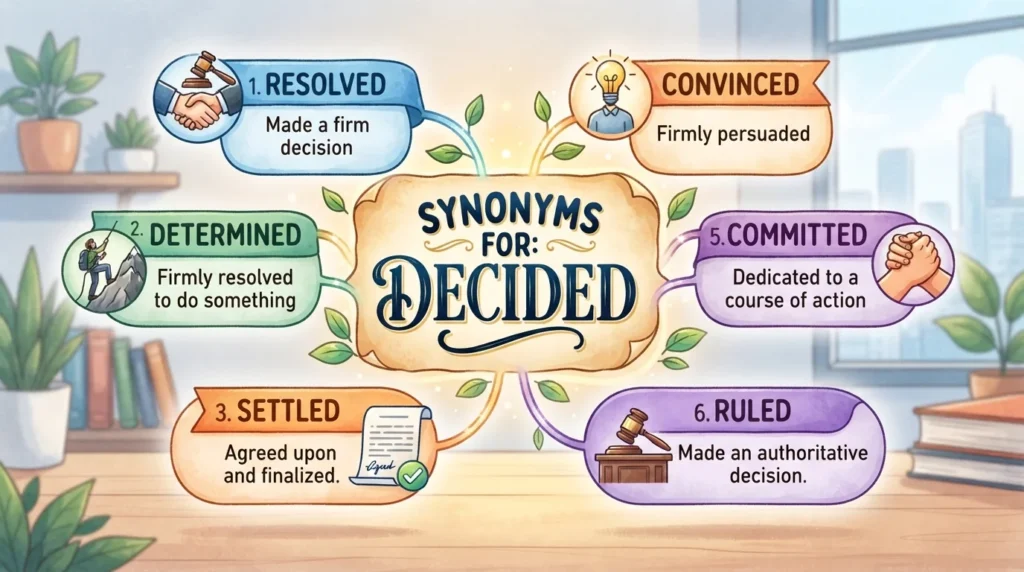
Quick Synonym List
The word decided can describe making a choice, reaching a conclusion, settling a disagreement, or showing firm determination. The following alternatives are grouped by meaning rather than treated as interchangeable synonyms.
Meaning | |
|---|---|
Making a choice | Chose, selected, picked, opted, elected |
Reaching a conclusion | Concluded, determined, established, inferred, judged |
Making a firm decision | Resolved, committed, made up one’s mind, settled on |
Completing a decision | Finalized, settled, confirmed, agreed upon |
Making an official decision | Ruled, decreed, ordered, adjudicated, resolved |
Choosing through discussion | Agreed, reached a consensus, came to an agreement |
Showing determination | Determined, resolute, firm, unwavering, decisive |
Being definite or clear | Definite, clear, unmistakable, pronounced, distinct |
Important distinction
Decided can be the past tense of the verb decide or an adjective meaning definite, unmistakable, or resolute. For example, “She decided to leave” and “There was a decided improvement” require completely different synonyms.
What Does “Decided” Mean?
Decided is the past tense and past participle of decide. It generally means making a choice, reaching a conclusion, or determining what should happen after considering available options.
It can also function as an adjective describing something definite or clearly noticeable.
Consider these examples:
“She decided to accept the offer.” — She made a choice.
“The committee decided to postpone the event.” — The committee reached a collective decision.
“The judge decided the case.” — The judge made an official ruling.
“He is decided in his views.” — He is firm in his opinions, although decided is uncommon in this construction in modern everyday English.
“The new system produced a decided improvement.” — The improvement was clear or unmistakable.
Choosing an accurate synonym requires identifying both the meaning and the grammatical function of decided.
The Best Synonyms for Decided
1. Chose
Meaning: Selected one possibility from two or more options.
Tone: Neutral.
Best for: Everyday decisions, personal preferences, education, careers, and purchases.
Example: She chose to study engineering instead of medicine.
How it differs: Chose emphasizes selecting an option, while decided can also mean reaching a conclusion without choosing between alternatives.
Watch out: “The investigation decided that the equipment had failed” is unnatural; concluded or determined would be more appropriate.
2. Selected
Meaning: Chose someone or something from a group of available options.
Tone: Neutral to professional.
Best for: Recruitment, education, products, research, and formal procedures.
Example: The committee selected three candidates for the final interview.
How it differs: Selected often emphasizes the result of a selection process.
3. Opted
Meaning: Made a choice between available possibilities.
Tone: Neutral to professional.
Best for: Personal preferences, business decisions, travel, and everyday choices.
Example: They opted for a smaller apartment closer to work.
Grammar: Use opted for before a noun and opted to before a verb.
Watch out: Opted is natural when alternatives exist, but less suitable for conclusions based on evidence.
4. Picked
Meaning: Chose someone or something.
Tone: Conversational.
Best for: Informal decisions, everyday conversation, and simple selections.
Example: He picked the blue shirt for the interview.
How it differs: Picked is more casual than selected and usually describes a straightforward choice.
5. Elected
Meaning: Chose to take a particular action, especially in formal or professional contexts.
Tone: Formal.
Best for: Legal, administrative, financial, and professional decisions.
Example: The employee elected to receive the payment in installments.
Watch out: Elected also means chosen for office through voting. Its meaning depends on context.
6. Resolved
Meaning: Made a firm decision to do something.
Tone: Formal or literary.
Best for: Serious personal decisions, commitments, and deliberate changes.
Example: She resolved to improve her writing skills before the next semester.
How it differs: Resolved emphasizes determination and commitment rather than simply choosing an option.
7. Determined
Meaning: Reached a conclusion after consideration or established something through investigation.
Tone: Neutral to formal.
Best for: Research, investigations, assessments, and official findings.
Example: The investigators determined that the equipment had malfunctioned.
Watch out: Determined can also be an adjective describing a persistent person. “She was determined to succeed” describes her attitude, not necessarily a completed decision.
8. Concluded
Meaning: Reached a judgment or opinion after considering evidence or information.
Tone: Neutral to formal.
Best for: Academic writing, research, investigations, and professional reports.
Example: The researchers concluded that further testing was necessary.
How it differs: Concluded emphasizes the result of reasoning rather than choosing an action.
9. Settled
Meaning: Reached a final decision or resolved an issue.
Tone: Neutral.
Best for: Disagreements, plans, arrangements, and final choices.
Example: After several discussions, they settled on a date for the event.
Grammar: Settled on is natural when naming the option chosen.
Watch out: Settled can also mean resolving a dispute or paying an obligation.
10. Finalized
Meaning: Completed the remaining details of a decision, plan, or arrangement.
Tone: Professional.
Best for: Business, projects, contracts, schedules, and administrative work.
Example: The organizers finalized the conference schedule on Monday.
How it differs: Finalized emphasizes completion. A person may decide on a plan before finalizing its details.
11. Agreed
Meaning: Reached the same decision or accepted a proposal.
Tone: Neutral or professional.
Best for: Team decisions, negotiations, relationships, and collaborative planning.
Example: The partners agreed to extend the deadline.
Watch out: Agreed normally implies acceptance or shared understanding, which decided does not necessarily imply.
12. Committed
Meaning: Made a firm promise or dedicated oneself to a particular course of action.
Tone: Neutral to professional.
Best for: Goals, responsibilities, relationships, and long-term plans.
Example: He committed to completing the training program.
How it differs: Committed emphasizes dedication after making a decision.
13. Established
Meaning: Determined or demonstrated something with sufficient evidence or authority.
Tone: Formal.
Best for: Research, investigations, official findings, and factual conclusions.
Example: The investigation established the cause of the technical failure.
Watch out: Established can imply stronger evidentiary support than decided. Do not use it for an uncertain conclusion.
14. Ruled
Meaning: Made an authoritative decision, particularly in a legal or official setting.
Tone: Formal.
Best for: Courts, judges, arbitrators, and official proceedings.
Example: The court ruled that the evidence was inadmissible.
How it differs: Ruled identifies a decision made through official authority.
15. Made Up One’s Mind
Meaning: Reached a definite personal decision.
Tone: Conversational.
Best for: Everyday choices, personal plans, and informal communication.
Example: After weeks of consideration, she made up her mind to move abroad.
How it differs: This expression emphasizes ending uncertainty or hesitation.
Synonyms for Decided by Context
The following distinctions help identify which alternative fits the sentence without changing its intended meaning.
Decided to Do Something
When decided introduces an intended action, chose, opted, resolved, committed, and made up one’s mind are useful alternatives.
Original | Alternative | Difference |
|---|---|---|
She decided to apply. | She chose to apply. | Emphasizes the choice. |
He decided to exercise daily. | He resolved to exercise daily. | Suggests firm determination. |
They decided to move. | They made up their minds to move. | Emphasizes ending uncertainty. |
We decided to use another supplier. | We opted to use another supplier. | Highlights a choice between options. |
Decided After Careful Consideration
Use concluded, determined, judged, settled on, or reached a decision when the process of thinking or evaluating information matters.
For example:
After examining the evidence, the researchers decided that further testing was necessary.
A more precise version is:
After examining the evidence, the researchers concluded that further testing was necessary.
Concluded identifies an evidence-based judgment rather than a personal preference.
Decided in Business Writing
Professional communication benefits from alternatives that identify the stage or nature of a decision.
Alternative | Appropriate situation |
|---|---|
Selected | Choosing a candidate or supplier |
Approved | Granting formal permission |
Finalized | Completing a plan or arrangement |
Confirmed | Verifying or formally accepting a decision |
Agreed upon | Reaching a shared decision |
Determined | Establishing a result through assessment |
Committed | Accepting an ongoing obligation |
For example, “The management team decided on the budget” can become “The management team finalized the budget” if all remaining details have been completed.
However, approved should be used only when someone with the appropriate authority has granted approval.
Decided in Academic Writing
In research, alternatives should reflect how a conclusion was reached.
Concluded describes a judgment drawn from evidence. Determined suggests establishing a result through a method or investigation. Inferred means reaching a conclusion from available information rather than directly observing the result.
For example, “The researchers inferred that the species had migrated” suggests an interpretation of evidence. It does not mean that migration was directly observed or conclusively established.
Decided as an Adjective
The adjective decided has a different set of alternatives.
Expression | Suitable alternative |
|---|---|
A decided improvement | A clear or noticeable improvement |
A decided advantage | A definite or distinct advantage |
A decided preference | A strong or definite preference |
A decided change | A pronounced or unmistakable change |
A decided difference | A clear or marked difference |
In this use, decided generally means definite, unmistakable, or clearly noticeable.
For example, “There has been a decided improvement in her pronunciation” can become “There has been a marked improvement in her pronunciation.”
Decided vs. Chose vs. Resolved vs. Concluded
Made a choice or reached a judgment
She decided to change careers.
Selected an option
She chose a career in engineering.
Made a firm commitment
She resolved to finish her degree.
Reached a judgment after consideration
She concluded that additional training was necessary.
True Synonyms vs. Related Alternatives
Alternative | Relationship | Can replace decided? | Best context |
|---|---|---|---|
Chose | Close synonym | Often | Selecting an option |
Selected | Close synonym | Often | Formal selections |
Opted | Near synonym | Often | Choosing between options |
Resolved | Stronger alternative | Sometimes | Firm commitments |
Determined | Contextual synonym | Sometimes | Findings and decisions |
Concluded | Contextual synonym | Sometimes | Evidence-based judgments |
Settled on | Close phrase-level alternative | Often | Final choices |
Finalized | Related action | Sometimes | Completed arrangements |
Agreed | Contextual alternative | Sometimes | Shared decisions |
Committed | Related action | Sometimes | Long-term obligations |
Approved | Specific official action | Only with authority | Formal permission |
Ruled | Specific official decision | In legal contexts | Court decisions |
Definite | Adjective synonym | For adjectival use | Clear preferences |
Marked | Adjective synonym | For adjectival use | Noticeable changes |
How to Choose the Right Alternative
What does “decided” mean in your sentence?
Suggested alternative
Chose
She chose the earlier flight.
10 Sentence Transformations
Original | Better alternative | Why |
|---|---|---|
She decided to study abroad. | She chose to study abroad. | Emphasizes selecting an option. |
He decided to stop procrastinating. | He resolved to stop procrastinating. | Expresses firm determination. |
We decided on the blue design. | We selected the blue design. | Identifies a specific selection. |
They decided to take the train. | They opted to take the train. | Highlights a choice between alternatives. |
The researchers decided more testing was needed. | The researchers concluded that more testing was needed. | Emphasizes an evidence-based judgment. |
The committee decided on a final date. | The committee settled on a final date. | Emphasizes reaching agreement. |
The team decided on all the project details. | The team finalized the project details. | Communicates completion. |
Both departments decided to cooperate. | Both departments agreed to cooperate. | Emphasizes a shared decision. |
The judge decided the case. | The judge ruled on the case. | Uses the appropriate legal term. |
There was a decided improvement. | There was a marked improvement. | Preserves the adjectival meaning. |
Grammar and Usage
Decided has two principal grammatical functions.
As a verb, it is the simple past tense and past participle of decide:
Present: decide
Past: decided
Past participle: decided
Present participle: deciding
For example, “They decided yesterday” uses the simple past, while “They have decided to proceed” uses the present perfect.
As an adjective, decided can mean definite, clear, or unmistakable, as in “a decided preference.”
Common verb patterns include decided to, decided on, decided against, decided that, and decided between.
Pay particular attention to prepositions. “She decided to buy a car” identifies an action, while “She decided on a car” identifies the option chosen. “She decided against buying a car” means she chose not to make the purchase.
Common Mistakes
Using determined for every decision. Determined may describe either reaching a finding or having a persistent attitude. The intended meaning must be clear.
Confusing decided and decisive. A decisive person makes decisions confidently or effectively; a decided improvement is a clearly noticeable improvement.
Using concluded for simple preferences. “She concluded on the red dress” is unnatural. Use chose or decided on.
Treating finalized as identical to decided. A plan can be chosen before its details are finalized.
Using agreed for an individual decision. Agreement normally involves accepting something or sharing a position with another person.
Using resolved for casual choices. “She resolved to order coffee” sounds unnecessarily dramatic unless the choice involves meaningful determination.
Confusing selected with approved. Selecting an option does not necessarily mean granting it formal approval.
Ignoring the adjectival meaning. In “a decided advantage,” decided means definite or clear, not chosen.
When “Decided” Is the Better Word
Decided is often the clearest option when the exact nature of a choice is not important or when a more specific verb would introduce an unintended meaning.
For example, “We decided to leave early” is natural and complete. Changing it to “We resolved to leave early” could make an ordinary scheduling choice sound like a serious personal commitment.
Similarly, “The committee decided to postpone the meeting” does not necessarily mean every member agreed or that the decision was unanimous.
Use a more specific alternative only when the context supports its additional meaning