
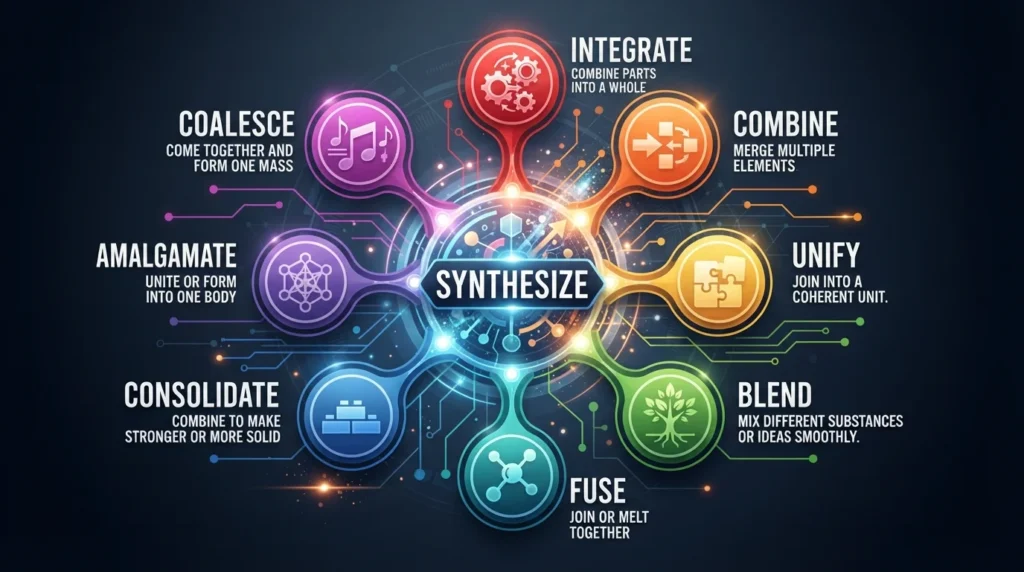
Quick Synonym List
Closest alternatives
- Combine
- Integrate
- Merge
- Unite
- Bring together
- Consolidate
- Blend
- Fuse
- Assemble
- Combine elements
Academic and analytical writing
- Integrate
- Combine
- Bring together
- Reconcile
- Connect
- Correlate
- Consolidate
- Draw together
- Incorporate
- Develop from multiple sources
Research and information
- Synthesize information
- Integrate findings
- Combine evidence
- Consolidate findings
- Bring together evidence
- Connect ideas
- Compare and integrate
- Draw together conclusions
- Reconcile perspectives
- Construct a broader understanding
Physical or technical combination
- Combine
- Mix
- Blend
- Fuse
- Join
- Assemble
- Integrate
- Incorporate
- Compound
- Form
Scientific/chemical sense
- Produce
- Manufacture
- Create
- Form
- Generate
- Prepare
- Construct
- Assemble
- Combine chemically
- Biosynthesize
More concise alternatives
- Combine
- Integrate
- Merge
- Consolidate
- Unite
- Compile
- Assemble
- Blend
What Does “Synthesize” Mean?
Synthesize has several related meanings, but its central idea is bringing separate elements together to form something more complete, organized, or new.
For example:
This means the researcher combined and integrated information from those studies to develop an overall understanding.
In another context:
“The chemist synthesized the compound in the laboratory.”
Here, synthesized means produced the compound through a chemical process.
The word can therefore describe:
- Combining ideas or information
- Integrating evidence from multiple sources
- Bringing different perspectives together
- Combining physical components
- Producing a chemical or biological substance
- Creating something new from separate elements
Because of these different senses, the best synonym depends on the context.
The Closest Synonyms for Synthesize
1. Combine
Meaning: Put two or more things together.
Tone: Neutral.
Best for: General writing, ideas, information, materials, and components.
Example:
“The report combines findings from several studies.”
Difference:
Combine is the broadest and simplest alternative. It does not necessarily suggest the deeper integration or new understanding implied by synthesize.
2. Integrate
Meaning: Combine separate parts so that they function or exist together as a unified whole.
Tone: Neutral to formal.
Best for: Academic writing, research, business, technology, and systems.
Example:
“The researchers integrated findings from several sources.”
Difference:
Integrate is often the closest alternative in academic and professional writing because it suggests that separate information is brought into a coherent whole.
3. Merge
Meaning: Combine two or more things into one.
Tone: Neutral.
Best for: Organizations, systems, ideas, data, businesses, and processes.
Example:
“The team merged data from two databases.”
Difference:
Merge strongly suggests that separate things become one. It is less natural than synthesize when discussing the interpretation of multiple sources.
4. Unite
Meaning: Bring separate people or things together.
Tone: Neutral to formal.
Best for: People, groups, ideas, causes, and forces.
Example:
“The theory unites several previously separate concepts.”
Difference:
Unite emphasizes bringing things together rather than analyzing or transforming them into a new understanding.
5. Consolidate
Meaning: Combine separate things into a single, stronger, or more organized whole.
Tone: Professional/formal.
Best for: Data, reports, information, resources, organizations, and findings.
Example:
“The analyst consolidated the findings into a single report.”
Difference:
Consolidate often emphasizes organization and reduction into a unified collection rather than creating a new interpretation.
6. Bring Together
Meaning: Combine separate information, ideas, people, or resources.
Tone: Neutral.
Best for: General and academic writing.
Example:
“The paper brings together research from several fields.”
Difference:
This is a clear phrase-level alternative, but it does not necessarily imply the analytical depth of synthesize.
7. Blend
Meaning: Mix different elements so they form a unified combination.
Tone: Neutral.
Best for: Ideas, styles, flavors, materials, approaches, and influences.
Example:
“The author blends historical research with personal experience.”
Difference:
Blend often suggests that the individual elements become less distinct within the combined result.
8. Fuse
Meaning: Join separate elements into a single entity or combination.
Tone: Neutral/formal.
Best for: Materials, technologies, ideas, styles, and concepts.
Example:
“The design fuses traditional techniques with modern technology.”
Difference:
Fuse suggests a particularly close or complete joining.
9. Assemble
Meaning: Put separate parts or pieces together.
Tone: Neutral.
Best for: Components, information, evidence, teams, and physical objects.
Example:
“The researcher assembled evidence from several sources.”
Difference:
Assemble emphasizes gathering and putting together. It does not necessarily imply analytical integration.
10. Incorporate
Meaning: Include something as part of a larger whole.
Tone: Neutral/formal.
Best for: Ideas, evidence, features, information, and elements.
Example:
“The revised report incorporates findings from recent research.”
Difference:
Incorporate means adding something to an existing whole. It does not necessarily mean combining several sources into a new interpretation.
Synthesize in Academic Writing
Synthesize is especially important in academic writing because researchers and students often need to combine information from multiple sources.
Consider:
“The essay synthesizes research on climate policy.”
This means the essay does more than list or summarize studies. It connects their ideas, compares them, identifies relationships, and develops an integrated understanding.
Useful alternatives include:
- Integrates
- Combines
- Brings together
- Connects
- Consolidates
- Reconciles
- Draws together
- Incorporates
- Correlates
- Integrates findings
- Combines evidence
- Connects perspectives
Important distinction
“The essay summarizes three studies.”
means the essay reports what each study says.
“The essay synthesizes three studies.”
means the essay connects and integrates their findings or arguments.
That distinction is important in academic writing.
Synthesize Research
When synthesize is used with research, useful alternatives include:
- Integrate research
- Combine findings
- Bring together findings
- Consolidate evidence
- Integrate evidence
- Connect findings
- Reconcile findings
- Compare and integrate research
- Draw together findings
- Develop an integrated analysis
Example
Original:
“The researcher synthesized evidence from several studies.”
“The researcher integrated evidence from several studies.”
“The researcher brought together evidence from several studies.”
“The researcher consolidated findings from several studies.”
Each is slightly different.
Integrated emphasizes connection.
Brought together is simpler.
Consolidated emphasizes organization into a unified body.
Synthesize Information
When you need a synonym for synthesize information, choose based on the intended action.
Combine information
“The analyst combined information from multiple reports.”
Simple and broad.
Integrate information
“The analyst integrated information from multiple reports.”
Suggests meaningful connection.
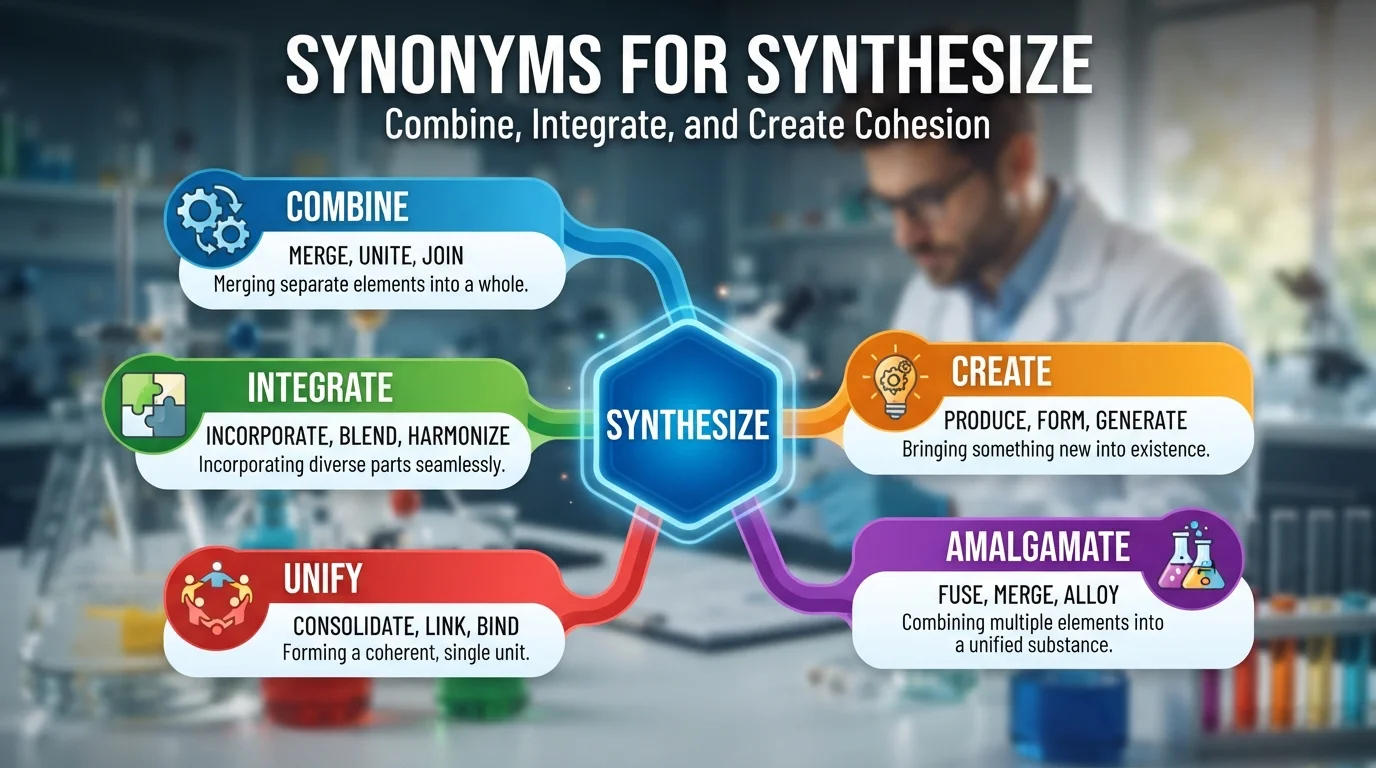
Consolidate information
“The analyst consolidated information from multiple reports.”
Suggests bringing information into one organized collection.
Compile information
“The analyst compiled information from multiple reports.”
Emphasizes collecting information rather than interpreting it.
Analyze and integrate
“The analyst analyzed and integrated findings from multiple reports.”
Useful when the process involves both examination and synthesis.
Synthesize vs. Summarize
These words are often confused.
Summarize
To summarize is to present the main points of something in a shorter form.
“The student summarized the article.”
The student reduces the original information.
Synthesize
To synthesize is to combine information from multiple sources or elements to create an integrated understanding.
“The student synthesized ideas from four articles.”
The student connects information across sources.
Simple rule
Summarize = shorten the main ideas.
Synthesize = connect ideas to create a broader understanding.
A synthesis can contain summaries of individual sources, but it goes beyond them.
Synthesize vs. Combine
These are close, but synthesize is more specific.
“The report combines information from five sources.”
This tells us the information has been put together.
“The report synthesizes information from five sources.”
This suggests that the information has been integrated into a coherent interpretation.
Use combine when simple joining is enough.
Use synthesize when integration and interpretation matter.
Synthesize vs. Integrate
These are among the closest alternatives.
Integrate means bringing separate elements into a unified whole.
Synthesize often adds the idea of creating a new understanding, product, or result from those elements.
Compare:
“The researcher integrated the findings.”
“The researcher synthesized the findings.”
Both are correct, but synthesized can suggest a more active process of drawing connections and producing an overall interpretation.
Synthesize vs. Consolidate
Consolidate usually means bringing things together into a single organized collection.
“The company consolidated its financial reports.”
Synthesize suggests more intellectual or creative integration.
“The researcher synthesized findings from several studies.”
You can consolidate information without synthesizing it.
Synthesize vs. Compile
Compile means collect and arrange information or materials.
“The researcher compiled a list of studies.”
Synthesize means connect and integrate information.
“The researcher synthesized the findings of those studies.”
Compilation is primarily about collection.
Synthesis is about integration and meaning.
Synthesize vs. Analyze
These are related but not synonymous.
Analyze means examine something by breaking it into parts or studying its components.
Synthesize means bring separate parts or findings together into a whole.
A strong research process may involve both:
“The researcher analyzed individual studies and synthesized their findings.”
A person can analyze without synthesizing, and synthesize without using analyze as the main description.
Synthesize in Science and Chemistry
In science, synthesize can mean produce a substance or compound through a chemical or biological process.
For example:
“Scientists synthesized the compound in the laboratory.”
Possible alternatives include:
- Produce
- Create
- Form
- Generate
- Prepare
- Manufacture
- Construct
- Assemble
- Biosynthesize
However, these words are not always exact technical equivalents.
Produce
Broadest alternative.
“Scientists produced the compound in the laboratory.”
Prepare
Common in laboratory contexts.
“The compound was prepared under controlled conditions.”
Manufacture
Usually suggests production on a larger or industrial scale.
“The compound is manufactured commercially.”
Form
Emphasizes the creation or development of a substance.
“The reaction forms a new compound.”
Biosynthesize
Specific to biological synthesis.
“Plants biosynthesize certain organic compounds.”
Synthesize in Biology
In biology, synthesize commonly means that a biological system produces a substance.
Examples include:
- synthesize proteins;
- synthesize hormones;
- synthesize enzymes;
- synthesize DNA;
- synthesize RNA;
- synthesize nutrients.
Depending on the context, alternatives may include:
- Produce
- Generate
- Form
- Create
- Biosynthesize
But synthesize is often the most precise scientific term and should not be replaced merely for stylistic variation.
Synthesize in Technology
Technology can use synthesize in several ways.
For example:
“The software synthesizes data from multiple sources.”
- Integrates data
- Combines data
- Consolidates data
- Aggregates data
- Processes data
- Merges data
Important distinction
Aggregates often means collects or combines data.
Integrates emphasizes making separate systems or information work together.
Synthesizes can suggest that the system combines information to generate a more meaningful result.
Synthesize in Business
Business writing may use synthesize when combining market research, customer feedback, financial information, or strategic insights.
“The team synthesized customer feedback and market data.”
Possible alternatives:
“The team integrated customer feedback and market data.”
“The team combined customer feedback with market data.”
“The team consolidated customer feedback and market data.”
Again, synthesize can imply that the team developed a broader interpretation rather than simply placing the data together.
Synthesize in Writing
In writing, synthesize often means combining ideas, evidence, examples, or perspectives into a coherent argument.
Useful alternatives include:
- Integrate
- Combine
- Connect
- Reconcile
- Bring together
- Draw together
- Incorporate
- Weave together
- Unite
- Blend
Example
“The author synthesizes several perspectives on the issue.”
Possible alternative:
“The author integrates several perspectives on the issue.”
This is usually a close replacement.
Synthesize Different Perspectives
When the object is perspectives, viewpoints, or opinions, useful alternatives include:
- Integrate perspectives
- Bring perspectives together
- Reconcile perspectives
- Combine viewpoints
- Unite viewpoints
- Connect perspectives
- Balance perspectives
- Draw together viewpoints
Important distinction
Reconcile suggests resolving or accommodating differences.
“The report reconciles two competing perspectives.”
That is more specific than simply synthesizing them.
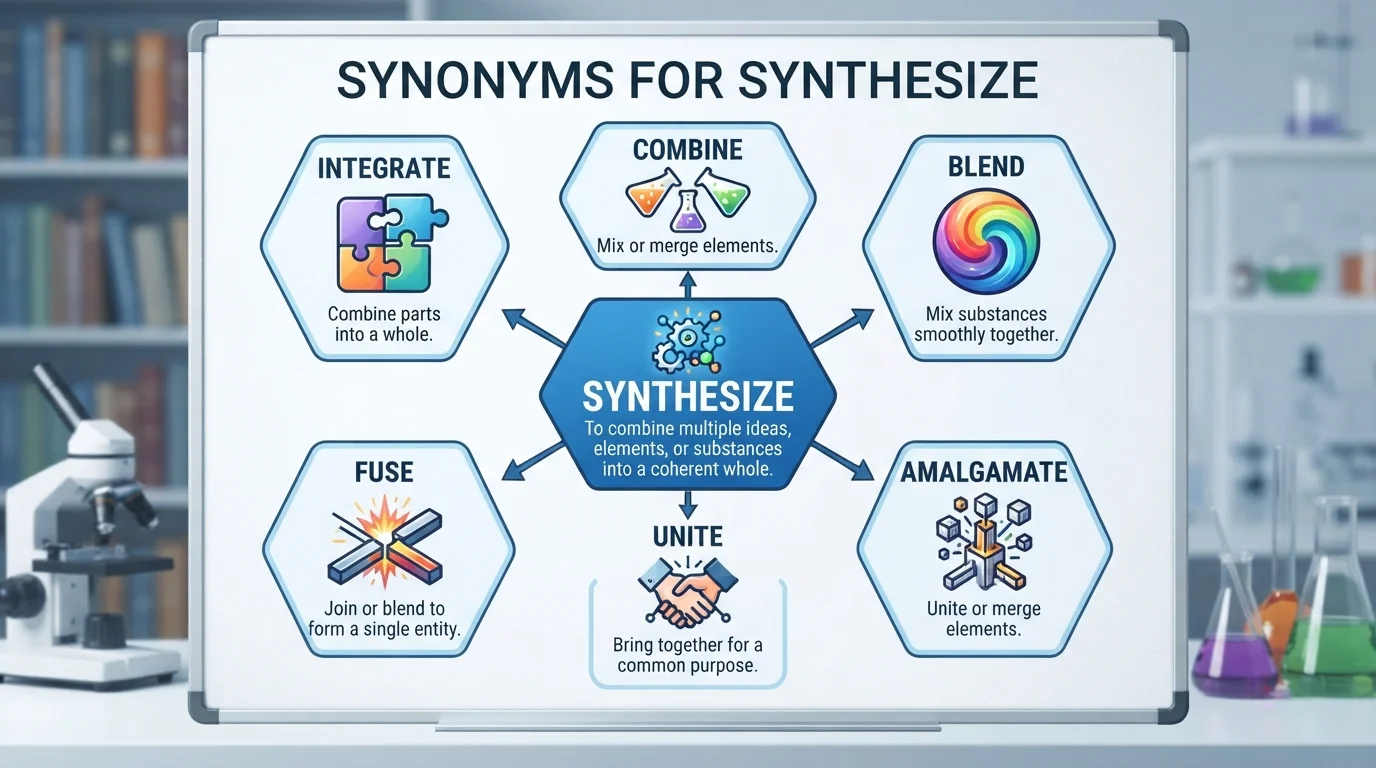
Synthesize vs. Reconcile
Reconcile means bring apparently conflicting ideas, accounts, or positions into agreement or compatibility.
“The researcher reconciled conflicting findings.”
Synthesize means combine information or ideas into an integrated whole.
“The researcher synthesized findings from several studies.”
Synthesis does not necessarily require disagreement.
Synthesize vs. Aggregate
These words are particularly useful in data contexts.
Aggregate means collect or combine items into a larger group or total.
“The system aggregates data from multiple sources.”
Synthesize suggests a more meaningful integration or interpretation.
“The system synthesizes data from multiple sources to identify patterns.”
Aggregation is about combining.
Synthesis can be about combining and making sense of.
True Synonyms vs. Related Alternatives
| Alternative | Relationship | Meaning | Interchangeable? |
|---|---|---|---|
| Combine | Very close synonym | Put elements together | Often |
| Integrate | Very close synonym | Combine into a unified whole | Often |
| Merge | Near synonym | Make separate things into one | Sometimes |
| Unite | Near synonym | Bring things together | Sometimes |
| Consolidate | Near synonym | Combine into one organized whole | Sometimes |
| Blend | Near synonym | Mix into a unified combination | Sometimes |
| Fuse | Near synonym | Join closely into one | Sometimes |
| Assemble | Related alternative | Put parts together | Sometimes |
| Incorporate | Related alternative | Include within a larger whole | Sometimes |
| Compile | Related alternative | Collect and arrange | No |
| Aggregate | Related alternative | Collect/combine into a group | Sometimes |
| Summarize | Distinct but related | Reduce to main points | No |
| Analyze | Distinct but related | Examine components | No |
| Reconcile | Contextual alternative | Bring conflicting views into agreement | Sometimes |
| Connect | Near alternative | Establish relationships | Sometimes |
| Create | Broader alternative | Make something new | In scientific contexts |
| Produce | Contextual alternative | Make or generate something | In scientific contexts |
| Prepare | Technical alternative | Make a substance for use | In laboratory contexts |
Sentence Transformations
1. Academic research
Original:
“The researcher synthesized evidence from several studies.”
Alternative:
“The researcher integrated evidence from several studies.”
Why:
Integrated is a close academic alternative that preserves the idea of bringing evidence into a unified whole.
2. Simple combination
Original:
“The report synthesizes data from three departments.”
Alternative:
“The report combines data from three departments.”
Why:
Combines is simpler and works when you only need to describe the act of bringing the data together.
3. Consolidation
Original:
“The analyst synthesized the findings into one report.”
Alternative:
“The analyst consolidated the findings into one report.”
Why:
Consolidated emphasizes bringing separate findings into a single organized report.
4. Academic writing
Original:
“The essay synthesizes ideas from several authors.”
Alternative:
“The essay brings together ideas from several authors.”
Why:
This is a clearer, less technical phrase for general readers.
5. Information collection
Original:
“The researcher synthesized information from multiple sources.”
Alternative:
“The researcher compiled information from multiple sources.”
Why:
Compiled works if the main activity was collecting information rather than interpreting and integrating it.
6. Conflicting evidence
Original:
“The review synthesizes conflicting findings.”
Alternative:
“The review reconciles conflicting findings.”
Why:
Reconciles is more precise when the review actively addresses differences or contradictions.
7. Technology
Original:
“The platform synthesizes data from multiple systems.”
Alternative:
“The platform integrates data from multiple systems.”
Why:
Integrates is particularly natural when separate technical systems or datasets are connected.
8. Chemistry
Original:
“Scientists synthesized the compound in the laboratory.”
Alternative:
“Scientists produced the compound in the laboratory.”
Why:
Produced is broader and more accessible, while synthesized is more technically precise.
9. Biology
Original:
“The cells synthesize proteins.”
Alternative:
“The cells produce proteins.”
Why:
Produce is understandable to a broad audience, but synthesize is the more precise scientific term.
10. Combining styles
Original:
“The designer synthesized traditional and modern styles.”
Alternative:
“The designer blended traditional and modern styles.”
Why:
Blended emphasizes the way the two styles are mixed into a unified aesthetic.
Common Collocations With Synthesize
Common academic and professional patterns include:
- synthesize information
- synthesize evidence
- synthesize research
- synthesize findings
- synthesize ideas
- synthesize perspectives
- synthesize data
- synthesize knowledge
- synthesize sources
- synthesize arguments
- synthesize results
- synthesize literature
- synthesize multiple studies
- synthesize information from multiple sources
- synthesize findings from different studies
Scientific collocations include:
- synthesize a compound
- synthesize chemicals
- synthesize proteins
- synthesize DNA
- synthesize RNA
- synthesize hormones
- synthesize enzymes
- synthesize organic compounds
- synthesize a substance
- chemically synthesize
- biologically synthesize
- biosynthesize
Grammar and Usage
Synthesize is a regular verb.
Present
“The researcher synthesizes the evidence.”
Past
“The researcher synthesized the evidence.”
Present participle
“The researcher is synthesizing the evidence.”
Noun
The related noun is synthesis.
“The paper provides a synthesis of recent research.”
Common structures
synthesize + noun
“The researcher synthesized the findings.”
synthesize + information from + sources
“The student synthesized information from five articles.”
synthesize + findings/evidence/ideas
“The report synthesizes findings from multiple studies.”
synthesize A and B
“The model synthesizes qualitative and quantitative data.”
Common Mistakes
Mistake 1: Treating synthesis as simple summarization
A summary reports the main points of a source.
A synthesis connects information across sources or elements.
“She summarized four articles.”
is different from:
“She synthesized ideas from four articles.”
Mistake 2: Using “compile” when analysis is involved
Compiling means collecting and arranging.
“The researcher compiled the articles.”
This does not necessarily mean the researcher connected their findings.
Mistake 3: Assuming “combine” always has the same meaning
Combine is broader and simpler.
You can combine two lists without synthesizing them.
Synthesis often implies a more meaningful integration.
Mistake 4: Using “analyze” as a synonym
Analysis breaks something down for examination.
Synthesis brings elements together.
Strong research may use both:
“The researchers analyzed individual studies and synthesized their findings.”
Mistake 5: Using “create” in academic writing
Create is much broader.
“The researcher created a synthesis of the findings.”
This is possible, but synthesized the findings is more precise.
Mistake 6: Using “merge” for every kind of synthesis
Merge works well for databases, organizations, files, systems, and some ideas.
It can sound unnatural when discussing complex academic arguments.
“The essay merges the theories.”
is possible, but:
“The essay synthesizes the theories.”
usually communicates the intended intellectual process more accurately.
Mistake 7: Assuming synthesis always creates something completely new
Synthesis often produces a new understanding, interpretation, arrangement, or whole, but it does not necessarily mean inventing entirely new information.
When “Synthesize” Is Actually the Better Word
Keep synthesize when you specifically mean that separate information, ideas, evidence, or components have been integrated into a coherent whole.
For example:
“The review synthesizes findings from 20 studies.”
This is concise and meaningful.
Replacing it with:
“The review combines findings from 20 studies.”
makes the claim broader and potentially weaker.
Likewise, in science:
“Cells synthesize proteins.”
is usually more precise than:
“Cells make proteins.”
Both may be understandable, but synthesize is the established scientific term.
Do not replace a precise technical word simply to avoid repetition.
How to Choose the Right Alternative
| If you mean… | Use… |
|---|---|
| Put things together generally | Combine |
| Create a unified whole | Integrate |
| Turn separate things into one | Merge |
| Bring people or ideas together | Unite |
| Organize several things into one | Consolidate |
| Mix elements smoothly | Blend |
| Join elements closely | Fuse |
| Put parts together | Assemble |
| Add something to an existing whole | Incorporate |
| Collect and arrange information | Compile |
| Combine data into a group | Aggregate |
| Shorten information to main points | Summarize |
| Examine parts separately | Analyze |
| Resolve conflicting ideas | Reconcile |
| Produce a chemical substance | Synthesize / produce |
| Produce something biologically | Synthesize / biosynthesize |
Editor’s Choice
Integrate
The strongest general alternative when writing about research, information, ideas, or systems.
Combine
The clearest everyday alternative when the meaning is simply putting things together.
Consolidate
Best when separate information or resources are brought into one organized whole.
Reconcile
Best when the elements being combined conflict or appear inconsistent.
Produce
Useful in scientific contexts when synthesize means creating a substance, although synthesize is often the more technically precise term.
These choices should be guided by meaning rather than by the desire to avoid repeating synthesize.