

Quick Synonym List
Closest alternatives
- Remark
- Comment
- Assertion
- Claim
- Declaration
- Explanation
- Account
- Report
- Observation
- Expression
- Proposition
- Response
Formal and professional alternatives
- Declaration
- Official statement
- Position
- Submission
- Testimony
- Representation
- Notice
- Announcement
- Report
- Disclosure
- Account
- Explanation
Strong or authoritative alternatives
- Assertion
- Declaration
- Proclamation
- Pronouncement
- Affirmation
- Insistence
- Denouncement
- Position
Academic and analytical alternatives
- Claim
- Proposition
- Argument
- Assertion
- Observation
- Finding
- Conclusion
- Interpretation
- Premise
- Thesis
Personal or conversational alternatives
- Remark
- Comment
- Opinion
- View
- Response
- Explanation
- Answer
- Observation
Financial and administrative alternatives
- Record
- Report
- Account
- Summary
- Disclosure
- Statement of account
- Financial report
- Transaction record
What Does “Statement” Mean?
Statement has several meanings, so there is no single synonym that works in every sentence.
As a general noun, a statement is something that someone says or writes:
“She made a statement about the incident.”
Here, remark, comment, assertion, or declaration may work depending on the speaker’s purpose and level of certainty.
A statement can also be an official declaration:
“The company released a statement after the announcement.”
Here, announcement, declaration, notice, or official communication may be more precise.
In academic or argumentative writing, a statement can be a claim, assertion, proposition, or argument:
“The statement requires supporting evidence.”
In finance, a statement can be a record or report of transactions:
“I downloaded my bank statement.”
Here, words such as account record, transaction record, or financial report are more appropriate.
The meaning therefore matters more than simply finding a word that looks similar in a thesaurus.
The Closest Synonyms for Statement
Remark
Meaning: Something someone says, especially a short comment or observation.
Tone: Neutral to conversational.
Best for: Everyday speech, interviews, conversations, and informal writing.
Example:
“His remark surprised everyone.”
How it differs: A remark is usually shorter and more conversational than a formal statement.
Comment
Meaning: Something said or written to express an opinion, reaction, or observation.
Tone: Neutral.
Best for: Conversations, social media, news, professional communication, and general writing.
Example:
“She declined to comment on the issue.”
How it differs: Comment often expresses a reaction or opinion, while statement can simply present information.
Assertion
Meaning: A confident statement that something is true.
Tone: Formal.
Best for: Academic, legal, analytical, and argumentative writing.
Example:
“The report challenges his assertion that the system was reliable.”
How it differs: Assertion emphasizes that someone is presenting something as true. It does not necessarily mean the statement has been proven.
Claim
Meaning: A statement that something is true, often one that requires evidence or justification.
Tone: Neutral to formal.
Best for: Academic writing, journalism, research, arguments, and debates.
Example:
“The study does not support the claim.”
How it differs: Claim often signals that the truth of the statement is being examined or disputed.
Declaration
Meaning: A formal or public statement that clearly expresses something.
Tone: Formal.
Best for: Official announcements, legal contexts, public positions, and important decisions.
Example:
“The government issued a declaration of support.”
How it differs: Declaration is more formal and deliberate than ordinary statement.
Explanation
Meaning: A statement that makes something clear or gives reasons for something.
Tone: Neutral.
Best for: Clarifying decisions, events, problems, or actions.
Example:
“The manager provided an explanation for the delay.”
How it differs: An explanation does more than state something; it helps the reader understand why or how.
Account
Meaning: A description or report of an event or experience.
Tone: Neutral to formal.
Best for: Incidents, experiences, historical events, journalism, and testimony.
Example:
“She gave an account of what happened.”
How it differs: Account usually describes events or experiences in some detail.
Report
Meaning: A spoken or written description of information, findings, events, or activities.
Tone: Neutral to formal.
Best for: Business, journalism, research, investigations, and official communication.
Example:
“The committee released a report on the incident.”
How it differs: A report is usually more developed and structured than a simple statement.
Observation
Meaning: A statement based on something someone has noticed.
Tone: Neutral to formal.
Best for: Academic writing, research, analysis, and everyday observations.
Example:
“Her observation about the pattern was accurate.”
How it differs: An observation emphasizes noticing or recognizing something.
Expression
Meaning: Something that communicates a thought, feeling, belief, or idea.
Tone: Neutral.
Best for: Opinions, emotions, attitudes, and ideas.
Example:
“The letter was an expression of gratitude.”
How it differs: Expression focuses on communicating an internal thought or feeling.
Formal Synonyms for Statement
Pronouncement
A pronouncement is a formal or authoritative statement.
“The judge’s pronouncement ended the discussion.”
It suggests that the speaker has authority or is making an important declaration.
Proclamation
A proclamation is a formal public announcement, often issued by an authority.
“The mayor issued a proclamation recognizing the volunteers.”
It is considerably more formal than ordinary statement.
Announcement
An announcement provides information about something that has happened or will happen.
“The company made an announcement about the new policy.”
Use announcement when the purpose is to inform people rather than simply express an opinion.
Notice
A notice is an official communication giving information, instructions, or a warning.
“The building manager posted a notice about the closure.”
It is common in administrative and public settings.
Official Communication
This phrase refers broadly to a formal message issued by an organization or authority.
“The organization released an official communication.”
It can be useful when statement sounds too vague.
Position
A position is an expressed view or stance on an issue.
“The organization clarified its position on the proposal.”
It is particularly useful when the statement expresses a policy, belief, or official stance.
Submission
A submission is information or an argument formally presented to an authority, committee, court, or organization.
“The company filed a written submission.”
It is not a general synonym for statement, but it works in formal procedural contexts.
Testimony
Testimony is a formal statement, especially one given by a witness or expert.
“The witness gave testimony before the committee.”
It is more specific than statement and often has legal or official associations.
Synonyms for Statement in Academic Writing
Academic writers often use statement in several different ways.
Claim
Use claim when the statement presents something as true.
“The author makes the claim that social media influences purchasing behavior.”
Assertion
Use assertion for a confident statement that is being put forward as true.
“This assertion requires further evidence.”
Proposition
A proposition is a statement or idea proposed for consideration, discussion, or testing.
“The researchers tested the proposition that early intervention improves outcomes.”
Argument
An argument is a set of reasons supporting a conclusion, although it can sometimes refer more broadly to a particular position.
“The author presents a strong argument for reform.”
Important: An argument is not always a direct synonym for statement. An argument normally involves reasoning or evidence.
Premise
A premise is a proposition used as the basis for an argument or conclusion.
“The conclusion depends on a questionable premise.”
It should not replace statement unless the statement functions as a basis for reasoning.
Finding
A finding is a result or conclusion reached through research or investigation.
“The study’s findings support the original hypothesis.”
A finding is therefore much more specific than a general statement.
Synonyms for Statement as an Opinion or View
When statement means an expressed belief or viewpoint, these alternatives may be more precise:
- Opinion
- View
- Viewpoint
- Perspective
- Position
- Stance
- Belief
- Judgment
- Assessment
- Interpretation
- Position statement
Opinion
An opinion expresses what someone thinks or believes.
“She gave her opinion on the proposal.”
Viewpoint
A viewpoint emphasizes someone’s particular way of seeing an issue.
“The article presents a different viewpoint.”
Stance
A stance is a clearly defined position on an issue.
“The organization adopted a firm stance on the matter.”
Perspective
A perspective emphasizes a particular way of understanding or interpreting something.
“The report offers a useful perspective on the problem.”
Assessment
An assessment is a considered judgment based on information or evaluation.
“The consultant provided an assessment of the risks.”
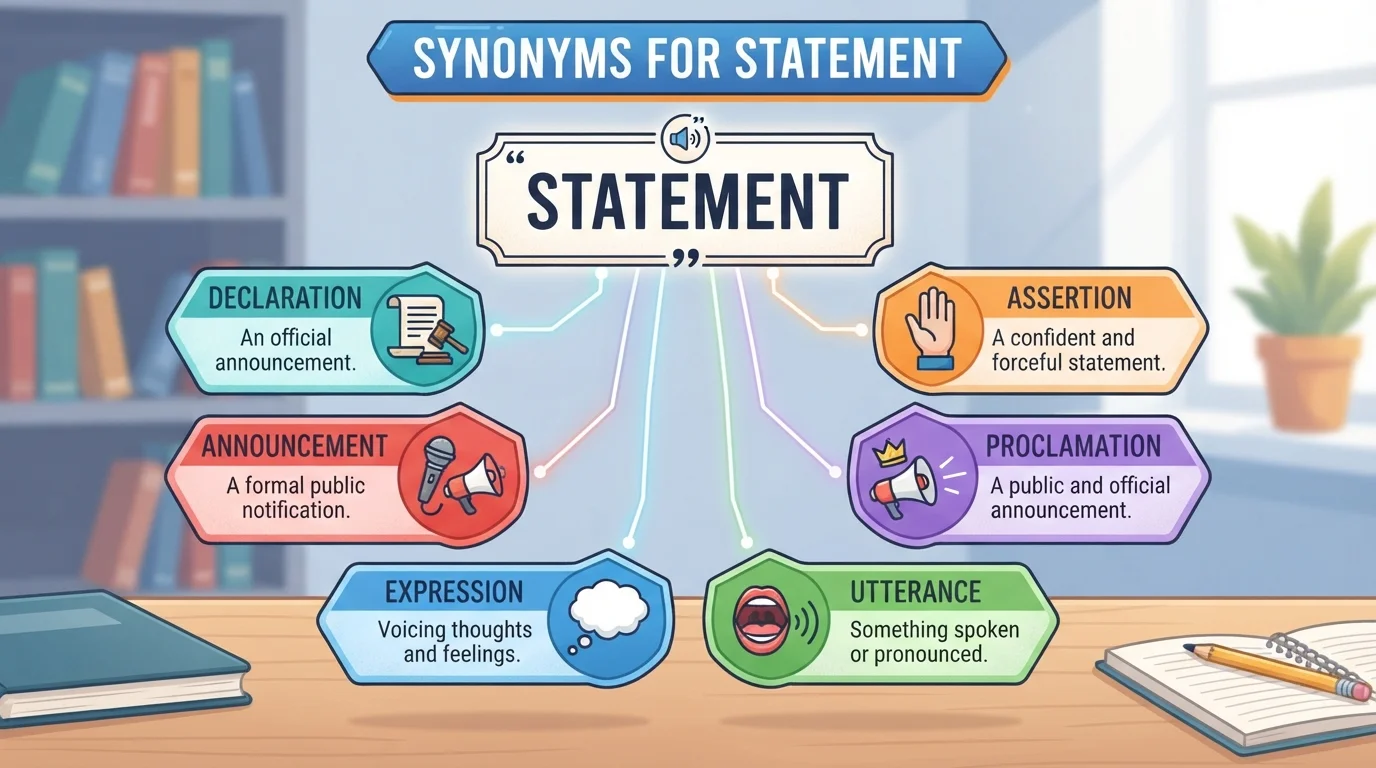
Synonyms for an Official Statement
When an organization, company, government agency, or public figure releases a statement, these words may fit depending on the purpose:AlternativeMeaningBest UseDirect Replacement?
For example:
“The company released a statement about the incident.”
could become:
“The company released an announcement about the new product.”
But:
“The company released a position on the proposed regulation.”
is better when the purpose is to express an official view.
Synonyms for Statement in Journalism
News writing frequently uses statement for comments or information provided by a person or organization.
Useful alternatives include:
- Comment
- Remark
- Response
- Declaration
- Announcement
- Explanation
- Account
- Claim
- Assertion
- Position
- Disclosure
- Confirmation
Example
Original:
“The company issued a statement denying the allegations.”
Possible alternatives:
“The company issued a denial of the allegations.”
“The company released a response to the allegations.”
“The company provided an explanation of its position.”
The best choice depends on what the company actually did.
Synonyms for Statement in Legal Contexts
Legal language requires particular care because similar-looking terms can have different procedural meanings.
Possible alternatives include:
- Declaration
- Testimony
- Affidavit
- Deposition
- Evidence
- Submission
- Representation
- Admission
- Denial
- Pleading
- Sworn statement
- Written declaration
Affidavit
An affidavit is a written statement confirmed by oath or affirmation.
“The witness submitted an affidavit.”
It is not a general synonym for statement.
Deposition
A deposition is sworn testimony taken outside court proceedings in a legal context.
“The attorney reviewed the witness’s deposition.”
Testimony
Testimony generally refers to evidence or statements given by a witness under the relevant legal procedure.
Representation
A representation can refer to a statement or assertion about a fact, particularly in legal or business contexts.
Because these terms have specific legal meanings, replacing statement with them without checking the context can change the meaning.
Synonyms for Statement in Business
In business writing, the best alternative depends on what the statement is doing.
Business update
Use for general information about developments.
“The company issued a business update.”
Report
Use for structured information or findings.
“The company published an annual report.”
Disclosure
Use when information is formally revealed, especially financial or regulatory information.
“The company made a regulatory disclosure.”
Position
Use for an organization’s official view.
“The association clarified its position.”
Announcement
Use when communicating news or a decision.
“The company issued an announcement about the acquisition.”
Briefing
Use when information is provided to a particular audience.
“Executives attended a private briefing.”
Statement as a Financial Record
One of the most important meanings of statement is a financial record.
“I checked my bank statement.”
Here, words such as remark, claim, or declaration obviously do not work.
Depending on the context, alternatives include:
- Account record
- Financial record
- Transaction record
- Account summary
- Financial report
- Billing record
- Account report
- Transaction history
Bank statement
A bank statement is a record of transactions and account activity.
“Please review your bank statement for unauthorized transactions.”
A transaction history may provide similar information, especially in online banking, but it is not necessarily the same document.
Credit card statement
This records charges, payments, fees, and the balance associated with a credit card account.
Financial statement
A financial statement is a formal financial report, such as a balance sheet or income statement.
It should not normally be replaced simply with report when technical precision matters.
Statement vs. Claim vs. Assertion
These words are closely related but not identical.
| Word | Main Meaning | Typical Tone | What It Emphasizes |
|---|---|---|---|
| Statement | Something said or written | Neutral | The communication itself |
| Claim | A statement presented as true | Neutral/formal | Truth or evidence |
| Assertion | A confident statement | Formal | Confidence or force |
| Opinion | A personal belief | Neutral | Personal viewpoint |
| Declaration | Formal public statement | Formal | Official expression |
| Remark | Short comment | Neutral/casual | Briefness |
| Comment | Reaction or observation | Neutral | Response or opinion |
Compare:
“He made a statement about the issue.”
This simply tells us that he said something.
“He made a claim about the issue.”
This suggests the statement makes a factual assertion that can be evaluated.
“He made an assertion about the issue.”
This emphasizes that he confidently presented something as true.
“He gave his opinion about the issue.”
This makes clear that the statement expresses a personal view.
Statement vs. Declaration
A statement is broad.
A declaration is usually formal, deliberate, or official.
Compare:
“She made a statement about the project.”
“She made a formal declaration about the project’s future.”
The second sentence suggests greater formality and significance.
Statement vs. Comment
A comment is generally a reaction, observation, or opinion.
A statement can be broader and may simply provide information.
“The spokesperson declined to comment.”
This means the spokesperson declined to give a reaction or opinion.
“The spokesperson released a statement.”
This suggests a prepared or deliberate communication.
Statement vs. Announcement
An announcement is specifically intended to tell people about news, an event, a decision, or a development.
“The company made a statement about the situation.”
“The company made an announcement about the new product.”
The second clearly suggests that new information is being communicated.
Statement vs. Explanation
An explanation answers questions such as why, how, or what happened.
“The manager issued a statement.”
“The manager gave an explanation for the delay.”
The second is more specific because it tells us that the purpose is to clarify the delay.
Statement vs. Report
A report normally contains more organized information, evidence, findings, or details.
“The committee issued a statement.”
“The committee published a report.”
A statement may be a few sentences. A report may contain many pages of analysis.
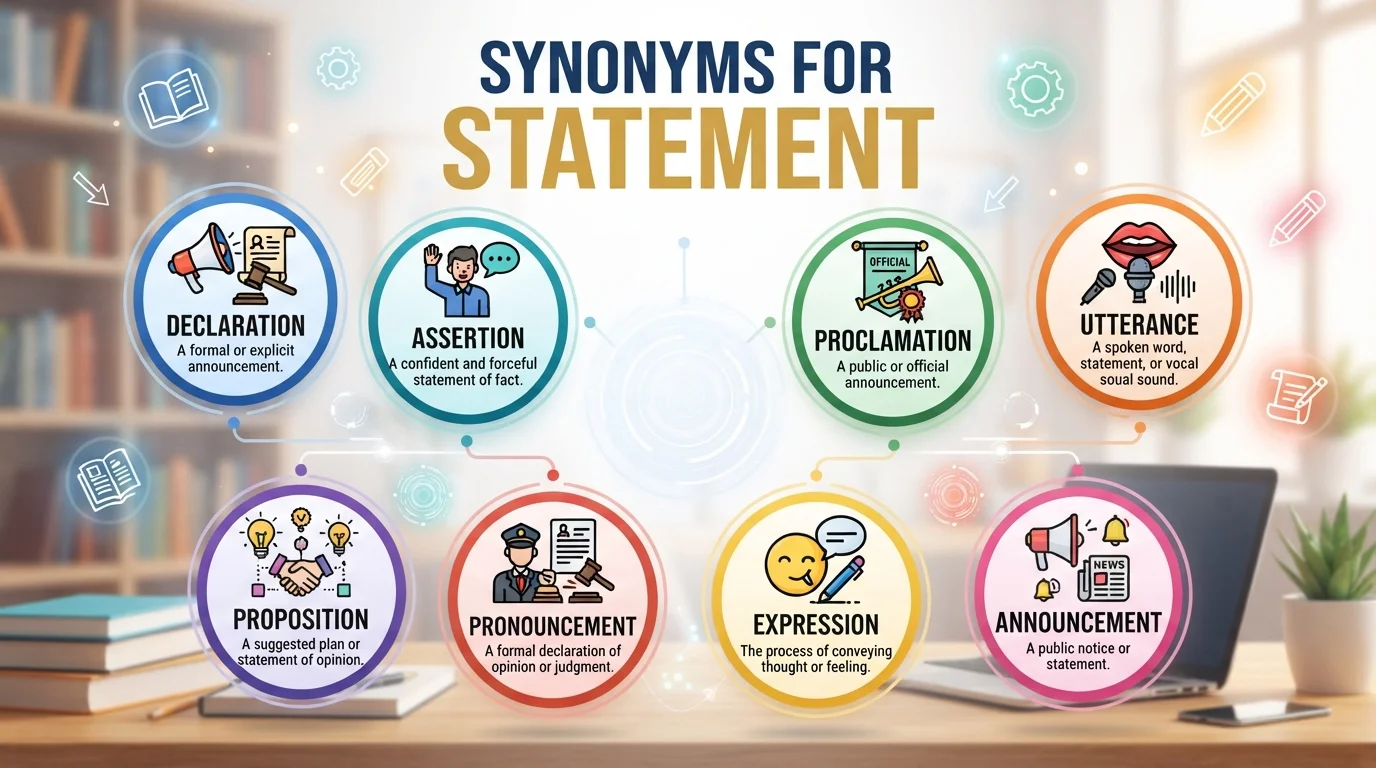
True Synonyms vs. Related Alternatives
Not every word associated with statement is a direct synonym.
| Alternative | Relationship | Can Replace “Statement”? | Tone | Best Context |
|---|---|---|---|---|
| Remark | Near synonym | Often | Neutral | Conversation |
| Comment | Near synonym | Often | Neutral | Reaction/opinion |
| Assertion | Near synonym | Sometimes | Formal | Claims |
| Claim | Near synonym | Sometimes | Neutral/formal | Evidence and arguments |
| Declaration | Contextual synonym | Sometimes | Formal | Official positions |
| Announcement | Contextual alternative | Sometimes | Neutral/formal | News |
| Explanation | Contextual alternative | Sometimes | Neutral | Clarification |
| Account | Contextual alternative | Sometimes | Neutral/formal | Events |
| Report | Related alternative | Sometimes | Formal | Findings/information |
| Opinion | Related alternative | Sometimes | Neutral | Personal views |
| Testimony | Narrower term | No, not generally | Formal | Legal/official evidence |
| Affidavit | Narrower term | No | Very formal | Legal documents |
| Proclamation | Narrower term | No | Very formal | Public declarations |
| Bank statement | Specific type | No | Financial | Banking |
| Disclosure | Contextual alternative | Sometimes | Formal | Released information |
Statement Synonyms by Purpose
| Purpose | Best Alternative | Example |
|---|---|---|
| General comment | Remark | “He made a brief remark.” |
| Reaction | Comment | “She declined to comment.” |
| Present a fact as true | Claim | “The study challenges the claim.” |
| Strong assertion | Assertion | “The assertion needs evidence.” |
| Official position | Declaration | “The organization issued a declaration.” |
| Public news | Announcement | “The company made an announcement.” |
| Explain something | Explanation | “He gave an explanation.” |
| Describe an event | Account | “She gave an account of the incident.” |
| Provide findings | Report | “The committee released a report.” |
| Express a viewpoint | Opinion | “He shared his opinion.” |
| Official stance | Position | “The group clarified its position.” |
| Legal evidence | Testimony | “The witness gave testimony.” |
| Legal sworn document | Affidavit | “She submitted an affidavit.” |
| Financial record | Account statement | “I checked my account statement.” |
Sentence Transformations
1. General statement
Original:
“She made a statement about the problem.”
Alternative:
“She made a comment about the problem.”
Why:
Comment sounds more natural when referring to a person’s reaction or observation.
2. Factual claim
Original:
“The scientist made a statement about the results.”
Alternative:
“The scientist made a claim about the results.”
Why:
Claim is more precise if the statement presents something as true and potentially requiring evidence.
3. Formal communication
Original:
“The organization released a statement.”
Alternative:
“The organization released an official declaration.”
Why:
Declaration emphasizes the formal and deliberate nature of the communication.
4. Sharing news
Original:
“The company issued a statement about the new service.”
Alternative:
“The company issued an announcement about the new service.”
Why:
Announcement makes the purpose—sharing new information—clear.
5. Explaining a decision
Original:
“The manager gave a statement about the delay.”
Alternative:
“The manager gave an explanation for the delay.”
Why:
Explanation is better when the purpose is to clarify why something happened.
6. Describing an event
Original:
“The witness gave a statement about the accident.”
Alternative:
“The witness gave an account of the accident.”
Why:
Account naturally describes someone’s description of an event.
7. Expressing an opinion
Original:
“She made a statement about the proposal.”
Alternative:
“She expressed her view on the proposal.”
Why:
View makes it clear that the communication represents a personal opinion.
8. Official position
Original:
“The organization released a statement on the policy.”
Alternative:
“The organization clarified its position on the policy.”
Why:
Position identifies the statement as an official stance.
9. Financial context
Original:
“I checked my statement online.”
Alternative:
“I checked my account record online.”
Why:
The financial meaning requires a financial term rather than a general synonym.
10. Academic writing
Original:
“The statement requires further evidence.”
Alternative:
“The claim requires further evidence.”
Why:
Claim is more precise when the statement is an assertion that needs support.
Professional Alternatives to “Make a Statement”
Instead of repeatedly writing make a statement, choose a verb that shows what the person actually did.
General
- Make a statement
- Give a statement
- Issue a statement
- Provide a statement
- Release a statement
Expressing an opinion
- Express a view
- State an opinion
- Give an assessment
- Present a position
- Share a perspective
Presenting information
- Provide information
- Report the facts
- Give an account
- Describe the situation
- Explain the circumstances
Making an official declaration
- Issue a declaration
- Announce
- Proclaim
- Declare
- Confirm
- Affirm
Responding to an issue
- Respond
- Comment
- Address the issue
- Clarify the position
- Issue a response
- Provide an explanation
The most precise verb is often better than simply replacing statement with another noun.
Common Collocations With Statement
Some combinations are so common that replacing statement is unnecessary.
General
- make a statement
- give a statement
- issue a statement
- release a statement
- provide a statement
- publish a statement
- read a statement
- prepare a statement
- write a statement
- sign a statement
Official
- official statement
- public statement
- formal statement
- written statement
- joint statement
- prepared statement
- opening statement
- closing statement
Academic
- factual statement
- theoretical statement
- general statement
- supporting statement
- research statement
- problem statement
- thesis statement
Financial
- bank statement
- credit card statement
- financial statement
- account statement
- billing statement
- income statement
- balance statement
Legal
- sworn statement
- written statement
- witness statement
- personal statement
- formal statement
- statement of claim
Common Mistakes
Mistake 1: Treating every synonym as interchangeable
A claim, comment, declaration, and report can all be forms of communication, but they emphasize different things.
Mistake 2: Using “opinion” for every statement
A statement can be factual:
“The meeting begins at nine.”
An opinion is someone’s belief or judgment:
“The meeting should begin at nine.”
These are not equivalent.
Mistake 3: Using “claim” when the statement is already established fact
Claim can imply that something is being asserted rather than established.
“The report states that the temperature was 20°C.”
may be more neutral than:
“The report claims that the temperature was 20°C.”
The second can sound skeptical depending on context.
Mistake 4: Using “announcement” for an explanation
An announcement gives information about something. An explanation provides reasons or clarification.
Mistake 5: Using “declaration” for ordinary conversation
“He made a declaration about his weekend.”
sounds much more formal than necessary.
For ordinary conversation, remark, comment, or observation is usually more natural.
Mistake 6: Using legal terms casually
Words such as affidavit, deposition, testimony, pleading, and declaration can have specific legal meanings.
Do not use them merely because they sound more formal.
Mistake 7: Replacing “statement” in financial terminology
Terms such as bank statement, financial statement, and income statement are established expressions. A general synonym can reduce accuracy.
Mistake 8: Assuming “argument” means statement
An argument normally contains reasoning intended to support a conclusion. A simple statement does not necessarily contain an argument.
When “Statement” Is the Better Word
A synonym is useful only when it adds precision.
Statement is often the best choice when you mean a general spoken or written communication.
For example:
“The spokesperson issued a statement.”
This is concise and neutral.
Replacing it with:
“The spokesperson issued a proclamation.”
would unnecessarily increase the formality and may suggest an authoritative public declaration.
Likewise:
“She made a statement about the incident.”
may be better than remark if the communication was prepared, deliberate, or substantial.
The goal is not to avoid repeating statement. The goal is to choose a word that accurately describes what the speaker or writer is doing.
How to Choose the Right Synonym
Use remark when:
The statement is short and conversational.
Use comment when:
Someone is reacting to an issue or expressing an observation.
Use claim when:
Something is presented as true and may require evidence.
Use assertion when:
The speaker confidently presents something as true.
Use declaration when:
The statement is formal, deliberate, or official.
Use announcement when:
The purpose is to communicate news or a decision.
Use explanation when:
The purpose is to clarify why or how something happened.
Use account when:
Someone describes an event or experience.
Use report when:
The communication contains organized information, findings, or details.
Use position when:
The statement expresses an official stance.
Use opinion when:
The statement expresses a personal belief or judgment.
Use testimony when:
The statement is formal evidence from a witness or other relevant person.
Use disclosure when:
Previously unrevealed information is formally made available.
Editor’s Choice
For most general writing, these five alternatives cover the most useful distinctions:
1. Comment
A natural choice for a reaction, observation, or opinion.
2. Claim
Useful when a statement presents something as true and evidence matters.
3. Declaration
Best when the statement is formal or official.
4. Explanation
Useful when the purpose is to clarify a reason, event, or decision.
5. Account
A strong choice for describing what happened, especially from a person’s perspective.
These are not interchangeable “better” versions of statement. Each is useful because it communicates a different meaning.