

Quick Answer: Synonyms for Attack
The best synonym depends on the sense of attack:
Physical attack:
Assault, strike, hit, ambush, charge, assaultive action
Military attack:
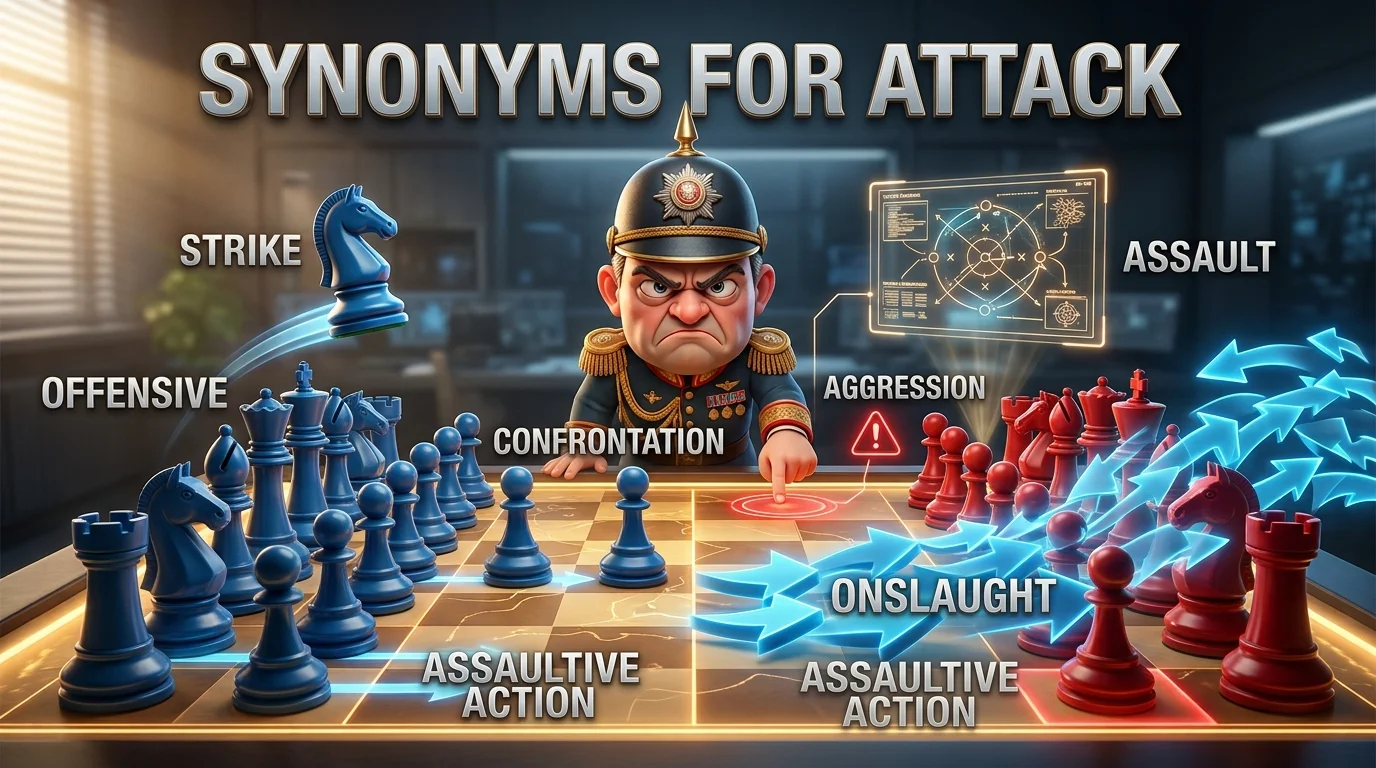
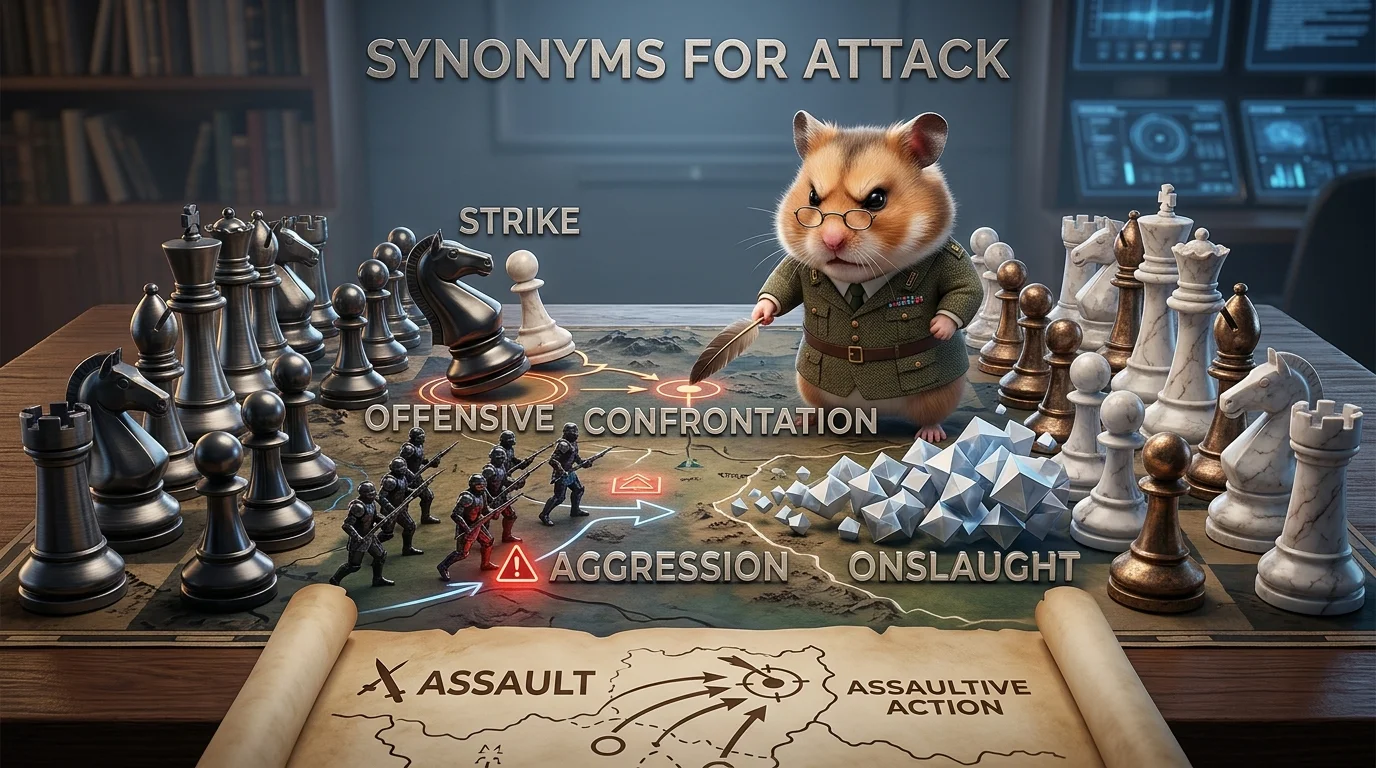
Offensive, assault, strike, raid, incursion, bombardment, onslaught
Verbal attack:
Criticize, condemn, denounce, challenge, rebuke, censure, disparage
Attack on a problem:
Tackle, address, confront, combat, deal with, take on
Sudden health-related attack:
Episode, spell, fit, flare-up, onset
Best General Alternatives
- Assault
- Strike
- Raid
- Offensive
- Onslaught
- Ambush
- Charge
- Criticize
- Condemn
- Denounce
- Challenge
- Rebuke
- Censure
- Confront
- Tackle
- Address
- Combat
- Target
- Counter
- Oppose
What Does “Attack” Mean?
Attack generally means to act aggressively against a person, place, thing, idea, or problem.
As a verb:
The dog attacked the stranger.
Critics attacked the proposal.
We need to attack the problem immediately.
As a noun:
The city suffered an attack.
The politician faced an attack from opponents.
She experienced an attack of coughing.
These sentences demonstrate why no single synonym works in every context.
Synonyms for Attack Meaning Physical Violence
Assault
Assault is one of the closest alternatives when attack means using physical force or threatening violence.
The man assaulted another passenger.
It is particularly common in formal, legal, and news contexts.
Best choice: Serious physical violence.
Strike
Strike means to hit or attack suddenly and forcefully.
The fighter struck his opponent.
It can also be used for military actions:
The forces launched a strike against the target.
Best choice: A direct or targeted attack.
Hit
Hit is a simple, everyday alternative when attack means physically striking someone or something.
The player hit the opponent.
However, “hit” is narrower than “attack” because an attack can involve more than one physical blow.
Best choice: Casual and straightforward descriptions.
Ambush
An ambush is a surprise attack in which the attacker waits for the target before attacking.
The soldiers were caught in an ambush.
Best choice: Surprise attacks.
Charge
A charge can describe moving rapidly toward an opponent in an attack.
The soldiers charged toward the enemy.
Best choice: Forceful movement toward a target.
Synonyms for Attack in a Military Context
Offensive
An offensive is an organized military campaign or operation intended to attack or gain territory.
The army launched a major offensive.
This is more specific than “attack.”
Raid
A raid is generally a sudden, targeted attack or operation.
The forces conducted a nighttime raid.
A raid is usually limited in scope compared with a large military offensive.
Incursion
An incursion is a relatively brief entry into another territory, often involving military forces.
The border region experienced a military incursion.
Tone: Formal and geopolitical.
Bombardment
Bombardment refers to sustained attacks involving artillery, missiles, bombs, or similar weapons.
The area endured heavy bombardment.
This word is much more specific than “attack.”
Onslaught
An onslaught is a powerful, intense, or sustained attack.
The defenders struggled against the enemy onslaught.
It is especially effective when emphasizing overwhelming force.
Synonyms for Verbal Attack
Sometimes “attack” means to criticize someone, an idea, policy, or argument.
Criticize
Criticize means to identify faults or express disapproval.
The journalist criticized the new policy.
This is usually more neutral than “attack.”
Challenge
Challenge means to question, dispute, or oppose an idea or position.
The researcher challenged the traditional theory.
This is especially useful in academic writing.
Condemn
Condemn means to express very strong disapproval.
The organization condemned the decision.
It is stronger than ordinary criticism.
Denounce
Denounce means to publicly criticize something or someone strongly.
Several leaders denounced the proposal.
It works especially well in political and public contexts.
Rebuke
Rebuke means to criticize or reprimand someone sharply.
The manager rebuked the employee.
It usually involves direct disapproval.
Censure
Censure means to express formal and strong disapproval.
The official faced public censure.
It is more formal than “criticize.”
Disparage
Disparage means to describe someone or something as less valuable, important, or impressive.
The article disparaged the competing product.
This emphasizes belittling rather than direct confrontation.
Synonyms for Attack Meaning “Deal With a Problem”
One of the most important figurative uses of attack appears in phrases such as:
We need to attack the problem.
Here, “attack” means deal with something actively and forcefully.
Tackle
We need to tackle the problem.
This is one of the most natural alternatives.
Address
We need to address the issue.
This is particularly appropriate in professional and formal writing.
Confront
We must confront the problem directly.
This emphasizes facing something difficult rather than avoiding it.
Combat
The organization works to combat poverty.
This is common when discussing serious social, economic, or environmental problems.
Take On
The team decided to take on the challenge.
This is more conversational and suggests accepting a difficult task.
“Attack” vs. “Assault”
These words are closely related, but assault is more specific.
Attack is broad:
The animal attacked the man.
Assault generally emphasizes physical violence or a threat of violence:
The man was assaulted outside the building.
In legal contexts, assault can have a specific technical meaning, so it should not automatically be substituted for “attack.”
“Attack” vs. “Strike”
A strike usually suggests a direct, forceful, or targeted action.
The aircraft launched a strike.
An attack can be broader and may involve multiple actions.
Therefore:
Strike → targeted action
Attack → broader aggressive action
“Attack” vs. “Raid”
A raid is a particular kind of attack, generally sudden and targeted.
Police conducted a raid on the building.
You would not normally use “raid” for every kind of attack.
“Attack” vs. “Offensive”
An offensive usually refers to an organized military campaign.
The army launched an offensive.
“Attack” can describe a single action, whereas an offensive may involve many operations over a longer period.
“Attack” vs. “Criticize”
When attack is metaphorical and refers to someone’s words or opinions, criticize is often the more neutral choice.
The writer attacked the policy.
The writer criticized the policy.
The first sounds more forceful. The second sounds more objective.
“Attack” vs. “Challenge”
Challenge is particularly useful when someone questions an argument, belief, theory, or assumption.
The study challenged the existing theory.
This does not necessarily imply hostility. It can simply mean presenting evidence that questions an established position.
“Attack” vs. “Condemn”
Condemn is stronger than ordinary criticism.
The organization criticized the decision.
This indicates disapproval.
The organization condemned the decision.
This indicates strong disapproval.
Therefore, condemn is appropriate when the speaker clearly expresses serious opposition.
“Attack” vs. “Address”
These words have almost opposite tones when discussing problems.
The company needs to attack the problem.
This sounds aggressive and energetic.
The company needs to address the problem.
This sounds neutral and professional.
For business reports, emails, and formal documents, address is usually the safer choice.
Formal Synonyms for Attack
Depending on the intended meaning, formal alternatives include:
- Assault
- Offensive
- Incursion
- Strike
- Criticize
- Condemn
- Denounce
- Censure
- Challenge
- Confront
- Address
- Combat
Example
Instead of:
The report attacks the government’s decision.
A formal version could be:
The report criticizes the government’s decision.
For stronger criticism:
The report condemns the government’s decision.
Professional Alternatives for Attack
In workplace communication, these words are often more appropriate:
- Address
- Tackle
- Confront
- Analyze
- Challenge
- Resolve
- Counter
- Respond to
- Deal with
- Examine
Example
Instead of:
We need to attack the customer’s concerns.
Write:
We need to address the customer’s concerns.
This sounds more constructive and professional.
Academic Synonyms for Attack
Academic writing generally benefits from precise and neutral language.
Depending on context, use:
- Challenge
- Criticize
- Question
- Dispute
- Contest
- Examine
- Refute
- Address
- Confront
Example
The researcher attacks the previous theory.
Better:
The researcher challenges the previous theory.
If the research actually disproves the theory:
The researcher refutes the previous theory.
Refute is more precise because it suggests providing evidence that something is incorrect.
Strong Synonyms for Attack
When you intentionally want to communicate intensity, consider:
- Assault
- Onslaught
- Offensive
- Barrage
- Strike
- Blitz
- Charge
- Bombardment
- Invasion
- Assault
For figurative criticism:
- Condemn
- Denounce
- Lambaste
- Blast
- Censure
- Rebuke
The strongest option depends on the context.
Casual Synonyms for Attack
In informal English, people may use:
- Go after
- Come at
- Take on
- Hit
- Go for
- Lay into
- Blast
Example
The commentator went after the politician during the interview.
This is conversational and often suggests strong criticism.
Synonyms for “Attack” in Business
When talking about competition or business strategy, the meaning may be figurative.
Possible alternatives include:
- Challenge
- Compete with
- Target
- Counter
- Disrupt
- Undercut
- Take on
- Confront
- Compete against
Example
The company attacked its competitor’s market share.
More natural alternatives:
The company challenged its competitor’s market position.
The company targeted its competitor’s customer base.
The best word depends on the strategy being described.
Synonyms for “Attack” in Sports
In sports, “attack” can describe aggressive play or movement toward an opponent’s goal.
Possible alternatives include:
- Advance
- Charge
- Press
- Push forward
- Strike
- Drive
- Assault
- Offensive push
Example
The team launched a powerful attack.
Possible alternative:
The team launched a powerful offensive push.
In sports writing, attack itself is often more natural than a forced synonym.
Synonyms for “Attack” in Cybersecurity
In cybersecurity, “attack” can describe an attempt to compromise a computer system, network, account, or data.
Depending on the specific situation, related terms include:
- Intrusion
- Breach
- Exploit
- Compromise
- Attempt
- Security incident
These are not exact synonyms.
For example, an exploit is a technique or code used to take advantage of a vulnerability, while a breach generally refers to unauthorized access or exposure.
Synonyms for “Attack” as a Sudden Episode
In phrases such as:
an attack of coughing
or:
an attack of anxiety
the meaning is closer to a sudden episode or period of symptoms.
Possible alternatives include:
- Episode
- Spell
- Fit
- Flare-up
- Onset
Examples
She had a coughing fit.
He experienced an episode of severe pain.
The condition caused a flare-up of symptoms.
These alternatives are highly context-dependent.
Common Collocations With Attack
Some common phrases include:
- launch an attack
- carry out an attack
- come under attack
- face an attack
- suffer an attack
- attack a target
- attack an argument
- attack a problem
- attack an issue
- verbal attack
- physical attack
- military attack
- surprise attack
- cyberattack
- terrorist attack
Changing the synonym can change which prepositions and grammatical structures sound natural.
Common Mistakes
Mistake 1: Using “assault” for every attack
Assault is more specific and often associated with physical violence.
Mistake 2: Using “raid” as a general synonym
A raid normally suggests a sudden and targeted operation.
Mistake 3: Using “condemn” for mild criticism
Condemn communicates strong disapproval.
For mild criticism, criticize or question may be better.
Mistake 4: Using “combat” for ordinary tasks
You can combat corruption, but you would not normally say:
We need to combat our homework.
Use tackle or work on instead.
Mistake 5: Using “challenge” as though it always means attack
Challenge can be neutral and intellectual.
The study challenged the assumption.
This does not necessarily imply hostility.
Mistake 6: Replacing “attack” without considering grammar
Different synonyms require different structures.
attack the problem
address the problem
confront the problem
But:
launch an attack on the problem
The grammar changes with the replacement.
Sentence Transformations
Physical
Original:
The dog attacked the man.
Alternative:
The dog assaulted the man.
Military
Original:
The army attacked the city.
Alternative:
The army launched an offensive.
Surprise action
Original:
The soldiers attacked the convoy unexpectedly.
Alternative:
The soldiers ambushed the convoy.
Criticism
Original:
The journalist attacked the policy.
Alternative:
The journalist criticized the policy.
Strong criticism
Original:
The organization attacked the decision.
Alternative:
The organization condemned the decision.
Academic disagreement
Original:
The researcher attacked the theory.
Alternative:
The researcher challenged the theory.
Problem-solving
Original:
We need to attack this problem.
Alternative:
We need to tackle this problem.
Professional
Original:
The company needs to attack the issue.
Alternative:
The company needs to address the issue.
How to Choose the Right Synonym
Ask what attack means in your sentence.
If it means physical violence, consider assault or strike.
If it means a surprise operation, consider ambush or raid.
If it means a military campaign, consider offensive.
If it means an overwhelming attack, consider onslaught.
If it means ordinary criticism, use criticize.
If it means strong public disapproval, use condemn or denounce.
If it means questioning an argument, use challenge.
If it means dealing with a problem, use tackle or address.
If it means fighting something harmful, use combat.
If it means a sudden episode, use a context-specific word such as episode, fit, spell, or flare-up.
Key Takeaways
- Attack has multiple meanings, including physical violence, military action, criticism, and actively dealing with a problem.
- Assault, strike, raid, ambush, and offensive are useful for different forms of physical or military attack.
- Criticize, challenge, condemn, denounce, and rebuke are better alternatives when “attack” refers to verbal criticism.
- Tackle, address, confront, and combat work when “attack” means dealing with a problem or harmful situation.
- The best synonym depends on the specific meaning, intensity, grammar, tone, and context of the original sentence.