

Quick Answer
The closest synonyms for sufficient are enough, adequate, ample, satisfactory, acceptable, sufficient, plenty, suitable, appropriate, and satisfactory depending on context. Enough is the simplest everyday alternative, adequate means enough to meet a requirement, and ample suggests more than enough. In formal writing, adequate, satisfactory, and appropriate can be useful, but they are not interchangeable in every sentence.
Quick Synonym List
Closest Alternatives
- Enough
- Adequate
- Ample
- Satisfactory
- Acceptable
- Plenty
- Suitable
- Appropriate
- Reasonable
- Satisfactory
Formal and Professional Alternatives
- Adequate
- Ample
- Satisfactory
- Acceptable
- Appropriate
- Suitable
- Reasonable
- Substantial
- Sufficiently resourced
- Fit for purpose
Contextual Alternatives
- Plenty
- Abundant
- Generous
- Extensive
- Considerable
- Copious
- Extensive enough
- Fit
- Capable
- Meeting requirements
Not all of these are direct synonyms. Some describe more than enough, while others describe fitness or suitability.
Closest Synonyms for Sufficient
Enough
Meaning: As much or as many as needed.
How it differs: Enough is the simplest and most direct everyday equivalent of sufficient.
Tone: Neutral and conversational.
Best for: Everyday conversation, general writing, instructions, and simple explanations.
Example:
We have enough food for everyone.
Watch out: Enough is usually less formal than sufficient.
Adequate
Meaning: Enough to meet a particular need or requirement.
How it differs: Adequate is one of the closest formal synonyms for sufficient. It can sometimes suggest that something meets only the basic requirement.
Tone: Neutral to formal.
Best for: Reports, evaluations, resources, facilities, preparation, and professional writing.
Example:
The team has adequate resources to complete the project.
Watch out: Adequate can sound weaker than sufficient because it may imply “just enough.”
Ample
Meaning: More than enough or enough with comfortable room to spare.
How it differs: Ample is stronger than sufficient when you want to communicate that there is plenty available.
Tone: Neutral to formal.
Best for: Time, space, opportunity, resources, evidence, and supplies.
Example:
We have ample time to finish the report.
Watch out: Do not use ample when the amount is barely enough.
Satisfactory
Meaning: Good enough to meet an expected standard.
How it differs: Satisfactory focuses on whether something meets a standard rather than simply whether there is enough of it.
Tone: Formal/neutral.
Best for: Performance, results, quality, work, and evaluations.
Example:
The student’s performance was satisfactory.
Watch out: It does not usually replace sufficient when discussing quantity.
Acceptable
Meaning: Good enough to be allowed, approved, or considered suitable.
How it differs: Acceptable focuses on approval or standards, while sufficient focuses more directly on adequacy.
Tone: Neutral to formal.
Best for: Standards, quality, behavior, proposals, and results.
Example:
The evidence was acceptable for the review.
Watch out: Something can be acceptable without being sufficient for a particular task.
Alternatives That Mean More Than Enough
Plenty
Meaning: More than enough.
Tone: Conversational and natural.
Example:
We have plenty of time.
Plenty is particularly useful in everyday English.
Abundant
Meaning: Existing in large quantities.
Tone: Formal or descriptive.
Example:
The region has abundant natural resources.
Watch out: Abundant is stronger than sufficient. It indicates a large supply, not merely enough.
Generous
Meaning: Larger than what is normally expected or needed.
Example:
The restaurant provides generous portions.
Here, generous describes an amount that is comfortably large.
Copious
Meaning: Existing in a large quantity.
Example:
The researchers collected copious amounts of data.
This is considerably stronger than sufficient and is more formal.
Formal and Professional Alternatives
Adequate
This is often the best professional alternative when you mean that something meets the necessary requirement.
The department has adequate funding for the current phase.
Ample
Use this when there is comfortably more than the required amount.
The project has ample financial support.
Appropriate
Appropriate means suitable or correct for a particular situation.
The company provided appropriate training.
It can overlap with sufficient, but it does not simply mean “enough.”
Suitable
Suitable means right or appropriate for a particular purpose.
This equipment is suitable for laboratory use.
Something can be suitable without being sufficient in quantity.
Reasonable
Reasonable can mean adequate or acceptable under the circumstances.
The company offered a reasonable amount of compensation.
It often expresses judgment rather than quantity.
Fit for Purpose
This phrase means suitable for the intended use.
The equipment is fit for purpose.
It is useful in professional, technical, and quality-related contexts.
Academic Alternatives
Academic writing often benefits from replacing broad words with more precise expressions.
Instead of:
The evidence was sufficient.
you might write:
The evidence was adequate to support the conclusion.
Or:
The available evidence was sufficient to support the conclusion.
Other context-specific academic choices include:
- Adequate
- Satisfactory
- Appropriate
- Acceptable
- Ample
- Substantial
- Enough
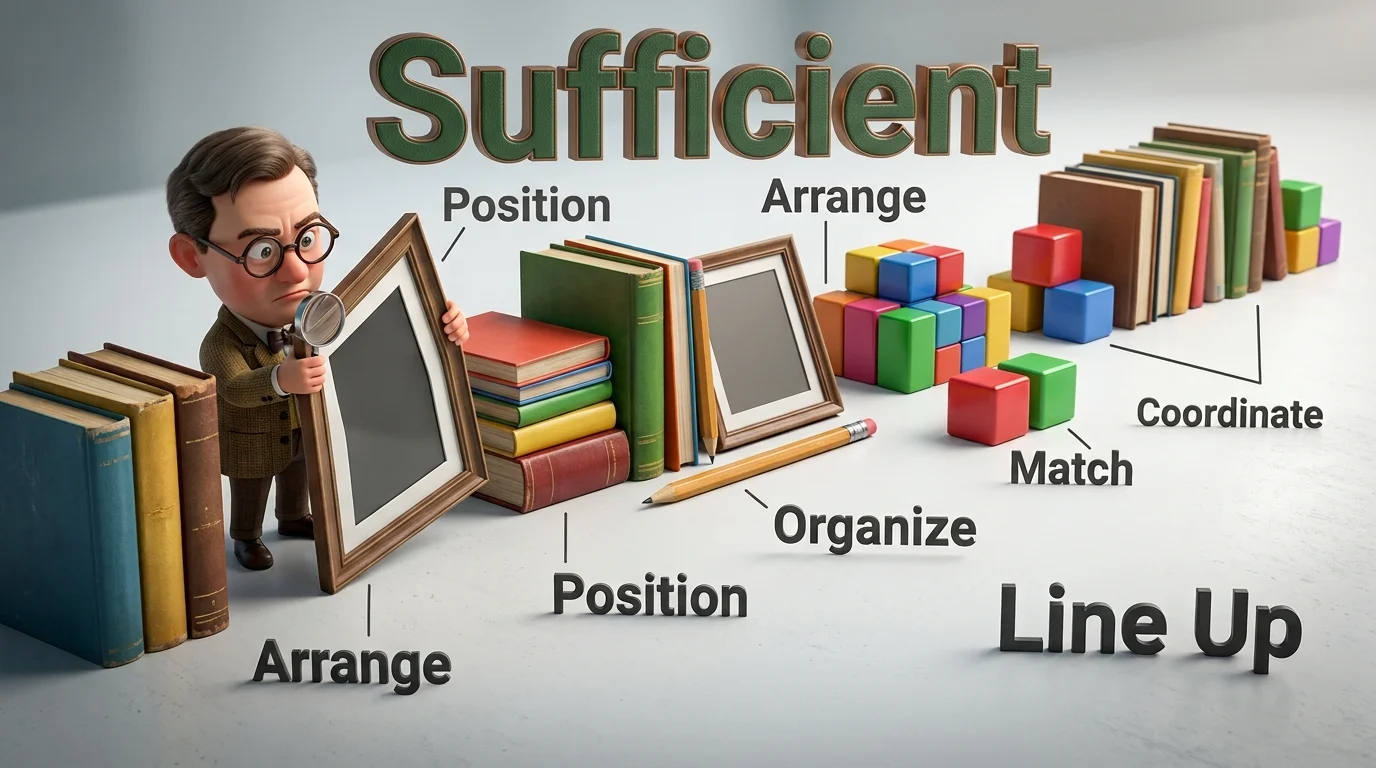
Substantial
Substantial means large or significant in amount, size, importance, or effect.
The study collected substantial evidence.
This is not always a direct synonym for sufficient. Something can be substantial without being sufficient for a particular purpose.
Meeting Requirements
This phrase is useful when you want to state precisely that something satisfies a defined standard.
The application contains all the information required and is therefore meeting the basic requirements.
A more natural version in many contexts is:
The application meets the requirements.
This can be clearer than using sufficient.
Everyday Alternatives
Enough
For everyday speech, enough is usually the best choice.
Sufficient:
Do we have sufficient water?
Everyday:
Do we have enough water?
Plenty
Use plenty when you want to reassure someone that there is more than enough.
Don’t worry. We have plenty of time.
More Than Enough
This phrase makes the meaning especially clear when the available amount comfortably exceeds the requirement.
We have more than enough food for the guests.
Good Enough
Good enough means adequate for a particular purpose or standard.
This laptop is good enough for basic office work.
It is conversational and often suggests that something meets the requirement without necessarily being excellent.
Sufficient for vs Sufficient to
Sufficient for
Use sufficient for + noun when identifying the thing or purpose that the amount or quality can meet.
The money is sufficient for the trip.
The evidence is sufficient for the investigation.
Sufficient to
Use sufficient to + verb when describing an action that can be accomplished.
The evidence was sufficient to support the claim.
The funds are sufficient to complete the project.
These patterns are common in formal and academic writing.
Sufficient vs Enough
These words often have the same basic meaning, but their register differs.
| Word | Meaning | Tone | Best Use |
|---|---|---|---|
| Sufficient | Enough for a need or requirement | Formal/neutral | Professional and academic writing |
| Enough | As much as needed | Neutral/conversational | Everyday English |
| Ample | More than enough | Formal/neutral | Time, space, resources |
| Adequate | Enough to meet a basic standard | Formal/neutral | Evaluation and requirements |
| Plenty | More than enough | Conversational | Everyday situations |
Compare:
We have sufficient time to finish.
We have enough time to finish.
Both are correct, but the second sounds more natural in ordinary conversation.
Sufficient vs Adequate
These words are very close.
Sufficient emphasizes having the amount or quality needed for a particular purpose.
Adequate often emphasizes meeting a minimum requirement or standard.
Compare:
The evidence was sufficient to support the conclusion.
The facilities were adequate for the number of students.
Both words can overlap, but adequate can carry a subtle suggestion of “acceptable but not exceptional.”
Sufficient vs Ample
The difference is mainly about quantity.
Sufficient: enough.
Ample: more than enough or comfortably enough.
Compare:
We have sufficient time to complete the task.
This simply says there is enough time.
We have ample time to complete the task.
This suggests there is plenty of time and little pressure.
Sufficient vs Satisfactory
These words are sometimes confused because both can describe something that meets expectations.
Sufficient focuses on adequacy.
Satisfactory focuses on meeting a standard of quality or performance.
Compare:
The funding was sufficient for the project.
The project’s results were satisfactory.
The first concerns quantity or resources. The second evaluates quality or performance.
True Synonyms vs Related Alternatives
| Alternative | Relationship | Can Replace Sufficient? | Tone | Best Context |
|---|---|---|---|---|
| Enough | Direct synonym | Usually | Neutral | Everyday English |
| Adequate | Close synonym | Usually | Formal/neutral | Requirements |
| Ample | Stronger alternative | Sometimes | Neutral/formal | More than enough |
| Satisfactory | Contextual alternative | Sometimes | Formal | Quality/performance |
| Acceptable | Contextual alternative | Sometimes | Neutral/formal | Standards |
| Plenty | Stronger alternative | Sometimes | Casual | Quantities |
| Appropriate | Related alternative | Sometimes | Formal | Suitability |
| Suitable | Related alternative | Sometimes | Neutral | Purpose |
| Abundant | Stronger alternative | Sometimes | Formal | Large quantities |
| Substantial | Related alternative | Sometimes | Formal | Significant amounts |
| Generous | Contextual alternative | Sometimes | Neutral | Large amounts |
| Fit for purpose | Contextual phrase | Sometimes | Professional | Functionality |
Comparison Table
| Word/Phrase | Meaning | Tone | Strength | Best Use | Interchangeable? |
|---|---|---|---|---|---|
| Sufficient | Enough for a purpose | Neutral/formal | Moderate | General formal use | Yes |
| Enough | As much as needed | Neutral | Moderate | Everyday English | Usually |
| Adequate | Enough to meet a standard | Formal | Moderate | Requirements | Usually |
| Ample | More than enough | Formal/neutral | Strong | Time/resources | Sometimes |
| Plenty | More than enough | Casual | Strong | Everyday quantities | Sometimes |
| Satisfactory | Meets a quality standard | Formal | Moderate | Performance | Sometimes |
| Acceptable | Meets an approval standard | Neutral/formal | Moderate | Quality/approval | Sometimes |
| Appropriate | Suitable for a situation | Formal | Contextual | Behavior/choices | No |
| Suitable | Right for a purpose | Neutral | Contextual | Products/options | No |
| Abundant | Available in large quantities | Formal | Very strong | Resources | No |
| Substantial | Large or significant | Formal | Strong | Amounts/evidence | No |
| Generous | Larger than expected | Neutral | Strong | Portions/amounts | No |
How to Choose the Right Alternative
If you want simple everyday English:
Choose enough.
If you mean enough to meet a requirement:
Choose adequate.
If you mean comfortably more than enough:
Choose ample or plenty.
If you are evaluating quality or performance:
Choose satisfactory.
If something meets an approval or acceptance standard:
Choose acceptable.
If something is right for a particular purpose:
Choose suitable or appropriate.
If a quantity is very large:
Choose abundant, substantial, or copious, depending on context.
For formal or academic writing:
Sufficient, adequate, and ample are often useful, but choose based on the exact meaning.
Sentence Transformations
1. Everyday conversation
Original:
We have sufficient food for everyone.
Better Alternative:
We have enough food for everyone.
Why:
Enough is simpler and more natural in everyday conversation.
2. Professional writing
Original:
The team has sufficient resources.
Better Alternative:
The team has adequate resources.
Why:
Adequate clearly communicates that the resources meet the required level.
3. More than enough
Original:
We have sufficient time to finish.
Better Alternative:
We have ample time to finish.
Why:
Ample suggests comfortable availability rather than merely enough.
4. Casual reassurance
Original:
There is sufficient food for everyone.
Better Alternative:
There is plenty of food for everyone.
Why:
Plenty is conversational and suggests more than enough.
5. Academic writing
Original:
There was sufficient evidence to support the conclusion.
Better Alternative:
There was adequate evidence to support the conclusion.
Why:
Both are possible, but adequate emphasizes meeting the evidential requirement.
6. Quality evaluation
Original:
The student’s performance was sufficient.
Better Alternative:
The student’s performance was satisfactory.
Why:
Satisfactory is more natural when evaluating performance against a standard.
7. Purpose
Original:
This equipment is sufficient for laboratory work.
Better Alternative:
This equipment is suitable for laboratory work.
Why:
If the intended meaning is that the equipment is appropriate for the task, suitable is more precise.
8. Large quantity
Original:
The country has sufficient natural resources.
Better Alternative:
The country has abundant natural resources.
Why:
Abundant communicates a large supply rather than merely an adequate one.
Common Mistakes
Mistake 1: Treating Ample as Exactly the Same as Sufficient
Sufficient means enough, while ample often suggests more than enough.
Fix: Use ample when there is comfortable excess.
Mistake 2: Using Adequate to Mean Excellent
Adequate normally means enough to meet a requirement. It does not mean outstanding.
Fix: Use excellent or exceptional when you want strong praise.
Mistake 3: Using Suitable as a Direct Replacement Everywhere
Suitable means appropriate for a purpose.
The equipment is suitable for the job.
But:
We have sufficient equipment.
means that the quantity is enough.
Mistake 4: Confusing Sufficient With Satisfactory
Sufficient usually concerns adequacy, while satisfactory evaluates quality or performance.
Fix: Ask whether you mean enough or good enough according to a standard.
Mistake 5: Using Abundant When You Mean Enough
Abundant means plentiful or existing in large quantities.
If there is exactly enough, sufficient is more accurate.
Mistake 6: Using Sufficient in Every Casual Sentence
Sufficient is correct, but enough is usually more natural in conversation.
Instead of:
Is there sufficient coffee?
say:
Is there enough coffee?
Mistake 7: Ignoring the Difference Between Quantity and Suitability
A product can be suitable but insufficient in quantity.
For example:
The chairs are suitable for the room, but there are not enough of them.
This demonstrates why context matters.
Mistake 8: Using More Formal Vocabulary Without Adding Meaning
Replacing enough with sufficient does not automatically improve a sentence.
Fix: Choose vocabulary based on audience, context, and precision.
When Not to Replace Sufficient
Keep sufficient when it is already the most precise word.
For example:
The evidence was sufficient to support the claim.
This is concise and natural in formal writing.
You do not need to change it to:
The evidence was adequate to support the claim.
unless you specifically want the slightly different emphasis associated with adequate.
Likewise, if you are writing a formal report, sufficient may be more appropriate than enough.
The purpose of synonyms is not to make every sentence different. The purpose is to choose the word that communicates the intended meaning most clearly.
Writing Tips
When replacing sufficient, first identify what “enough” means in your sentence.
If it means a required quantity, use enough or adequate.
If it means more than needed, use ample or plenty.
If it means meeting a quality standard, use satisfactory.
If it means appropriate for a purpose, use suitable.
If it means a large quantity, use abundant.
This approach prevents thesaurus abuse and makes writing more precise.
For example:
The company has sufficient staff.
could become:
The company has adequate staff.
if you mean the staffing level meets requirements.
But if you mean there are more employees than necessary:
The company has ample staff.
is better.

Key Takeaways
- Enough is the simplest everyday synonym for sufficient.
- Adequate means enough to meet a particular requirement or standard.
- Ample and plenty suggest more than enough, so they are stronger than sufficient.
- Satisfactory describes something that meets an expected quality standard, while suitable describes something that is appropriate for a purpose.
- Keep sufficient when it is already the clearest and most precise word; synonyms should improve meaning, not simply add variety.