
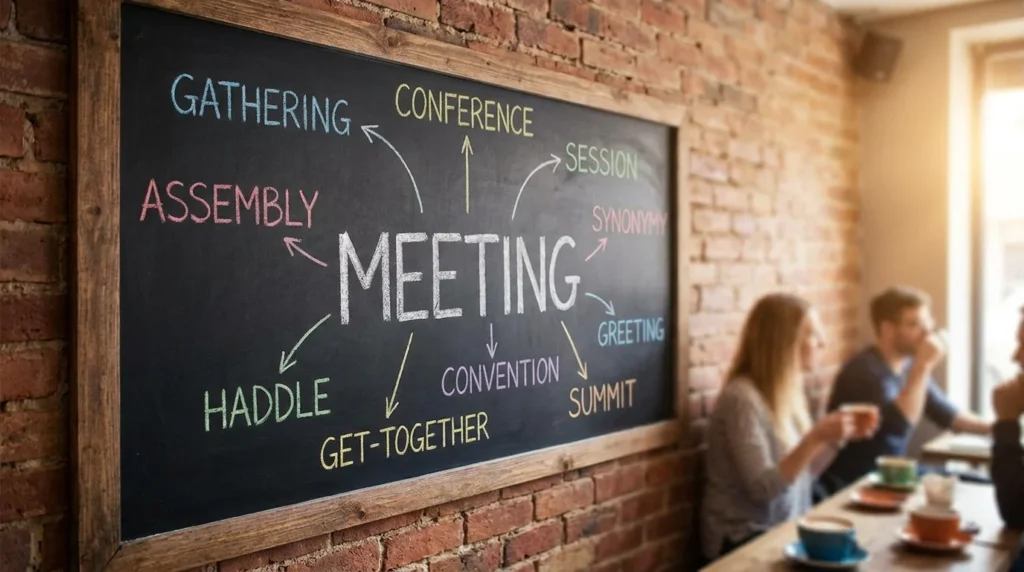
Quick Synonym List
Closest alternatives
- Gathering
- Conference
- Session
- Appointment
- Assembly
- Discussion
- Consultation
- Encounter
- Get-together
Professional and business alternatives
- Conference
- Briefing
- Consultation
- Session
- Business appointment
- Board meeting
- Staff meeting
- Strategy session
- Review
- Huddle
Formal alternatives
- Conference
- Assembly
- Convention
- Summit
- Consultation
- Deliberation
- Proceeding
- Session
Casual alternatives
- Get-together
- Huddle
- Chat
- Catch-up
- Gathering
- Meetup
Context-specific alternatives
- Interview — a meeting for questioning or evaluation
- Hearing — a formal opportunity to present or consider information
- Negotiation — a meeting focused on reaching an agreement
- Workshop — a practical, interactive working session
- Seminar — an educational meeting or class
- Reception — a social event for welcoming or entertaining guests
- Encounter — an occasion when people meet, often unexpectedly
What Does “Meeting” Mean?
Meeting can refer to several different things, so its best synonym depends heavily on context.
As a noun, it commonly means an occasion when two or more people come together to discuss something, make decisions, work, or socialize.
“We have a meeting at 10 a.m.”
It can also mean an arranged appointment:
“I have a meeting with my doctor tomorrow.”
In a broader sense, it can describe people coming together socially:
“The family meeting was held at her home.”
The word meeting can also refer to the act or occasion of encountering someone:
“Their first meeting was completely unexpected.”
Because these meanings overlap but are not identical, replacing meeting with a random thesaurus entry can easily change the meaning.
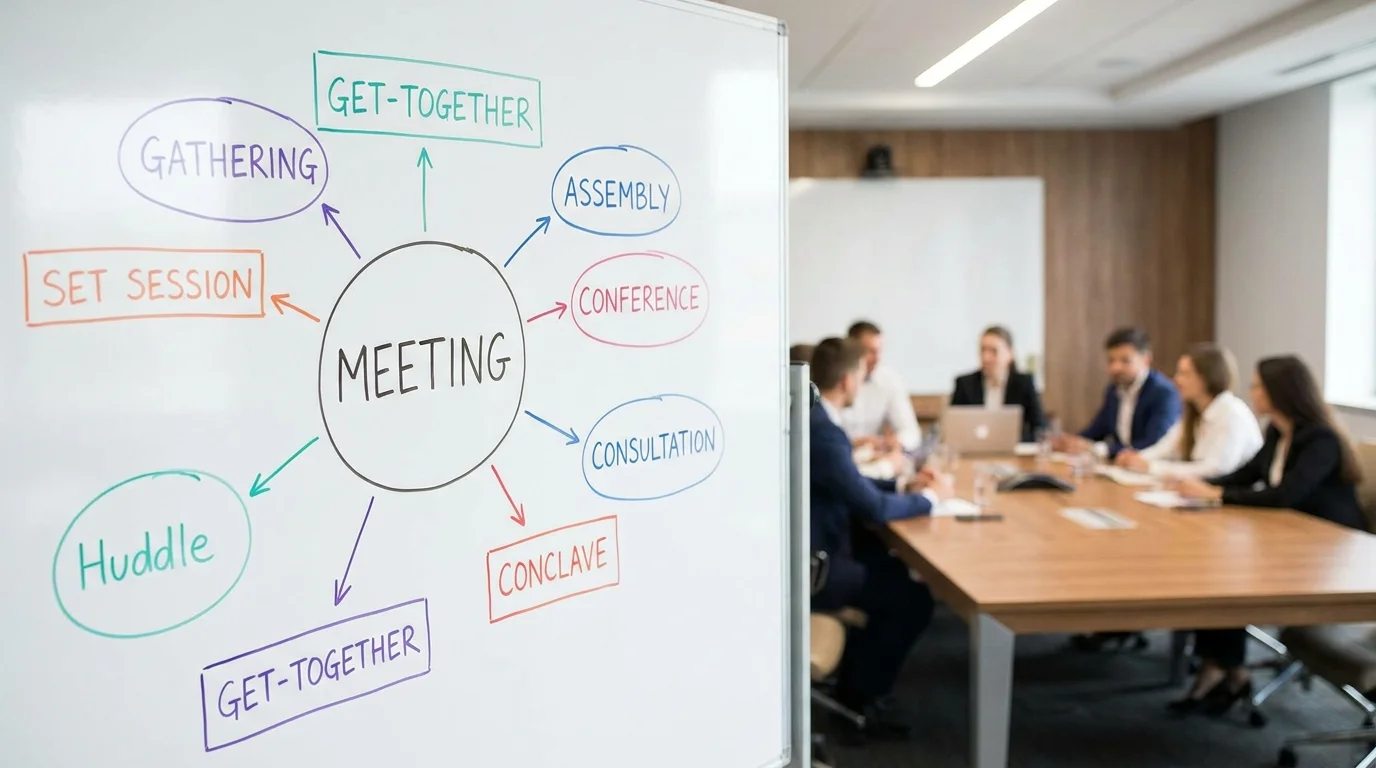
The Closest Synonyms for Meeting
Gathering
Meaning: A group of people coming together in one place.
Tone: Neutral.
Best for: Social events, community events, families, and informal groups.
Example:
“The annual family gathering will be held on Saturday.”
Watch out: A gathering does not necessarily involve discussion, decisions, or a formal agenda.
Conference
Meaning: A formal meeting, often involving several people discussing a particular subject.
Tone: Formal or professional.
Best for: Business, academic, professional, and industry events.
Example:
“She is attending a technology conference next week.”
Watch out: A conference is often larger and more structured than an ordinary meeting.
Session
Meaning: A period devoted to a particular activity, discussion, or purpose.
Tone: Neutral to formal.
Best for: Training, therapy, education, negotiations, and focused discussions.
Example:
“The team held a strategy session in the afternoon.”
Watch out: Session emphasizes the period of activity rather than simply the fact that people gathered.
Appointment
Meaning: An arranged time to meet someone.
Best for: Doctors, consultants, clients, interviews, services, and one-to-one meetings.
Example:
“I have an appointment with my financial adviser.”
Watch out: Not every meeting is an appointment. A scheduled team meeting is normally still called a meeting.
Assembly
Meaning: A group of people gathered for a particular purpose, often in a formal setting.
Tone: Formal.
Best for: Schools, organizations, legislatures, and official gatherings.
Example:
“The students attended the morning assembly.”
Watch out: Assembly can refer to the group itself as well as the event.
Discussion
Meaning: An exchange of ideas, opinions, or information.
Best for: Meetings where conversation and consideration of an issue are the main purpose.
Example:
“We had a productive discussion about the new proposal.”
Watch out: A discussion describes the activity, not necessarily the entire meeting.
Consultation
Meaning: A meeting in which someone seeks advice, information, or professional guidance.
Tone: Professional/formal.
Best for: Doctors, lawyers, consultants, experts, and clients.
Example:
“The company scheduled a consultation with a legal adviser.”
Watch out: Consultation implies seeking advice or expertise.
Encounter
Meaning: An occasion when people meet, especially unexpectedly or briefly.
Tone: Neutral to formal.
Example:
“Their first encounter took place at a conference.”
Watch out: It is generally not a good substitute for a planned business meeting.
Get-together
Meaning: An informal social meeting.
Tone: Casual and friendly.
Example:
“We’re having a small get-together this weekend.”
Watch out: It sounds inappropriate for a formal board or client meeting.
Professional Synonyms for Meeting
Briefing
A briefing is a meeting or presentation designed to give people important information or instructions.
“The manager held a briefing before the launch.”
Use it when the primary purpose is informing people rather than having a general discussion.
Huddle
A huddle is a short, informal meeting, especially among coworkers or a small team.
“Let’s have a quick huddle before the client call.”
It is common in workplace speech but more informal than meeting.
Consultation
Use consultation when participants seek advice or expert input.
“The project requires consultation with several specialists.”
Strategy Session
A strategy session is focused on planning or deciding how to achieve a goal.
“The leadership team held a strategy session to discuss expansion.”
This is more specific than simply saying meeting.
Review
A review focuses on examining progress, performance, results, or a particular matter.
“We have a quarterly performance review tomorrow.”
It is useful in professional contexts because it tells the reader what the meeting is actually about.
Interview
An interview is a structured meeting in which one or more people ask questions for a particular purpose.
“She has a job interview on Monday.”
An interview is therefore a type of meeting, but not every meeting is an interview.
Formal Alternatives for Meeting
Conference
Best for formal professional or academic gatherings.
Convention
A convention is a large organized gathering, often involving members of a profession, organization, or interest group.
“The association’s annual convention attracted members from across the country.”
Summit
A summit is a high-level meeting, especially involving senior leaders or representatives.
“The leaders met for an international summit.”
It conveys importance and usually involves senior decision-makers.
Deliberation
Deliberation refers to careful consideration and discussion before making a decision.
“The committee’s deliberations continued for several hours.”
It is not a direct replacement for meeting because it describes the decision-making process rather than simply the gathering.
Proceeding
Proceeding is a formal term for an activity or process conducted as part of official business.
“The proceedings of the committee were recorded.”
It is usually too formal for ordinary workplace communication.
Casual Synonyms for Meeting
Get-Together
Use this for a relaxed social event.
“We’re planning a get-together after work.”
Catch-Up
A catch-up is an informal conversation or meeting intended to exchange updates.
“Let’s schedule a quick catch-up next week.”
This is especially natural in workplace and personal communication.
Chat
A chat suggests an informal conversation rather than a structured meeting.
“Can we have a quick chat about the project?”
Huddle
Use huddle for a short, informal team discussion.
“Let’s have a five-minute huddle.”
Meetup
Meetup is an informal term for an organized or planned meeting, often among people who share an interest.
“The local photography group is hosting a meetup.”
It is more casual than conference or assembly.
Meeting Synonyms by Purpose
The most useful way to choose an alternative is often to identify why the people are meeting.
| Purpose | Better Word | Example |
|---|---|---|
| General business | Meeting | “We have a meeting at noon.” |
| Give information | Briefing | “The manager held a briefing.” |
| Seek expert advice | Consultation | “They arranged a consultation.” |
| Make a decision | Deliberation | “The committee began deliberations.” |
| Develop plans | Strategy session | “We scheduled a strategy session.” |
| Review progress | Review | “The team held a project review.” |
| Hire someone | Interview | “She has an interview tomorrow.” |
| Learn something | Seminar | “I attended a marketing seminar.” |
| Practice together | Workshop | “The team joined a writing workshop.” |
| Socialize | Get-together | “We had a family get-together.” |
| Short team discussion | Huddle | “Let’s have a quick huddle.” |
| Large professional event | Conference | “He attended a medical conference.” |
| High-level negotiations | Summit | “The presidents met at a summit.” |
| Community gathering | Assembly | “Residents attended the assembly.” |
Meeting vs. Conference vs. Session
These three words are frequently confused.
Meeting is the broadest term. It can describe a small workplace discussion, a formal committee gathering, or a scheduled conversation.
Conference usually suggests a larger or more formal event centered on a subject or profession.
Session emphasizes a period devoted to a particular activity.
Compare:
“We have a meeting at 2.”
“We are attending a conference on cybersecurity.”
“The afternoon session focuses on cybersecurity.”
The three words overlap, but they highlight different aspects of the event.
Meeting vs. Appointment
An appointment is an arranged time to meet a specific person or receive a service.
“I have a doctor’s appointment.”
A meeting usually emphasizes interaction or discussion between participants.
“I have a meeting with my manager.”
A scheduled meeting with one person can be called an appointment in some situations, but the words are not universally interchangeable.
For example, a doctor’s visit is naturally an appointment, while a weekly team discussion is naturally a meeting.
Meeting vs. Gathering
A gathering simply means people have come together.
A meeting normally suggests a purpose such as discussing an issue, exchanging information, planning, or making decisions.
Compare:
“The neighbors had a gathering.”
This could simply be social.
“The neighbors had a meeting.”
This suggests they came together to discuss something, such as a community issue.
Meeting vs. Discussion
A discussion is an exchange of ideas or opinions.
A meeting is the broader event that may contain one or several discussions.
For example:
“The meeting lasted an hour.”
“The discussion about the budget lasted an hour.”
The first describes the entire event. The second describes what participants were doing during it.
Meeting vs. Conference vs. Convention
These terms are useful at different scales.
| Word | Typical Scale | Main Idea |
|---|---|---|
| Meeting | Small to medium | People gather for a purpose |
| Conference | Medium to large | Formal event focused on a subject |
| Convention | Usually large | Organized gathering of a group or community |
| Summit | Small, high-level | Senior leaders meet |
| Session | Any size | A defined period of activity |
These are not strict size rules, but they are useful general distinctions.
How to Choose the Right Alternative
For a normal workplace meeting
Use meeting, session, catch-up, or huddle, depending on the tone and purpose.
For a formal professional event
Use conference, convention, or summit when the context supports them.
For an information-sharing event
Choose briefing.
For expert advice
Choose consultation.
For hiring
Choose interview.
For training
Choose workshop, seminar, or training session.
For informal socializing
Choose get-together, gathering, or meetup.
For a short team discussion
Choose huddle.
For careful decision-making
Use deliberation when you mean the process of considering an issue, not simply the meeting itself.
Sentence Transformations
1. General workplace use
Original:
“We have a meeting tomorrow.”
Better Alternative:
“We have a strategy session tomorrow.”
Why:
Use strategy session when planning is the central purpose.
2. Sharing information
Original:
“The manager called a meeting to explain the changes.”
Better Alternative:
“The manager called a briefing to explain the changes.”
Why:
Briefing makes the information-sharing purpose explicit.
3. Informal workplace conversation
Original:
“Can we have a meeting about this?”
Better Alternative:
“Can we have a quick chat about this?”
Why:
Chat creates a more informal and approachable tone.
4. Expert advice
Original:
“I have a meeting with my lawyer.”
Better Alternative:
“I have a consultation with my lawyer.”
Why:
Consultation emphasizes that professional advice is being sought.
5. Social event
Original:
“We’re having a meeting at my house.”
Better Alternative:
“We’re having a get-together at my house.”
Why:
Get-together makes the social nature clear.
6. Large professional event
Original:
“She attended a meeting for marketing professionals.”
Better Alternative:
“She attended a marketing conference.”
Why:
Conference is more appropriate for a larger organized professional event.
7. Team check-in
Original:
“Let’s schedule a meeting before the presentation.”
Better Alternative:
“Let’s have a quick huddle before the presentation.”
Why:
Huddle suggests a short, informal team discussion.
8. Hiring
Original:
“I have a meeting with the hiring manager.”
Better Alternative:
“I have an interview with the hiring manager.”
Why:
Interview identifies the specific purpose of the meeting.
Common Mistakes
Mistake 1: Using “conference” for every meeting
A conference is generally more formal or larger in scope. A ten-minute team discussion is normally just a meeting or huddle.
Mistake 2: Using “appointment” for every scheduled meeting
A scheduled event is not automatically an appointment. Appointment is particularly natural for arranged visits or one-to-one services.
Mistake 3: Treating “discussion” as a complete synonym
A discussion describes an exchange of ideas. A meeting may include presentations, decisions, voting, or several discussions.
Mistake 4: Calling every meeting a “summit”
Summit implies a high-level gathering, often involving senior leaders. Using it for an ordinary team meeting can sound exaggerated.
Mistake 5: Using “get-together” in formal documents
It is friendly and natural in casual contexts but usually too informal for official reports or professional notices.
Mistake 6: Assuming “session” means a formal meeting
A session can involve training, therapy, education, practice, discussion, or other activities. It focuses on a period of activity rather than necessarily a meeting.
Mistake 7: Using “huddle” in every workplace
Huddle is informal and usually suggests a short discussion. It may not fit formal client communication.
Mistake 8: Confusing “meeting” with “meet-up”
A meet-up is generally informal and social or interest-based. It does not normally replace a formal business meeting.
Grammar and Usage
Meeting is commonly used as a countable noun:
- “a meeting”
- “two meetings”
- “the meeting”
- “our next meeting”
Common collocations include:
- attend a meeting
- hold a meeting
- schedule a meeting
- arrange a meeting
- cancel a meeting
- postpone a meeting
- join a meeting
- chair a meeting
- lead a meeting
- run a meeting
- have a meeting
- go to a meeting
For a planned event, these constructions are natural:
“We scheduled a meeting for Monday.”
“The team held a meeting to discuss the proposal.”
For an informal conversation, alternatives such as chat or catch-up often require different phrasing:
“Let’s have a quick chat.”
“Let’s arrange a catch-up.”
Do not assume that a synonym can always be inserted into exactly the same grammatical structure.
When “Meeting” Is Actually the Better Word
Synonyms should not be used simply to make writing look sophisticated.
Meeting is often preferable because it is:
- clear;
- familiar;
- flexible;
- professional without sounding stiff;
- suitable for many types of workplace communication.
For example:
“The project team will have a meeting on Friday.”
is perfectly clear.
Changing it to:
“The project team will conduct a conference on Friday.”
could make the sentence less accurate if only a small group is gathering.
Likewise, meeting is usually better than get-together in a business report because the formal context already tells the reader what kind of event is being discussed.
Editor’s Choice
Meeting
The best general-purpose word. Use it when you do not need to emphasize a special purpose or level of formality.
Conference
Best when referring to a larger or more formal professional or academic event.
Briefing
Best when the main purpose is to give people information or instructions.
Consultation
Best when participants are seeking professional advice or expert input.
Huddle
Best for a short, informal team discussion.
These choices are useful because they add information instead of merely replacing meeting with a more complicated word.