
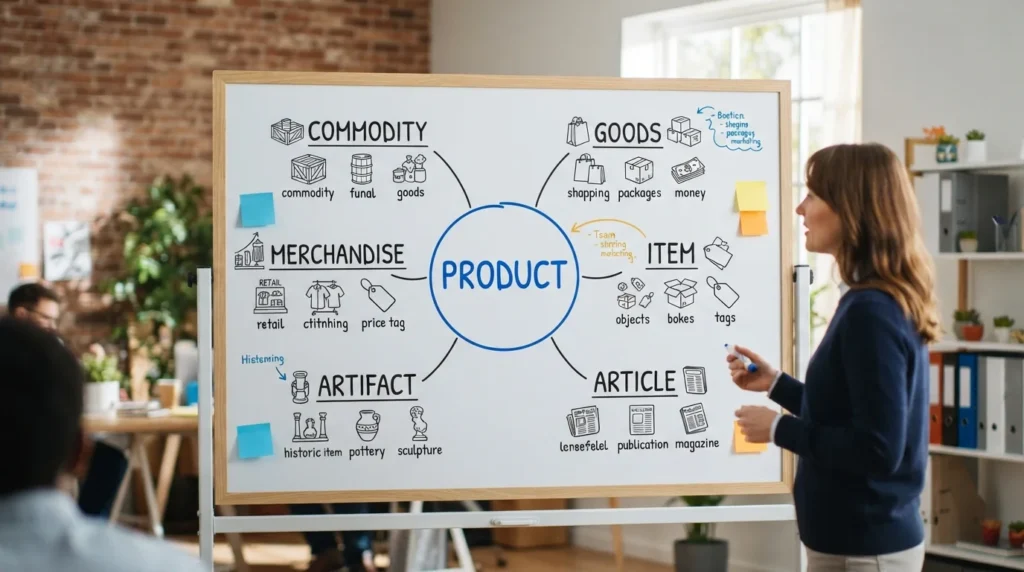
Quick List: Synonyms for Product
General and commercial
- item
- goods
- merchandise
- commodity
- offering
- purchase
- article
- stock
- wares
- line
- brand
- model
- solution
- service
- package
Physical products
- item
- article
- good
- merchandise
- commodity
- manufactured good
- consumer good
- retail item
- physical good
- material
Business and marketing
- offering
- solution
- service
- brand
- line
- product line
- model
- package
- subscription
- deliverable
- portfolio offering
Manufactured or produced things
- output
- creation
- result
- production
- end product
- finished good
- manufactured good
- yield
- by-product
- derivative
Food and consumer goods
- item
- good
- food product
- packaged good
- merchandise
- brand
- variety
- offering
Result or outcome
- result
- outcome
- consequence
- effect
- creation
- achievement
- end result
- by-product
Mathematics
- result
- multiplication result
- quantity
- value
What Does “Product” Mean?
Product has several distinct meanings, so no single synonym works in every sentence.
The most common meaning is something made or sold for people to use or buy.
The company launched a new product.
But product can also mean:
- A physical or commercial item
- This product is available in three sizes.
- Something a business offers customers
- The company expanded its product portfolio.
- Goods or merchandise
- The store sells imported products.
- Something produced by a process
- The chemical reaction creates several products.
- A result or outcome
- The policy was a product of years of negotiation.
- A mathematical result
- The product of 6 and 8 is 48.
The correct alternative depends heavily on which meaning you intend.
1. Product Meaning “Item”
Item
Meaning: An individual thing, especially something sold, bought, listed, or considered.
Tone: Neutral
Best for: Retail, shopping, catalogs, websites, general writing
Example:
The store offers more than 500 products.
→ The store offers more than 500 items.
Difference: Item is one of the closest general alternatives, but it does not necessarily imply something was manufactured for sale.
Article
Meaning: An individual object or commodity, especially one offered for sale.
Tone: Formal or neutral
Example:
Each article is inspected before shipping.
Difference: Article can replace product in some retail contexts, but it can also mean a written piece, so context matters.
Good
Meaning: A physical item produced for sale or use.
Tone: Formal/business
Example:
The company exports consumer goods.
Difference: Good is a specialized commercial term. It is most natural in phrases such as consumer goods, durable goods, and capital goods.
2. Product Meaning “Goods”
Goods
Meaning: Physical products or merchandise bought, sold, or traded.
Tone: Neutral/formal
Best for: Business, economics, trade, logistics, commerce
Example:
The company imports electronic goods.
Difference: Goods generally refers to products as a category or collection rather than one specific branded item.
Merchandise
Meaning: Goods offered for sale, especially in retail.
Tone: Business/retail
Example:
The store receives new merchandise every week.
Difference: Merchandise emphasizes products available for sale.
Commodities
Meaning: Basic goods that can be bought and sold, often in markets where products are standardized.
Tone: Business/economic
Example:
Oil and agricultural commodities are traded globally.
Watch out: Not every product is a commodity. A branded smartphone is a product but generally isn’t called a commodity in the same sense.
Wares
Meaning: Goods or products offered for sale.
Tone: Literary, traditional, or commercial
Example:
The market was filled with handmade wares.
Difference: Wares is less common in ordinary modern business writing.
3. Product Meaning “Business Offering”
This sense is common in marketing, sales, SaaS, consulting, and business strategy.
Offering
Meaning: Something a company makes available to customers, such as a product or service.
Tone: Professional
Example:
The company expanded its product offering.
→ The company expanded its offering.
Difference: Offering is broader than product because it can include services, subscriptions, packages, and combinations of products and services.
Solution
Meaning: A product, service, or combination designed to solve a customer’s problem.
Tone: Professional/marketing
Example:
The company developed a software product for small businesses.
→ The company developed a software solution for small businesses.
Watch out: Solution is not a direct synonym for every product. It emphasizes the problem being solved.
Service
Meaning: An activity or ongoing provision offered to customers rather than a physical object.
Example:
The company offers several digital products and services.
Difference: A service is not generally a synonym for a physical product, although businesses often discuss both together as offerings.
Package
Meaning: A combination of products, services, features, or benefits sold together.
Example:
The company introduced a new software package.
Difference: Package suggests multiple elements grouped together.
4. Product Meaning “Brand or Product Line”
Brand
Meaning: A name, identity, or commercial identity associated with products or services.
Example:
The company launched a new product.
This does not automatically mean:
The company launched a new brand.
A brand can contain many products.
Product Line
Meaning: A group of related products offered by a company.
Example:
The company expanded its product line.
Difference: A product line refers to multiple related products, not usually one product.
Model
Meaning: A particular design, version, or type of product.
Example:
The company released a new laptop model.
Difference: Model is especially useful when a product exists in multiple versions or designs.
Version
Meaning: A particular form or edition of a product.
Example:
The company released an updated version of the software product.
Difference: Version emphasizes differences between releases or editions.
5. Product Meaning “Manufactured Good”
Manufactured Good
Meaning: An item produced through manufacturing.
Tone: Technical/business
Example:
The factory exports manufactured goods.
Difference: This specifically identifies products made through a manufacturing process.
Finished Good
Meaning: A completed product ready for sale or use.
Tone: Business/manufacturing
Example:
The finished goods were moved to the warehouse.
Difference: This is more specific than product because it emphasizes completion.
Output
Meaning: Something produced by a person, machine, process, or organization.
Tone: Neutral/technical
Example:
The factory increased its product output.
Difference: Output emphasizes production, quantity, or result rather than the commercial identity of the item.
Creation
Meaning: Something that has been made or created.
Tone: Neutral
Example:
The painting was one of the artist’s most famous creations.
Difference: Creation is broader and can refer to art, ideas, products, or other things.
End Product
Meaning: The final result of a process.
Tone: Neutral/technical
Example:
The end product is ready for distribution.
Difference: End product emphasizes the final stage of production.
6. Product Meaning “Result or Outcome”
Sometimes product means something produced by an event, process, relationship, or set of circumstances.
The agreement was a product of years of negotiation.
Here, useful alternatives include:
- result
- outcome
- consequence
- effect
- creation
- outcome of
- end result
- by-product
Result
Meaning: Something that happens or is produced because of an action or process.
Example:
The agreement was the result of years of negotiation.
Difference: Result is usually clearer than product when discussing an outcome.
Outcome
Meaning: The final result of a process or event.
Tone: Neutral/professional
Example:
The policy was an outcome of extensive negotiations.
Difference: Outcome is especially common for decisions, processes, studies, and events.
Consequence
Meaning: A result that follows from an action or event, often with an emphasis on its effects.
Example:
The change was a consequence of rising costs.
Watch out: Consequence often carries a negative or serious implication, although it can be neutral.
By-Product
Meaning: Something produced incidentally while making something else.
Example:
Heat is a by-product of the reaction.
Difference: A by-product is secondary rather than the main intended product.
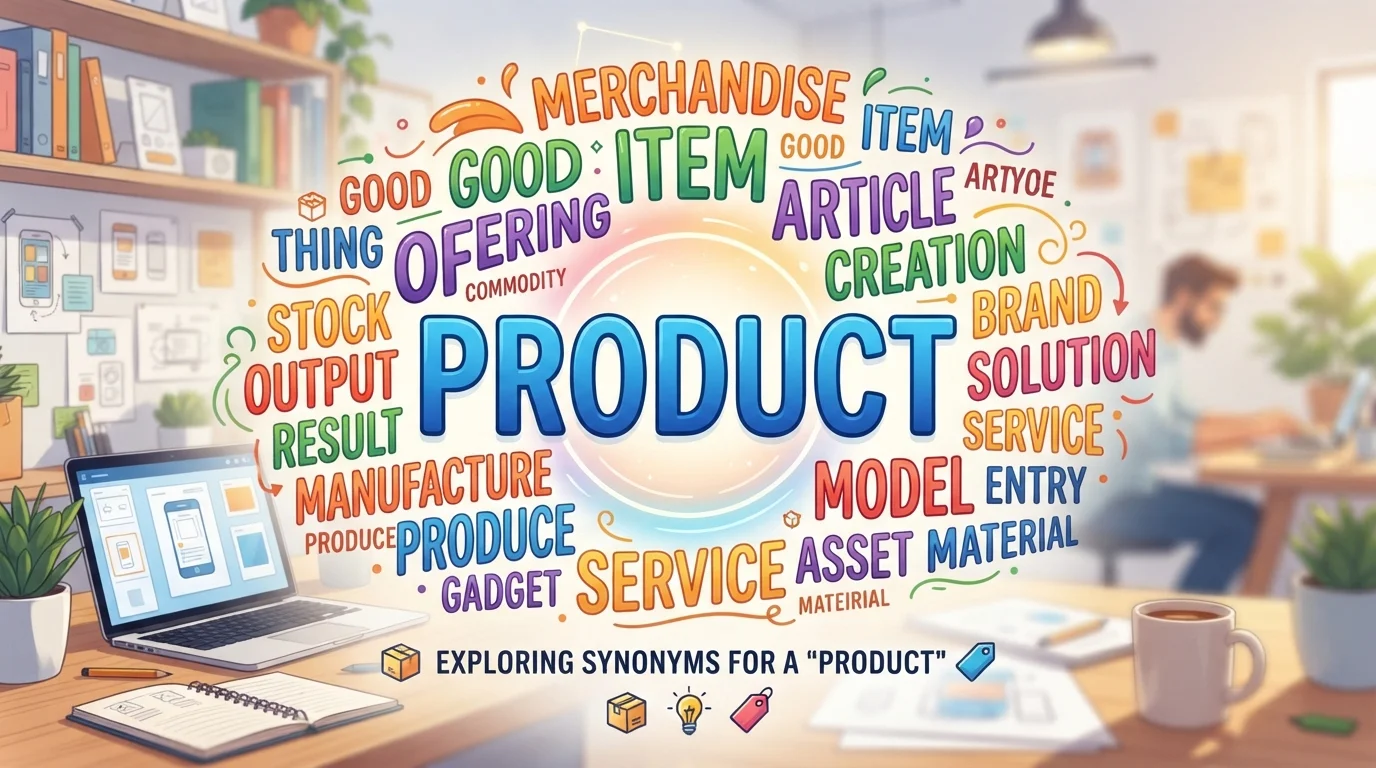
7. Product in Science and Chemistry
In science, product can refer to a substance produced by a chemical reaction or process.
Water is a product of the reaction.
Possible alternatives include:
- reaction product
- resulting substance
- compound
- output
- resultant
But product is often the correct technical term, so replacing it is not always an improvement.
For example:
The reaction produces two products.
is more precise than forcing a general synonym such as items or results.
8. Product in Mathematics
In mathematics, product means the result obtained by multiplying numbers or quantities.
The product of 7 and 9 is 63.
Possible descriptive alternatives include:
- multiplication result
- result
- value
But product is the standard mathematical term.
7 × 9 = 63
Here, saying result is understandable, but product is more precise.
Product vs. Similar Words
| Word | Main Meaning | Typical Context | Direct Replacement? |
|---|---|---|---|
| product | Something made, sold, or produced | General/business | — |
| item | Individual thing | Retail/general | Often |
| goods | Products as merchandise | Commerce/economics | Sometimes |
| merchandise | Goods offered for sale | Retail | Sometimes |
| commodity | Standardized tradable good | Economics/trade | Sometimes |
| offering | Product/service made available | Marketing/business | Often in business |
| solution | Offering designed to solve a problem | Business/technology | Context-dependent |
| service | Nonphysical customer offering | Business | No, usually |
| model | Particular product design/type | Manufacturing/retail | Sometimes |
| brand | Commercial identity | Marketing | No |
| output | Something produced | Manufacturing/science | Sometimes |
| result | Outcome of a process | General/academic | Only in outcome sense |
| by-product | Secondary result of production | Manufacturing/science | Only in specific contexts |
| specification | Detailed product requirement | Technical | No |
| creation | Something made | Art/general | Sometimes |
| finished good | Completed item ready for sale | Manufacturing | Sometimes |
Product in Different Contexts
E-commerce and Retail
The most natural alternatives are:
- item
- merchandise
- goods
- article
- offering
- model
Browse our latest products.
→ Browse our latest items.
This works well on a shopping website, but products may still be the more natural commercial term.
Business and Marketing
Use:
- offering
- solution
- product line
- service
- package
- portfolio offering
- model
We are expanding our product range.
→ We are expanding our product offering.
The company introduced a new product.
→ The company introduced a new offering.
The second version is especially useful when the offering includes both products and services.
Technology and Software
Depending on what you mean:
Software product
→ software offering
Specific release
→ version
Specific type
→ model or edition
Problem-solving business product
→ solution
Technical result
→ output
For example:
The company launched a new software product.
could become:
The company launched a new software solution.
But only use solution if the software is being presented as a way to solve a specific customer problem.
Manufacturing
Useful alternatives include:
- manufactured good
- finished good
- output
- item
- end product
- production
The factory produces 10,000 products per month.
→ The factory produces 10,000 units per month.
Units is often more precise when counting manufactured products.
Product vs. Unit
Unit refers to one individual item or quantity, especially when counting production or sales.
The factory produced 50,000 units.
This does not mean that unit is always a synonym for product.
The company launched a new product.
A unit would not normally work here because the sentence is about the product itself, not the number of individual products produced or sold.
Product vs. Offering
These words overlap heavily in business writing, but they are not identical.
Product = what the company sells.
Offering = what the company makes available to customers, which may be a product, service, package, or combination.
Our newest product is a cloud-based platform.
Our newest offering includes the platform, training, and support.
The second sentence has a broader scope.
Product vs. Merchandise
Product is broader.
Merchandise specifically emphasizes goods being offered for sale.
The company developed a new product.
The store received new merchandise.
The first focuses on creation; the second focuses on retail availability.
Product vs. Commodity
A commodity is generally a standardized good that can be traded and substituted with similar goods.
Wheat is a commodity.
This company sells a premium consumer product.
Calling every product a commodity removes important information about branding, differentiation, and uniqueness.
Product vs. Result
These overlap only when product means the thing produced by a process.
The agreement was a product of negotiation.
→ The agreement was a result of negotiation.
Here, result is natural.
But:
The company launched a new product.
does not mean:
The company launched a new result.
The meanings are completely different.
Sentence Transformations
1. General retail
Original:
The store sells hundreds of products.
Alternative:
The store sells hundreds of items.
Why:
Items is a natural general term for individual things sold in a store.
2. Retail goods
Original:
The store receives new products every week.
Alternative:
The store receives new merchandise every week.
Why:
Merchandise emphasizes goods available for sale.
3. Business offering
Original:
The company launched a new product for small businesses.
Alternative:
The company launched a new offering for small businesses.
Why:
Offering works well in professional and marketing contexts.
4. Problem-solving product
Original:
The company developed a new software product.
Alternative:
The company developed a new software solution.
Why:
Solution is appropriate if the software is designed and positioned as an answer to a specific customer problem.
5. Product version
Original:
The company released a new product for its laptop range.
Alternative:
The company released a new laptop model.
Why:
Model is more precise when referring to a particular design or version of a product.
6. Manufacturing
Original:
The factory produced 20,000 products.
Alternative:
The factory produced 20,000 units.
Why:
Units is more natural when emphasizing the number of individual manufactured items.
7. Technical production
Original:
The factory increased its product production.
Alternative:
The factory increased its output.
Why:
Output focuses on the amount produced.
8. Process result
Original:
The agreement was a product of several months of negotiations.
Alternative:
The agreement was a result of several months of negotiations.
Why:
Here, product means something produced by a process, so result is more direct.
9. Secondary result
Original:
Heat was a product of the chemical reaction.
Alternative:
Heat was a by-product of the chemical reaction.
Why:
By-product is appropriate when the result is secondary rather than the main intended product.
10. Mathematical meaning
Original:
The product of 8 and 5 is 40.
Alternative:
The result of multiplying 8 by 5 is 40.
Why:
This paraphrase preserves the mathematical meaning, although product remains the standard technical term.
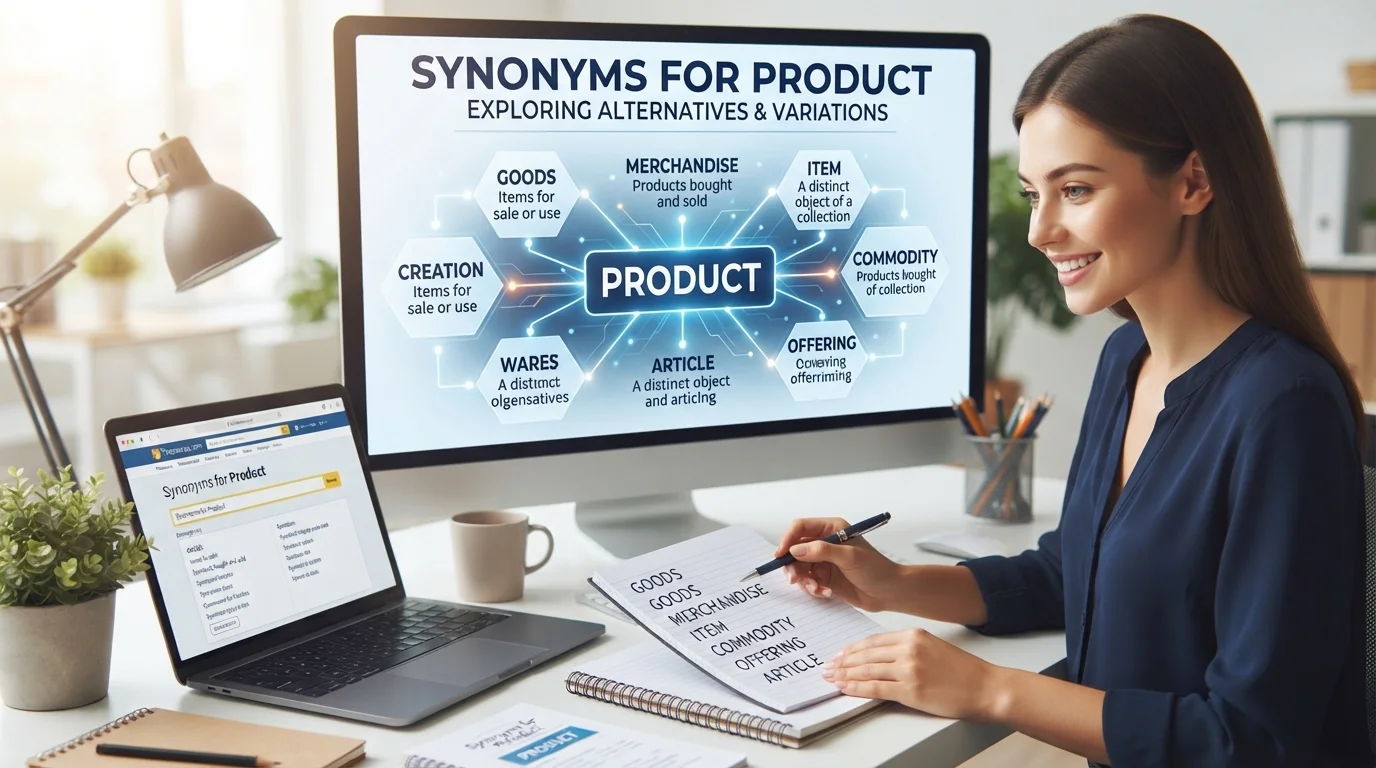
Common Collocations with “Product”
Some expressions are so established that replacing product may make the sentence less natural.
Business
- new product
- product launch
- product development
- product design
- product strategy
- product portfolio
- product range
- product line
- product market
- product category
- product offering
- product lifecycle
- product quality
Retail
- consumer product
- retail product
- physical product
- packaged product
- finished product
- popular product
- premium product
- luxury product
- household product
Technology
- software product
- digital product
- technology product
- product update
- product release
- product version
- product features
- product requirements
Manufacturing
- finished product
- end product
- manufactured product
- product output
- product quality
- product defect
- product testing
Common Mistakes
1. Treating “product” and “brand” as synonyms
A brand can contain many products.
Nike is a brand.
A particular pair of shoes is a product.
2. Calling every product a commodity
A commodity is generally standardized and traded as such.
A highly differentiated consumer product is not automatically a commodity.
3. Using “service” for a physical product
A service is generally something provided rather than a physical item.
The company sells products and services.
Keeping the distinction makes business writing clearer.
4. Using “offering” for every product
Offering is useful in business writing, but it is broader and can sound like marketing language.
We launched a new product.
is often clearer than:
We launched a new offering.
if you are simply talking about one physical product.
5. Confusing “product” with “output”
Output focuses on what a process produces, often in terms of quantity or performance.
Product can refer to the actual commercial item.
The factory increased its output.
The company launched a new product.
6. Using “result” for a commercial product
A product can be a result of production, but the two words are not generally interchangeable.
The company launched a new product.
not:
The company launched a new result.
7. Confusing “product line” with “product”
A product line is a group of related products.
The company expanded its product line.
It does not mean the company launched one product.
8. Using “unit” when the focus is the product itself
Unit is useful for counting individual items.
The factory produced 50,000 units.
But when discussing features, design, or market positioning, product is usually more appropriate.
When Not to Replace “Product”
Keep product when:
- you mean a commercial item;
- you are discussing product development or marketing;
- you need a broad term covering a physical or digital offering;
- the phrase is an established business term;
- the distinction between product, service, and brand matters;
- a replacement would introduce a different meaning.
For example:
The company is investing in product development.
This is clearer than replacing product with item, goods, or merchandise.
Likewise, product launch, product design, product strategy, product quality, product portfolio, and product line are established terms.
Decision Guide: Which Synonym Should You Use?
A general individual thing for sale?
→ item
Products as a category of merchandise?
→ goods
Retail goods?
→ merchandise
A standardized tradable good?
→ commodity
A product or service offered to customers?
→ offering
A problem-solving business product?
→ solution
A particular version or design?
→ model
A specific release or edition?
→ version
A completed manufactured item?
→ finished good / finished product
Something produced by a process?
→ output / result
A secondary result?
→ by-product
An individual manufactured quantity?
→ unit
A commercial identity?
→ brand
A group of related products?
→ product line
A mathematical multiplication result?
→ product
Editor’s Choice: Most Useful Alternatives
These are editorial recommendations based on precision and natural usage, not an objective ranking.
Item
Best general alternative for an individual product in retail or everyday contexts.
Add the item to your cart.
Offering
Best professional alternative when the business provides a product, service, or package.
The company expanded its offering.
Goods
Best for products considered collectively in commerce or economics.
The company imports consumer goods.
Merchandise
Best for retail products offered for sale.
The new merchandise arrived this morning.
Output
Best when product means something produced by a process.
The factory increased its output.
Result
Best when product means an outcome.
The agreement was a result of negotiations.