
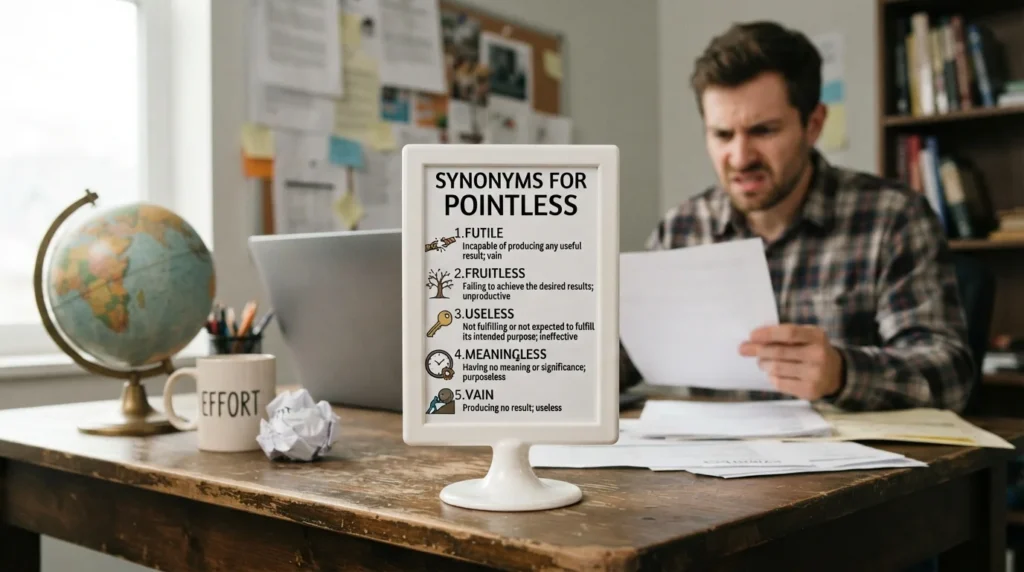
Quick Synonym List
Pointless can describe something that has no useful purpose, produces no worthwhile result, lacks meaning, or is unnecessary. These meanings overlap, but they require different alternatives.
Meaning | |
|---|---|
Closest alternatives | Useless, futile, meaningless, purposeless, senseless |
Unlikely to succeed | Futile, hopeless, fruitless, vain, doomed |
Producing no useful result | Unproductive, ineffective, unavailing, unsuccessful |
Having no meaning | Meaningless, insignificant, empty, hollow, devoid of meaning |
Having no clear purpose | Purposeless, aimless, directionless, without purpose |
Unnecessary | Needless, unnecessary, redundant, superfluous, gratuitous |
Having little practical value | Impractical, unhelpful, worthless, of little use |
Wasteful activities | Time-wasting, wasteful, inefficient, a waste of time |
Informal alternatives | A waste of time, good for nothing, going nowhere, not worth the effort |
Key distinction
Pointless is a broad judgment. A pointless task may be unnecessary, a pointless argument may be futile, and a pointless story may lack meaning. These alternatives are not interchangeable: an unsuccessful effort can still have value, and an activity without a practical goal can still be enjoyable.
What Does “Pointless” Mean?
Pointless is an adjective meaning that something has no useful purpose, produces no worthwhile result, or lacks sufficient meaning or value.
Consider these examples:
“It’s pointless to argue with someone who refuses to listen.” The argument is unlikely to achieve anything.
“The form contains several pointless questions.” The questions appear unnecessary.
“The meeting felt pointless because no decisions were made.” The meeting seemed unproductive.
“The movie’s ending felt pointless.” The ending appeared to lack meaning or contribute little to the story.
The word is usually negative and can sound dismissive when applied to someone’s work, opinions, or personal interests. A more specific alternative often makes criticism clearer and more constructive.
The Best Synonyms for Pointless
1. Useless
Meaning: Having no practical use or failing to serve an intended purpose.
Tone: Neutral to strongly negative.
Best for: Objects, tools, advice, information, actions, and procedures.
Example: The outdated instructions were useless because the software had completely changed.
How it differs: Useless emphasizes a lack of practical utility. Pointless can also describe something that lacks meaning or a worthwhile goal.
Watch out: Calling a person useless is harsh and insulting. Describe the specific action or result instead.
2. Futile
Meaning: Incapable of producing the desired result or unlikely to succeed.
Tone: Formal or literary.
Best for: Efforts, attempts, arguments, struggles, and resistance.
Example: Their attempts to repair the severely damaged equipment proved futile.
How it differs: Futile emphasizes the impossibility or extreme unlikelihood of success.
It is particularly natural in phrases such as a futile attempt, a futile effort, and a futile exercise.
3. Meaningless
Meaning: Having no meaning, significance, or apparent value.
Tone: Neutral to strongly negative.
Best for: Statements, gestures, activities, promises, and experiences.
Example: The apology felt meaningless because his behavior never changed.
How it differs: Meaningless focuses on significance rather than practical usefulness.
A conversation may have no practical outcome but still be meaningful because it helps people understand one another.
4. Purposeless
Meaning: Having no clear purpose, objective, or intended function.
Tone: Neutral to formal.
Best for: Activities, behavior, movement, and routines.
Example: The team spent the afternoon in purposeless discussions.
How it differs: Purposeless emphasizes the absence of a goal. An activity can have a purpose yet still be pointless if that purpose is unimportant or impossible to achieve.
5. Fruitless
Meaning: Producing no useful or desired results.
Tone: Neutral to formal.
Best for: Searches, investigations, negotiations, efforts, and discussions.
Example: After several fruitless attempts to contact the supplier, the company chose another provider.
How it differs: Fruitless describes the absence of results, particularly after an effort has been made.
It does not necessarily mean that the original effort was unreasonable.
6. Unproductive
Meaning: Producing little or no useful work, progress, or results.
Tone: Professional or neutral.
Best for: Meetings, discussions, work sessions, routines, and business activities.
Example: The meeting was unproductive because participants repeatedly discussed issues that had already been resolved.
How it differs: Unproductive focuses on measurable progress or output. It is often a more constructive alternative to pointless in workplace communication.
7. Ineffective
Meaning: Failing to achieve an intended result.
Tone: Neutral or professional.
Best for: Methods, strategies, policies, treatments, procedures, and communication.
Example: The marketing strategy was ineffective at reaching younger customers.
How it differs: An ineffective strategy has an intended purpose but does not accomplish it. A pointless strategy may lack a worthwhile purpose altogether.
8. Unnecessary
Meaning: Not needed or required.
Tone: Neutral or professional.
Best for: Tasks, steps, expenses, requirements, comments, and procedures.
Example: The new system eliminates several unnecessary administrative steps.
How it differs: Unnecessary does not always imply a lack of value. Something may be optional yet still enjoyable or beneficial.
9. Needless
Meaning: Unnecessary, especially when something causes avoidable effort, trouble, or harm.
Tone: Neutral to critical.
Best for: Delays, complications, expenses, arguments, and suffering.
Example: Poor planning caused needless delays.
How it differs: Needless often emphasizes that a problem could have been avoided.
10. Senseless
Meaning: Lacking a sensible reason, purpose, or justification.
Tone: Strongly negative.
Best for: Decisions, behavior, destruction, violence, and avoidable harm.
Example: The senseless destruction of public property affected the entire neighborhood.
How it differs: Senseless can carry a stronger moral or emotional judgment than pointless.
11. Worthless
Meaning: Having no value or being of extremely little value.
Tone: Strongly negative.
Best for: Objects, investments, promises, and information.
Example: The expired discount coupons were worthless.
Watch out: Worthless is more severe than pointless. Avoid using it for people or their interests.
12. Wasteful
Meaning: Using time, money, energy, or other resources without sufficient benefit.
Tone: Neutral to critical.
Best for: Spending, processes, habits, and resource management.
Example: Printing every email was a wasteful use of paper.
How it differs: Wasteful emphasizes the resources consumed, not merely the absence of a purpose.
13. Redundant
Meaning: Unnecessary because something else already performs the same function or provides the same information.
Tone: Professional or technical.
Best for: Repeated tasks, words, procedures, systems, and information.
Example: The second approval step was redundant because the first review covered the same requirements.
Watch out: Redundant can also describe deliberate backup systems that improve reliability. Redundancy is not always pointless.
14. Superfluous
Meaning: More than is needed or useful.
Tone: Formal.
Best for: Writing, details, requirements, explanations, and additional features.
Example: The editor removed several superfluous sentences from the article.
How it differs: Superfluous emphasizes excess rather than a complete lack of purpose.
15. Aimless
Meaning: Having no clear direction, goal, or plan.
Tone: Neutral to critical.
Best for: Activities, wandering, conversations, and behavior.
Example: The discussion became aimless after the group abandoned its agenda.
How it differs: An aimless activity lacks direction, but it may still be enjoyable or meaningful.
16. Hollow
Meaning: Lacking genuine feeling, substance, or sincerity.
Tone: Critical or literary.
Best for: Promises, apologies, praise, victories, and gestures.
Example: The promise sounded hollow because no concrete action followed it.
How it differs: Hollow suggests an absence of genuine substance or sincerity rather than a lack of practical usefulness.
Synonyms for Pointless by Context
Pointless Argument
When an argument is unlikely to produce agreement or understanding, futile, fruitless, unproductive, and a waste of time are natural alternatives.
Alternative | When to use it | Example |
|---|---|---|
Futile | Agreement or success appears impossible | Further arguments would be futile. |
Fruitless | Previous discussions produced no results | Their negotiations proved fruitless. |
Unproductive | The discussion makes little progress | The debate became unproductive. |
Unnecessary | The disagreement could be avoided | Their argument was unnecessary. |
Circular | The same points are repeated without progress | The discussion became circular. |
A circular argument or discussion is not necessarily pointless, but repetition without progress can make it feel that way.
Pointless Meeting
In professional writing, pointless can sound unnecessarily dismissive. More specific descriptions help identify what went wrong.
For example, “The meeting was pointless” could mean that it was unproductive because no progress was made, unnecessary because an email would have been sufficient, or poorly structured because it lacked a clear agenda.
Each alternative communicates a different problem and suggests a different solution.
Pointless Exercise or Task
Use futile when the intended result is unattainable, redundant when another task already serves the same purpose, unnecessary when the task is not required, and ineffective when it fails to accomplish its goal.
A task can also be time-consuming without being pointless. Time-consuming activities may still produce worthwhile results.
Pointless Conversation
Depending on the situation, a conversation may be unproductive, aimless, repetitive, trivial, superficial, or meaningless.
These descriptions should be used carefully. Casual conversation does not need to achieve a practical result to have social or emotional value.
Pointless Rules and Procedures
Useful alternatives include unnecessary, redundant, arbitrary, ineffective, impractical, and bureaucratic.
Arbitrary describes a decision or rule that lacks a consistent or adequately justified basis. Bureaucratic describes something associated with administrative procedures, sometimes implying excessive complexity.
Neither word automatically means pointless.
Pointless vs. Useless vs. Futile vs. Meaningless
Lacking a worthwhile purpose or result
Repeating the same complaint without seeking a solution seemed pointless.
Lacking practical utility
The broken charger was useless.
Unable or extremely unlikely to achieve the intended result
Trying to restart the completely destroyed computer was futile.
Lacking meaning or significance
His promises became meaningless when he repeatedly broke them.
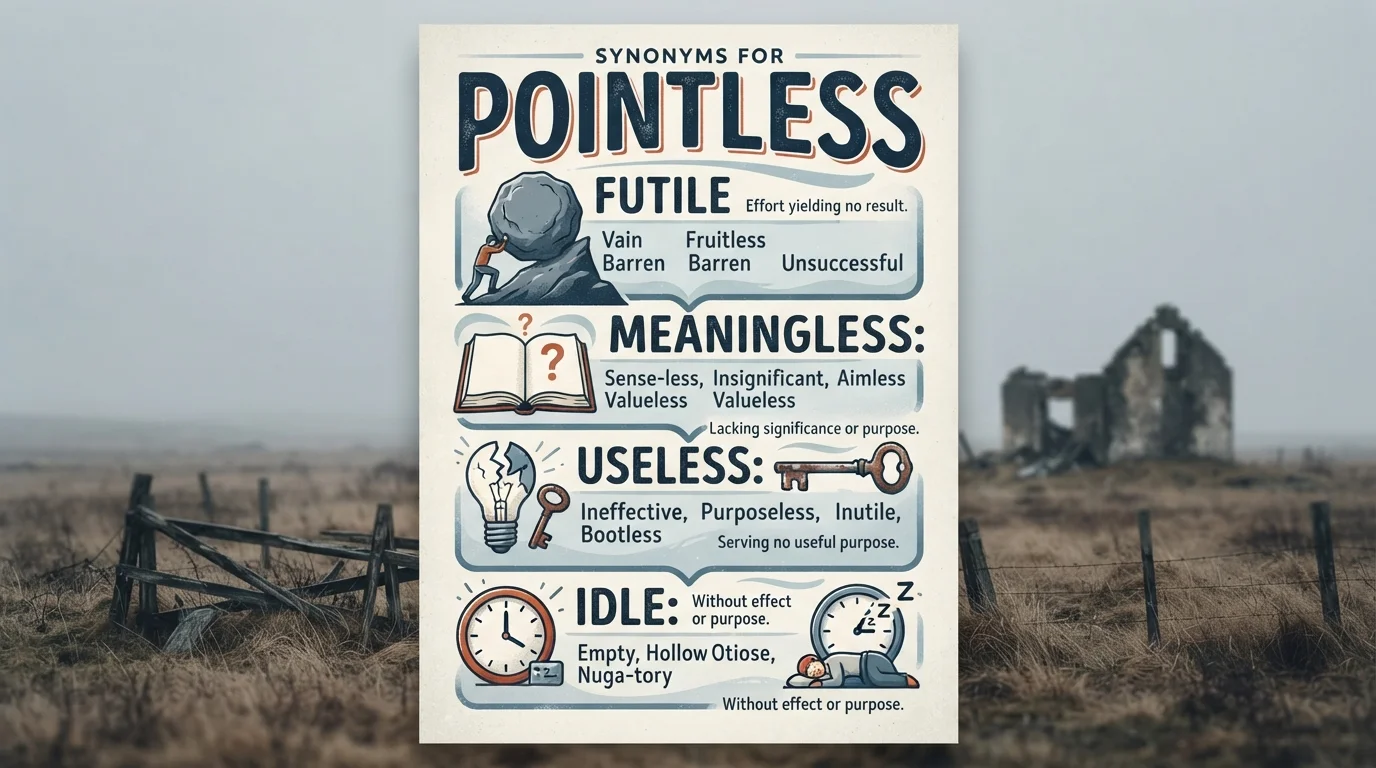
True Synonyms vs. Related Alternatives
Alternative | Relationship | Can replace pointless? | Best context |
|---|---|---|---|
Useless | Close synonym | Often | Practical utility |
Futile | Near synonym | Often for efforts | Unlikely success |
Meaningless | Near synonym | Sometimes | Significance |
Purposeless | Near synonym | Often | Lack of purpose |
Fruitless | Contextual synonym | Often for efforts | Lack of results |
Unproductive | Contextual alternative | Often | Meetings and work |
Ineffective | Related alternative | Sometimes | Failed methods |
Unnecessary | Related alternative | Sometimes | Unneeded tasks |
Senseless | Stronger alternative | Sometimes | Unjustified actions |
Worthless | Stronger alternative | Sometimes | Lack of value |
Redundant | Narrower alternative | Sometimes | Duplication |
Aimless | Related alternative | Sometimes | Lack of direction |
How to Choose the Right Alternative
What makes the activity or situation seem pointless?
Suitable alternative
Futile
Further attempts to repair the device would be futile.
10 Sentence Transformations
Original | Better alternative | Why |
|---|---|---|
The meeting was pointless. | The meeting was unproductive. | Emphasizes the lack of progress. |
It’s pointless to keep arguing. | Further arguments would be futile. | Suggests the discussion cannot achieve its goal. |
The instructions were pointless. | The instructions were useless. | Emphasizes a lack of practical value. |
The additional step is pointless. | The additional step is unnecessary. | Identifies a task that is not required. |
The search was pointless. | The search proved fruitless. | Emphasizes the absence of results. |
His apology felt pointless. | His apology felt meaningless. | Focuses on the lack of significance. |
The repeated questions were pointless. | The repeated questions were redundant. | Identifies unnecessary duplication. |
Their conversation became pointless. | Their conversation became aimless. | Emphasizes the absence of direction. |
The policy was pointless. | The policy was ineffective. | Focuses on its failure to achieve its goal. |
The additional expense was pointless. | The additional expense was wasteful. | Highlights unnecessary resource use. |
Grammar and Usage
Pointless is an adjective. It commonly appears before a noun or after linking verbs such as be, seem, feel, and become.
Natural expressions include pointless argument, pointless exercise, pointless task, pointless question, pointless meeting, pointless discussion, and pointless effort.
The most common sentence patterns are:
It’s pointless to + verb: “It’s pointless to complain if nobody is willing to address the problem.”
There’s no point in + -ing verb: “There’s no point in repeating the same information.”
A pointless + noun: “They spent hours on a pointless exercise.”
Seems or feels pointless: “The extra paperwork feels pointless.”
The noun is pointlessness, and the adverb is pointlessly. The usual comparative and superlative forms are more pointless and most pointless.
Common Mistakes
Treating pointless and unsuccessful as identical. An unsuccessful effort may still provide experience, knowledge, or other benefits.
Using futile for every unnecessary task. Futile emphasizes the inability to achieve a desired outcome, not simply the absence of a need.
Confusing meaningless with useless. Something can have emotional meaning without having a practical function.
Calling every unproductive meeting pointless. A meeting may establish relationships or clarify issues without producing an immediate decision.
Using redundant for anything unnecessary. Redundant usually involves duplication or excess.
Overusing worthless. This word expresses a particularly strong negative judgment.
Assuming aimless activities have no value. Walking without a destination or having an informal conversation can still be enjoyable.
Replacing pointless with a more formal word unnecessarily. A precise, familiar word is often preferable to an obscure alternative.
When “Pointless” Is the Better Word
Pointless is useful when you want to express a broad judgment that something lacks sufficient purpose or value without identifying one particular reason.
For example, “The extra paperwork seems pointless” communicates frustration naturally. Replacing it with futile would suggest that the paperwork cannot achieve its intended goal, which may not be what you mean.
In professional feedback, however, a specific description such as unnecessary, duplicative, or unproductive can make the criticism easier to address.