
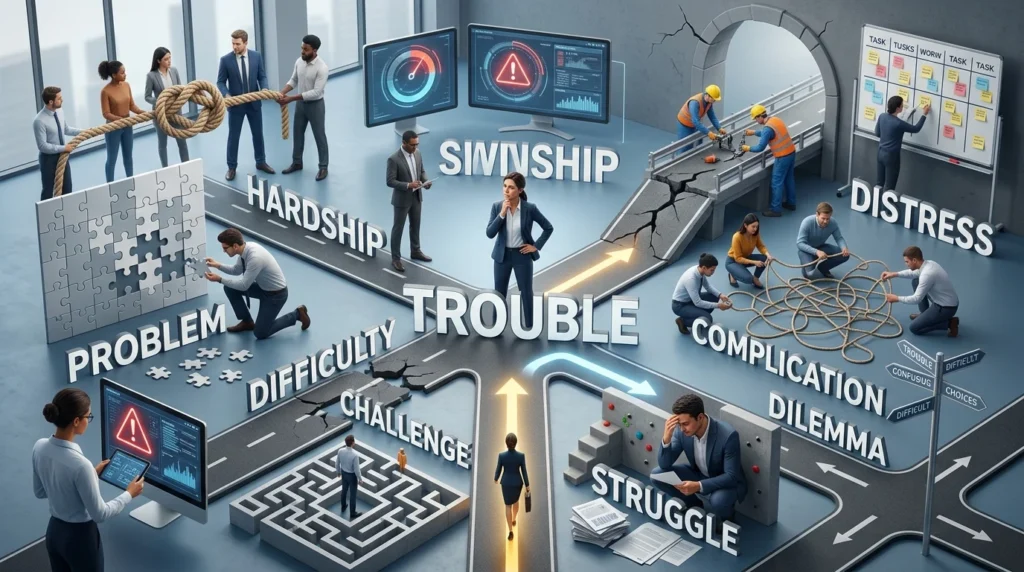
What Does “Trouble” Mean?
The word trouble can be used as a noun, verb, or part of a common expression.
Trouble as a problem
We are having trouble with the new software.
Here, trouble means a problem or difficulty.
Trouble as a difficult situation
The company experienced financial trouble.
Here, it describes a serious or ongoing difficulty.
Trouble as disagreement
The two neighbors are having trouble with each other.
In this context, trouble can refer to conflict or tension.
Trouble as inconvenience
Sorry to trouble you.
Here, trouble means to inconvenience or bother someone.
Trouble as danger
He could get into trouble if he ignores the rules.
Here, trouble refers to negative consequences or a difficult situation.
Trouble as an action
I don’t want to trouble you with this request.
As a verb, trouble can mean to bother, inconvenience, or worry someone.
Because the meaning changes depending on context, the right synonym should reflect the exact sense intended.
1. Problem
Problem is the most common general synonym for trouble.
It describes something that is wrong, difficult, or requires a solution.
We are having trouble with the printer.
can become:
We are having a problem with the printer.
Best used for:
- Everyday situations
- Technical issues
- Business
- Personal matters
- Academic writing
Problem is broader and more neutral than many alternatives.
2. Difficulty
Difficulty refers to something that is hard to do, understand, manage, or overcome.
She had difficulty understanding the instructions.
It is especially useful when the focus is on the effort required rather than something being fundamentally wrong.
Difference
A problem usually needs to be solved.
A difficulty may simply make something harder.
3. Challenge
Challenge describes something demanding that requires effort, skill, or determination.
Learning a new language can be a challenge.
Unlike trouble, challenge can have a positive or neutral tone.
For example:
The project is challenging.
does not necessarily mean:
The project is causing serious trouble.
Best used for:
- Work
- Education
- Personal development
- Leadership
- Business
- Goals
4. Issue
Issue is a common professional and neutral alternative to problem or trouble.
We need to address this issue quickly.
It is widely used in business, technology, customer service, and formal communication.
Example
The system is experiencing technical issues.
This often sounds more professional and less negative than:
The system is having technical trouble.
5. Complication
A complication is an unexpected problem that makes a situation more difficult.
The project encountered several complications.
It is especially useful when a problem develops during an existing process.
Common contexts:
- Healthcare
- Business
- Projects
- Travel
- Legal matters
- Technical work
6. Obstacle
An obstacle is something that blocks or slows progress.
Lack of funding became an obstacle to the project.
Unlike a general problem, an obstacle specifically interferes with achieving a goal.
Best used for:
- Goals
- Progress
- Projects
- Success
- Personal development
7. Setback
A setback is a problem or event that delays progress or reverses some previous success.
The company suffered a financial setback.
It usually suggests that progress has been interrupted rather than completely destroyed.
Examples
- financial setback
- career setback
- unexpected setback
- temporary setback
- major setback
8. Hardship
Hardship refers to difficult conditions that cause suffering, deprivation, or serious strain.
The family experienced financial hardship.
It is stronger and more serious than ordinary trouble.
Best used for:
- Poverty
- Financial problems
- Difficult living conditions
- Long-term adversity
- Social difficulties
9. Adversity
Adversity refers to difficult or unfavorable circumstances.
She remained determined despite adversity.
It is formal and often used when discussing long-term challenges or difficult life circumstances.
Difference
Trouble is broad and everyday.
Adversity usually suggests significant or sustained difficulty.
10. Conflict
Conflict refers to serious disagreement or opposition between people, groups, ideas, or interests.
The organization is experiencing internal conflict.
It is a useful alternative when trouble involves disagreement.
Common contexts:
- Personal relationships
- Workplace
- Politics
- International relations
- Organizations
- Communities
11. Dispute
A dispute is a disagreement or argument, often involving a specific issue.
The two companies are involved in a legal dispute.
It is more specific than trouble.
Best used for:
- Legal disagreements
- Business disagreements
- Property issues
- Contract disagreements
- Formal conflicts
12. Disagreement
Disagreement means that two or more people have different opinions or positions.
They had a disagreement about the project.
It is generally less severe than conflict.
13. Concern
A concern is something that causes worry or deserves attention.
Rising costs are a major concern for the company.
It is often a softer alternative to problem or trouble.
Difference
A concern may become a problem, but it does not necessarily mean something is already seriously wrong.
14. Worry
Worry refers to anxiety or concern about something.
Financial trouble caused a lot of worry.
When trouble refers to emotional concern, worry may be an appropriate alternative.
15. Distress
Distress means severe anxiety, suffering, or emotional difficulty.
The situation caused considerable distress.
It is stronger than worry and often focuses on emotional suffering.
Best used for:
- Emotional suffering
- Financial hardship
- Emergency situations
- Trauma
- Serious difficulties
16. Burden
A burden is a responsibility, difficulty, or problem that creates strain.
The unexpected expense became a financial burden.
It emphasizes the weight or pressure created by a difficult situation.
17. Strain
Strain refers to pressure or stress placed on a person, relationship, system, or resource.
The long hours put a strain on the team.
It is particularly useful when trouble develops because something is being pushed beyond comfortable limits.
18. Stress
Stress describes mental or physical pressure caused by difficult circumstances.
The financial problems caused significant stress.
It focuses on the pressure experienced rather than the problem itself.
19. Crisis
A crisis is a serious situation that requires immediate attention or action.
The company is facing a financial crisis.
This is much stronger than ordinary trouble.
Use carefully
Do not describe every minor problem as a crisis. The word implies seriousness and urgency.
20. Emergency
An emergency is an unexpected situation requiring immediate action.
The flooding created an emergency.
It is appropriate when immediate safety or urgent response is involved.
21. Predicament
A predicament is a difficult or unpleasant situation that is hard to escape.
He found himself in a difficult predicament.
It is more formal than trouble and often emphasizes being stuck between difficult choices.
22. Dilemma
A dilemma is a situation involving two or more difficult choices.
She faced a difficult dilemma.
It should not be used for every problem. A dilemma specifically involves difficult decisions or alternatives.
23. Quandary
A quandary describes a state of uncertainty about what decision to make.
The manager was in a quandary over how to respond.
It is more formal and less common in everyday conversation.
24. Predicament
A predicament emphasizes being caught in an unpleasant or difficult situation.
The travelers found themselves in a serious predicament.
It often describes circumstances that are difficult to escape.
25. Nuisance
A nuisance is something annoying, inconvenient, or troublesome.
The constant noise became a nuisance.
It is much less serious than crisis or hardship.
Best used for:
- Annoyances
- Minor inconveniences
- Noise
- Delays
- Irritating situations
26. Inconvenience
An inconvenience is something that causes minor difficulty or disruption.
We apologize for the inconvenience.
It is a polite and relatively mild alternative to trouble.
27. Hassle
Hassle describes an annoying or complicated situation that requires unnecessary effort.
Getting a refund was a real hassle.
It is informal and common in everyday American English.
Best used for:
- Customer service
- Travel
- Shopping
- Administrative tasks
- Everyday frustrations
28. Annoyance
An annoyance is something that irritates or bothers someone.
The delay was a minor annoyance.
It is usually less serious than trouble.
29. Irritation
Irritation refers to the feeling of being annoyed or something that causes annoyance.
The repeated delays caused irritation among customers.
It focuses more on the emotional response than the underlying problem.
30. Nuisance
A nuisance is a persistent source of annoyance or inconvenience.
The broken elevator has become a nuisance for residents.
It is useful for relatively minor problems that repeatedly bother people.
31. Misfortune
Misfortune refers to bad luck or an unfortunate event.
The accident was an unfortunate piece of misfortune.
It is often used when the situation was not caused intentionally.
Example
He experienced several misfortunes during his journey.
32. Misfortune
When trouble is caused by bad luck, misfortune can be more precise than problem.
Losing his luggage was an unfortunate misfortune.
However, avoid unnecessary repetition because misfortune already expresses an unfortunate event.
33. Predicament
A predicament emphasizes being placed in a difficult situation.
The lost passport left him in a serious predicament.
It is particularly useful when someone has limited options.
34. Difficulty
Difficulty is often the best choice when trouble refers to an obstacle in completing a task.
We had trouble finding the address.
can become:
We had difficulty finding the address.
This sounds natural and precise.
35. Complication
Complication is useful when an existing situation becomes harder because of an additional problem.
The delay created complications for the entire schedule.
It is particularly useful in professional and technical writing.
36. Barrier
A barrier is something that prevents movement, communication, access, or progress.
Language can be a barrier to communication.
It is similar to obstacle but often emphasizes prevention or separation.
37. Blockage
A blockage is something that physically or figuratively prevents movement or progress.
A blockage in the pipe caused the problem.
It is common in mechanical, medical, and technical contexts.
38. Impediment
An impediment is something that makes progress difficult or prevents success.
Lack of experience was an impediment to his career development.
It is formal and often appears in academic or professional writing.
39. Hurdle
A hurdle is a difficulty that must be overcome to reach a goal.
Finding qualified employees was the biggest hurdle.
It often has a more positive or manageable tone than problem.
40. Difficulty
Difficulty is one of the most flexible alternatives to trouble when describing challenges in completing something.
The students had trouble completing the assignment.
can become:
The students had difficulty completing the assignment.
This is especially natural when trouble is followed by a gerund.
41. Predicament
Predicament is appropriate when a person is caught in an uncomfortable or difficult situation.
She was in a difficult predicament.
It is stronger and more descriptive than simply saying:
She was in trouble.
42. Plight
A plight is a difficult, unfortunate, or distressing situation.
The organization highlighted the plight of displaced families.
It is especially common in humanitarian, social, and journalistic writing.

43. Suffering
Suffering refers to physical, emotional, or psychological pain.
The organization works to reduce human suffering.
It is stronger than ordinary trouble and should be used when genuine pain or distress is involved.
44. Trouble With Someone
When trouble refers to disagreement with another person, alternatives include:
- conflict
- disagreement
- dispute
- tension
- friction
- hostility
- disagreement
- misunderstanding
Example
She is having trouble with her manager.
could mean:
She is experiencing conflict with her manager.
or:
She has a disagreement with her manager.
The exact replacement depends on what is actually happening.
45. Tension
Tension describes a strained or uncomfortable relationship or atmosphere.
There is growing tension between the two teams.
It is useful when trouble exists but has not necessarily become an open conflict.
46. Friction
Friction refers to disagreement or tension between people or groups.
There has been friction between the two departments.
It is particularly useful for ongoing interpersonal or organizational difficulties.
47. Misunderstanding
A misunderstanding occurs when people interpret something incorrectly.
The disagreement was caused by a misunderstanding.
It is useful when trouble results from communication problems.
48. Trouble as a Verb: Bother
When trouble is used as a verb, bother is often the closest everyday alternative.
Sorry to trouble you.
can become:
Sorry to bother you.
Both mean that you apologize for inconveniencing someone.
49. Trouble as a Verb: Inconvenience
Inconvenience means to cause someone difficulty or disruption.
I don’t want to trouble you.
can become:
I don’t want to inconvenience you.
This sounds slightly more formal.
50. Trouble as a Verb: Disturb
Disturb means to interrupt, bother, or interfere with someone’s peace or activity.
I didn’t want to trouble him.
could become:
I didn’t want to disturb him.
It is especially appropriate when someone is busy, resting, or occupied.
Synonyms for “Trouble” in Everyday English
For casual conversations, useful alternatives include:
- problem
- difficulty
- hassle
- issue
- bother
- nuisance
- inconvenience
- worry
- challenge
- setback
Example
I had trouble finding parking.
Possible alternatives:
I had difficulty finding parking.
I had a hard time finding parking.
Finding parking was a hassle.
The best choice depends on how serious or informal you want the sentence to sound.
Synonyms for “Trouble” in Professional Writing
Professional alternatives include:
- issue
- difficulty
- complication
- concern
- obstacle
- challenge
- setback
- impediment
- conflict
- disruption
For example:
We are experiencing trouble with the system.
could become:
We are experiencing a technical issue with the system.
This sounds more precise and professional.
Synonyms for “Trouble” in Academic Writing
Academic writing often benefits from more precise terms such as:
- difficulty
- challenge
- obstacle
- limitation
- complication
- concern
- issue
- impediment
- adversity
- constraint
Example
Instead of:
Students have trouble accessing educational resources.
you could write:
Students face difficulties accessing educational resources.
Or:
Limited internet access creates a significant barrier to educational resources.
The second version provides more specific information.
Synonyms for “Trouble” in Relationships
When trouble occurs between people, useful alternatives include:
- conflict
- disagreement
- dispute
- tension
- friction
- misunderstanding
- strain
- hostility
- discord
Example
They are having trouble in their relationship.
could become:
Their relationship is experiencing strain.
or:
There is tension between them.
These alternatives help explain what type of trouble exists.
Synonyms for “Trouble” in Business
Useful business alternatives include:
- issue
- challenge
- complication
- setback
- concern
- obstacle
- disruption
- crisis
- difficulty
- conflict
Example
The company is in financial trouble.
Possible alternatives include:
The company is experiencing financial difficulties.
The company is facing financial challenges.
The company is dealing with a financial crisis.
Each sentence communicates a different level of seriousness.
Synonyms for “Trouble” When Something Is Difficult
If trouble means difficulty completing an action, use:
- difficulty
- challenge
- struggle
- obstacle
- problem
- hardship
- complication
Example
I had trouble understanding the instructions.
could become:
I had difficulty understanding the instructions.
or:
I struggled to understand the instructions.
The second option emphasizes the person’s effort.
Trouble vs. Problem
Problem is probably the closest general synonym for trouble.
We have a problem.
We are having trouble.
Both can describe something that needs attention.
However, trouble can sometimes sound less direct or more conversational.
Problem is usually clearer when identifying something specific that needs to be solved.
Trouble vs. Difficulty
Difficulty emphasizes that something is hard to do.
She had difficulty walking.
Trouble can have a broader meaning:
She was having trouble with her leg.
The first focuses on difficulty performing an action. The second may suggest a physical or medical problem.
Trouble vs. Challenge
Challenge is often more positive or neutral.
Starting a business is a challenge.
This does not necessarily mean something is going wrong.
By contrast:
Starting the business has caused a lot of trouble.
suggests actual problems or complications.
Trouble vs. Issue
Issue is often a more professional or neutral alternative.
We have an issue with the software.
This can sound less negative than:
We have a problem with the software.
In business communication, issue is often preferred because it sounds measured and solution-focused.
Trouble vs. Obstacle
An obstacle specifically prevents or slows progress.
Lack of funding is an obstacle to growth.
A problem may exist without preventing progress.
Therefore, obstacle is more specific than trouble.
Trouble vs. Crisis
A crisis is a serious problem requiring urgent attention.
The company has financial trouble.
is much less severe than:
The company is facing a financial crisis.
Do not use crisis simply to make ordinary difficulties sound more dramatic.
Common Mistakes When Using Synonyms for “Trouble”
Using “crisis” for minor problems
A delayed email may be a problem, but it is rarely a crisis.
Use issue, inconvenience, difficulty, or minor problem when the situation is not severe.
Using “challenge” when something is actually harmful
Challenge can make a serious problem sound more neutral.
If a situation involves significant damage, danger, or suffering, words such as crisis, hardship, distress, or problem may be more accurate.
Using “hardship” for temporary inconvenience
Hardship generally implies serious or sustained difficulty.
A slow website is an inconvenience, not usually a hardship.
Using “conflict” for every disagreement
A disagreement may be minor.
Conflict often suggests more serious or sustained opposition.
Using “obstacle” without a goal
An obstacle usually stands in the way of something.
Lack of funding is an obstacle to expansion.
If there is no specific goal being blocked, problem or difficulty may be more natural.

Best Synonyms for “Trouble” by Context
| Context | Best Alternatives |
|---|---|
| General problem | problem, issue, difficulty |
| Difficult task | difficulty, challenge, struggle |
| Professional setting | issue, concern, complication |
| Business problems | challenge, setback, issue, obstacle |
| Financial trouble | hardship, difficulty, crisis, strain |
| Relationship trouble | conflict, tension, disagreement, friction |
| Minor annoyance | nuisance, hassle, inconvenience |
| Serious suffering | distress, hardship, adversity, plight |
| Emergency | crisis, emergency |
| Blocked progress | obstacle, barrier, impediment, hurdle |
| Difficult decision | dilemma, quandary, predicament |
| Emotional concern | worry, concern, distress |
| Causing inconvenience | bother, inconvenience, disturb |