
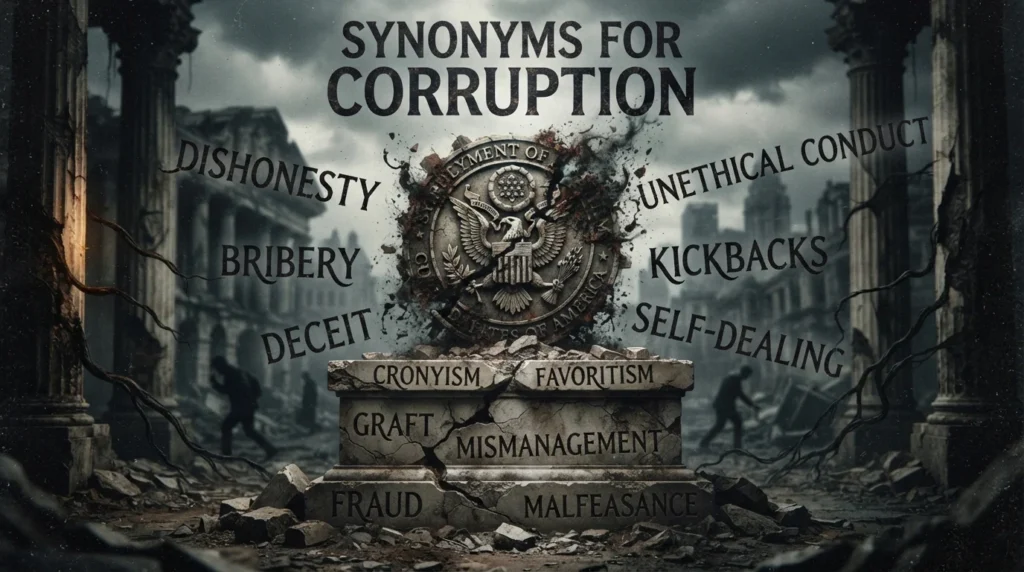
Quick Synonym List
The word corruption has several distinct meanings. The following alternatives are grouped by meaning rather than treated as interchangeable synonyms.
Meaning | |
|---|---|
General dishonesty | Dishonesty, wrongdoing, misconduct, unethical behavior, malpractice |
Bribery and improper influence | Bribery, graft, kickbacks, payoffs, influence peddling |
Abuse of authority | Abuse of power, abuse of office, favoritism, nepotism, cronyism |
Financial wrongdoing | Fraud, embezzlement, misappropriation, financial misconduct |
Moral corruption | Moral decay, depravity, moral degradation, immorality |
Institutional corruption | Systemic misconduct, institutional wrongdoing, entrenched malpractice |
Physical deterioration | Decay, deterioration, decomposition, degradation, spoilage |
Contamination | Contamination, pollution, adulteration, tainting |
Data corruption | Data damage, file corruption, data integrity failure, corrupted data |
Important distinction
Corruption is a broad word. Bribery, embezzlement, favoritism, and abuse of power describe different forms of improper conduct. Similarly, data corruption and moral corruption have entirely different meanings. Choose a synonym that matches the specific behavior, process, or condition.
What Does “Corruption” Mean?
Corruption is a noun with several meanings, including dishonest conduct involving entrusted authority, the deterioration of moral standards, the contamination or degradation of something, and the alteration or damage of digital information.
Its meaning depends on the context.
Public or institutional corruption: “The investigation examined allegations of corruption in the procurement process.”
Financial corruption: “The audit identified suspicious payments and possible embezzlement.”
Moral corruption: “The novel explores the moral corruption of its central character.”
Physical corruption: “Improper storage caused the deterioration of the material.”
Data corruption: “A storage failure caused corruption in several database files.”
A precise synonym can make a sentence more informative by identifying the particular problem rather than relying on a broad label.
The Best Synonyms for Corruption
1. Dishonesty
Meaning: A lack of truthfulness or integrity.
Tone: Neutral to critical.
Best for: General descriptions of unethical conduct, workplace behavior, and personal actions.
Example: The investigation uncovered widespread dishonesty in the reporting process.
How it differs: Dishonesty is broader than corruption. Someone can be dishonest without misusing entrusted authority.
2. Bribery
Meaning: Offering, giving, requesting, or receiving an improper benefit to influence someone’s actions.
Tone: Formal or legal.
Best for: Procurement, public administration, business transactions, and investigations.
Example: Investigators examined allegations of bribery involving several procurement contracts.
Watch out: Bribery is a specific form of corruption. Not every corrupt act involves a bribe.
3. Fraud
Meaning: Deception intended to obtain an improper benefit or cause another party to act on false information.
Tone: Formal or legal.
Best for: Finance, business, insurance, accounting, and legal matters.
Example: The company introduced additional controls to reduce the risk of procurement fraud.
How it differs: Fraud centers on deception, while corruption often involves the misuse of authority or entrusted responsibility.
4. Misconduct
Meaning: Improper, unacceptable, or rule-breaking behavior.
Tone: Professional or formal.
Best for: Workplace investigations, disciplinary procedures, professional standards, and organizational reports.
Example: The review identified several instances of employee misconduct.
Watch out: Misconduct does not necessarily involve corruption. It may include behavior unrelated to financial gain or abuse of authority.
5. Graft
Meaning: Dishonest acquisition of money or benefits through the misuse of a position of power.
Tone: Journalistic or informal, particularly in American English.
Best for: Discussions of public corruption, dishonest financial benefits, and historical accounts.
Example: The investigation focused on allegations of graft connected to public contracts.
How it differs: Graft is particularly associated with dishonest personal gain through an official or influential position.
6. Abuse of Power
Meaning: Improper use of authority to obtain benefits, influence decisions, or harm others.
Tone: Formal or professional.
Best for: Government, organizations, management, and institutional accountability.
Example: The inquiry examined whether officials had abused their authority during the selection process.
Watch out: Abuse of power is broader than financial corruption and does not always involve money.
7. Embezzlement
Meaning: Dishonestly taking money or property that has been entrusted to someone’s care.
Tone: Legal or financial.
Best for: Accounting, organizational finance, audits, and criminal investigations.
Example: The accountant was accused of embezzling company funds.
How it differs: Embezzlement involves the misuse of entrusted property. It is not a general synonym for all corruption.
8. Extortion
Meaning: Obtaining money, property, or another benefit through threats, coercion, or intimidation.
Tone: Formal or legal.
Best for: Legal reporting, criminal investigations, and descriptions of coercive demands.
Example: The investigation examined allegations that payments had been obtained through extortion.
Watch out: Extortion involves coercion. It differs from bribery, although particular situations may involve overlapping offenses.
9. Wrongdoing
Meaning: Behavior that is morally, professionally, or legally improper.
Tone: Neutral or formal.
Best for: Investigations, reporting, organizational statements, and situations where specific facts remain uncertain.
Example: The organization established an independent process for reporting suspected wrongdoing.
How it differs: Wrongdoing is a broad term that does not assume a particular type of offense.
10. Malpractice
Meaning: Improper, negligent, or unethical conduct in a professional role.
Tone: Formal.
Best for: Professional services, organizational standards, and certain legal contexts.
Example: The professional association investigated allegations of malpractice.
Watch out: Malpractice can involve negligence rather than deliberate dishonesty. It should not automatically replace corruption.
11. Favoritism
Meaning: Giving unfair preference to particular people or groups.
Tone: Neutral to critical.
Best for: Hiring, promotions, contracts, education, and organizational decision-making.
Example: Employees complained about favoritism in the promotion process.
How it differs: Favoritism describes preferential treatment. Whether it constitutes corruption depends on the circumstances and applicable rules.
12. Nepotism
Meaning: Favoring relatives, especially in employment, appointments, or the distribution of opportunities.
Tone: Formal or critical.
Best for: Recruitment, appointments, family-controlled organizations, and institutional governance.
Example: The organization introduced conflict-of-interest rules to address concerns about nepotism.
Watch out: Nepotism specifically concerns relatives. Favoring friends or associates is more accurately described as cronyism.
13. Cronyism
Meaning: Giving preferential treatment to friends or close associates, particularly in appointments or the distribution of benefits.
Tone: Critical.
Best for: Organizational governance, appointments, and discussions of preferential treatment.
Example: The report raised concerns about cronyism in senior appointments.
How it differs: Cronyism emphasizes personal relationships rather than family relationships.
14. Moral Decay
Meaning: A gradual decline in moral standards or ethical behavior.
Tone: Literary, philosophical, or critical.
Best for: Literature, cultural analysis, ethical discussions, and descriptions of fictional characters.
Example: The novel portrays the moral decay of a once-principled businessman.
Watch out: Moral decay is an evaluative expression. In factual reporting, identify the specific conduct rather than relying on a broad moral judgment.
15. Deterioration
Meaning: A decline in quality, condition, or effectiveness.
Tone: Neutral or technical.
Best for: Physical materials, organizational conditions, infrastructure, and gradual decline.
Example: Prolonged exposure to moisture accelerated the deterioration of the wooden structure.
How it differs: Deterioration is suitable for physical or general decline but does not normally imply dishonest behavior.
Corruption Synonyms by Context
1. Political and Public-Sector Corruption
In public administration, corruption commonly refers to the misuse of entrusted authority for improper personal or private benefit. More specific terms identify the conduct involved.
Alternative | Specific meaning | Example |
|---|---|---|
Bribery | Improper benefits intended to influence decisions | The inquiry examined allegations of bribery. |
Graft | Dishonest personal gain through an influential position | Investigators uncovered evidence of graft. |
Abuse of office | Improper use of official authority | The complaint alleged abuse of office. |
Influence peddling | Improperly trading on actual or claimed influence | The investigation concerned suspected influence peddling. |
Kickbacks | Improper payments made in return for favorable treatment | Auditors discovered suspicious payments resembling kickbacks. |
Embezzlement | Misappropriation of entrusted property | The official faced allegations of embezzlement. |
These expressions are not interchangeable. Bribery involves improper inducements, while embezzlement concerns entrusted money or property. An investigation may examine several types of conduct, but a particular label should match the available evidence.
2. Corporate and Workplace Corruption
In business, corruption may involve improper payments, conflicts of interest, dishonest accounting, or the misuse of organizational resources.
Useful alternatives include financial misconduct, procurement fraud, embezzlement, unethical practices, conflict-of-interest violations, and corporate wrongdoing.
For example:
Original: “The company investigated corruption in its purchasing department.”
More precise: “The company investigated allegations of procurement fraud and improper payments.”
The second version identifies the alleged conduct. When facts have not been established, words such as alleged, suspected, or possible help distinguish accusations from confirmed findings.
3. Moral Corruption
Moral corruption refers to the deterioration of a person’s character, values, or ethical behavior. It is particularly common in literature, philosophy, and character analysis.
Words for moral corruption
Moral decay
A gradual deterioration in ethical standards or behavior.
Depravity
Severe moral wrongdoing or a deeply immoral condition. This is much stronger than corruption.
Moral degradation
A decline in ethical character or standards.
Degeneracy
A strongly judgmental term for perceived moral decline. It is often stigmatizing and usually unsuitable for neutral factual writing.
For creative writing, the intensity of the word matters. A character who gradually abandons their principles may experience moral decay. Describing the same character as depraved makes a much stronger judgment.
4. Corruption of Information and Data
In computing, data corruption occurs when information is altered, damaged, or rendered unusable in an unintended way.
Related terms include data damage, file corruption, data integrity failure, data loss, and data alteration.
These describe different technical problems. Data loss means information is missing or unavailable; data corruption means stored or transmitted information has been altered in a way that compromises its integrity.
For example, “The database suffered data corruption” could be rewritten as “A storage error damaged several database records,” provided that description accurately identifies the problem.
5. Physical Corruption and Contamination
In older or specialized usage, corruption can describe physical decay, decomposition, or contamination.

Decay and deterioration
Use for the gradual breakdown or worsening of physical materials.
Use for food becoming unsuitable for consumption or organic matter breaking down.

Contamination and pollution
Use when unwanted substances make something impure or potentially harmful.
Adulteration is particularly useful when a substance or product has been made impure through the addition of another substance.
Corruption vs. Bribery vs. Fraud vs. Misconduct
These four words are often used together, but they describe different things.
Word | Main meaning | Scope | Best use |
|---|---|---|---|
Corruption | Improper conduct involving entrusted authority or responsibility | Broad | Institutional wrongdoing |
Bribery | Improper benefits intended to influence actions | Specific | Improper payments or favors |
Fraud | Deception for improper benefit | Specific | Dishonest representations |
Misconduct | Behavior violating rules or professional standards | Broad | Workplace and professional investigations |
Embezzlement | Dishonest appropriation of entrusted property | Specific | Financial investigations |
Extortion | Obtaining benefits through coercion | Specific | Threats and coercive demands |
Favoritism | Unfair preferential treatment | Context-dependent | Hiring and allocation decisions |
The main question is whether the writer wants to describe an overall problem or identify a particular action.
For a general discussion of organizational integrity, corruption may be appropriate. For a detailed account of falsified invoices, fraud may be more informative.
True Synonyms vs. Related Alternatives
Not every word associated with corruption is a synonym. Some describe specific forms of misconduct, while others apply to entirely different meanings of the original word.
Alternative | Relationship | Can replace corruption? | Tone |
|---|---|---|---|
Dishonesty | Broad near synonym | Sometimes | Neutral |
Wrongdoing | Broad alternative | Sometimes | Neutral |
Graft | Contextual synonym | Often for dishonest financial gain through office | Journalistic |
Bribery | Specific form | Only when bribes are involved | Legal |
Fraud | Related offense | Only when deception is involved | Legal |
Misconduct | Broader term | Sometimes | Professional |
Embezzlement | Specific form | Only for entrusted property | Legal |
Abuse of power | Related conduct | Sometimes | Formal |
Moral decay | Contextual synonym | For moral deterioration | Literary |
Depravity | Stronger alternative | Rarely directly | Strongly critical |
Deterioration | Contextual synonym | For physical or general decline | Neutral |
Contamination | Contextual synonym | For impurities | Technical |
Data damage | Contextual alternative | For damaged digital information | Technical |
How to Choose the Right Alternative
Which meaning do you want to express?
Suggested term
Bribery
The investigation examined allegations of bribery.10 Sentence Transformations
These examples show how replacing corruption with a more specific term can improve clarity. Each rewrite assumes the stated conduct has been established or is appropriately described as an allegation.
Original | More precise alternative | Why |
|---|---|---|
The investigation revealed corruption. | The investigation revealed evidence of bribery. | Identifies improper payments. |
The accountant was involved in corruption. | The accountant was accused of embezzlement. | Specifies misuse of entrusted funds. |
The company discovered corruption in its accounts. | The company discovered financial fraud. | Identifies deceptive financial activity. |
Employees reported corruption in hiring. | Employees reported favoritism in hiring. | Identifies preferential treatment. |
The organization investigated corruption. | The organization investigated suspected misconduct. | Avoids assuming a particular offense. |
The official faced corruption allegations. | The official faced allegations of abuse of office. | Identifies the alleged misuse of authority. |
The novel explores corruption. | The novel explores moral decay. | Identifies the literary theme. |
The material showed signs of corruption. | The material showed signs of deterioration. | Uses natural terminology for physical decline. |
The water suffered corruption. | The water became contaminated. | Identifies the introduction of impurities. |
The system experienced corruption. | The system experienced data corruption. | Makes the technical meaning explicit. |
Grammar and Natural Usage
Corruption is generally an uncountable noun when referring to dishonest conduct or moral deterioration.
Natural expressions include widespread corruption, systemic corruption, allegations of corruption, corruption investigation, corruption scandal, anti-corruption measures, and corruption prevention.
The related adjective is corrupt, and the related verb is corrupt.
For example:
“The investigation uncovered corrupt practices.”
“The organization introduced measures to prevent corruption.”
“A software error corrupted the file.”
Avoid confusing corrupt with corrupted. Both forms are possible in some contexts, but corrupt officials is the usual expression for people engaging in corruption, while corrupted files is standard in computing.
Common Mistakes
1. Treating bribery and corruption as identical
Bribery is one form of corruption, but corruption can involve other conduct, including embezzlement and abuse of entrusted authority.
2. Calling every unethical action corruption
Unethical behavior does not always involve the misuse of entrusted authority. Misconduct or wrongdoing may be more accurate.
3. Confusing fraud with embezzlement
Fraud centers on deception. Embezzlement involves dishonestly taking property entrusted to someone’s care. Particular conduct may involve both.
4. Using nepotism for favoritism toward friends
Nepotism concerns relatives. Cronyism refers to preferential treatment of friends or close associates.
5. Using extortion when no coercion occurred
Extortion involves threats or coercion. An improper payment is not automatically extortion.
6. Presenting allegations as established facts
When reporting disputed or unproven conduct, distinguish allegations, evidence, investigations, and confirmed findings.
7. Using moral decay in neutral investigative writing
Moral decay is a broad evaluative expression. Specific descriptions of documented conduct are usually more informative.
8. Confusing data corruption with data loss
Data corruption involves damaged or improperly altered information. Data loss means information is missing or inaccessible. The two can occur together but are not identical.
When “Corruption” Is the Better Word
Sometimes corruption is more useful than a narrow alternative.
For example, an organization may investigate several types of suspected misconduct involving improper payments, conflicts of interest, and abuse of entrusted authority. In that situation, corruption can serve as an appropriate umbrella term.
It is also the established expression in phrases such as anti-corruption policy, corruption prevention, and data corruption. Replacing it merely to avoid repetition may make the writing less accurate.