
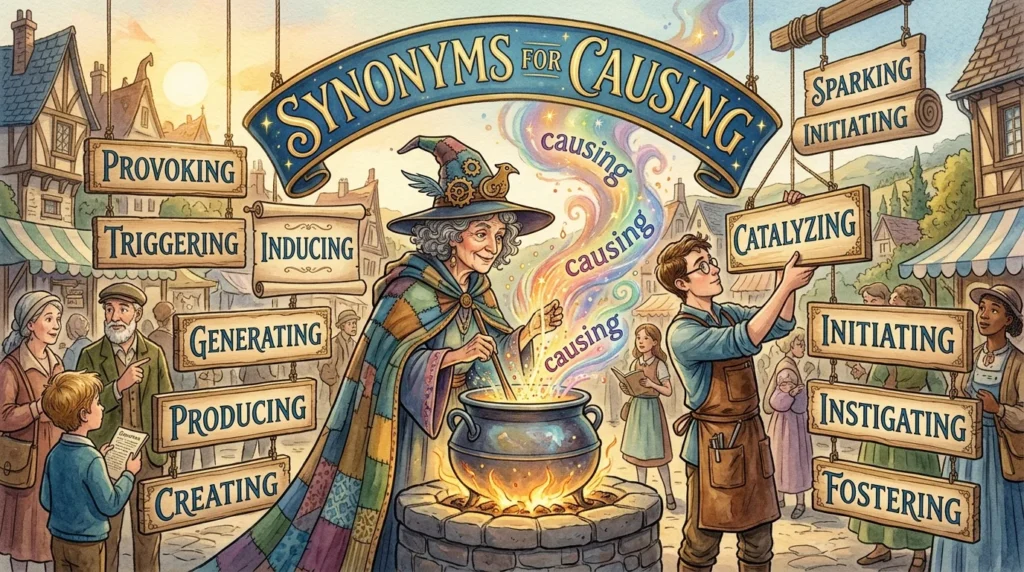
Quick synonym list
- creating — making something happen or exist
- producing — causing a result, effect, or output
- generating — creating or producing something
- bringing about — causing a particular result
- leading to — resulting in a later consequence
- resulting in — producing a particular outcome
- triggering — causing something to begin suddenly
- prompting — causing someone to act or respond
- provoking — causing a reaction, often strong or negative
- inducing — causing a condition, state, or response
- sparking — causing something to begin or develop
- driving — strongly influencing or pushing an outcome
- giving rise to — causing something to develop
- producing — bringing about an effect or outcome
- contributing to — helping cause something without being the only cause
- bringing on — causing an unpleasant condition or event
- occasioning — causing or resulting in something; formal
- effecting — bringing something about deliberately; formal
- influencing — affecting an outcome without necessarily directly causing it
- fostering — encouraging something to develop
- facilitating — making an outcome easier or more likely
- engendering — causing a feeling, situation, or condition to develop
- eliciting — causing a response or reaction
- evoking — bringing a feeling, memory, or response to mind
- stimulating — encouraging activity, growth, or a response
- cultivating — deliberately encouraging development
- inciting — encouraging a strong or often harmful action
- provoking — deliberately or unintentionally producing a reaction
- setting off — causing something to start suddenly
- setting in motion — initiating a process or series of events
- making — causing something to happen or become a certain way
What Does “Causing” Mean?
Causing is the present participle of cause, meaning to make something happen, produce an effect, or bring about a particular result.
For example:
The storm is causing serious damage.
Here, causing means producing or bringing about damage.
The word can describe both intentional and unintentional effects:
The new policy is causing confusion.
The manager is causing the team to work more efficiently.
It can also describe physical, emotional, social, scientific, or abstract effects:
- causing damage
- causing pain
- causing confusion
- causing problems
- causing change
- causing a reaction
- causing an increase
- causing an illness
- causing people to reconsider their decision
Because causing is so broad, the most precise replacement depends on the type of relationship between the action and the result.
The Closest Synonyms for Causing
Creating
Creating means making something exist or bringing a situation into existence.
The policy is causing new opportunities.
can become:
The policy is creating new opportunities.
Creating works especially well when the result is something newly formed.
Best for: opportunities, problems, conditions, situations, environments, possibilities.
Producing
Producing means bringing about a result, effect, product, or outcome.
The treatment is causing positive results.
The treatment is producing positive results.
This is particularly useful in scientific, technical, and analytical writing.
Best for: results, effects, outcomes, changes, reactions, outputs.
Generating
Generating emphasizes producing something, especially something measurable, useful, or substantial.
The campaign is causing more interest.
The campaign is generating more interest.
It is common in business, technology, economics, and professional writing.
Best for: revenue, interest, demand, energy, data, discussion, traffic, opportunities.
Bringing About
Bringing about means causing a particular change or result.
The reforms are causing major changes.
The reforms are bringing about major changes.
It is a close substitute for causing, but sounds slightly more deliberate and formal.
Best for: change, reform, improvement, transformation, social developments.
Leading To
Leading to emphasizes the relationship between an action or event and a later result.
Poor communication is causing delays.
Poor communication is leading to delays.
This version is especially useful when you want to describe a chain of events rather than direct causation.
Best for: consequences, developments, outcomes, problems, changes.
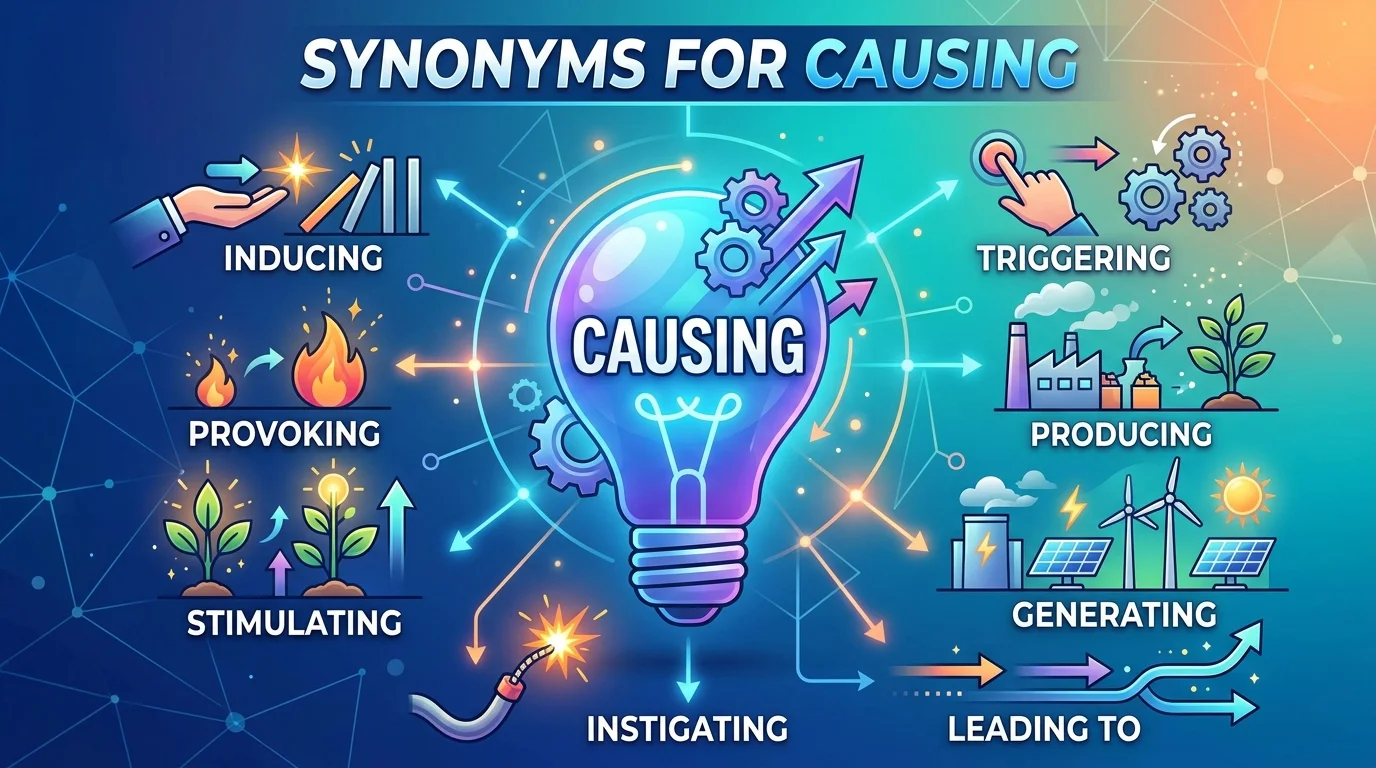
Resulting In
Resulting in focuses on the outcome rather than the cause.
The accident caused several injuries.
The accident resulted in several injuries.
There is an important grammatical difference: resulting in normally describes what follows from something, rather than what an agent actively causes.
Synonyms for Causing a Reaction
Sometimes causing means making someone or something respond.
Prompting
Prompting means causing someone to take an action or causing a response.
The announcement caused customers to ask questions.
The announcement prompted customers to ask questions.
This is one of the best alternatives when a cause produces a human decision or response.
Best for: action, questions, discussion, investigation, reconsideration, responses.
Provoking
Provoking means causing a reaction, particularly a strong, emotional, angry, or negative one.
His comment caused an angry response.
His comment provoked an angry response.
It can suggest that the reaction was deliberately or naturally stimulated.
Best for: anger, criticism, debate, laughter, outrage, reactions.
Eliciting
Eliciting means drawing out or producing a response.
The question caused an emotional response.
The question elicited an emotional response.
This is more formal than causing and is especially common in academic, psychological, medical, and research contexts.
Best for: responses, reactions, information, emotions, feedback.
Evoking
Evoking means bringing a feeling, memory, image, or response into someone’s mind.
The music caused memories of childhood.
The music evoked memories of childhood.
Do not use evoke for every type of cause. It is particularly associated with mental or emotional associations.
Best for: memories, emotions, images, feelings, associations.
Sparking
Sparking suggests causing something to begin, especially an energetic reaction or process.
The article caused a debate.
The article sparked a debate.
It is vivid and relatively informal.
Best for: debate, interest, conversation, protests, creativity, movements.
Synonyms for Causing Something to Begin
Triggering
Triggering means causing something to start, often suddenly.
The announcement caused a market reaction.
The announcement triggered a market reaction.
It is common in journalism, medicine, psychology, science, technology, and everyday English.
Best for: reactions, events, crises, symptoms, changes, alarms, processes.
Tone: neutral to technical.
Setting Off
Setting off is a natural, conversational alternative to triggering.
The noise caused the alarm.
The noise set off the alarm.
It often suggests that one event directly activates another.
Best for: alarms, explosions, reactions, chains of events.
Setting in Motion
Setting in motion means starting a process that continues to develop.
The decision caused a series of changes.
The decision set a series of changes in motion.
This is useful when the result unfolds over time rather than happening immediately.
Best for: processes, reforms, developments, events, negotiations.
Initiating
Initiating means beginning something deliberately.
The manager’s decision caused the investigation.
The manager’s decision initiated the investigation.
Unlike causing, initiating strongly suggests that the subject started the process.
Best for: procedures, investigations, projects, discussions, processes.
Synonyms for Causing a Condition or Effect
Inducing
Inducing means causing a particular state, condition, response, or effect.
The medication is causing sleep.
The medication is inducing sleep.
It is particularly common in medical, scientific, and technical writing.
Best for: sleep, anesthesia, symptoms, reactions, conditions, states.
Bringing On
Bringing on means causing an unpleasant condition or experience.
Stress is causing headaches.
Stress is bringing on headaches.
This expression is more conversational than inducing.
Best for: headaches, illness, fatigue, stress, symptoms, trouble.
Engendering
Engendering means causing a feeling, attitude, condition, or situation to develop.
The decision is causing distrust.
The decision is engendering distrust.
It is formal and works best in polished analytical or academic prose.
Best for: trust, distrust, support, hostility, concern, attitudes.
Fostering
Fostering means encouraging something to develop.
The program is causing collaboration.
The program is fostering collaboration.
This is not a perfect synonym for causing. It usually implies a positive or constructive contribution rather than direct causation.
Best for: cooperation, growth, creativity, learning, relationships.
Facilitating
Facilitating means making something easier or more likely to happen.
The software is causing faster communication.
The software is facilitating faster communication.
Again, this is weaker and more indirect than causing.
Best for: communication, access, cooperation, progress, change, development.
Synonyms for Causing Change
When causing refers to change, several alternatives can sound more precise.
Driving
Driving means strongly influencing or pushing a development.
Technology is causing changes in the workplace.
Technology is driving changes in the workplace.
Driving is especially common in business, economics, journalism, and strategy writing.
Best for: growth, change, innovation, demand, development, transformation.
It often suggests a major force rather than a minor contributing factor.
Influencing
Influencing means affecting an outcome without necessarily being its sole or direct cause.
Several factors are causing consumer behavior to change.
Several factors are influencing consumer behavior.
This is safer than causing when the evidence shows an association or contribution rather than direct causation.
Shaping
Shaping means gradually influencing the development or character of something.
Technology is causing modern communication habits.
Technology is shaping modern communication habits.
It is particularly useful for long-term social, cultural, and behavioral effects.
Contributing To
Contributing to means helping cause something without necessarily being the only cause.
Poor planning is causing the problem.
If several factors are involved:
Poor planning is contributing to the problem.
This distinction matters greatly in academic and professional writing.
If you cannot prove that X directly caused Y, contributing to may be more accurate.
Formal and Academic Alternatives to “Causing”
For formal writing, choose the word that describes the exact causal relationship.
| Alternative | Meaning | Typical context |
|---|---|---|
| bringing about | causing a result | formal/general |
| resulting in | producing an outcome | academic/analytical |
| giving rise to | causing something to develop | formal/academic |
| engendering | causing a state or feeling | formal |
| occasioning | causing or producing | very formal |
| inducing | producing a condition or response | scientific/medical |
| eliciting | drawing out a response | research/psychology |
| generating | producing something | business/technical |
| facilitating | making something easier | professional/academic |
| contributing to | helping produce an outcome | analytical |
| driving | strongly influencing development | business/economics |
| precipitating | causing something to happen suddenly | formal/medical |
Giving Rise To
The policy caused several concerns.
The policy gave rise to several concerns.
This is a strong formal alternative, particularly when discussing consequences or developments.
Occasioning
Occasioning means causing or giving rise to something.
The error caused considerable inconvenience.
The error occasioned considerable inconvenience.
It is grammatically correct but uncommon in everyday English. Use it when a deliberately formal style is appropriate.
Precipitating
Precipitating means causing an event or condition to happen, often suddenly or sooner than it otherwise would.
The dispute caused the crisis.
The dispute precipitated the crisis.
This is particularly useful in medical, historical, political, and analytical writing.
Casual Alternatives to “Causing”
In everyday conversation, simpler expressions are usually better.
Making
Making is one of the most natural alternatives.
The noise is causing me to lose concentration.
The noise is making me lose concentration.
The construction is usually:
make + object + base verb
The joke made everyone laugh.
Not:
The joke made everyone to laugh.
Bringing On
You’re causing trouble.
You’re bringing on trouble.
It is informal and often has a negative meaning.
Setting Off
The smoke caused the alarm.
The smoke set off the alarm.
This is natural when something activates a response.
Starting
Sometimes causing simply means beginning something.
The announcement caused a debate.
The announcement started a debate.
This is simpler and more conversational.
“Causing” in Professional and Business Writing
The best replacement depends on the type of business outcome.
For growth
Use:
- driving
- generating
- fueling
- stimulating
- supporting
- contributing to
The campaign is driving sales growth.
For problems
Use:
- creating
- generating
- producing
- contributing to
- resulting in
- leading to
The outdated system is contributing to operational delays.
For decisions
Use:
- prompting
- influencing
- encouraging
- motivating
- leading to
The data prompted management to revise the strategy.
For improvement
Use:
- enabling
- facilitating
- supporting
- promoting
- fostering
The new process is facilitating faster approvals.
Notice that these alternatives can make business writing more precise without simply replacing causing with a longer word.
“Causing” in Scientific and Medical Writing
Scientific writing requires particular care with causation.
Useful alternatives include:
- inducing
- triggering
- producing
- generating
- eliciting
- stimulating
- precipitating
- contributing to
- resulting in
Consider:
The drug is causing drowsiness.
Depending on the evidence, you might write:
The drug is associated with drowsiness.
or:
The drug induces drowsiness.
or:
The drug may contribute to drowsiness.
These sentences do not make exactly the same claim.
Causing can imply a direct causal relationship. Associated with is considerably weaker and may be preferable when the evidence establishes correlation rather than causation.
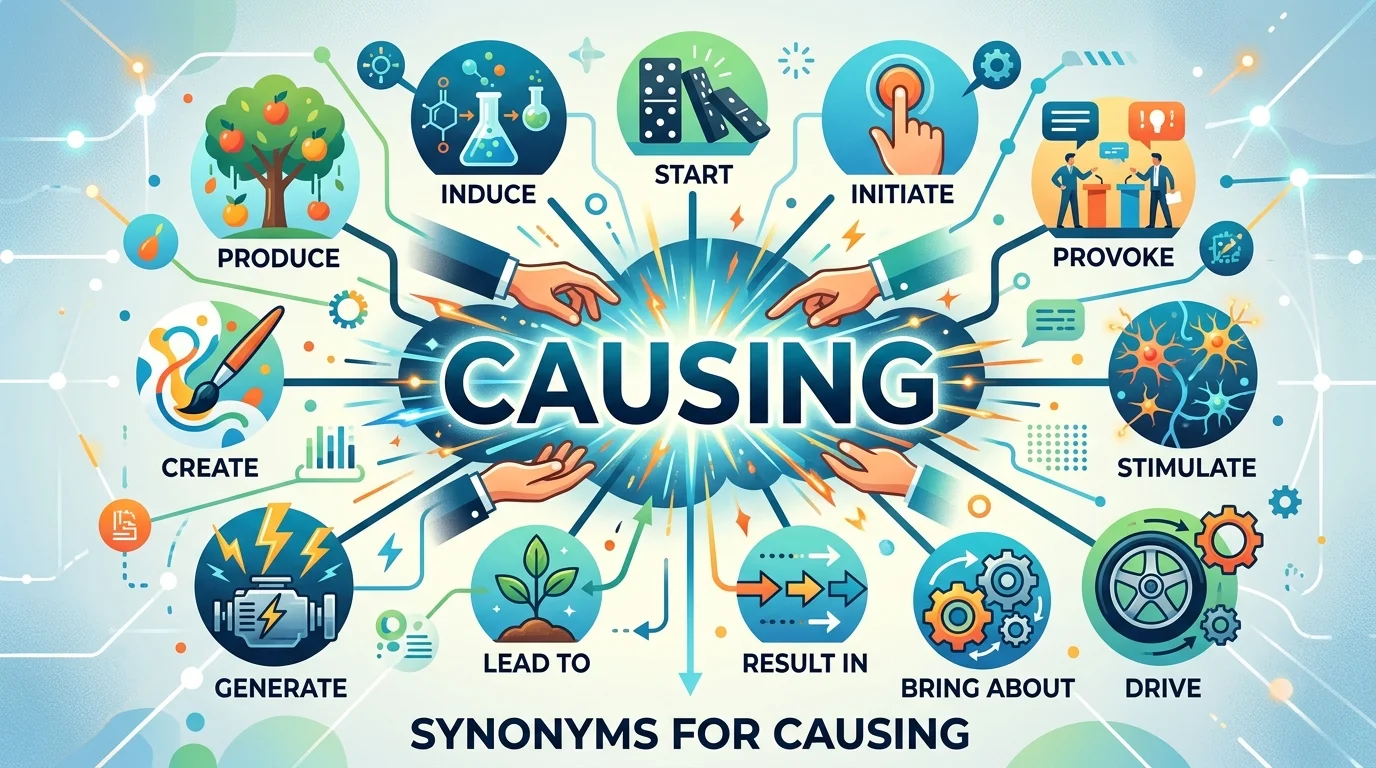
Causing vs. Leading To
These two expressions are close but emphasize different things.
Causing focuses on the causal action:
Heavy rain is causing flooding.
Leading to focuses on the resulting sequence:
Heavy rain is leading to flooding.
Both can work, but leading to is often useful when describing a chain:
Poor planning led to delays, which led to additional costs.
For analytical writing, leading to can make a sequence of events especially clear.
Causing vs. Triggering
Triggering suggests that something starts a reaction or process.
The news caused widespread concern.
The news triggered widespread concern.
The second version can imply that the concern began rapidly in response to the news.
Compare:
- caused — broad causal relationship
- triggered — activated or started a response
- prompted — caused a person or group to act
- provoked — produced a strong reaction
- sparked — started something energetic or significant
Causing vs. Prompting
Use prompting when the result is usually an action or response.
The discovery caused researchers to investigate further.
The discovery prompted researchers to investigate further.
This is often more natural than caused when describing decisions.
Prompting is especially useful with:
- prompted questions
- prompted an investigation
- prompted a response
- prompted changes
- prompted people to act
- prompted reconsideration
Causing vs. Contributing To
This is one of the most important distinctions.
Causing can imply that something is responsible for the result.
The software error caused the failure.
Contributing to means that something was one factor among several.
The software error contributed to the failure.
If multiple causes exist, contributing to is usually more precise.
Compare:
Lack of sleep caused the problem.
This makes a strong causal claim.
Lack of sleep contributed to the problem.
This allows for other factors.
Lack of sleep may have contributed to the problem.
This is even more cautious.
Causing vs. Creating
These words overlap, but creating often suggests bringing something new into existence.
The policy caused confusion.
The policy created confusion.
Both are natural.
But:
The policy caused the opportunity.
sounds less natural than:
The policy created the opportunity.
Likewise, creating works naturally with:
- opportunities
- problems
- conditions
- possibilities
- uncertainty
- demand
- an environment
Causing vs. Producing
Producing is particularly useful when the result is measurable or observable.
The experiment caused a reaction.
The experiment produced a reaction.
The machine is causing more energy.
The machine is producing more energy.
Producing often sounds more objective and technical.
Sentence Transformations
Here are practical ways to replace causing without changing the intended meaning.
Original
The storm is causing serious damage.
Alternatives:
The storm is producing serious damage.
The storm is resulting in serious damage.
The storm is leading to serious damage.
In natural English, however, causing serious damage may still be the best option.
Original
The announcement caused concern.
Alternatives:
The announcement prompted concern.
The announcement sparked concern.
The announcement generated concern.
The announcement gave rise to concern.
Original
The new law caused major changes.
Alternatives:
The new law brought about major changes.
The new law led to major changes.
The new law resulted in major changes.
The new law triggered major changes.
Original
The question caused an emotional response.
Alternatives:
The question elicited an emotional response.
The question provoked an emotional response.
The question prompted an emotional response.
Original
Stress is causing health problems.
Alternatives:
Stress is contributing to health problems.
Stress is leading to health problems.
Stress is producing health problems.
Stress is exacerbating health problems.
The last choice is appropriate only when stress is making an existing problem worse.
Grammar: How to Use “Causing” Correctly
Causing is the -ing form of cause.
Common structures include:
Causing + noun
The storm is causing damage.
The delay is causing problems.
Causing + object + to + verb
The noise is causing me to lose concentration.
The policy is causing customers to reconsider their purchases.
Causing + adjective/state
The situation is causing concern.
The experience is causing confusion.
Causing + passive construction
The delay is causing the project to be postponed.
This structure identifies the cause while showing the resulting passive action.
Common Collocations With “Causing”
Some combinations are particularly natural:
- causing problems
- causing trouble
- causing damage
- causing concern
- causing confusion
- causing delays
- causing pain
- causing stress
- causing difficulties
- causing harm
- causing injuries
- causing changes
- causing disruption
- causing a reaction
- causing an increase
- causing a decrease
- causing an accident
- causing people to worry
- causing someone to reconsider
- causing something to happen
If a phrase already sounds natural with causing, there is no need to replace it merely to sound sophisticated.
Common Mistakes When Choosing a Synonym
Mistake 1: Treating every synonym as identical
Words such as causing, prompting, triggering, and contributing to describe different kinds of relationships.
Replacing one with another without considering the meaning can make a sentence inaccurate.
Mistake 2: Using “resulting in” incorrectly
The manager resulted in the changes.
This is generally unnatural.
Better:
The manager’s decision resulted in the changes.
The cause is the thing that produces the result.
Mistake 3: Using “influencing” when direct causation is established
The fire influenced the building to collapse.
This is awkward.
Better:
The fire caused the building to collapse.
Influence generally describes an effect that is less direct or less absolute.
Mistake 4: Using “provoking” for neutral results
The new software provoked faster processing.
This sounds unusual because provoke often implies a reaction, especially an emotional or oppositional one.
Better:
The new software enabled faster processing.
Mistake 5: Overusing formal vocabulary
Words such as occasioning, engendering, and precipitating have legitimate uses, but they are not automatically better than causing.
Good writing chooses the most accurate word, not the longest one.
When “Causing” Is Better Than a Synonym
Sometimes the original word is the strongest choice.
Use causing when:
- you need a simple, direct statement of causation
- the audience is general
- the relationship is clearly causal
- the result is neutral or broad
- a more specialized synonym would add unnecessary complexity
For example:
Heavy rain is causing flooding.
This is perfectly clear. Replacing it with:
Heavy rain is precipitating widespread inundation.
does not improve the sentence for most readers.
The best synonym is not necessarily the most sophisticated word. It is the word that communicates the intended relationship most clearly.
A Simple Decision Guide
Choose your replacement based on what the cause actually does:
| If you mean… | Use… |
|---|---|
| make something happen | cause |
| make something exist | create |
| produce a result | produce |
| produce something measurable | generate |
| cause a change | bring about |
| result in something later | lead to |
| produce an outcome | result in |
| suddenly start a reaction | trigger |
| cause someone to act | prompt |
| cause a strong reaction | provoke |
| cause a feeling or memory | evoke |
| draw out a response | elicit |
| start something energetic | spark |
| strongly push development | drive |
| help cause something | contribute to |
| make something easier | facilitate |
| encourage development | foster |
| cause a condition | induce |
| start a process | initiate |
| cause something suddenly | precipitate |
| influence development | shape |
| encourage activity | stimulate |