
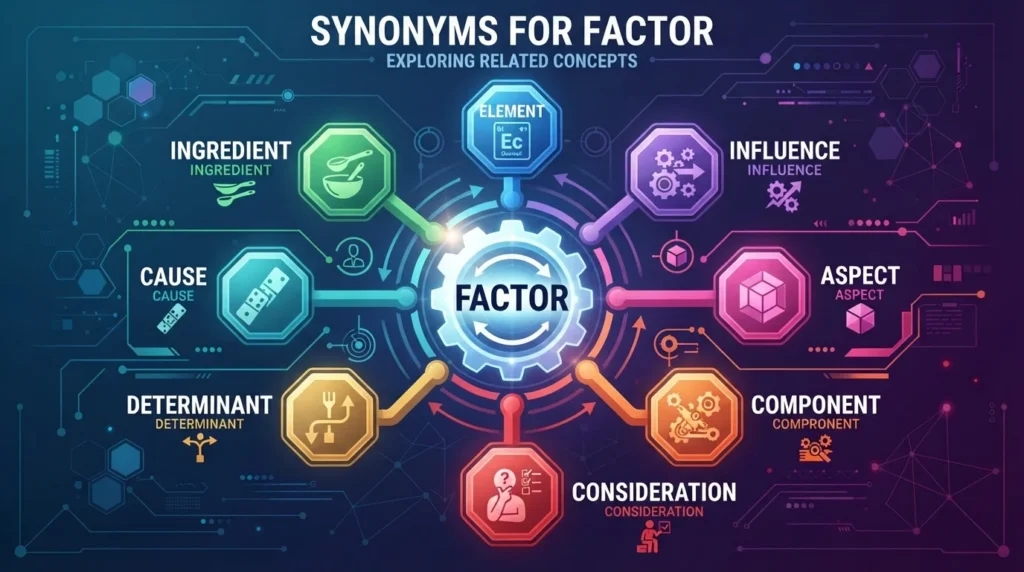
Quick Synonym List
Because factor has several meanings, there is no single synonym that works in every sentence.
When factor means something that affects an outcome
- influence
- contributor
- determinant
- cause
- reason
- driver
- force
- condition
- circumstance
- element
When factor means a part of something
- component
- element
- part
- constituent
- feature
- aspect
- ingredient
- building block
When factor means something considered in a decision
- consideration
- point
- issue
- criterion
- concern
- circumstance
- condition
- requirement
In research and statistics
- variable
- determinant
- predictor
- explanatory variable
- independent variable
- characteristic
- attribute
- measure
In business and economics
- driver
- influence
- determinant
- force
- condition
- market force
- contributor
- consideration
In mathematics
- multiplier
- divisor
- component
- quantity
Key distinction: Factor is a broad word. It can mean something that contributes to an outcome, a part of a larger whole, something considered in a decision, or a mathematical quantity that divides another number. Choosing the right synonym means identifying which meaning is intended.
What Does “Factor” Mean?
Factor is a noun with several related but distinct meanings. In general English, it often refers to something that contributes to a result or influences a situation.
For example:
Cost is an important factor in choosing a car.
Here, factor means something that should be considered when making a decision.
Weather was a major factor in the cancellation of the event.
Here, factor means something that contributed to an outcome.
Experience is a key factor in successful leadership.
Here, factor refers to something that influences success.
In mathematics:
3 is a factor of 12.
Here, factor has a completely different technical meaning: a number that divides another number exactly.
In business or systems:
Labor is an important factor in production.
Here, factor refers to an element or resource involved in a process.
Because these meanings differ, replacing factor with a random thesaurus entry can easily make a sentence inaccurate.
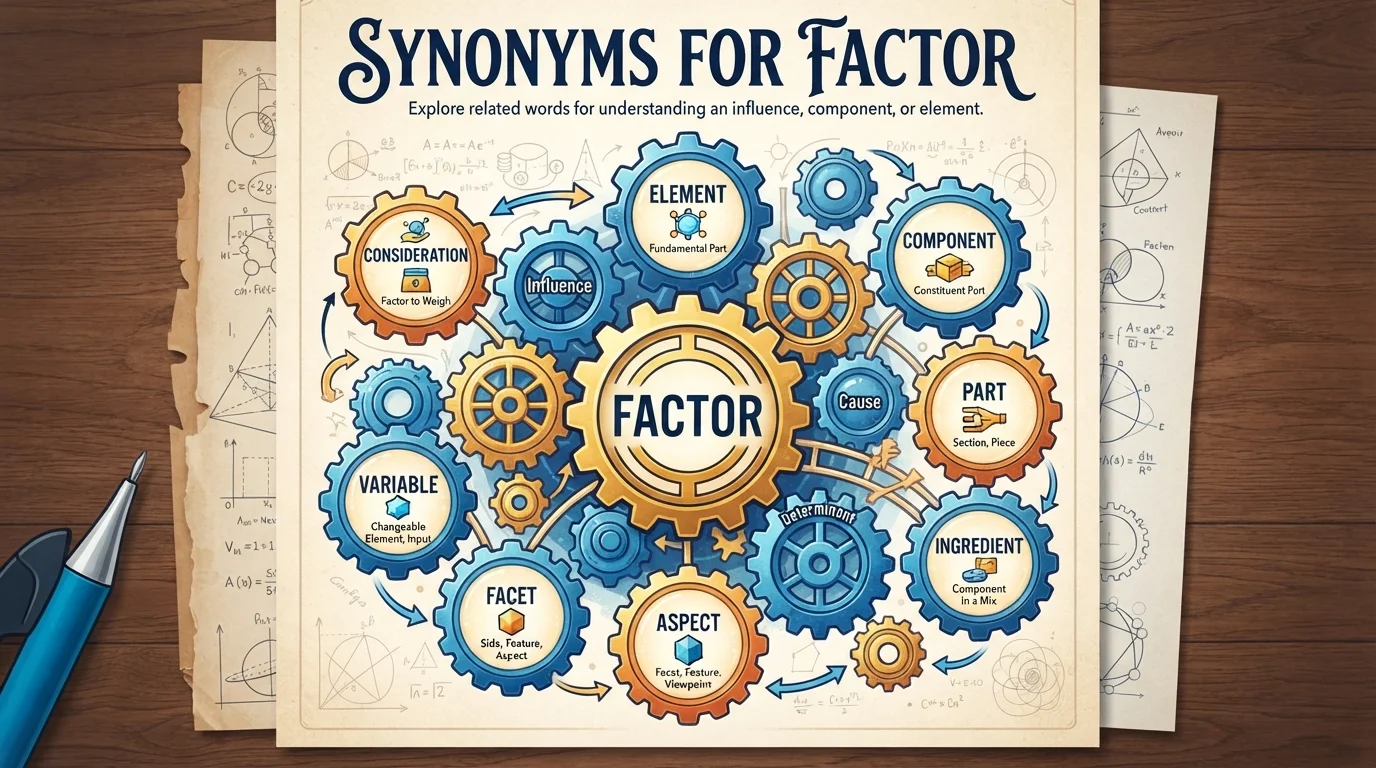
The Best Synonyms for Factor
1. Influence
Meaning: Something that affects the development, behavior, or outcome of something else.
Tone: Neutral and professional.
Best for: Decisions, behavior, social issues, business, research, and general analysis.
Example:
Social media can be a major influence on consumer behavior.
How it differs: Influence emphasizes the effect something has. It does not necessarily suggest that it is the only or primary cause.
Compare:
Cost was an important factor in the decision.
Cost had a strong influence on the decision.
Both can work, but influence focuses more directly on the effect.
2. Cause
Meaning: Something that produces an event, condition, or result.
Tone: Neutral.
Best for: Problems, events, effects, scientific explanations, and direct relationships.
Example:
Poor maintenance was a major cause of the equipment failure.
How it differs: Cause is stronger than factor. A factor may contribute to an outcome without being sufficient to produce it by itself.
Lack of sleep was a factor in the accident.
does not necessarily mean:
Lack of sleep caused the accident.
Use cause when the evidence supports a causal relationship.
3. Reason
Meaning: An explanation for why something happened or why someone made a decision.
Tone: Neutral.
Best for: Decisions, actions, opinions, explanations, and everyday writing.
Example:
Cost was one reason the company chose the smaller office.
How it differs: Reason often explains why something happened, while factor can simply identify something that contributed to the outcome.
4. Element
Meaning: An important part or feature of a larger situation, system, or process.
Tone: Neutral to formal.
Best for: Analysis, writing, systems, plans, and complex situations.
Example:
Trust is an essential element of a successful partnership.
How it differs: Element is broader than factor. It can describe a part of something without necessarily affecting an outcome.
5. Component
Meaning: One of the parts that make up a larger system, object, or process.
Tone: Neutral to technical.
Best for: Technology, machines, systems, plans, products, and organizations.
Example:
Communication is a critical component of the project.
How it differs: Component emphasizes being part of a whole. Factor emphasizes influence or contribution.
6. Consideration
Meaning: Something taken into account when making a decision or judgment.
Tone: Professional and formal.
Best for: Decisions, planning, business, applications, and professional writing.
Example:
Cost should be an important consideration when choosing a supplier.
How it differs: Consideration is especially useful when the factor is something people deliberately evaluate.
Cost was a factor in the decision.
Cost was an important consideration in the decision.
The second emphasizes the decision-making process.
7. Contributor
Meaning: Something or someone that helps produce a result.
Tone: Neutral to formal.
Best for: Causes, research, business, health, social issues, and performance.
Example:
Stress was a significant contributor to the decline in productivity.
How it differs: Contributor strongly suggests that something played a role in producing an outcome without necessarily being the sole cause.
8. Determinant
Meaning: Something that strongly influences or determines an outcome.
Tone: Formal, academic, or technical.
Best for: Research, economics, statistics, medicine, social science, and formal analysis.
Example:
Income is an important determinant of housing choices.
How it differs: Determinant can imply a stronger relationship than the general word factor. Use it when the relationship is sufficiently established.
9. Driver
Meaning: A force or condition that causes or strongly encourages change or development.
Tone: Professional and business-oriented.
Best for: Business, economics, technology, growth, markets, and trends.
Example:
Consumer demand is a major driver of market growth.
How it differs: Driver is more dynamic than factor. It suggests something actively pushing a trend or process forward.
10. Condition
Meaning: A circumstance or state that affects what happens.
Tone: Neutral.
Best for: Situations, agreements, processes, scientific explanations, and requirements.
Example:
Weather conditions were an important factor in the decision.
This can become:
Weather conditions influenced the decision.
How it differs: Condition often describes the circumstances under which something occurs rather than simply one contributing influence.
11. Circumstance
Meaning: A condition or situation that affects an event or decision.
Tone: Neutral to formal.
Best for: Decisions, explanations, legal writing, personal situations, and formal analysis.
Example:
Financial circumstances were an important factor in her decision.
How it differs: Circumstance usually refers to the surrounding situation rather than a specific causal mechanism.
12. Aspect
Meaning: A particular part, feature, or side of a subject.
Tone: Neutral and professional.
Best for: Analysis, evaluations, writing, projects, and discussions.
Example:
Cost is only one aspect of the decision.
How it differs: An aspect is something viewed as part of a broader subject. It does not necessarily influence the outcome.
13. Variable
Meaning: Something that can change and may affect an outcome.
Tone: Technical or academic.
Best for: Statistics, mathematics, science, research, and experiments.
Example:
Age was an important variable in the study.
How it differs: Variable is more specific than factor in research. It refers to something that can take different values.
14. Feature
Meaning: A noticeable or important characteristic of something.
Tone: Neutral.
Best for: Products, services, software, descriptions, and evaluations.
Example:
Ease of use is an important feature of the new software.
How it differs: A feature is normally a characteristic or attribute. It becomes a factor when that feature influences a decision or outcome.
15. Characteristic
Meaning: A quality or property that distinguishes someone or something.
Tone: Neutral or formal.
Best for: People, products, groups, research, and descriptions.
Example:
Age is an important characteristic of the study population.
How it differs: Characteristic describes what something is like; factor emphasizes how something affects an outcome.
16. Criterion
Meaning: A standard used to evaluate, judge, or make a decision.
Tone: Formal and professional.
Best for: Selection, evaluation, hiring, grading, purchasing, and decision-making.
Example:
Price was one of the main criteria used to select the supplier.
How it differs: A criterion is something deliberately used as a standard for judgment. It is not simply any circumstance that affects an outcome.
17. Issue
Meaning: A matter, problem, or subject that needs attention or consideration.
Tone: Neutral.
Best for: Business, discussions, decisions, problems, and public communication.
Example:
Cost remains an important issue in the project.
How it differs: An issue may be something that needs to be addressed, whereas a factor may simply contribute to a result.
18. Point
Meaning: A particular fact, consideration, or idea relevant to a discussion.
Tone: Neutral and conversational.
Best for: Arguments, discussions, decisions, and everyday writing.
Example:
Availability was another important point to consider.
How it differs: Point is broader and more conversational than factor.
19. Ingredient
Meaning: An essential part of something, especially something that contributes to a result.
Tone: Neutral; sometimes figurative.
Best for: Food, success, formulas, strategies, and figurative descriptions.
Example:
Hard work is one ingredient in long-term success.
How it differs: Ingredient is often metaphorical when used outside cooking. It emphasizes a contributing part of a result.
20. Force
Meaning: A power or influence that produces change or affects an outcome.
Tone: Neutral to formal.
Best for: Economics, politics, science, social change, and broad trends.
Example:
Technology has become a powerful force for economic change.
How it differs: Force can suggest stronger or more active influence than factor.
Factor Synonyms by Context
Factors That Affect an Outcome
When factor means something that contributes to an outcome, the strongest alternatives are:
- influence
- contributor
- determinant
- cause
- driver
- force
- condition
- circumstance
- element
Example
Several factors contributed to the company’s success.
Several influences contributed to the company’s success.
Several conditions contributed to the company’s success.
Several drivers contributed to the company’s growth.
The best choice depends on the relationship being described.
Factors in Decision-Making
When factor refers to something considered before making a choice, use:
- consideration
- criterion
- concern
- issue
- point
- circumstance
- requirement
Example
Price is an important factor when choosing a laptop.
More specific alternatives:
Price is an important consideration when choosing a laptop.
Price is an important criterion when selecting a laptop.
The distinction is useful:
- consideration = something taken into account
- criterion = a standard used to judge options
- concern = something that creates worry or needs attention
- requirement = something that must be satisfied
Factors in Research
In academic and scientific writing, factor can be replaced by more precise technical terms such as:
- variable
- determinant
- predictor
- explanatory variable
- characteristic
- attribute
- condition
- measure
Example
Age was an important factor in the study.
Depending on the research design, you might write:
Age was an important variable in the study.
or:
Age was an important predictor of the outcome.
These are not automatically interchangeable. Predictor has a more specific statistical meaning than factor.
Factors in Business
Business writing frequently uses:
- driver
- influence
- determinant
- consideration
- contributor
- market force
- condition
- component
Example
Customer demand is an important factor in business growth.
Possible rewrite:
Customer demand is a major driver of business growth.
This is particularly natural when discussing growth, trends, sales, or market changes.
Factors in Economics
Economic writing often uses determinant, driver, influence, force, variable, and condition.
Example
Interest rates are an important factor affecting investment.
More specific:
Interest rates are an important determinant of investment.
or:
Interest rates are a major driver of investment decisions.
The appropriate word depends on whether you are emphasizing statistical relationship, causation, or economic pressure.
Factors in Personal Decisions
For everyday decisions, consideration, reason, influence, concern, circumstance, and point are often more natural.
Example
Distance was a major factor in my decision.
Distance was a major consideration in my decision.
Distance was one of the main reasons for my decision.
Distance strongly influenced my decision.
Each version emphasizes something slightly different.
Factors in Success
Common alternatives include:
- contributor
- ingredient
- influence
- driver
- element
- condition
- reason
Example
Practice is an important factor in improving performance.
You could write:
Practice is an important contributor to improved performance.
or:
Practice is an important ingredient in successful performance.
The first is more analytical; the second is more figurative.
Factors in Problems or Failure
When explaining why something went wrong, useful alternatives include:
- cause
- contributor
- reason
- source
- influence
- condition
- circumstance
Example
Poor communication was a major factor in the project’s failure.
More precise:
Poor communication was a major contributor to the project’s failure.
If evidence shows a direct causal relationship:
Poor communication was a major cause of the project’s failure.
Do not automatically replace factor with cause. The stronger word makes a stronger claim.
Factors in Mathematics
In mathematics, factor has a specialized meaning.
A factor is a number or algebraic expression that divides another quantity exactly.
For example:
3 is a factor of 12 because 12 ÷ 3 = 4.
Possible related terms include:
- divisor
- multiplier
- component
- quantity
But these are not interchangeable in every mathematical sentence.
Factor vs. divisor
A factor is a number that multiplies with another number to produce a product.
3 × 4 = 12
Both 3 and 4 are factors of 12.
A divisor is a number that divides another number without leaving a remainder.
Thus, 3 is both a factor and a divisor of 12, but the terms emphasize different mathematical relationships.
True Synonyms vs. Related Alternatives
| Alternative | Relationship | Can Replace factor? | Tone | Best Context |
|---|---|---|---|---|
| Influence | Close synonym | Often | Neutral | Effects and decisions |
| Contributor | Close contextual synonym | Often | Professional | Causes and outcomes |
| Cause | Stronger alternative | Sometimes | Neutral | Direct causation |
| Reason | Near synonym | Sometimes | Neutral | Explanations and decisions |
| Element | Broad synonym | Often | Neutral/formal | Systems and situations |
| Component | Contextual synonym | Sometimes | Technical | Parts of systems |
| Consideration | Contextual synonym | Often | Professional | Decisions |
| Determinant | Specific synonym | Sometimes | Academic | Research and analysis |
| Driver | Contextual synonym | Often | Business | Trends and growth |
| Condition | Related alternative | Sometimes | Neutral | Circumstances |
| Circumstance | Related alternative | Sometimes | Formal | Situations |
| Aspect | Related alternative | Sometimes | Neutral | Analysis |
| Variable | Technical alternative | Sometimes | Academic | Research/statistics |
| Criterion | Specific alternative | Sometimes | Formal | Evaluation |
| Feature | Related alternative | Sometimes | Neutral | Characteristics |
| Ingredient | Figurative alternative | Sometimes | Neutral | Success and processes |
| Force | Contextual alternative | Sometimes | Formal | Change and trends |
Factor vs. Cause vs. Reason vs. Influence
These four words are frequently confused.
Factor
A contributing condition or element.
Several factors contributed to the delay.
This does not say that any one factor caused the delay by itself.
Cause
Something that produces an outcome.
Heavy rain caused the delay.
This is a stronger causal statement.
Reason
An explanation for an action or event.
Heavy rain was the reason the event was canceled.
This focuses on explaining the decision or event.
Influence
Something that affects an outcome without necessarily determining it.
Weather influenced the decision.
This emphasizes effect rather than direct causation.
Simple rule
Factor = contributor
Cause = producer
Reason = explanation
Influence = effect
These meanings overlap, but they are not identical.
Factor vs. Element vs. Component
These words all describe parts of a larger situation, but they emphasize different relationships.
Factor emphasizes contribution or influence.
Cost was a major factor in the decision.
Element emphasizes an important part of a larger whole.
Trust is an important element of the relationship.
Component emphasizes a structural part of a system.
The battery is a key component of the device.
A component may be a factor, but a factor does not always function as a physical or structural component.
Factor vs. Consideration
These are especially close in decision-making.
Price was a factor in our decision.
This simply says price influenced the decision.
Price was an important consideration in our decision.
This more strongly suggests that people consciously evaluated price.
Use consideration when you want to emphasize the decision-making process.
Factor vs. Determinant
A factor can have a small or large influence.
A determinant generally suggests a more powerful or decisive influence.
Compare:
Several factors affect employee satisfaction.
Income is a major determinant of housing choice.
The second sentence makes a stronger analytical claim.
Factor vs. Variable
A variable is something that can take different values and is measured or manipulated in research or mathematics.
A factor is a broader term for something that contributes to an outcome.
For example:
Age was a factor in the study.
is broad.
Age was an independent variable in the study.
is technically specific and should only be used if the research design supports that description.
Factor vs. Feature
A feature is a characteristic.
A factor is something that contributes to an outcome.
For example:
Battery life is a feature of the phone.
Battery life was a factor in my decision to buy the phone.
The same thing can be both a feature and a factor, depending on its role in the sentence.
Comparison Table
| Word | Main meaning | Tone | Strength | Best use | Interchangeable with factor? |
|---|---|---|---|---|---|
| Factor | Something that contributes or influences | Neutral | Medium | General analysis | — |
| Influence | Something that affects an outcome | Neutral | Medium | Effects and decisions | Often |
| Cause | Something that produces an outcome | Neutral | Strong | Direct causation | Sometimes |
| Reason | Explanation for something | Neutral | Medium | Decisions and events | Sometimes |
| Contributor | Something that helps produce an outcome | Professional | Medium | Analysis | Often |
| Determinant | Strong influence on an outcome | Formal | Strong | Research | Sometimes |
| Driver | Force pushing change | Professional | Strong | Business and trends | Often |
| Element | Part of a larger whole | Neutral | Medium | Systems and analysis | Often |
| Component | Structural part of a system | Technical | Medium | Technology and systems | Sometimes |
| Consideration | Something taken into account | Professional | Medium | Decisions | Often |
| Variable | Changeable measured quantity | Technical | Medium | Research/statistics | Only in specific contexts |
| Criterion | Standard for judgment | Formal | Medium | Selection/evaluation | Sometimes |
| Aspect | Part or side of a subject | Neutral | Low-medium | Analysis | Sometimes |
| Feature | Characteristic | Neutral | Low-medium | Products/descriptions | Sometimes |
How to Choose the Right Synonym
Ask what factor is doing in your sentence.
If it affects an outcome
Use influence, contributor, or determinant.
Experience was a major contributor to the team’s success.
If it directly produces an outcome
Use cause.
Equipment failure was the cause of the shutdown.
If it explains a decision
Use reason or consideration.
Cost was an important consideration.
If it is part of a system
Use component or element.
The battery is a key component of the device.
If it is a research measurement
Use variable.
Age was an important variable in the analysis.
If it drives growth or change
Use driver.
Innovation is a major driver of growth.
If it is a standard for evaluation
Use criterion.
Reliability was one of the main criteria.
If it is simply one side of a larger subject
Use aspect.
Cost is one aspect of the problem.
If you mean a mathematical factor
Keep factor, or use divisor where mathematically appropriate.
Sentence Transformations
1. General influence
Original:
Cost was an important factor in the decision.
Alternative:
Cost was an important consideration in the decision.
Why: Consideration emphasizes deliberate evaluation during decision-making.
2. Direct causation
Original:
Poor maintenance was a factor in the failure.
Alternative:
Poor maintenance was a cause of the failure.
Why: Use cause only when the evidence supports a stronger causal relationship.
3. Research writing
Original:
Age was an important factor in the study.
Alternative:
Age was an important variable in the study.
Why: Variable is more precise when age was measured or analyzed as a research variable.
4. Business writing
Original:
Consumer demand was a factor in the company’s growth.
Alternative:
Consumer demand was a major driver of the company’s growth.
Why: Driver emphasizes an active force producing growth.
5. Personal decision
Original:
Distance was a major factor in my decision.
Alternative:
Distance was a major reason for my decision.
Why: Reason makes the connection to the speaker’s decision more direct.
6. System description
Original:
Communication is an important factor in the project.
Alternative:
Communication is an important component of the project.
Why: Component works when communication is being described as an integral part of the project itself.
7. Positive outcome
Original:
Practice was an important factor in her success.
Alternative:
Practice was an important contributor to her success.
Why: Contributor clearly expresses participation in producing the outcome.
8. Evaluation
Original:
Price was an important factor when selecting the supplier.
Alternative:
Price was an important criterion when selecting the supplier.
Why: Criterion works when price was deliberately used as a standard for comparing suppliers.
9. Broad analysis
Original:
Several factors affect employee satisfaction.
Alternative:
Several influences affect employee satisfaction.
Why: Influences emphasizes things that affect satisfaction without implying direct causation.
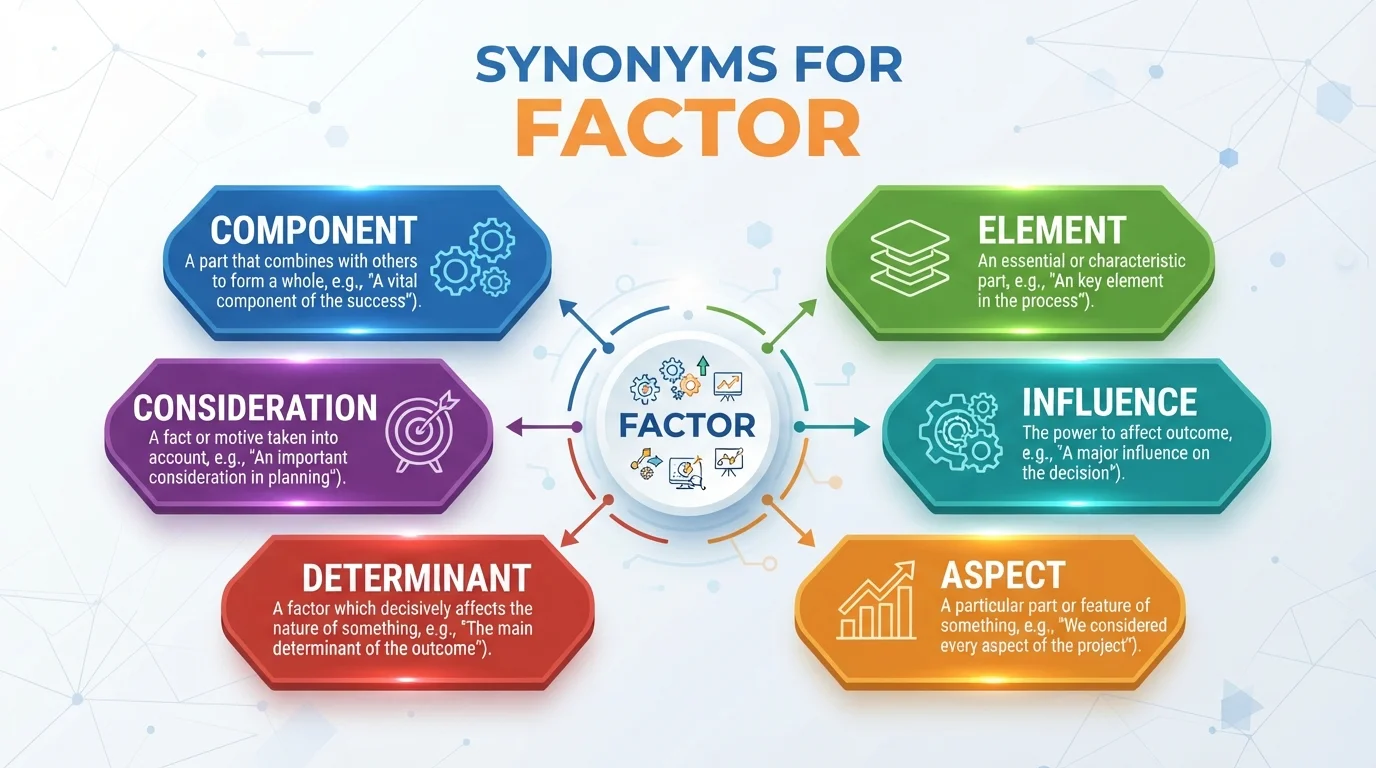
10. Technical description
Original:
Battery capacity is an important factor in the device’s performance.
Alternative:
Battery capacity is an important component of the device’s performance.
Why: This alternative is appropriate only if battery capacity is being treated as an integral part of the performance system; otherwise, factor or influence is more accurate.
Professional Alternatives to “Factor”
In professional writing, the best alternative depends on the sentence.
For decisions
- consideration
- criterion
- concern
- issue
For business performance
- driver
- contributor
- determinant
- influence
For reports and analysis
- element
- aspect
- contributor
- determinant
- variable
For problems
- cause
- contributor
- reason
- circumstance
For systems
- component
- element
- variable
- condition
A useful professional-writing rule is to replace factor only when the alternative provides additional information.
“Several factors affected the outcome.”
is perfectly professional.
There is no need to change it to a more complicated phrase simply to sound sophisticated.
Formal Alternatives to “Factor”
For formal and academic writing, useful choices include:
- determinant
- contributor
- consideration
- variable
- component
- element
- circumstance
- condition
- criterion
- influence
However, formality should not override precision.
For example:
Several factors contributed to the decline.
is often better than:
Several determinants contributed to the decline.
if the evidence does not establish that the variables were decisive determinants.
Casual Alternatives to “Factor”
In everyday conversation, people often use simpler expressions such as:
- reason
- part
- influence
- point
- consideration
- thing
- cause
Example
Money was a big factor in my decision.
Casual alternatives:
Money was a big reason for my decision.
Money played a big part in my decision.
The phrase played a part is especially natural when talking about something that contributed to an outcome.
“Factor” vs. “Play a Part”
Play a part is an idiomatic alternative when something contributes to an outcome.
Exercise was a factor in his recovery.
Exercise played a part in his recovery.
The second sounds more conversational.
It is especially useful when you want to avoid implying that one thing was solely responsible.
Several things played a part in the project’s success.
This can be a natural alternative to:
Several factors contributed to the project’s success.
“Factor” vs. “Play a Role”
Play a role is another highly useful phrase-level alternative.
Communication was an important factor in the project’s success.
Communication played an important role in the project’s success.
These sentences are very close in meaning.
Play a role is often more natural when describing contribution:
Training played a major role in improving performance.
It also avoids suggesting that the factor was necessarily the primary cause.
Common Mistakes
1. Using “cause” when you only mean “factor”
A factor may contribute without directly causing an outcome.
Cost was a factor in the decision.
does not necessarily mean:
Cost caused the decision.
2. Treating “factor” and “reason” as identical
A reason explains why something happened. A factor can simply be one influence among several.
3. Using “determinant” too freely
Determinant can imply a stronger relationship than factor. It is especially common in formal research and economics.
4. Using “variable” outside a technical context
A variable is not simply any factor. It normally refers to something that can vary and be measured, manipulated, or observed.
5. Confusing a factor with a component
A component is part of a larger system. A factor is something that influences an outcome.
6. Using “criterion” when you mean influence
A criterion is a standard for evaluation. Not every factor is a criterion.
7. Assuming every feature is a factor
A feature becomes a factor when it affects a decision, outcome, or judgment.
8. Overusing “factor”
If the relationship is clearly causal, cause may be more precise. If it is a decision standard, criterion may be better.
9. Forcing synonyms into technical writing
In scientific, statistical, mathematical, or legal contexts, replacing a precise technical term simply for variety can reduce accuracy.
When “Factor” Is the Better Word
Sometimes factor is the most accurate and natural choice.
Use factor when:
- several things contribute to an outcome;
- you do not want to claim direct causation;
- the exact strength of the influence is uncertain;
- you are discussing general considerations;
- the relationship is more complex than a simple cause-and-effect relationship.
For example:
Several factors contributed to the project’s success.
This is useful because it does not claim that any single factor was responsible.
Similarly:
Cost is an important factor in the decision.
is broad enough to include cost as one of several considerations without making the sentence unnecessarily technical.