

Quick Synonym List
Because aura has several meanings, there is no single replacement that works everywhere.
Closest general alternatives
- atmosphere
- ambiance
- air
- vibe
- feeling
- mood
- presence
- impression
- character
- quality
For a person’s presence
- presence
- charisma
- magnetism
- energy
- bearing
- demeanor
- appeal
- personality
- influence
- allure
For a place or environment
- atmosphere
- ambiance
- mood
- feeling
- character
- environment
- setting
- tone
- air
- spirit
For a mysterious or intangible quality
- air
- presence
- essence
- quality
- character
- mystique
- allure
- magic
- charm
- spirit
For a positive or attractive aura
- charisma
- magnetism
- charm
- allure
- radiance
- warmth
- appeal
- glow
- energy
For a negative aura
- air
- atmosphere
- mood
- tension
- menace
- darkness
- unease
- heaviness
- hostility
Informal alternatives
- vibe
- energy
- feel
- mood
- presence
- vibe check
Key distinction: Aura often refers to an intangible quality that seems to surround a person, place, or thing. Some alternatives describe only one part of that idea. Atmosphere emphasizes the surrounding mood, presence emphasizes a person’s effect, and vibe is a casual way to describe an overall feeling.
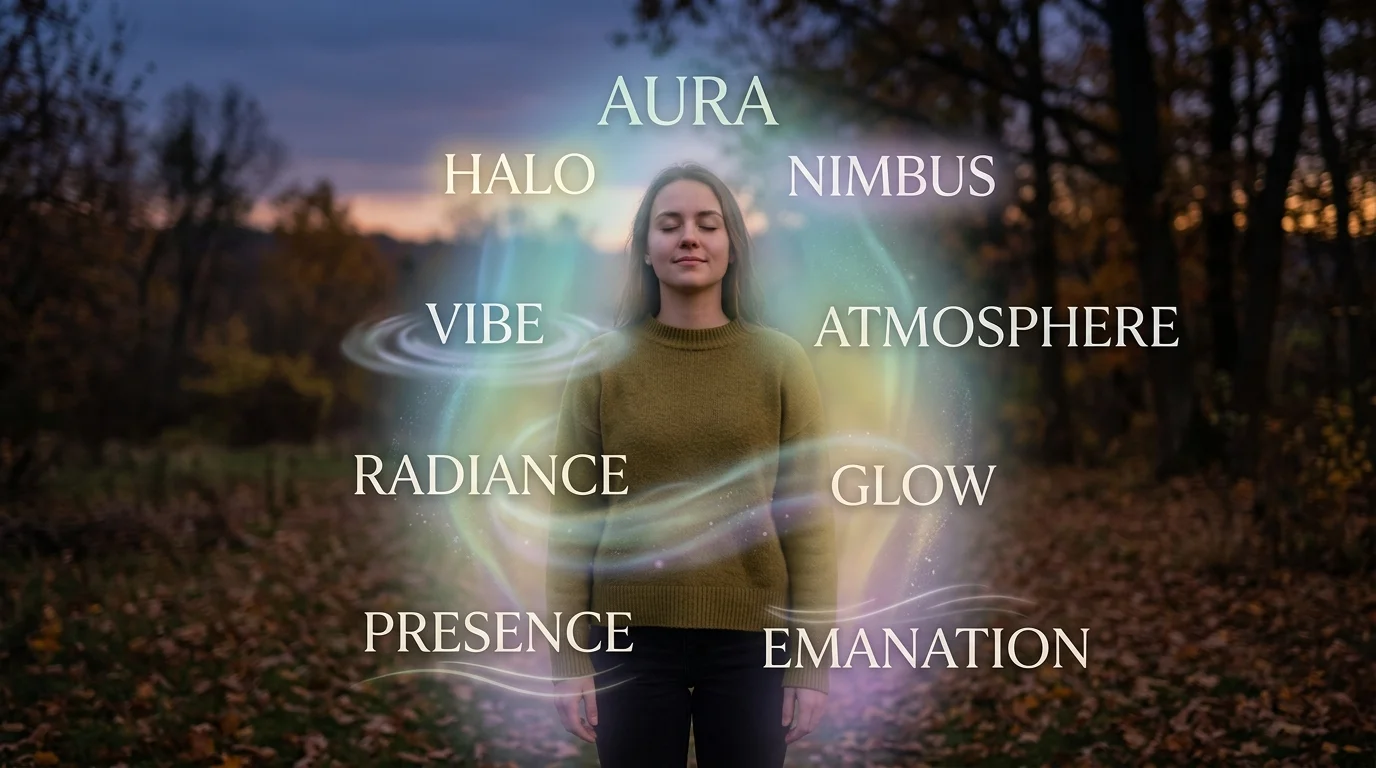
What Does “Aura” Mean?
Aura is a noun with several related meanings. It can describe an intangible quality surrounding a person or place, a distinctive atmosphere, or, in medical contexts, a sensory disturbance that can occur before certain neurological events.
The most common everyday meaning is the first one:
She has a calm, confident aura.
Here, aura means the distinctive feeling or quality she seems to project.
Another example:
The old house has a mysterious aura.
Here, aura describes the atmosphere or impression associated with the house.
The word can therefore overlap with:
- atmosphere
- ambiance
- presence
- vibe
- energy
- feeling
- mood
- character
- mystique
- charm
But these words are not identical.
The Main Senses of “Aura”
1. Aura = Intangible Quality or Feeling
This is the broadest everyday sense.
The building has an aura of elegance.
- atmosphere
- air
- quality
- character
- feeling
- impression
- ambiance
- vibe
Example
The restaurant has an aura of sophistication.
The restaurant has an air of sophistication.
The restaurant has an atmosphere of sophistication.
Both alternatives work, but they emphasize slightly different things.
Air suggests an intangible quality or appearance.
Atmosphere focuses more on the environment and mood.
2. Aura = Presence
When describing a person, presence is often the closest alternative.
She has a powerful aura.
She has a powerful presence.
Presence describes the noticeable effect someone has simply by being there.
It is particularly useful for:
- leaders
- performers
- speakers
- celebrities
- athletes
- public figures
- charismatic people
Example
The actor has a commanding aura.
The actor has a commanding presence.
This is usually a more natural choice in professional or descriptive writing.
3. Aura = Atmosphere
Atmosphere is one of the closest synonyms when aura describes a place.
The café has a cozy aura.
The café has a cozy atmosphere.
Atmosphere refers to the general mood or feeling of a place, situation, or environment.
It is especially useful for:
- restaurants
- homes
- hotels
- cities
- events
- workplaces
- rooms
- social situations
Example
The hotel has a peaceful aura.
The hotel has a peaceful atmosphere.
In this context, atmosphere is usually more precise.
4. Aura = Ambiance
Ambiance refers to the character, mood, or atmosphere of a place.
The restaurant has a romantic aura.
The restaurant has a romantic ambiance.
This is especially common when discussing:
- restaurants
- hotels
- cafés
- interior design
- events
- entertainment venues
Ambiance can sound more polished or descriptive than atmosphere, although both are common.
American English note
Ambiance is widely used in American English. Ambience is also an accepted spelling, particularly in British English.
5. Aura = Vibe
Vibe is an informal alternative to aura.
This place has a strange aura.
This place has a strange vibe.
The meaning is often very close in casual speech.
Vibe is particularly common when describing:
- people
- places
- music
- social situations
- events
- online communities
- fashion
- creative work
Example
I like the relaxed aura of this café.
I like the relaxed vibe of this café.
The second sounds much more conversational.
6. Aura = Energy
Energy can describe the quality or feeling someone seems to project.
She has a positive aura.
She has positive energy.
This is especially common in casual and contemporary language.
However, energy can imply an active emotional quality, while aura can be quieter or more mysterious.
Compare
He has a calm aura.
He has calm energy.
Both can work, but energy makes the quality feel more dynamic.
7. Aura = Air
Air is a useful literary and formal alternative when aura means an intangible quality or appearance.
He has an aura of authority.
He has an air of authority.
The phrase an air of is particularly natural.
Common combinations include:
- an air of confidence
- an air of mystery
- an air of authority
- an air of elegance
- an air of sophistication
- an air of seriousness
- an air of uncertainty
Example
She entered the room with an air of confidence.
This does not necessarily mean she consciously projected confidence. It describes the impression she gave.
8. Aura = Charisma
Charisma refers to a compelling personal quality that attracts attention, admiration, or loyalty.
The speaker has a powerful aura.
The speaker has tremendous charisma.
Use charisma when the aura is specifically connected to personal magnetism.
A person can have an aura without being charismatic, so these words are not always interchangeable.
9. Aura = Magnetism
Magnetism describes a powerful ability to attract people’s attention or interest.
She has an unusual aura.
She has an unusual magnetism.
This is a strong alternative when someone’s presence seems especially attractive or compelling.
Example
The performer had a magnetic aura.
The performer had a powerful magnetism.
10. Aura = Allure
Allure means a quality that attracts or fascinates people.
The city has an aura of mystery.
The city has a mysterious allure.
Allure emphasizes attraction, while aura is broader.
Use allure when the intangible quality is specifically drawing people toward something.
11. Aura = Mystique
Mystique describes an intriguing, mysterious, or glamorous quality that makes someone or something fascinating.
The singer has an aura of mystery.
The singer has a certain mystique.
This is particularly useful for:
- celebrities
- artists
- historical figures
- places
- brands
- mysterious subjects
Example
The old city has an aura of mystery.
The old city has a powerful mystique.
12. Aura = Essence
Essence means the fundamental nature or most important quality of something.
The painting captures the aura of the era.
Depending on the intended meaning:
The painting captures the essence of the era.
This is not an exact synonym. Essence refers to what something fundamentally is, whereas aura often refers to the impression surrounding it.
13. Aura = Character
Character can describe the distinctive qualities that make a person or place recognizable.
The neighborhood has a unique aura.
The neighborhood has a distinctive character.
This works particularly well for:
- cities
- neighborhoods
- buildings
- institutions
- cultures
- people
14. Aura = Impression
Impression refers to the idea or feeling someone or something creates in another person’s mind.
He gives off an aura of confidence.
He creates an impression of confidence.
This is useful when the focus is on how something is perceived rather than on the quality itself.
15. Aura = Feeling
Feeling is a simple, broad alternative.
The room has a peaceful aura.
The room has a peaceful feeling.
It is less vivid and sophisticated than aura, but often clearer.
Use it when straightforward language is more important than style.
16. Aura = Mood
Mood refers to the emotional quality of a place, situation, piece of writing, or work of art.
The film has a dark aura.
The film has a dark mood.
Use mood when the quality is specifically emotional.
17. Aura = Tone
Tone can describe the general attitude or emotional quality of communication, writing, art, or a situation.
The article has a serious aura.
The article has a serious tone.
This is particularly useful for:
- writing
- speeches
- advertisements
- conversations
- presentations
- creative work
18. Aura = Spirit
Spirit can describe the distinctive feeling, character, or emotional quality of a person, group, place, or activity.
The town has a lively aura.
The town has a lively spirit.
It can also refer to a broader cultural or emotional character.
19. Aura = Radiance
Radiance means a bright or glowing quality, literally or figuratively.
She seemed to have a warm aura.
She seemed to have a warm radiance.
This is more poetic and is particularly useful for descriptions of:
- beauty
- happiness
- warmth
- light
- people
It does not work for every type of aura.
20. Aura = Glow
Glow can describe an attractive, healthy, happy, or positive quality.
She had an aura of happiness.
She had a glow about her.
Glow is more specific and often suggests visible attractiveness or happiness.
Aura Synonyms by Context
Aura of a Person
When describing a person, consider:
- presence
- charisma
- magnetism
- energy
- air
- demeanor
- bearing
- allure
- mystique
- charm
- radiance
- personality
Example
The leader had a strong aura.
The leader had a strong presence.
The leader had considerable charisma.
The leader had a commanding air.
Each one emphasizes a different quality.
Aura of a Place
For a place, the best alternatives are often:
- atmosphere
- ambiance
- mood
- feeling
- character
- vibe
- air
- spirit
- environment
- setting
Example
The village has a peaceful aura.
The village has a peaceful atmosphere.
The village has a peaceful ambiance.
The village has a peaceful vibe.
Atmosphere is the safest general choice.
Aura of Mystery
When aura means mystery or intrigue, use:
- mystique
- mystery
- allure
- intrigue
- enchantment
- fascination
- air
- sense
Example
The artist has an aura of mystery.
The artist has a certain mystique.
The artist has an air of mystery.
These are more precise than simply using atmosphere.
Positive Aura
For a positive aura, consider:
- warmth
- charm
- charisma
- radiance
- energy
- glow
- appeal
- magnetism
- positivity
- friendliness
- serenity
- tranquility
Example
She has a warm aura.
Possible alternatives:
She has a warm presence.
She gives off positive energy.
She has a natural charm.
She has a calming presence.
Negative Aura
When aura suggests something unpleasant or threatening, consider:
- atmosphere
- air
- tension
- unease
- menace
- hostility
- darkness
- heaviness
- gloom
- foreboding
Example
The building had a sinister aura.
The building had a sinister atmosphere.
The building had an air of menace.
The building created a sense of unease.
The best choice depends on whether you mean general darkness, threat, or emotional discomfort.
Aura in Spiritual or Mystical Contexts
In spiritual or metaphysical contexts, aura can refer to a supposed field of energy surrounding a person or object.
Possible related terms include:
- energy field
- spiritual energy
- radiance
- emanation
- presence
- vibration
- energy
These terms are not necessarily scientifically equivalent. If you are writing about spiritual beliefs, it is useful to preserve the distinction between a belief or tradition and an empirically established physical phenomenon.
Example
The healer described the person’s aura as blue.
In this context, replacing aura with atmosphere would change the meaning.
Aura in Medical Contexts
Aura also has a specific medical meaning: a sensory, visual, or other neurological disturbance that can occur before or during certain conditions, including some migraine attacks and seizures.
Possible context-specific terms include:
- warning symptom
- sensory disturbance
- visual disturbance
- neurological symptom
- premonitory symptom
These are not exact synonyms, because the medical term aura has a specific clinical meaning.
Example
She experienced a visual aura before the migraine.
A more explanatory version could be:
She experienced a visual disturbance before the migraine.
But in medical writing, aura may be the more precise term when referring to the recognized clinical phenomenon.
Aura vs. Atmosphere
These are among the most easily confused alternatives.
Aura = an intangible quality associated with a person, place, or thing.
Atmosphere = the general mood or feeling of a place, situation, or environment.
Compare:
The artist has a mysterious aura.
The artist has a mysterious atmosphere. ❌
For a person, aura or presence works much better.
But:
The gallery has a mysterious aura.
The gallery has a mysterious atmosphere.
Both can work.
Simple rule
Person → aura / presence
Place → aura / atmosphere
Aura vs. Ambiance
Ambiance specifically emphasizes the character or mood of a setting.
The restaurant has a romantic ambiance.
Aura is broader and can apply to people, places, objects, experiences, and abstract things.
The restaurant has a romantic aura.
Both work, but ambiance is more specifically environmental.
Aura vs. Vibe
Vibe is informal and conversational.
This place has a strange vibe.
Aura is more literary, descriptive, or somewhat mystical.
This place has a strange aura.
The choice is largely one of register and style, although vibe often sounds more contemporary and casual.
Aura vs. Presence
Presence is particularly useful for people.
The actor has a commanding presence.
This means the actor naturally attracts attention or creates a strong impression.
The actor has a commanding aura.
This is possible but somewhat more abstract.
Use presence when you want a clear, professional description of someone’s effect.
Aura vs. Energy
Energy is common in informal descriptions of people and social settings.
She has positive energy.
She has a positive aura.
Energy often sounds more active or emotional, while aura can sound more mysterious or intangible.
Aura vs. Charisma
Charisma specifically means personal magnetism or an ability to attract, influence, or inspire others.
The speaker has charisma.
The speaker has a powerful aura.
The second statement is broader. The speaker could have an aura of authority, mystery, calmness, or seriousness without necessarily being charismatic.
Aura vs. Air
The phrase an air of is one of the closest stylistic alternatives to an aura of.
She had an aura of confidence.
She had an air of confidence.
Both are natural.
However, air can sometimes sound more literary or understated.
Common expressions include:
- an air of confidence
- an air of mystery
- an air of authority
- an air of elegance
- an air of seriousness
Comparison Table
| Word | Main meaning | Tone | Best use | Interchangeable with “aura”? |
|---|---|---|---|---|
| Aura | Intangible surrounding quality | Neutral/literary | People, places, things | — |
| Atmosphere | General mood of a setting | Neutral | Places, situations | Often |
| Ambiance | Character of a setting | Neutral/polished | Restaurants, rooms, venues | Often |
| Vibe | Overall feeling | Informal | People, places, situations | Often |
| Presence | Noticeable personal effect | Neutral/formal | People | Often |
| Air | Intangible quality or appearance | Literary/formal | People, qualities | Often |
| Energy | Emotional or dynamic quality | Informal/neutral | People, groups, spaces | Sometimes |
| Charisma | Personal magnetism | Positive | People/leaders | Sometimes |
| Magnetism | Strong attraction | Positive/literary | People, performers | Sometimes |
| Allure | Attractive quality | Literary | People, places, things | Sometimes |
| Mystique | Fascinating mystery | Literary | People, brands, places | Sometimes |
| Essence | Fundamental nature | Formal | Ideas, things, experiences | Sometimes |
| Character | Distinctive qualities | Neutral | Places, people, institutions | Sometimes |
| Impression | Effect on perception | Neutral | People, things | Sometimes |
| Mood | Emotional atmosphere | Neutral | Art, places, situations | Contextual |
| Tone | Emotional or attitudinal quality | Neutral/formal | Writing, speech, art | Contextual |
| Spirit | Distinctive emotional quality | Neutral/literary | Groups, places, cultures | Contextual |
| Radiance | Glowing quality | Literary | People, beauty, happiness | Contextual |
| Glow | Visible or figurative warmth | Informal/literary | People, appearance | Contextual |
Formal Alternatives to Aura
For professional or academic writing, consider:
- presence
- atmosphere
- character
- air
- impression
- quality
- ambiance
- tone
- essence
- mystique
Example
Informal:
The CEO has a powerful aura.
Professional:
The CEO has a commanding presence.
Academic:
The building creates an atmosphere of authority and tradition.
Descriptive:
The building has an air of historical significance.
The best alternative depends on exactly what you are trying to describe.
Casual Alternatives to Aura
For everyday conversation, use:
- vibe
- energy
- feeling
- mood
- presence
- feel
- atmosphere
- charm
Example
This place has a weird aura.
Casual:
This place has a weird vibe.
This place has a strange feel.
This place has weird energy.
These alternatives sound more natural in conversation.
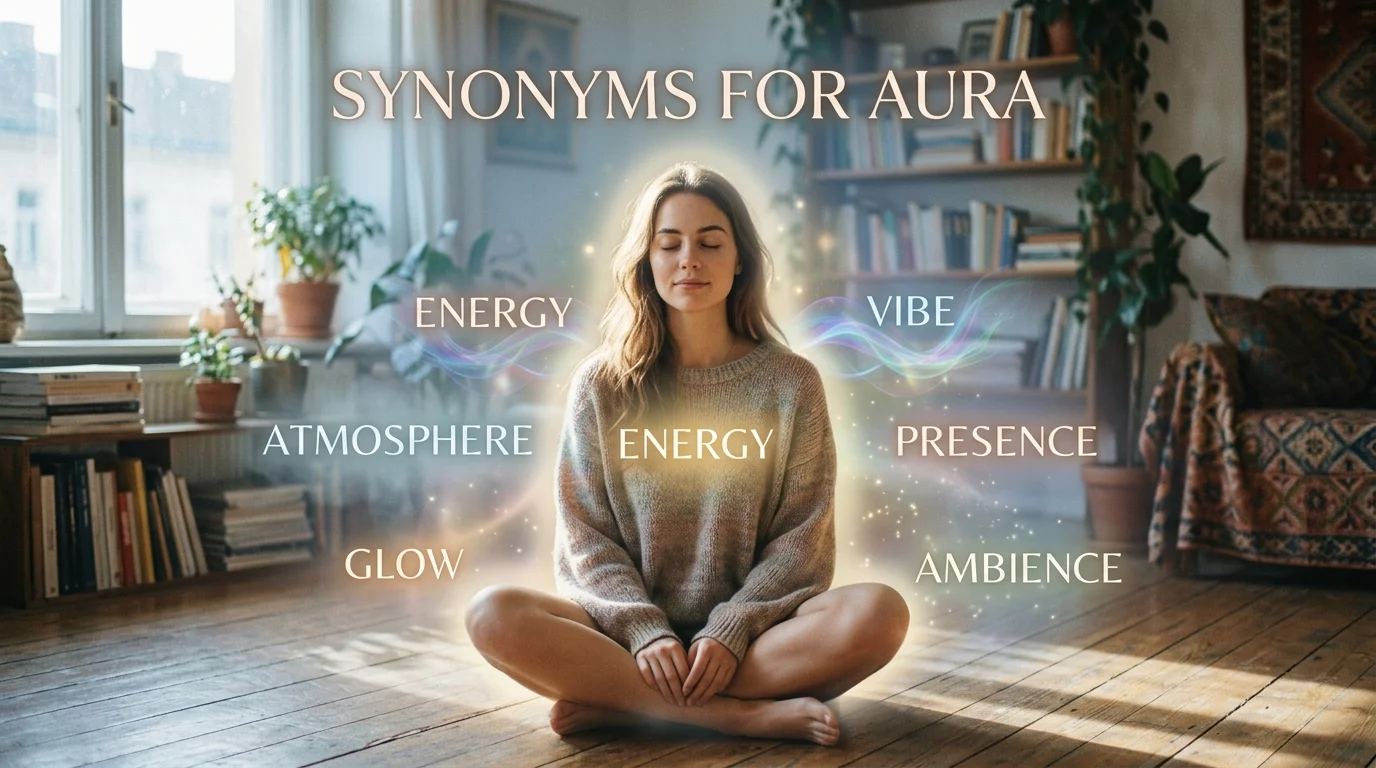
Sentence Transformations
1. Person’s presence
Original:
The actor has a powerful aura.
Alternative:
The actor has a powerful presence.
Why: Presence is more direct when describing the effect a person has on others.
2. Place
Original:
The café has a warm aura.
Alternative:
The café has a warm atmosphere.
Why: Atmosphere naturally describes the mood of a place.
3. Casual writing
Original:
This neighborhood has a relaxed aura.
Alternative:
This neighborhood has a relaxed vibe.
Why: Vibe is informal and natural in casual writing and conversation.
4. Mystery
Original:
The singer has an aura of mystery.
Alternative:
The singer has an air of mystery.
Why: An air of mystery is a natural and established expression.
5. Personal magnetism
Original:
The speaker has a compelling aura.
Alternative:
The speaker has considerable charisma.
Why: Charisma specifically identifies the ability to attract and influence others.
6. Attractive quality
Original:
The city has an aura that attracts artists.
Alternative:
The city has an allure that attracts artists.
Why: Allure emphasizes the city’s power to attract.
7. Mysterious quality
Original:
The brand has a mysterious aura.
Alternative:
The brand has a certain mystique.
Why: Mystique captures an intriguing quality created by mystery or glamour.
8. Positive quality
Original:
She has a positive aura.
Alternative:
She gives off positive energy.
Why: Energy is a natural contemporary expression for the emotional quality someone projects.
9. Literary description
Original:
The old castle has a dark aura.
Alternative:
The old castle has an air of darkness.
Why: An air of provides a literary way to describe an intangible quality.
10. Clearer writing
Original:
The room had an aura of calm.
Alternative:
The room had a calm atmosphere.
Why: Atmosphere is clearer when describing an environmental mood.
Grammar and Usage
“Aura” Is a Noun
Common structures include:
an aura of confidence
an aura of mystery
an aura of authority
an aura of elegance
an aura of calm
an aura of danger
an aura of sophistication
an aura of positivity
Common verbs
have an aura
create an aura
give off an aura
project an aura
convey an aura
radiate an aura
exude an aura
Examples
She has an aura of confidence.
The room creates an aura of calm.
He gives off an aura of authority.
The building has an aura of mystery.
“Aura of” vs. “Aura Around”
Both structures can be grammatical, but they serve slightly different purposes.
Aura of
Usually describes the quality being associated with something.
an aura of mystery
an aura of confidence
an aura of elegance
Aura around
Emphasizes something seemingly surrounding a person or object.
There was an aura around the performer.
The aura of + quality structure is much more common in ordinary descriptive writing.
Common Collocations With Aura
Natural combinations include:
- aura of mystery
- aura of confidence
- aura of authority
- aura of elegance
- aura of sophistication
- aura of calm
- aura of danger
- aura of power
- aura of romance
- aura of serenity
- aura of positivity
- aura of importance
- aura of exclusivity
- aura of secrecy
- aura of excitement
Common Mistakes
1. Treating “aura” as exactly the same as “atmosphere”
They overlap, but atmosphere is primarily about the mood of a setting or situation.
2. Using “vibe” in formal writing
Vibe is perfectly natural in casual English but may sound too informal in academic or professional prose.
3. Using “charisma” for every positive aura
Charisma specifically involves personal magnetism. A calm or peaceful aura is not necessarily charismatic.
4. Using “energy” when you mean mystery
Energy usually suggests an emotional or dynamic quality. Mystique or an air of mystery may be more precise.
5. Assuming “aura” always has a spiritual meaning
In ordinary English, aura often simply means an intangible quality or impression. It does not automatically refer to a supernatural energy field.
6. Replacing “aura” with “essence”
Essence means fundamental nature, not simply the feeling something creates.
7. Using “ambiance” for a person
Ambiance is normally associated with an environment or setting. Presence is usually better for a person.
8. Confusing the medical meaning
In medical contexts, aura can refer to a specific neurological phenomenon. Ordinary alternatives such as vibe or atmosphere would completely change the meaning.
When Not to Replace “Aura”
Sometimes aura is the best word because it deliberately leaves the quality somewhat intangible or difficult to define.
For example:
The artist has an aura that is difficult to describe.
Replacing it with:
The artist has an atmosphere that is difficult to describe.
would sound unnatural because atmosphere usually belongs to an environment.
Likewise:
The ancient temple has an aura of mystery.
has a slightly more evocative quality than:
The ancient temple has a mysterious atmosphere.
Both are possible, but the original may better convey the sense of a distinctive, almost intangible quality.
Which Synonym Should You Choose?
For a person’s overall effect
Use presence.
For a place’s mood
Use atmosphere or ambiance.
For casual conversation
Use vibe, energy, or feel.
For personal magnetism
Use charisma or magnetism.
For an attractive quality
Use allure or charm.
For mystery or glamour
Use mystique.
For an intangible appearance or quality
Use air.
For fundamental nature
Use essence.
For emotional quality
Use mood or feeling.
For writing or communication
Use tone.
For a distinctive place or culture
Use character or spirit.
For a glowing or beautiful quality
Use radiance or glow.
Editor’s Choice: The Most Useful Alternatives
If you need a small set of reliable choices rather than a long thesaurus list, these are particularly useful:
- Atmosphere — best for places and environments
- Presence — best for people
- Vibe — best for casual language
- Air — best for an intangible quality, especially “an air of…”
- Charisma — best for personal magnetism
- Mystique — best for mystery or glamour
- Ambiance — best for the mood of a setting
- Energy — best for an emotional quality someone projects
These are not ranked by quality; they simply cover different meanings of aura.