
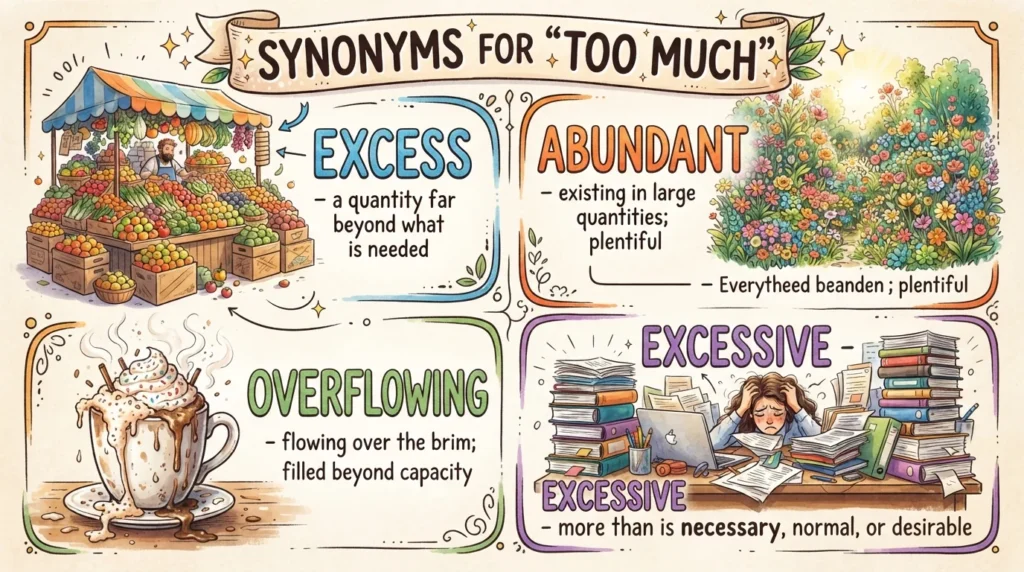
Quick Synonym List
Too much has several meanings, so its alternatives are best grouped by context.
Meaning | |
|---|---|
Excessive amount | Excessive, an excess of, more than necessary, surplus, overabundance |
Excessive degree | Excessively, overly, unduly, inordinately, excessively so |
Very large quantity | Enormous amount, vast amount, tremendous amount, abundance |
More than needed | Unnecessary, surplus, superfluous, redundant, extra |
Too high a price | Excessive, overpriced, exorbitant, unreasonable, inflated |
Excessive behavior | Overdoing it, going overboard, overindulgence, excess |
Excessive demands | Unreasonable, excessive, unrealistic, disproportionate |
Overwhelming quantity | Overwhelming, unmanageable, more than one can handle |
Informal expressions | Way too much, over the top, a bit much, overkill, going overboard |
Important: Not every large amount is too much. Words such as abundance, enormous, and plentiful describe quantity but do not necessarily suggest that the amount is excessive or undesirable.
What Does “Too Much” Mean?
Too much describes an amount, degree, or intensity that exceeds what is necessary, appropriate, desirable, or manageable.
It can refer to quantities, emotions, prices, behavior, responsibilities, and many other situations.
Consider these examples:
“There’s too much sugar in this coffee.” — An excessive quantity.
“He worries too much.” — An excessive degree of an activity.
“The jacket costs too much.” — A price that is higher than acceptable.
“The workload is too much for one person.” — An overwhelming amount.
“His reaction was too much.” — Behavior that was excessive or inappropriate.
Although the expression is common in everyday English, a more specific alternative can make writing clearer by identifying exactly what is excessive.
The Best Synonyms for Too Much
1. Excessive
Meaning: Greater than what is necessary, normal, reasonable, or acceptable.
Tone: Neutral to formal.
Best for: Spending, consumption, noise, behavior, costs, and professional writing.
Example: Excessive screen time can interfere with other daily activities.
How it differs: Excessive is one of the closest general alternatives, especially when too much describes a noun. However, the grammar often needs to change.
Instead of “The project requires too much paperwork,” write “The project requires excessive paperwork.”
2. Excessively
Meaning: To a degree that exceeds what is reasonable or appropriate.
Tone: Professional or formal.
Best for: Describing actions, qualities, intensity, and behavior.
Example: The instructions were excessively complicated.
Watch out: Excessively is an adverb. Use it to modify adjectives, adverbs, or actions rather than directly replacing every instance of too much.
3. Overly
Meaning: To an excessive degree.
Tone: Neutral or professional.
Best for: Descriptions of emotions, behavior, complexity, and personal qualities.
Example: The manager was overly critical of minor mistakes.
How it differs: Overly is particularly natural before adjectives, such as overly complicated, overly cautious, and overly expensive.
4. An Excess Of
Meaning: An amount greater than what is necessary or desirable.
Tone: Neutral to formal.
Best for: Quantities, resources, consumption, and analytical writing.
Example: An excess of unnecessary details made the report difficult to read.
Watch out: This noun phrase usually requires a different sentence structure from too much.
5. More Than Necessary
Meaning: A quantity or degree greater than what is actually needed.
Tone: Neutral.
Best for: Everyday communication, instructions, spending, and resource management.
Example: We purchased more equipment than necessary.
How it differs: This expression clearly identifies the standard being exceeded: necessity.
6. Unduly
Meaning: To an unreasonable, inappropriate, or excessive degree.
Tone: Formal.
Best for: Academic writing, legal discussions, professional evaluations, and criticism.
Example: The new requirements placed an unduly heavy burden on small businesses.
Watch out: Unduly usually modifies an adjective or verb. It is more formal than too much and may sound unnatural in casual conversation.
7. Inordinately
Meaning: To an unusually or excessively high degree.
Tone: Formal or literary.
Best for: Strong descriptions of cost, complexity, duration, and intensity.
Example: The application process was inordinately complicated.
How it differs: Inordinately emphasizes a degree that is unusually high, often beyond reasonable expectations.
8. Overabundance
Meaning: A quantity that is greater than what is needed or desirable.
Tone: Neutral to formal.
Best for: Supplies, information, resources, choices, and descriptive writing.
Example: An overabundance of options made the decision more difficult.
Watch out: Overabundance refers to quantity. It does not naturally replace too much when describing the intensity of an action.
9. Surplus
Meaning: An amount remaining after requirements have been met.
Tone: Neutral, professional, or technical.
Best for: Inventory, resources, production, finance, and supplies.
Example: The warehouse had a surplus of winter clothing.
How it differs: A surplus is not necessarily a problem. It can be useful, profitable, or deliberately maintained.
10. Superfluous
Meaning: Unnecessary because more than enough already exists.
Tone: Formal.
Best for: Writing, explanations, procedures, features, and unnecessary details.
Example: The editor removed several superfluous paragraphs.
How it differs: Superfluous describes something unnecessary rather than simply excessive in quantity.
11. Disproportionate
Meaning: Too large, strong, or severe in relation to something else.
Tone: Formal or professional.
Best for: Responses, penalties, spending, workloads, and comparisons.
Example: The penalty seemed disproportionate to the minor violation.
Watch out: This word requires an implied or explicit comparison. It is not a general substitute for every use of too much.
12. Overwhelming
Meaning: So great in amount or intensity that it becomes difficult to manage.
Tone: Neutral to expressive.
Best for: Responsibilities, emotions, workloads, information, and experiences.
Example: The number of messages became overwhelming.
How it differs: Overwhelming emphasizes the effect on someone rather than simply the quantity involved.
13. Exorbitant
Meaning: Unreasonably or excessively high, especially in price.
Tone: Formal or emphatic.
Best for: Prices, fees, rent, and financial charges.
Example: The hotel charged exorbitant prices during the holiday weekend.
Watch out: Exorbitant is considerably stronger than expensive. It expresses criticism of the amount being charged.
14. Overpriced
Meaning: Priced higher than the item or service is considered to be worth.
Tone: Neutral to critical.
Best for: Shopping, products, housing, and services.
Example: The apartment was overpriced for its size and condition.
How it differs: Overpriced evaluates value for money, while too much may simply mean that something exceeds a person’s budget.
15. Overkill
Meaning: More effort, force, complexity, or resources than a situation requires.
Tone: Informal.
Best for: Everyday decisions, equipment, preparation, and workplace conversations.
Example: Hiring ten people for such a small task would be overkill.
Watch out: Overkill is a noun and is usually unsuitable for formal academic writing.
16. Going Overboard
Meaning: Doing something to an excessive or unreasonable degree.
Tone: Informal.
Best for: Spending, decorating, celebrating, preparing, and personal behavior.
Example: They went overboard with the decorations for the party.
How it differs: This expression usually describes someone’s actions rather than a static quantity.
17. Over the Top
Meaning: Excessive, exaggerated, or more dramatic than necessary.
Tone: Informal.
Best for: Reactions, clothing, performances, decorations, and behavior.
Example: His reaction to the small mistake was over the top.
Watch out: Over the top can also be complimentary when describing an extravagant performance or entertaining style. Context determines the tone.
18. A Bit Much
Meaning: Somewhat excessive, unreasonable, or difficult to accept.
Tone: Informal and conversational.
Best for: Polite criticism, social situations, prices, and behavior.
Example: Asking everyone to work through the weekend seems a bit much.
How it differs: This expression can soften criticism, although the speaker may still feel strongly about the situation.
Synonyms for Too Much by Context
Too Much Work
When a workload exceeds what someone can reasonably manage, alternatives include excessive workload, overwhelming responsibilities, unmanageable workload, unreasonable demands, and work overload.
Compare:
“The manager assigned too much work.”
“The manager assigned an excessive amount of work.”
“The manager assigned an unmanageable workload.”
The first simply identifies excess. The second sounds more professional. The third emphasizes that the work cannot reasonably be handled with the available resources.
In professional communication, describing the specific problem is often more useful than merely saying there is too much work.
Too Much Money
The right alternative depends on whether a price is unusually high, poor value, or simply beyond someone’s budget.
Alternative | Meaning | Example |
|---|---|---|
Expensive | Costs a large amount | The laptop is expensive. |
Overpriced | Costs more than its perceived value | The laptop is overpriced. |
Exorbitant | Unreasonably high | The repair fees were exorbitant. |
Unaffordable | Beyond someone’s financial means | The rent is unaffordable for many residents. |
Excessive | Greater than reasonable or necessary | The company charged excessive fees. |
An expensive product is not automatically overpriced. Similarly, something can be reasonably priced but unaffordable for a particular buyer.
Too Much Food
For food, useful expressions include excess food, excessive portions, an overabundance of food, more food than necessary, and more than enough to eat.
If you are describing the act of eating rather than the quantity of food, use overeating, overindulging, or eating excessively.
For example, “We prepared too much food” can become “We prepared more food than necessary.” However, “He eats too much” can become “He tends to overeat.”
These sentences describe different things: the first concerns preparation, while the second concerns consumption.
Too Much Information
Useful alternatives include information overload, excessive detail, overwhelming information, unnecessary detail, and an overabundance of information.
“Information overload” is especially useful when someone receives more information than they can effectively process.
“Excessive detail” is more precise when the problem is unnecessary explanation rather than the total volume of information.
Too Much Emotion or Intensity
When too much describes emotional intensity, use overly emotional, excessively intense, overwhelming, extreme, exaggerated, or disproportionate, depending on the circumstances.
For example:
“His response was too much.”
“His response was disproportionate to the situation.”
The second sentence identifies the relationship between the reaction and the event that prompted it.
Be careful with terms such as overly emotional. They can sound dismissive when used to characterize another person’s feelings. Describing the specific behavior or its effects is often clearer.
Too Much Noise
Natural alternatives include excessive noise, overwhelming noise, unbearable noise, deafening noise, and an unacceptable noise level.
These expressions differ in strength. Excessive noise identifies a level that exceeds an acceptable limit. Deafening describes extremely loud sound, while unbearable emphasizes the listener’s experience.
Too Much vs. Too Many vs. Excessive
One of the most common vocabulary mistakes is using too much with the wrong kind of noun.
Used with uncountable nouns
Too much water, too much noise, too much information.
Used with plural countable nouns
Too many books, too many mistakes, too many visitors.
An adjective used with both types of nouns
Excessive spending, excessive delays, excessive consumption.
Excessive is useful because it can work with both countable and uncountable nouns. However, it is more formal than too much or too many.
True Synonyms vs. Related Alternatives
Alternative | Relationship | Direct replacement? | Best use |
|---|---|---|---|
Excessive | With grammatical changes | General excess | |
Excessively | Close adverbial alternative | Often, with changes | Excessive degree |
Overly | Close adverbial alternative | Sometimes | Adjectives and qualities |
More than necessary | Phrase-level alternative | Often | Unneeded quantities |
Unduly | Formal alternative | Sometimes | Unreasonable intensity |
Inordinately | Stronger formal alternative | Sometimes | Unusually high degree |
Overabundance | Contextual alternative | With changes | Excessive quantity |
Surplus | Related concept | Sometimes | Extra resources |
Superfluous | Related concept | Sometimes | Unnecessary elements |
Disproportionate | Contextual alternative | Sometimes | Relative excess |
Overwhelming | Related alternative | Sometimes | Unmanageable intensity |
Exorbitant | Specific alternative | Only for prices or charges | Financial excess |
Overkill | Informal contextual alternative | With changes | Unnecessary effort |
Going overboard | Idiomatic alternative | With changes | Excessive behavior |
How to Choose the Right Alternative
What kind of excess are you describing?
Suggested alternative
Excessive
The process requires excessive paperwork.
10 Sentence Transformations
Original | Better alternative | Why |
|---|---|---|
The report contains too much information. | The report contains excessive detail. | Identifies unnecessary detail. |
She spends too much money on subscriptions. | She spends excessively on subscriptions. | More concise and formal. |
The instructions are too much for beginners. | The instructions are overly complicated for beginners. | Identifies complexity. |
We bought too much equipment. | We purchased more equipment than necessary. | Identifies unnecessary quantity. |
The rent is too much for our budget. | The rent is unaffordable for us. | Emphasizes affordability. |
The restaurant charges too much. | The restaurant charges exorbitant prices. | Expresses stronger criticism of pricing. |
His reaction was too much. | His reaction was disproportionate. | Identifies excessive intensity relative to the situation. |
There’s too much work to finish today. | The workload is unmanageable today. | Emphasizes capacity. |
They did too much for a small event. | They went overboard for a small event. | Natural informal expression. |
The project uses too many unnecessary resources. | The project uses excessive resources. | More concise and professional. |
Grammar and Usage
Too much can function in several ways.
Before an uncountable noun: “There is too much traffic.”
After a verb: “He complains too much.”
As a pronoun-like expression: “You’ve already done too much.”
With an adjective in the pattern too much of a: “It’s too much of a risk.”
Do not confuse too much with very much. “I like this very much” expresses a high degree of liking without necessarily suggesting excess. “I worry too much” suggests that the degree of worrying is undesirable.
The pattern too + adjective is often more natural than too much:
Too expensive, rather than “too much expensive.”
Too complicated, rather than “too much complicated.”
Too loud, rather than “too much loud.”
You can also use much too for emphasis: “The room is much too hot.”
Common Mistakes
Using too much with plural countable nouns. Say “too many books,” not “too much books.”
Using overly before a noun without an adjective. Write “excessive spending” or “spending excessively,” not “overly spending” in ordinary usage.
Treating abundance as inherently negative. An abundance of resources may be beneficial.
Confusing expensive with overpriced. A high price does not necessarily mean poor value.
Using exorbitant for minor excess. It suggests a notably unreasonable amount.
Using surplus as a universal synonym. Surplus resources can be desirable.
Overusing strong words such as unbearable. These suggest a more severe experience than ordinary excess.
Replacing too much when it is already clear. “I ate too much” is natural and does not need to become “I consumed an excessive quantity of food.”
When “Too Much” Is the Better Expression
Too much is often the clearest choice in everyday conversation. It is short, familiar, and works with many different situations.
For example, “You’re worrying too much” sounds more natural in casual speech than “You’re worrying inordinately.”
Likewise, “This costs too much” may be preferable to overpriced when the issue is your budget rather than the item’s actual value.
A more formal word is useful only when it communicates the intended meaning more accurately.