
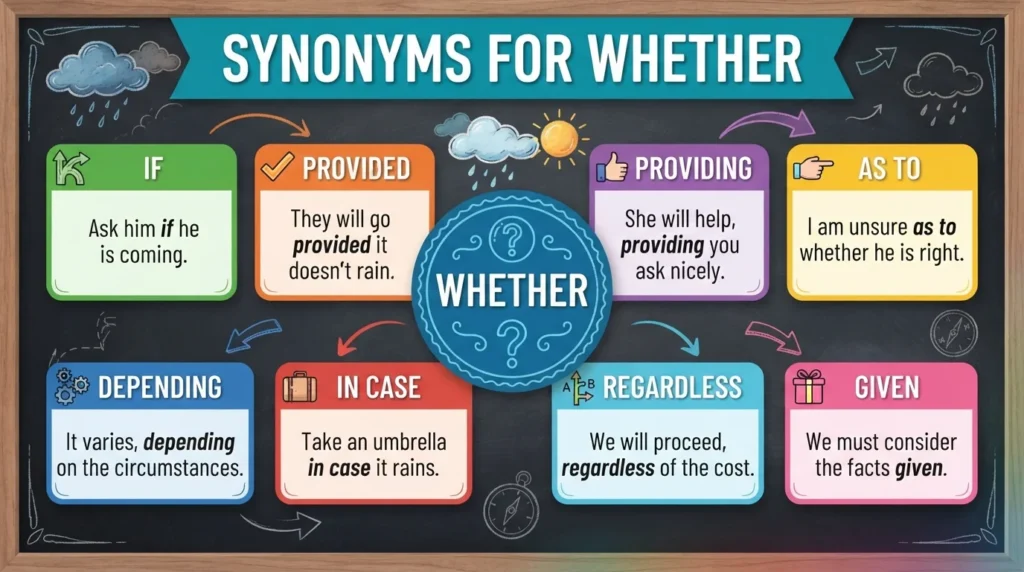
Quick Synonym Reference
Closest alternatives
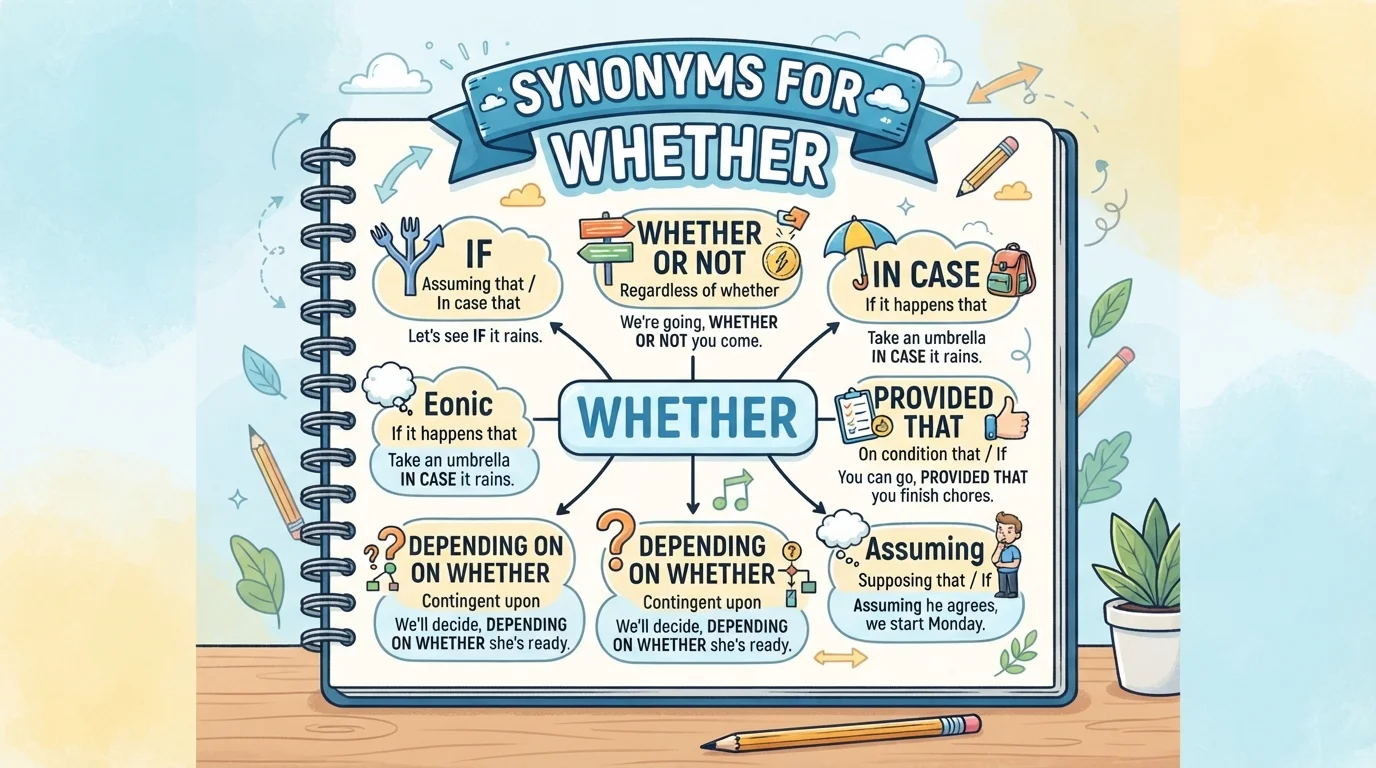
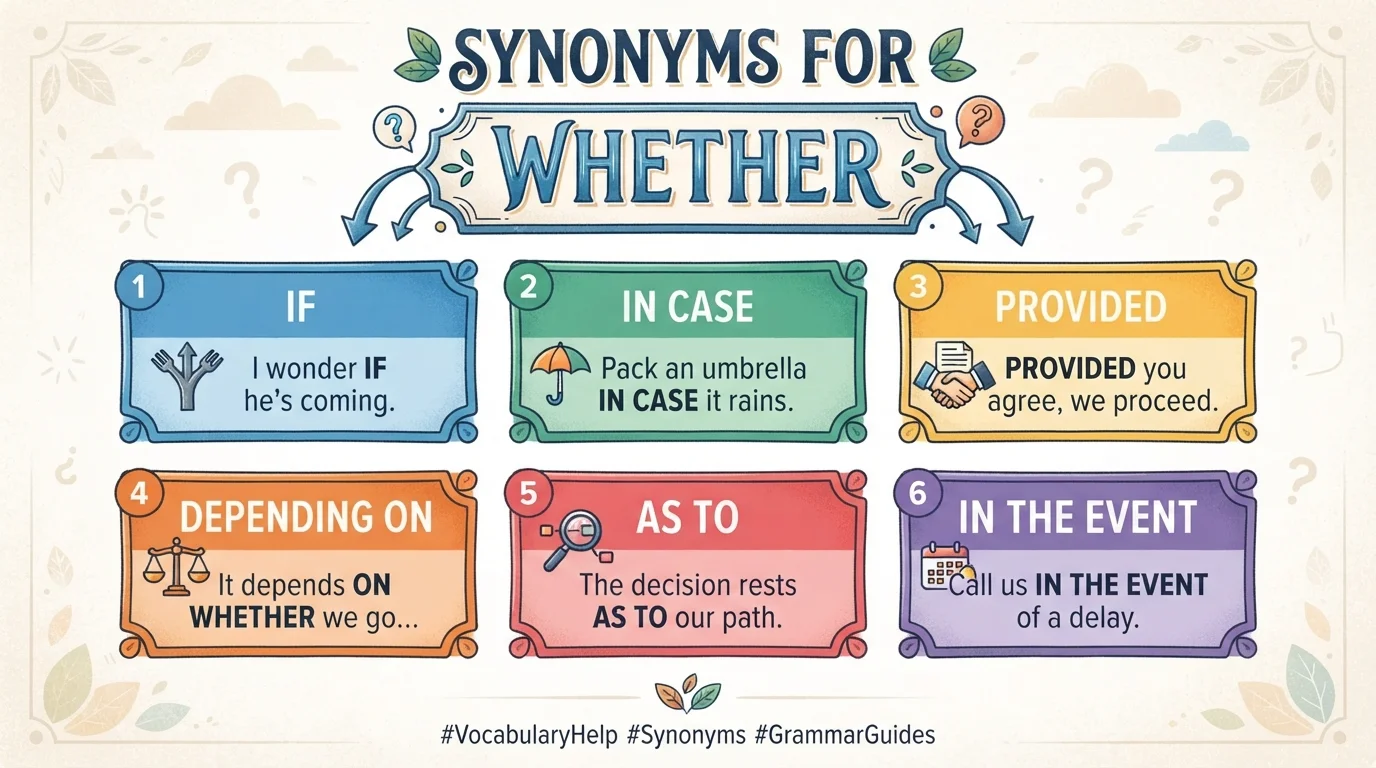
- If
- Whether or not
- Regardless of whether
- No matter whether
- Irrespective of whether
- Depending on whether
For uncertainty or two possibilities
- If
- Whether or not
- If or not
- Whether…or
- Either…or
- Depending on whether
For “regardless of which possibility”
- Regardless of whether
- Irrespective of whether
- No matter whether
- No matter if
- Whether or not
- Regardless of if
For conditional situations
- If
- Depending on whether
- Provided that
- Assuming that
- In case
- On the condition that
For formal writing
- Whether
- Whether or not
- Regardless of whether
- Irrespective of whether
- Depending on whether
- On the question of whether
- As to whether
Useful sentence-level alternatives
- Regardless
- Either way
- In either case
- In any event
- No matter what
- Whatever the case
- Regardless of the outcome
What Does “Whether” Mean?
Whether is mainly used to introduce two or more possibilities, uncertainty, or a choice between alternatives.
For example:
“I don’t know whether she will come.”
The speaker is uncertain about two possibilities:
- She will come.
- She will not come.
It can also introduce alternatives:
“We need to decide whether to stay or leave.”
Here, whether presents a choice between two actions.
It can also mean that something applies regardless of which possibility is true:
“Whether you agree or disagree, the decision has been made.”
The exact meaning matters because alternatives such as if, regardless of whether, and either…or perform different grammatical jobs.
The Closest Synonym for Whether: “If”
If is the closest everyday alternative to whether in some constructions.
Compare:
“I don’t know whether he is coming.”
“I don’t know if he is coming.”
Both are natural in ordinary English.
However, if is not a universal replacement.
Whether
“We need to decide whether to stay.”
If
“We need to decide if we should stay.”
The second sentence is possible, but the grammatical structure has changed.
More importantly, whether is usually preferred when there are explicit alternatives:
“I don’t know whether he will stay or leave.”
Here, whether clearly introduces the alternatives.
If is less natural:
“I don’t know if he will stay or leave.”
This is possible, but whether is often the clearer choice.
Whether vs. If
This is the most important distinction to understand.
Use “whether” for explicit alternatives
“She asked whether I wanted tea or coffee.”
The alternatives are stated directly.
Use “whether” before “or not”
“I don’t know whether or not he will come.”
This is standard and very natural.
Use “whether” after a preposition
“It depends on whether we have enough time.”
Using if here is generally less formal and can be awkward:
“It depends on if we have enough time.”
In careful formal writing, whether is the better choice.
Use “whether” before an infinitive
“We need to decide whether to continue.”
Not:
“We need to decide if to continue.”
This is one of the clearest grammatical reasons to choose whether.
“Whether or Not”
Whether or not means that the result applies in either case.
“Whether or not you agree, we have to proceed.”
This can be paraphrased as:
“Regardless of whether you agree, we have to proceed.”
Or:
“No matter whether you agree, we have to proceed.”
The phrase whether or not is often the most natural way to emphasize that both possibilities lead to the same result.
Examples
“Whether or not it rains, the event will continue.”
“Whether or not she accepts, we will move forward.”
“I don’t know whether or not he has received the message.”
Notice that whether or not has two related uses:
- Uncertainty:
“I don’t know whether or not he is coming.” - Regardless:
“Whether or not he comes, we will begin.”
“Regardless of Whether”
Regardless of whether means it does not matter which possibility is true.
“Regardless of whether you agree, the rule applies.”
It is more formal than:
“Whether or not you agree, the rule applies.”
Best for
- Professional writing
- Academic writing
- Formal instructions
- Reports
- Policies
- Legal or administrative writing
Example
“The policy applies regardless of whether the customer has an account.”
This clearly means that both possibilities are covered.
“Irrespective of Whether”
Irrespective of whether has essentially the same meaning as regardless of whether.
“The decision applies irrespective of whether the applicant is a resident.”
Tone: Formal
It is especially common in formal British and international English.
In American English, regardless of whether is often more natural.
“No Matter Whether”
No matter whether means that the result is the same regardless of the possibility.
“No matter whether you agree, we must continue.”
It is grammatical, but in many situations whether or not or regardless of whether sounds more natural.
Compare:
“No matter whether it rains, we will go.”
“Whether or not it rains, we will go.”
The second is often smoother.
“Depending on Whether”
Depending on whether means that the outcome changes according to which possibility is true.
“Depending on whether it rains, we may cancel the event.”
This is not a direct synonym for whether.
The difference is important:
“Whether it rains, we will go.”
means the statement concerns the two possibilities.
“Depending on whether it rains, we may cancel the event.”
means the result changes according to the condition.
Use this phrase when the answer or action is conditional.
“Either…Or”
Either…or presents two alternatives.
“We must decide whether to stay or leave.”
can become:
“We must choose either to stay or to leave.”
The grammatical structure changes, but the underlying idea of alternatives remains.
Whether
“I don’t know whether to call or email.”
Either…or
“I can either call or email.”
These are related, but not interchangeable word-for-word.
Whether often introduces uncertainty or a decision.
Either…or directly presents the alternatives.
“If or Not”
In some contexts, if…or not can express the same basic uncertainty as whether…or not.
“I don’t know if he is coming or not.”
“I don’t know whether he is coming or not.”
Both are common.
However, whether or not is usually preferred in formal writing.
“No Matter If”
No matter if can sometimes replace whether or not in informal English.
“No matter if it rains, we’ll go.”
However, many writers prefer:
“No matter whether it rains, we’ll go.”
or:
“Whether or not it rains, we’ll go.”
No matter if is therefore best treated as a contextual alternative rather than a direct replacement in every sentence.
“Regardless”
Sometimes regardless can replace a longer phrase when the context is already clear.
“Whether you agree or disagree, we will proceed.”
can become:
“We will proceed regardless.”
Here, regardless means the outcome does not change.
It cannot normally replace whether inside every sentence:
“I don’t know regardless he is coming.”
This is incorrect.
Instead:
“I don’t know whether he is coming.”
Or:
“I don’t know if he is coming.”
“Either Way”
Either way means that the result is the same whichever of two possibilities occurs.
“Whether we take the train or drive, we’ll arrive before noon.”
can become:
“We can take the train or drive. Either way, we’ll arrive before noon.”
It is a useful sentence-level alternative, not a direct replacement for whether.
“In Either Case”
In either case means the same result applies to either of two situations.
“Whether the application is approved or rejected, we will notify the applicant.”
can become:
“The application may be approved or rejected. In either case, we will notify the applicant.”
This is particularly useful in formal or professional writing.
“In Any Event”
In any event means that something remains true or will happen regardless of circumstances.
“Whether the negotiations succeed or fail, we will issue a statement.”
can become:
“The negotiations may succeed or fail. In any event, we will issue a statement.”
It is broader than whether and should not be used as a direct substitute in every sentence.
“Whatever the Case”
Whatever the case means regardless of the particular situation.
“Whether she agrees or disagrees, we will continue.”
can become:
“Whatever the case, we will continue.”
This is useful when the exact alternatives are already understood.
“On the Question of Whether”
On the question of whether is a formal phrase used when discussing an issue or decision.
“The committee debated whether the proposal should be approved.”
More formally:
“The committee debated the question of whether the proposal should be approved.”
This is useful in:
- Academic writing
- Legal writing
- Policy discussions
- Formal reports
However, it is often unnecessarily wordy in everyday writing.
“As to Whether”
As to whether means concerning the question of whether.
“There is some uncertainty as to whether the project will continue.”
It is formal and sometimes useful, but it can sound unnecessarily bureaucratic.
A simpler version is:
“There is some uncertainty about whether the project will continue.”
Or:
“It is unclear whether the project will continue.”
The simpler construction is often better.
True Synonyms vs. Related Alternatives
| Alternative | Relationship | Can Replace “Whether”? | Tone | Best Context |
|---|---|---|---|---|
| If | Closest contextual alternative | Sometimes | Neutral | Everyday speech, indirect questions |
| Whether or not | Close phrase-level alternative | Often | Neutral/formal | Uncertainty, two possibilities |
| Regardless of whether | Contextual alternative | Sometimes | Formal | Policies, reports, formal writing |
| No matter whether | Contextual alternative | Sometimes | Neutral | General statements |
| Irrespective of whether | Contextual alternative | Sometimes | Formal | Formal/professional writing |
| Depending on whether | Related conditional phrase | No | Neutral/formal | Conditional outcomes |
| Either…or | Related alternative structure | No | Neutral | Choices and alternatives |
| Either way | Sentence-level alternative | No | Neutral | Same outcome |
| In either case | Sentence-level alternative | No | Formal | Two possible situations |
| Regardless | Sentence-level alternative | No | Neutral/formal | Outcome unaffected |
| In any event | Related expression | No | Formal | Outcome despite circumstances |
| Whatever the case | Related expression | No | Neutral/formal | General circumstances |
| No matter if | Contextual alternative | Sometimes | Informal/neutral | Casual conditional statements |
| If or not | Related construction | Sometimes | Neutral | Informal uncertainty |
| As to whether | Formal phrase | Sometimes | Formal | Formal discussion |
| On the question of whether | Formal phrase | Sometimes | Formal | Academic/legal writing |
Whether Synonyms by Meaning
The best alternative depends on what whether is doing in the sentence.
| Meaning | Best Alternative | Example |
|---|---|---|
| Uncertainty | If | “I don’t know if she is coming.” |
| Two explicit alternatives | Whether…or | “Whether we stay or leave…” |
| Either possibility has same result | Whether or not | “Whether or not he agrees…” |
| Outcome unaffected | Regardless of whether | “Regardless of whether it rains…” |
| Outcome depends on condition | Depending on whether | “Depending on whether it rains…” |
| Present two choices | Either…or | “Either call or email.” |
| Same result either way | Either way | “Either way, we’ll continue.” |
| Same result in two cases | In either case | “In either case, we’ll notify them.” |
| Formal discussion of uncertainty | As to whether | “Questions remain as to whether…” |
Whether in Everyday English
In casual conversation, if often sounds more natural.
More conversational
“I don’t know if he’ll come.”
More formal
“I don’t know whether he will come.”
Both are standard.
However, whether is still common in everyday English, especially when alternatives are explicitly stated:
“I’m not sure whether to call him or wait.”
This sounds completely natural.
Whether in Professional Writing
Whether is often preferable in professional writing because it makes alternatives and uncertainty clear.
Example
Less formal:
“We need to see if the system is working.”
Professional:
“We need to determine whether the system is working.”
Another example
“The policy applies whether or not the customer submits a request.”
This is concise and precise.
Whether in Academic Writing
Academic writing frequently uses whether because it introduces questions, alternatives, and uncertainty without sounding conversational.
Examples
“The study examined whether the treatment affected outcomes.”
“Researchers investigated whether the results could be replicated.”
“It remains unclear whether the observed difference is statistically significant.”
Formal alternatives
Depending on the sentence:
- whether
- whether or not
- regardless of whether
- irrespective of whether
- depending on whether
- the question of whether
- the issue of whether
Do not replace whether merely to sound more academic. It is already a precise academic word.
Whether in Business and Workplace Writing
Useful alternatives include:
- whether
- if
- depending on whether
- regardless of whether
- whether or not
- either way
- in either case
Example
“We will decide whether to proceed after reviewing the results.”
Possible alternative:
“We will decide if we should proceed after reviewing the results.”
The first is often cleaner because whether + infinitive is a compact and standard construction.
Whether in Formal Documents
Whether is especially useful in policies, procedures, contracts, and formal notices.
“The fee applies whether or not the customer cancels the reservation.”
“Eligibility will be determined regardless of whether the applicant has prior experience.”
In formal writing, whether can be clearer than if because if may sometimes be interpreted as introducing a condition rather than an alternative.
Whether + Infinitive
One of the most useful structures with whether is:
whether + to + verb
Examples:
- whether to stay
- whether to go
- whether to accept
- whether to continue
- whether to apply
- whether to respond
- whether to invest
- whether to proceed
Examples
“I don’t know whether to accept the offer.”
“The committee must decide whether to continue.”
“She is considering whether to apply.”
You generally cannot use if + infinitive in the same way:
“I don’t know if to accept the offer.” ❌
Use:
“I don’t know whether to accept the offer.” ✓
Or restructure it:
“I don’t know if I should accept the offer.” ✓
Whether…Or
Whether…or explicitly presents alternatives.
“We must decide whether to stay or leave.”
“Whether you agree or disagree, the policy will remain in effect.”
“She could not decide whether to call or wait.”
The alternatives can be:
- nouns
- verbs
- adjectives
- clauses
- entire situations
Nouns
“I don’t know whether tea or coffee is better.”
Verbs
“She couldn’t decide whether to stay or leave.”
Adjectives
“I’m not sure whether the answer is correct or incorrect.”
Clauses
“We don’t know whether the system failed or the connection was interrupted.”
Whether or If After Prepositions
In careful formal English, whether is normally preferred after a preposition.
Preferred
“It depends on whether they agree.”
Less formal
“It depends on if they agree.”
The second construction is common in actual usage, particularly in speech, but whether is the safer choice in formal writing.
Other examples:
“There is uncertainty about whether the plan will work.”
“The decision depends upon whether funding is available.”
“They disagreed over whether the proposal was practical.”
Whether vs. “If” in Meaning
Sometimes if introduces a condition while whether introduces uncertainty.
Compare:
“If it rains, we will stay home.”
This means rain is a condition for staying home.
Now compare:
“I don’t know whether it will rain.”
This expresses uncertainty.
The two words can overlap in indirect questions:
“I don’t know if it will rain.”
But they are not identical in all grammatical structures.
Common Mistakes
Mistake 1: Assuming “if” always replaces “whether”
It does not.
Incorrect:
“I don’t know if to go.”
Correct:
“I don’t know whether to go.”
Or:
“I don’t know if I should go.”
Mistake 2: Using “whether” when you mean a condition
“Whether it rains, we will stay home.”
This is not the normal way to express a conditional relationship.
Use:
“If it rains, we will stay home.”
Or, if the meaning is that the result is the same either way:
“Whether or not it rains, we will stay home.”
The addition of or not changes the meaning.
Mistake 3: Confusing “whether or not” with ordinary “whether”
Compare:
“I don’t know whether he will come.”
This expresses uncertainty.
“Whether or not he comes, we will begin.”
This means the outcome does not depend on his attendance.
Mistake 4: Using “either…or” as a direct replacement
You cannot simply substitute either for whether.
“I don’t know either to stay or leave.” ❌
Use:
“I don’t know whether to stay or leave.” ✓
Or:
“I can either stay or leave.” ✓
The sentence structure changes.
Mistake 5: Overusing formal phrases
“The committee must determine as to whether the proposal is acceptable.”
This is unnecessarily wordy.
Better:
“The committee must determine whether the proposal is acceptable.”
Clear writing does not require a longer synonym.
Mistake 6: Using “regardless” where “whether” is required
Incorrect:
“I don’t know regardless he will come.”
Correct:
“I don’t know whether he will come.”
Or:
“Regardless of whether he comes, we will continue.”
Mistake 7: Treating “depending on whether” as a direct synonym
Compare:
“I don’t know whether the store is open.”
with:
“Depending on whether the store is open, we may go there.”
The second sentence means the action changes according to the condition.
When Not to Replace “Whether”
Whether is often the best word because it is short, precise, and grammatically flexible.
Do not replace it simply to avoid repetition.
For example:
“The researchers examined whether the treatment was effective.”
This is already clear and professional.
Changing it to:
“The researchers examined the question of whether the treatment was effective.”
adds words without adding meaning.
Likewise:
“I don’t know whether to go.”
is more concise than:
“I don’t know as to whether I should go.”
Use an alternative when it adds a genuine distinction:
- if → more conversational conditional/indirect-question wording
- whether or not → emphasizes both possibilities
- regardless of whether → outcome is unaffected
- depending on whether → outcome changes with the condition
- either…or → presents explicit choices
- either way → result is the same
Sentence Transformations
1. Everyday uncertainty
Original:
“I don’t know whether he is coming.”
Alternative:
“I don’t know if he is coming.”
Why:
If is a natural conversational alternative in an indirect question.
2. Formal writing
Original:
“We need to decide whether the proposal should be accepted.”
Alternative:
“We need to determine whether the proposal should be accepted.”
Why:
The word whether remains because it is already precise; only the main verb changes.
3. Explicit alternatives
Original:
“She couldn’t decide whether to stay or leave.”
Alternative:
“She couldn’t decide between staying and leaving.”
Why:
Between can restructure the sentence around two explicit alternatives.
4. Regardless of the outcome
Original:
“Whether you agree or disagree, we will proceed.”
Alternative:
“Regardless of whether you agree, we will proceed.”
Why:
The alternative emphasizes that the result is unaffected by the person’s position.
5. Same result either way
Original:
“Whether it rains or not, the event will continue.”
Alternative:
“Either way, the event will continue.”
Why:
Either way works when the two possible conditions are already understood.
6. Conditional outcome
Original:
“Whether the application is approved will determine the next step.”
Alternative:
“Depending on whether the application is approved, we will take the next step.”
Why:
The new sentence emphasizes that the next action changes according to the outcome.
7. Formal phrasing
Original:
“It is unclear whether the results are reliable.”
Alternative:
“There is uncertainty as to whether the results are reliable.”
Why:
As to whether creates a more formal structure, although the original is shorter and usually preferable.
8. Two possible cases
Original:
“Whether the payment arrives today or tomorrow, we will process it.”
Alternative:
“The payment may arrive today or tomorrow. In either case, we will process it.”
Why:
In either case works at sentence level and makes the two possible situations explicit.
9. Decision
Original:
“We must decide whether to continue.”
Alternative:
“We must decide if we should continue.”
Why:
If can replace whether when the sentence is restructured into a full clause.
10. Outcome unaffected
Original:
“Whether or not the customer responds, the request will be closed.”
Alternative:
“Regardless of whether the customer responds, the request will be closed.”
Why:
Regardless of whether makes the independence of the outcome especially explicit and works well in formal writing.
Common Collocations With Whether
Some structures occur especially often with whether.
Verbs + whether
- decide whether
- determine whether
- consider whether
- examine whether
- assess whether
- investigate whether
- establish whether
- question whether
- ask whether
- discuss whether
- debate whether
- wonder whether
- check whether
- confirm whether
- evaluate whether
- assess whether
- determine whether
- consider whether
Examples
“We need to determine whether the plan is feasible.”
“The researchers investigated whether the treatment was effective.”
“She wondered whether she had made the right choice.”
Nouns + whether
- question of whether
- issue of whether
- uncertainty about whether
- uncertainty as to whether
- decision about whether
- debate over whether
- doubt about whether
Examples:
“There is uncertainty about whether the project will continue.”
“The debate over whether the policy should change continued.”
Whether in Questions
Whether is frequently used in indirect questions.
Direct question
“Is she coming?”
Indirect question
“I don’t know whether she is coming.”
Another example:
Direct
“Should we stay?”
Indirect
“We need to decide whether we should stay.”
This is why whether is especially useful for expressing uncertainty without directly asking a question.
Whether vs. Whether or Not
The difference is often subtle.
Whether
“I don’t know whether he will come.”
The speaker is uncertain.
Whether or not
“I don’t know whether or not he will come.”
This makes the two possibilities—coming and not coming—more explicit.
But when the meaning is regardless, whether or not becomes especially useful:
“Whether or not he comes, we will start at eight.”
This means his attendance will not change the plan.
Whether vs. Regardless of Whether
These can express the same underlying idea in some sentences.
“Whether she agrees or disagrees, we will continue.”
“Regardless of whether she agrees, we will continue.”
The first presents the two alternatives.
The second emphasizes that the result is independent of the alternatives.
For concise general writing, the first is often more direct.
For formal policies and rules, the second can be useful:
“The policy applies regardless of whether the applicant has previous experience.”
Whether vs. Depending on Whether
These expressions point in opposite directions.
Whether
“Whether the project succeeds or fails, we will publish the results.”
The publication happens in either case.
Depending on whether
“Depending on whether the project succeeds or fails, we may change the schedule.”
The action depends on the outcome.
This distinction is essential.
Whether vs. Either…Or
Whether usually introduces uncertainty or a question involving alternatives.
“I don’t know whether to stay or leave.”
Either…or directly presents a choice.
“You can either stay or leave.”
A useful rule:
whether = question/uncertainty
either…or = choice/alternatives
The structures can express related ideas but should not be treated as interchangeable.
Whether vs. “No Matter Whether”
Both can describe alternatives whose outcome does not change.
“Whether you agree or disagree, the rule applies.”
“No matter whether you agree or disagree, the rule applies.”
The first is usually more concise.
No matter whether adds emphasis and can sound more conversational or emphatic.
Whether vs. “Whatever”
Whatever can sometimes replace a longer whether construction, but it changes the grammar.
“Whatever happens, we will continue.”
This is related to:
“Whether something good or bad happens, we will continue.”
But whatever means regardless of what happens, not specifically “whether one of two possibilities is true.”
Decision Guide
Use whether when:
- you are expressing uncertainty;
- two possibilities are being considered;
- you need the structure whether + to-infinitive;
- you are writing formally;
- alternatives are explicitly stated.
Use if when:
- the sentence is an indirect question;
- the meaning is conversational;
- no explicit alternatives are needed;
- the structure is a normal conditional clause.
Use whether or not when:
- both possibilities matter;
- you want to emphasize that something applies in either case.
Use regardless of whether when:
- the outcome is unaffected by the condition;
- you are writing a policy, report, or formal statement.
Use depending on whether when:
- the outcome changes according to the answer.
Use either…or when:
- you want to present two choices directly.
Use either way when:
- the result is the same regardless of the two alternatives.
Use in either case when:
- you are discussing two previously stated situations in formal or professional writing.
Editor’s Choice
Whether
The clearest general-purpose choice. It works especially well for uncertainty, alternatives, and whether + infinitive constructions.
If
The most natural everyday alternative in many indirect questions.
Whether or not
Best when you want to make both possible outcomes explicit or show that the result applies in either case.
Regardless of whether
Best for formal and professional writing when the outcome does not depend on the condition.
Depending on whether
Best when the result changes according to which possibility is true.