

Synonyms for social media Try is a versatile English word that can mean making an effort, attempting something difficult, testing a product, experimenting with a new approach, or sampling an unfamiliar experience. The most appropriate alternative depends on what you are trying to do and how much effort, uncertainty, or experimentation is involved.
For example, you might attempt a difficult task, test a new device, sample an unfamiliar food, or strive to achieve an important goal. These words overlap with try, but they do not express exactly the same meaning.
Quick Answer
Common synonyms for try include attempt, endeavor, strive, seek, aim, test, experiment, sample, undertake, and make an effort. Use attempt for a specific action, strive for sustained effort, test for checking performance, and sample for experiencing a small amount of something. The right alternative depends on whether you mean effort, experimentation, or evaluation.
Quick Synonym List
Meaning of try | |
|---|---|
Make an attempt | Attempt, endeavor, undertake, venture, have a go |
Make an effort | Strive, work toward, exert oneself, make an effort, do one’s best |
Pursue a goal | Seek, aim, aspire, pursue, work toward |
Test something | Test, evaluate, assess, examine, trial |
Experiment | Experiment, explore, investigate, pilot, explore alternatives |
Experience something new | Sample, experience, give something a try, try out |
Make a difficult attempt | Tackle, undertake, venture, attempt |
Make repeated attempts | Persist, persevere, keep trying, continue trying |
Informal alternatives | Give it a shot, have a go, take a crack at it, give it a whirl |
Formal alternatives | Attempt, endeavor, undertake, seek, evaluate |
Some entries are contextual alternatives rather than direct synonyms. Persist, for example, means continue despite difficulty, while try can describe just one attempt.
What Does Try Mean?
Try functions as both a verb and a noun.
As a verb, it commonly means to make an effort to do or achieve something:
“I’ll try to finish the report today.”
It can also mean testing something to determine whether it works:
“Try the new software before purchasing it.”
Another common meaning is experiencing or sampling something unfamiliar:
“You should try the new restaurant.”
As a noun, try refers to an attempt:
“Give it a try.”
The expression also has specialized legal and sporting meanings. For example, try a case means examine it in a court of law, while a try in rugby is a scoring action. Those meanings require different vocabulary.
The Closest Synonyms for Try
1. Attempt
Meaning: Make an effort to perform an action or achieve something, particularly when success is uncertain.
Tone: Neutral to formal.
Best for: Difficult tasks, specific actions, professional writing, and academic contexts.
Example: “The researchers attempted to replicate the experiment.”
How it differs: Attempt is one of the closest general synonyms for try. It often sounds more formal and can emphasize the possibility of failure.
“She tried to open the locked door.”
“She attempted to open the locked door.”
Both are natural, but the second sounds slightly more formal.
2. Endeavor
Meaning: Make a serious or determined effort to achieve something.
Tone: Formal.
Example: “The organization will endeavor to improve its services.”
Endeavor emphasizes purposeful effort and commitment. It is particularly common in formal statements, professional communication, and literary writing.
In ordinary conversation, try is usually more natural.
3. Strive
Meaning: Make a strong, sustained effort toward a goal.
Tone: Neutral to formal.
Example: “The team strives to maintain high standards.”
Strive is useful when effort continues over time and involves a meaningful objective.
It is not usually appropriate for a simple, one-time experiment.
4. Undertake
Meaning: Begin or accept responsibility for a task, project, or activity.
Tone: Professional or formal.
Example: “The company undertook a detailed review of its procedures.”
Undertake emphasizes committing to an activity rather than merely attempting it.
It does not necessarily imply uncertainty about success.
5. Venture
Meaning: Dare to do something involving uncertainty or risk.
Tone: Neutral to literary.
Example: “She ventured to suggest a different approach.”
Venture emphasizes the courage or uncertainty involved in an action.
It is useful when someone tries something unfamiliar or potentially risky.
6. Seek
Meaning: Attempt to obtain, achieve, or find something.
Tone: Neutral to professional.
Example: “The organization seeks to improve access to education.”
Seek is especially useful when describing goals, opportunities, solutions, or desired outcomes.
Unlike try, it does not necessarily describe the specific action taken.
7. Aim
Meaning: Intend or plan to achieve a particular result.
Tone: Neutral.
Example: “We aim to complete the project by Friday.”
Aim emphasizes intention rather than effort.
Someone can aim to achieve something without yet taking action, so it is not always interchangeable with try.
8. Test
Meaning: Examine something to determine its performance, quality, or effectiveness.
Tone: Neutral to technical.
Example: “The engineers tested the new equipment.”
Test is the appropriate alternative when try means checking whether something works.
It is common in science, technology, education, and product evaluation.
9. Experiment
Meaning: Try different methods or approaches to discover what happens or what works.
Tone: Neutral.
Example: “She experimented with different writing styles.”
Experiment suggests exploration and uncertainty. It is especially useful when there is no single established method or when several possibilities are being compared.
10. Sample
Meaning: Experience or examine a small amount of something to assess its qualities.
Tone: Neutral.
Example: “Visitors can sample several local dishes.
Sample is particularly useful for food, drinks, products, and other experiences that can be evaluated through limited exposure.
It does not naturally replace try when describing an effort to achieve a goal.
Grammar and Natural Usage
Try to Do vs. Try Doing
These two structures often have different meanings.
Try to + verb emphasizes making an effort to accomplish something.
“I tried to open the window, but it was stuck.”
Try + verb-ing often suggests experimenting with a possible solution.
“Try opening the window from the other side.”
The first describes an attempted action. The second proposes a method to see whether it works.
Try, Tried, Trying
Try is a regular verb with a spelling change in the past tense.
Form | Example |
|---|---|
Base form | “I try to exercise regularly.” |
Past tense | “I tried to call yesterday.” |
Past participle | “We’ve tried several approaches.” |
Present participle | “She’s trying to improve.” |
Try vs. Attempt
Both verbs can be followed by an infinitive.
“They tried to finish early.”
“They attempted to finish early.”
However, attempt is more formal and is less natural in some everyday expressions.
For example, “Try this cake” is natural, but “Attempt this cake” does not mean the same thing.
Try Out vs. Try On
Try out means test or experience something.
“I want to try out the new camera.”
Try on means put on clothing or accessories to check their fit or appearance.
“Can I try on this jacket?”
These phrasal verbs are not interchangeable.
Common Mistakes
1. Treating attempt and test as identical
Attempt describes an effort to do something. Test describes evaluating something.
You can attempt to repair a machine and then test it to see whether the repair worked.
2. Using strive for a minor, one-time action
Strive generally suggests sustained or determined effort. It may sound exaggerated when describing a simple activity such as trying a new snack.
3. Confusing try to do with try doing
Try to do usually emphasizes an attempt to achieve something. Try doing often introduces an experimental method.
4. Using sample for every new experience
Sample is natural for food, drinks, and some products or experiences. It is not a general substitute for attempting difficult tasks.
5. Treating seek as proof of effort
Seek describes pursuing or looking for something. It does not necessarily communicate how hard someone worked.
6. Using pilot for an ordinary attempt
Pilot generally describes a limited trial of a program, service, or process before wider use.
7. Confusing persistence with success
Persist and persevere describe continued effort. They do not guarantee that the desired outcome was achieved.
8. Replacing try unnecessarily
Try is clear, familiar, and natural in everyday English. A longer or more formal alternative may make a simple sentence awkward.
When Try Is the Better Word
Sometimes try is the clearest and most natural choice.
“Try restarting your computer.”
“I’d like to try the pasta.”
“I’ll try to arrive early.”
“Let’s try something different.”
These sentences do not need more elaborate vocabulary. In fact, replacing try with endeavor, undertake, or experiment could change the meaning or create an unnecessarily formal tone.
Use a more specific alternative when it adds useful information about effort, duration, uncertainty, evaluation, or experimentation.
Frequently Asked Questions
What is the closest synonym for try?
Attempt is one of the closest general synonyms when try means making an effort. When it means checking how something works, test is more appropriate.
What is a formal synonym for try?
Formal alternatives include attempt, endeavor, undertake, seek, and strive. Each has a different emphasis, so choose according to the intended meaning.
What is a stronger word for try?
Strive, persevere, and endeavor can suggest more serious or sustained effort. Persevere is particularly useful when someone continues despite difficulties.
What is a professional way to say try?
Depending on the context, use attempt, test, evaluate, seek, pilot, or work toward. For example, “We will evaluate the proposed solution” is more precise than “We will try the proposed solution” when assessment is the objective.
What is another word for try something new?
Experiment with, explore, experience, sample, and give something a try are useful alternatives. Sample works particularly well for food and products, while experiment emphasizes exploration.
What is the difference between try and attempt?
Both describe making an effort. Try is broader and more conversational, while attempt is slightly more formal and often emphasizes a particular action whose success is uncertain.
What is the opposite of try?
There is no single antonym for every meaning. Depending on context, alternatives include avoid, abandon, give up, refrain from, and decline. Give up describes stopping an effort, while avoid describes not attempting something.
Key Takeaways
Attempt is the closest general synonym for try when describing an effort to accomplish something.
Strive, endeavor, and persevere emphasize serious, sustained, or continued effort.
Test, evaluate, experiment, and pilot describe different ways of trying something to learn whether it works.
Sample is useful for food and limited experiences, while give it a shot is a natural informal expression.
Keep try when it is the clearest option. Choose a more specific verb when it improves accuracy or communicates the type of effort involved.
Conclusion
The best synonym for try depends on whether you mean making an attempt, working toward a goal, testing something, or exploring a new experience. Attempt is a close general alternative, while strive and endeavor suggest more sustained or serious effort. Test and evaluate are appropriate when assessing performance, and experiment emphasizes exploring possibilities.
For casual conversation, expressions such as give it a shot, have a go, and give it a whirl can create a friendly tone. In professional writing, attempt, seek, evaluate, and pilot often provide greater precision.
However, try remains one of the most useful everyday verbs because it is simple, flexible, and widely understood. Replace it when a more specific word adds meaning, not merely to avoid repetition.
SEO Title
Synonyms for Try: 40+ Alternatives With Meanings and Examples
Meta Description
Explore 40+ synonyms and related phrases for try, including attempt, strive, test, endeavor, and experiment, with meanings and natural examples.
URL Slug
synonyms-for-try
Internal-Link Opportunities
Anchor text | Suggested topic | Why it fits |
|---|---|---|
Synonyms for attempt | Alternatives for Try, Undertake and Endeavor | Explores the closest general meaning |
Synonyms for effort | Alternatives for Work, Exertion and Endeavor | Covers the effort-related sense |
Synonyms for strive | Alternatives for Pursue, Endeavor and Work Toward | Explores sustained effort |
Synonyms for test | Alternatives for Evaluate, Examine and Assess | Covers trying something to assess it |
Synonyms for experiment | Alternatives for Explore, Investigate and Test | Develops the experimentation meaning |
Synonyms for persevere | Alternatives for Persist, Continue and Keep Going | Explains repeated attempts despite difficulty |
Try vs. attempt | Differences in Meaning, Tone and Usage | Addresses a common vocabulary distinction |
Common phrasal verbs | Try Out, Try On and Other Everyday Expressions | Connects the topic to practical English usage |
Synonyms for Social Media: 30+ Alternatives With Meanings and Examples
Social media refers to digital platforms and services where people create, share, discover, and interact with content and other users. Common examples include Instagram, TikTok, Facebook, Reddit, and LinkedIn.
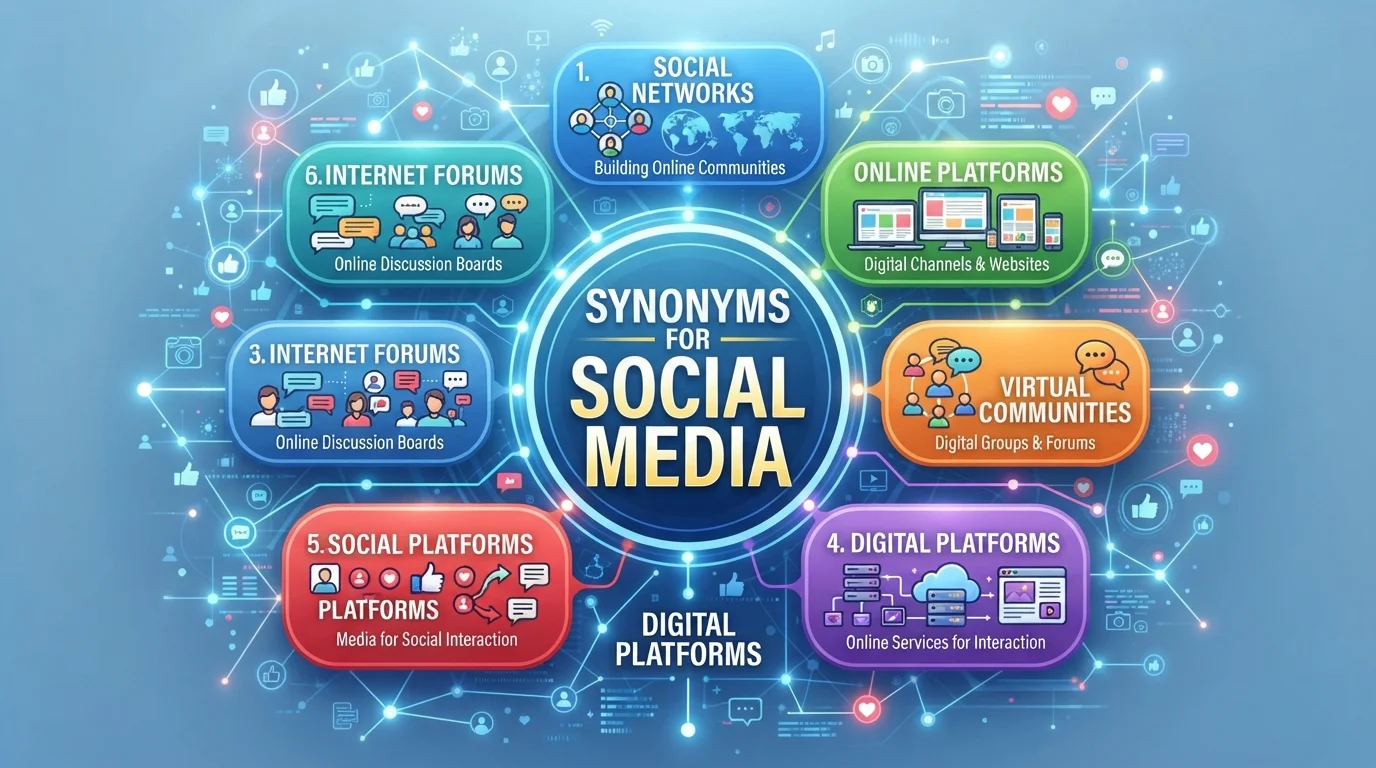
Although the term is widely understood, alternatives such as social networks, social platforms, online communities, and digital communities can be more precise in certain contexts. However, these expressions are not always interchangeable.
Quick Answer
Common synonyms and alternatives for social media include social networks, social platforms, social networking sites, online communities, digital communities, and social networking platforms. Use social networks for services built around connections, online communities for groups with shared interests, and digital platforms for a broader category of online services. No single alternative fits every context.
Quick Synonym List
Category | Alternatives |
|---|---|
Closest alternatives | Social platforms, social networking platforms, social networking sites, social networks |
General digital terms | Online platforms, digital platforms, web-based platforms, internet platforms |
Community-focused | Online communities, digital communities, virtual communities, interest-based communities |
Content-focused | Content-sharing platforms, media-sharing platforms, video-sharing platforms, photo-sharing platforms |
Communication-focused | Online communication platforms, social communication platforms, digital communication channels |
Professional and marketing | Social channels, social media channels, digital channels, online engagement platforms |
Informal expressions | Socials, social apps, social networking apps |
Broader related terms | Digital media, online media, new media, user-generated media, interactive media |
These are not 30 exact synonyms. Some refer to particular types of social media, while others describe broader digital services that may include websites, messaging applications, or other online tools.
What Does Social Media Mean?
Social media is a collective term for digital platforms that allow users to create, publish, share, and interact with content and other people.
Its defining features often include user-generated content, profiles or accounts, social interaction, and mechanisms for distributing or discovering content.

Content sharing
Users publish photographs, videos, text, links, and other media for others to discover and interact with.
Users establish connections, follow accounts, join groups, and interact with individuals or organizations.
People gather around shared interests, professions, experiences, or topics.
Not every digital platform is social media. An ordinary company website or a private file-storage service may be an online platform without providing the social interaction and content-sharing features typically associated with social media.
The Closest Alternatives to Social Media
1. Social Platforms
Meaning: Digital platforms designed for social interaction, networking, and content sharing.
Tone: Neutral to professional.
Example: “The company publishes educational content across several social platforms.”
How it differs: Social platforms is one of the closest and most versatile alternatives to social media. It emphasizes the services themselves rather than the content or broader communication environment.
It works naturally in marketing, technology, and everyday writing.
2. Social Networks
Meaning: Digital services or networks that connect people, organizations, and communities.
Tone: Neutral.
Example: “Professional social networks help people maintain industry connections.”
Social networks emphasizes relationships and connections between users.
It can refer to social media platforms, but it also has a broader meaning in sociology: networks of relationships that exist offline as well as online.
3. Social Networking Sites
Meaning: Websites that allow users to create profiles, connect with others, and interact online.
Tone: Neutral to academic.
Example: “The study examined how students use social networking sites.”
This expression is particularly useful in academic writing and research.
It is narrower than social media because some social media services emphasize content discovery or sharing rather than traditional networking.
4. Social Networking Platforms
Meaning: Digital services that support connections, communication, and content sharing among users.
Tone: Professional.
Example: “The organization uses social networking platforms to communicate with its members.”
This is a more formal alternative to social networks and is useful in reports, presentations, and professional communication.
5. Online Communities
Meaning: Groups of people who interact through the internet, often around shared interests or experiences.
Tone: Neutral.
Example: “Online communities provide opportunities for people to exchange advice.”
Online communities describes the people and their interactions rather than necessarily the platform hosting them.
An online community can exist on social media, a discussion forum, a gaming platform, or a specialized website.
6. Digital Communities
Meaning: Groups of people connected through digital communication and shared activities.
Tone: Neutral to professional.
Example: “The organization developed digital communities around its educational programs.”
Digital communities overlaps with online communities but can sound more appropriate in technology, marketing, and organizational writing.
It is not a direct synonym when you mean social media platforms in general.
7. Online Platforms
Meaning: Internet-based services that provide users with digital tools, content, or interactions.
Tone: Neutral to professional.
Example: “The campaign used several online platforms to distribute educational materials.”
Online platforms is broader than social media. It may include e-commerce websites, learning platforms, streaming services, and other digital systems.
Use it when your discussion genuinely includes more than social media.
8. Digital Platforms
Meaning: Technology-based environments that provide digital services or enable interactions.
Tone: Professional.
Example: “Businesses use digital platforms for communication, sales, and customer support.”
Digital platforms is a broad term that includes social media but also covers many unrelated technologies.
It is useful in business and technology writing but can be too vague when you specifically mean social media.
9. Social Channels
Meaning: Social media accounts or platforms used to distribute content and communicate with an audience.
Tone: Professional and marketing-oriented.
Example: “The marketing team publishes updates across its social channels.”
Social channels is common in marketing, public relations, and content strategy.
It often refers to an organization’s presence on social media rather than the platforms as a whole.
10. Social Apps
Meaning: Mobile or desktop applications designed for social networking, communication, or content sharing.
Tone: Conversational.
Example: “She limits the amount of time she spends on social apps.”
Social apps is a natural informal alternative when discussing applications people use on their devices.
However, it is narrower than social media because it emphasizes apps rather than the broader digital environment.
Social Media Alternatives by Context
Professional and Business Writing
For workplace communication, marketing plans, and business reports, useful alternatives include social platforms, social channels, social networking platforms, and digital communication channels.
“Our business is expanding its presence on social media.”
More specific:
“Our business is expanding its presence across several social platforms.”
In marketing, social channels is particularly useful when referring to the accounts or channels through which an organization publishes content.
Academic Writing
Academic discussions may use social networking sites, social networking platforms, online communities, user-generated media, or social media platforms, depending on the research subject.
“The research examines how social networking sites influence communication patterns.”
Avoid replacing social media with digital media unless the study includes other digital formats. The latter is a broader category.
Content Creation
When the emphasis is on publishing and distributing material, consider content-sharing platforms, video-sharing platforms, photo-sharing platforms, and media-sharing platforms.
“Creators use video-sharing platforms to distribute short-form educational content.”
These terms identify the type of content or functionality involved. They are narrower than social media.
Everyday Conversation
In informal English, socials and social apps are common alternatives.
“I haven’t checked my socials today.”
Socials is informal and usually refers to someone’s social media accounts or activity. It may sound out of place in formal reports or academic writing.
Social Media vs. Social Networks vs. Online Communities
Term | Main emphasis | Scope | Example |
|---|---|---|---|
Social media | User content and social interaction | Broad | “Social media has changed how people share news.” |
Social networks | Connections and relationships | More specific in digital contexts | “Professional social networks support career connections.” |
Online communities | Groups with shared interests | Community-focused | “Online communities connect people with similar hobbies.” |
Digital platforms | Technology-based services | Much broader | “Digital platforms support communication and commerce.” |
Social channels | Distribution and audience engagement | Marketing-focused | “The brand updated its social channels.” |
True Synonyms vs. Related Alternatives
Alternative | Relationship | Can replace social media? | Tone | Best context |
|---|---|---|---|---|
Social platforms | Close alternative | Often | Neutral | General and professional |
Social networks | Near synonym | Often, depending on meaning | Neutral | User connections |
Social networking sites | Narrower alternative | Sometimes | Academic | Networking services |
Online communities | Related alternative | Only for community-focused contexts | Neutral | Shared interests |
Digital platforms | Broader term | Only when broader scope is intended | Professional | Technology and business |
Content-sharing platforms | Narrower term | When content sharing is central | Neutral | Publishing |
Social channels | Contextual alternative | Often in marketing | Professional | Brand communication |
Social apps | Informal alternative | Often when referring to applications | Casual | Everyday conversation |
Digital media | Broader term | Not generally | Professional | Digital content and formats |
Socials | Informal expression | Sometimes | Informal | Accounts and activity |
How to Choose the Right Alternative
What are you writing about?
Social media · Social platforms
“Many people use social platforms to share information.”
Social media remains the broadest and clearest term.
Sentence Transformations
Original | Alternative | Why |
|---|---|---|
“The company uses social media for marketing.” | “The company uses several social platforms for marketing.” | Emphasizes the services being used. |
“She manages our social media.” | “She manages our social channels.” | Natural marketing terminology. |
“Students communicate through social media.” | “Students communicate through social networking sites.” | More specific when referring to networking services. |
“Social media brings hobbyists together.” | “Online communities bring hobbyists together.” | Emphasizes groups with shared interests. |
“He posts videos on social media.” | “He posts videos on video-sharing platforms.” | Identifies the content format. |
“I spend too much time on social media.” | “I spend too much time on social apps.” | Natural informal alternative. |
“Our social media audience is growing.” | “Our audience across social channels is growing.” | Appropriate for marketing reports. |
“The organization built a community on social media.” | “The organization built an online community.” | Focuses on the community itself. |
Common Mistakes
1. Treating digital media as an exact synonym
Digital media includes many forms of digitally delivered content, not just social media.
2. Using online communities for all social media
An online community is a group of people who interact around shared interests or purposes. It does not refer to every social media service or account.
3. Confusing social networks with social media
The terms overlap, but social networks emphasizes connections, while social media also includes content-sharing and discovery services.
4. Using social channels in every context
Social channels is especially common in marketing. It may sound less natural in everyday conversation or academic writing.
5. Assuming social media means only mobile apps
Social media services can be accessed through websites, applications, and other digital interfaces.
6. Replacing social media merely to avoid repetition
Sometimes social media is the clearest and most accurate term. Replacing it with a broader phrase such as digital platforms can make your writing less precise.
Frequently Asked Questions
What is another word for social media?
Social platforms is one of the closest general alternatives. Other options include social networks, social networking sites, social apps, and social channels, depending on the context.
What is a professional term for social media?
Social media platforms, social networking platforms, and social channels are common in professional writing. Social channels is especially natural in marketing.
What is a formal synonym for social media?
Social networking platforms or social networking sites may be appropriate, especially when discussing services designed around user connections. However, social media itself is acceptable in formal and academic writing.
What is a casual word for social media?
Socials and social apps are common informal expressions. For example, “I deleted my social apps” or “I’m taking a break from my socials.”
Is social networking the same as social media?
Not exactly. Social networking emphasizes building and maintaining connections. Social media is broader and includes creating, distributing, and interacting with content.
What is the difference between social media and digital media?
Social media generally involves user-generated content and social interaction. Digital media is a broader category that can include websites, online publications, digital advertising, streaming content, and social media.
Key Takeaways
Social platforms is one of the closest general alternatives to social media.
Social networks and social networking sites emphasize connections between users.
Online communities and digital communities focus on groups formed around shared interests.
Social channels is particularly useful in marketing, while socials is informal.
Keep social media when referring broadly to the category; use a narrower alternative only when it improves precision.
Conclusion
The best alternative to social media depends on whether you mean digital services, user connections, online communities, or content distribution. Social platforms is a versatile general alternative, while social networks emphasizes relationships between users. In marketing, social channels is particularly useful, and in community-focused writing, online communities may be more precise.
Broader terms such as digital platforms and digital media are appropriate only when your subject extends beyond social media. For most general writing, social media remains the clearest and most recognizable expression.