
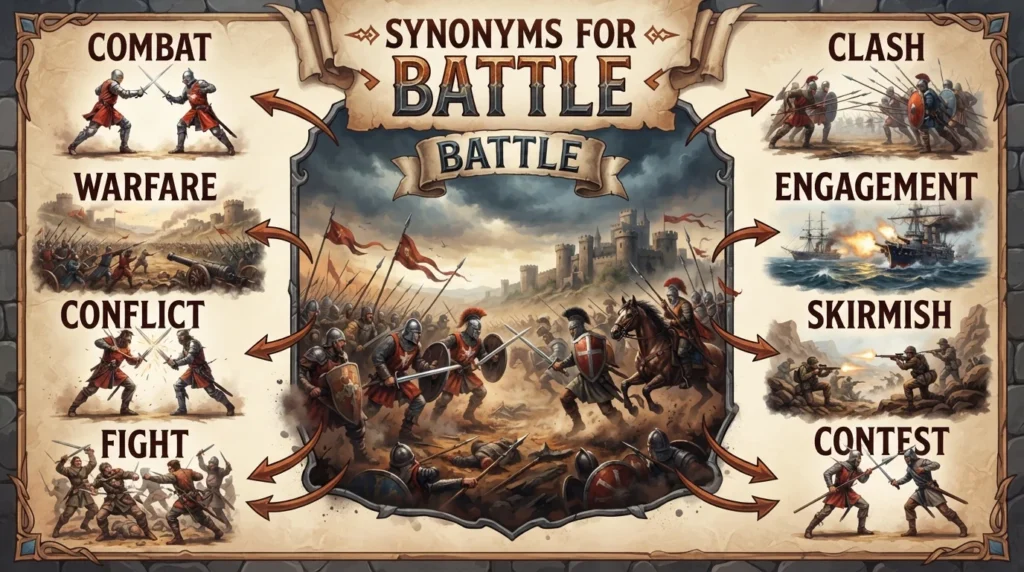
Quick Synonym List
Not every alternative can replace battle directly. Some describe a particular type of fighting, while others apply to arguments, competition, or personal challenges.
Context | |
|---|---|
Closest alternatives | Fight, combat, conflict, clash, engagement |
Military fighting | Engagement, combat, skirmish, firefight, encounter, offensive |
Large-scale warfare | Warfare, campaign, hostilities, armed conflict |
Arguments and disputes | Confrontation, dispute, quarrel, altercation, disagreement |
Competition | Contest, match, showdown, face-off, rivalry |
Personal difficulties | Struggle, ordeal, challenge, uphill battle |
Political or legal disputes | Dispute, contest, legal fight, confrontation |
Informal expressions | Scrap, scuffle, dust-up, slugfest |
Verb alternatives | Fight, combat, confront, resist, oppose, contend with |
Key distinction
A battle is usually a particular fight or sustained effort. War refers to a broader conflict that may include many battles. Struggle emphasizes difficulty and effort, while showdown suggests a decisive confrontation.
What Does “Battle” Mean?
Battle functions as both a noun and a verb.
As a noun, it commonly refers to a fight between opposing armed forces, a fierce disagreement or competition, or a sustained effort to overcome a problem.
As a verb, it means to fight against someone or something, compete intensely, or work hard to overcome difficulties.
Consider these examples:
“The soldiers fought a battle near the river.” — military fighting.
“The two companies are engaged in a battle for market share.” — business competition.
“She faced a difficult battle to complete the project.” — sustained personal effort.
“The neighbors battled over the property boundary.” — disagreement.
“The team battled back after falling behind.” — determined competitive effort.
These meanings overlap, but they require different alternatives. A skirmish is appropriate for a small military encounter, while a struggle is more natural for overcoming a personal difficulty.
The Best Synonyms for Battle
1. Fight
Meaning: A physical confrontation, argument, competition, or determined effort against opposition.
Tone: Neutral or conversational.
Best for: Everyday situations, sports, disagreements, military encounters, and personal challenges.
Example: The two teams put up a fierce fight in the championship game.
How it differs: Fight is broader and more conversational than battle. It can describe a brief argument or a single physical confrontation without suggesting a military operation.
2. Combat
Meaning: Fighting between opposing forces, especially in a military context.
Tone: Formal, military, or technical.
Best for: Military history, armed conflict, and descriptions of direct fighting.
Example: The troops were trained for combat in difficult terrain.
Watch out: Combat often refers to the activity of fighting rather than one clearly defined battle. As a verb, it can also mean taking action against a problem, as in “combat pollution.”
3. Conflict
Meaning: Serious disagreement, opposition, or fighting between people, groups, or countries.
Tone: Neutral to formal.
Best for: International relations, history, workplace disagreements, and competing interests.
Example: The conflict continued despite repeated attempts to negotiate a settlement.
How it differs: Conflict is broader than battle. A conflict may involve many battles, ongoing tensions, or disagreements without physical violence.
4. Clash
Meaning: A short or forceful confrontation between opposing groups, individuals, or ideas.
Tone: Neutral, journalistic, or dramatic.
Best for: Military encounters, protests, sports, and disagreements.
Example: A clash between the two teams resulted in several penalties.
How it differs: Clash emphasizes direct opposition and often suggests a relatively brief encounter.
5. Engagement
Meaning: A military encounter involving opposing forces.
Tone: Formal or military.
Best for: Military history, operational reports, and descriptions of specific encounters.
Example: The engagement lasted several hours before the forces withdrew.
Watch out: Engagement has many other meanings, including an appointment, commitment, or agreement to marry. Its military meaning depends on context.
6. Skirmish
Meaning: A relatively small or brief fight, often involving limited numbers of combatants.
Tone: Neutral or military.
Best for: Military encounters, minor disputes, and figurative descriptions of limited conflict.
Example: A brief skirmish occurred near the border.
How it differs: Skirmish suggests a smaller encounter than a major battle, although it does not have a strict numerical definition.
7. Confrontation
Meaning: A situation in which opposing people or groups directly challenge one another.
Tone: Neutral to formal.
Best for: Disputes, negotiations, workplace disagreements, and tense encounters.
Example: The disagreement developed into a confrontation between the two managers.
Watch out: A confrontation does not necessarily involve physical fighting. It may consist entirely of verbal disagreement.
8. Struggle
Meaning: A difficult or sustained effort to overcome opposition, hardship, or an obstacle.
Tone: Neutral or serious.
Best for: Personal challenges, social movements, difficult projects, and prolonged competition.
Example: The organization faced a long struggle to secure sufficient funding.
How it differs: Struggle emphasizes effort and difficulty rather than a specific confrontation.
9. Warfare
Meaning: The conduct or practice of war, including military operations and methods of fighting.
Tone: Formal or technical.
Best for: Military history, international relations, and descriptions of military methods.
Example: Advances in technology have changed the nature of naval warfare.
Watch out: Warfare usually describes a broad activity or type of fighting, not one individual battle.
10. Showdown
Meaning: A decisive confrontation intended to settle a disagreement, rivalry, or competition.
Tone: Conversational, journalistic, or dramatic.
Best for: Sports, entertainment, negotiations, and intense rivalries.
Example: The championship match became a showdown between the league’s two leading teams.
How it differs: Showdown suggests an important or potentially decisive encounter. An ordinary battle may not settle the larger conflict.
11. Contest
Meaning: A competition in which participants try to win or demonstrate superiority in a particular activity.
Tone: Neutral.
Best for: Sports, elections, competitions, and disputes over prizes or positions.
Example: The final round was a closely fought contest.
Watch out: A contest usually involves competition under some recognizable structure or rules. It does not necessarily imply hostility.
12. Dispute
Meaning: A disagreement or argument between people, organizations, or groups.
Tone: Neutral or professional.
Best for: Legal matters, workplace issues, property disagreements, and negotiations.
Example: The companies entered into a dispute over the terms of their agreement.
How it differs: Dispute emphasizes disagreement rather than physical fighting.
13. Altercation
Meaning: A heated or angry confrontation, usually involving a relatively brief argument and sometimes physical aggression.
Tone: Formal or journalistic.
Best for: Incident reports, workplace disputes, and descriptions of heated exchanges.
Example: A verbal altercation occurred outside the stadium.
Watch out: Altercation generally describes a limited incident, not a prolonged campaign or military battle.
14. Scuffle
Meaning: A short, disorderly physical fight.
Tone: Neutral or conversational.
Best for: Minor physical confrontations, sports incidents, and news reports.
Example: A scuffle broke out between several spectators.
How it differs: Scuffle implies a brief physical encounter rather than organized combat.
15. Ordeal
Meaning: A prolonged, difficult, or distressing experience.
Tone: Serious or neutral.
Best for: Personal hardships, emergencies, and difficult experiences.
Example: Completing the journey without adequate supplies became a difficult ordeal.
Watch out: An ordeal does not require an opponent. It is a related alternative only when battle is used figuratively to describe hardship.
More Alternatives for Battle
The following words are useful in specific situations, but they are not all direct synonyms.
Alternative | Meaning | Best use |
|---|---|---|
Firefight | An exchange of gunfire | Military or armed encounters |
Encounter | An occasion when opposing forces meet | Military or historical writing |
Offensive | An organized attack intended to achieve an objective | Military operations |
Campaign | A coordinated series of operations | Extended military activity |
Hostilities | Acts of fighting between opposing forces | Formal reporting |
Siege | An operation involving the encirclement of a defended location | Military history |
Quarrel | An angry disagreement | Personal relationships |
Feud | A prolonged and often bitter dispute | Families, groups, or organizations |
Rivalry | Continuing competition between opponents | Sports or business |
Face-off | A direct encounter between competitors | Sports or entertainment |
Duel | A contest between two opponents | Historical or figurative writing |
Slugfest | A fierce contest involving repeated exchanges | Informal sports writing |
Uphill battle | A particularly difficult effort | Work, goals, or personal challenges |
Resistance | Opposition to an action, force, or policy | Social or organizational contexts |
Opposition | The act or condition of resisting something | General disagreements |
Synonyms for Battle by Context
Military battles
For descriptions of armed fighting, the most useful alternatives include combat, engagement, clash, skirmish, firefight, and armed conflict.
The distinction often depends on scale and the nature of the encounter. A firefight involves an exchange of gunfire. A skirmish is relatively limited, while an engagement is a formal military term that can describe encounters of varying sizes.

Battle
A distinct episode of fighting between opposing forces, potentially involving substantial numbers of personnel and equipment.

Skirmish
A smaller or more limited encounter, often occurring between relatively small groups.
A military operation in which a defended location is surrounded or isolated, often to force its surrender.
A siege or military campaign may include several battles. These terms describe different levels or forms of military activity.
Personal battles
When battle describes an individual’s effort to overcome difficulty, struggle, challenge, ordeal, fight, difficult journey, and uphill battle are useful alternatives.
For example, “She faced a battle to rebuild her business” could become “She faced an uphill struggle to rebuild her business.”
Struggle emphasizes continuing effort, ordeal emphasizes a distressing experience, and challenge is often less dramatic.
Legal battles
In legal writing, use legal dispute, litigation, court case, legal challenge, or court proceedings, according to what is actually happening.
A legal dispute does not always result in litigation. Litigation specifically involves resolving a matter through the court system. A court case may involve several proceedings rather than one direct confrontation.
For example, “The companies entered a lengthy legal battle” could become “The companies became involved in lengthy litigation,” provided the disagreement actually reached the courts.
Business competition
For business contexts, alternatives include competition, rivalry, contest, struggle, competitive race, and market-share contest.
“The companies are battling for customers” can become “The companies are competing for customers.”
Competition is generally more neutral than battle. Rivalry suggests an ongoing competitive relationship, while showdown suggests a particularly significant encounter.
Sports
Sports writing often uses contest, match, showdown, face-off, duel, clash, and fight.
A match is a scheduled sporting event. A showdown emphasizes its significance, while a duel usually focuses on two closely matched individual opponents.
A battle may describe either the entire match or an intense struggle within it.
Battle vs. War vs. Conflict vs. Struggle
A particular episode of fighting or sustained contest
The battle lasted throughout the afternoon.
A broader state of organized armed conflict
The war continued for several years.
Opposition or disagreement, with or without violence
The conflict involved several competing interests.
A difficult effort against opposition or hardship
The community faced a long struggle to rebuild.
A single war may contain numerous battles, while a conflict can exist without a declared war or any physical fighting. A struggle may involve no human opponent at all.
True Synonyms vs. Related Alternatives
Alternative | Relationship | Can replace battle? | Tone |
|---|---|---|---|
Fight | Close synonym | Often | Neutral |
Combat | Near synonym | In physical or military fighting | Formal |
Engagement | Contextual synonym | In military contexts | Military |
Clash | Near synonym | Often for direct encounters | Neutral |
Skirmish | Narrower term | Only for limited fighting | Neutral |
Conflict | Broader term | Sometimes | Neutral |
War | Broader term | Rarely directly | Serious |
Struggle | Contextual synonym | Often for figurative battles | Neutral |
Showdown | For decisive encounters | Dramatic | |
Contest | Contextual alternative | For competition | Neutral |
Dispute | Related alternative | For disagreements | Professional |
Ordeal | Related alternative | For difficult experiences | Serious |
Campaign | Broader military term | Rarely directly | Formal |
Rivalry | Related concept | For continuing competition | Neutral |
How to Choose the Right Alternative
What kind of battle are you describing?
Suggested alternative
Engagement
The engagement continued until nightfall.10 Sentence Transformations
Original | Alternative | Why |
|---|---|---|
The soldiers entered the battle. | The soldiers entered combat. | Emphasizes military fighting. |
A small battle occurred near the river. | A skirmish occurred near the river. | Identifies a limited encounter. |
The battle continued for several hours. | The engagement continued for several hours. | Uses formal military terminology. |
She faced a battle to complete her education. | She faced a struggle to complete her education. | Emphasizes sustained personal effort. |
The companies began a legal battle. | The companies entered into a legal dispute. | More neutral and precise. |
The teams prepared for their final battle. | The teams prepared for their final showdown. | Highlights a significant encounter. |
The brothers had a battle over the inheritance. | The brothers had a dispute over the inheritance. | Identifies a disagreement. |
The organization battled rising costs. | The organization struggled with rising costs. | Natural in business writing. |
The candidates were in a battle for the position. | The candidates were competing for the position. | Removes unnecessary combative language. |
The final battle was extremely close. | The final contest was extremely close. | Appropriate for organized competition. |
Grammar and Usage
Battle can function as a countable noun or a verb.
As a noun, common expressions include a battle, several battles, fight a battle, win a battle, lose a battle, and the battle for control.
As a verb, it appears in constructions such as battle against, battle for, battle over, and battle with.
The preposition changes the meaning:
Battle against: oppose an enemy, problem, or difficulty.
Battle for: fight to obtain or protect something.
Battle over: dispute a particular issue.
Battle with: fight against someone or struggle with a difficulty.
For example, “The company battled for market share” describes a goal, while “The company battled against rising costs” identifies the problem it faced.
The past tense and past participle are battled, and the present participle is battling.
Common Mistakes
Using war and battle interchangeably. A war is a broader conflict that may contain many battles.
Calling every military encounter a skirmish. A skirmish generally suggests limited fighting.
Using combat for every disagreement. Combat usually refers to physical fighting, although the verb can be figurative.
Treating a confrontation as necessarily violent. A confrontation may involve only words.
Using ordeal as a direct synonym. An ordeal is a difficult experience that does not necessarily involve an opponent.
Calling every competition a showdown. A showdown suggests an especially important or decisive encounter.
Confusing a campaign with an individual battle. A campaign may involve several coordinated operations.
Overusing military metaphors. In professional writing, competition, disagreement, or challenge may be more precise than battle.
When “Battle” Is the Better Word
Battle remains appropriate when you want to emphasize a direct confrontation, intense competition, or sustained effort against opposition.
For example, “The team battled back from a two-goal deficit” conveys determination more vividly than “The team competed back.”
Similarly, “The Battle of Waterloo” is the established name of a historical event. Replacing battle with conflict or skirmish would be inaccurate.
In ordinary workplace writing, however, describing every disagreement or difficult assignment as a battle can make relatively minor situations sound unnecessarily dramatic.