
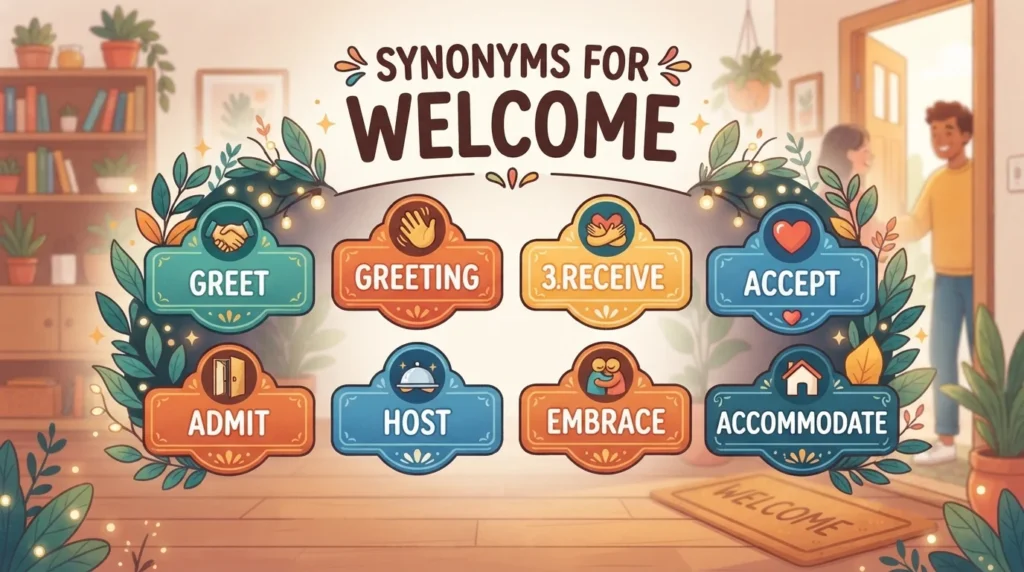
Quick List: Synonyms for Welcome
When “welcome” means greet someone
- greet
- meet
- receive
- salute
- hail
- acknowledge
When it means accept someone warmly
- accept
- embrace
- receive warmly
- take in
- accommodate
- include
- admit
- make someone feel at home
When it means invite someone
- invite
- ask
- encourage
- call upon
- request
- extend an invitation to
When it means approve of something
- accept
- approve of
- support
- endorse
- favor
- embrace
- appreciate
- encourage
When it means receive something positively
- appreciate
- value
- embrace
- applaud
- accept
- respond positively to
- view favorably
As an adjective
- invited
- accepted
- wanted
- appreciated
- valued
- included
- desired
- encouraged
- warmly received
- well received
As a noun
- greeting
- reception
- invitation
- acceptance
- hospitality
- reception
What Does “Welcome” Mean?
Welcome has several distinct meanings, so it does not have one perfect synonym.
It can be a verb, adjective, noun, or interjection.
Welcome as a verb
It can mean to greet someone warmly:
We welcomed our guests at the door.
It can also mean to accept something positively:
The company welcomed the new proposal.
Or it can mean to invite someone:
The center welcomes volunteers.
Welcome as an adjective
It can describe someone or something that is wanted or gladly accepted:
You are always welcome here.
The financial support was welcome.
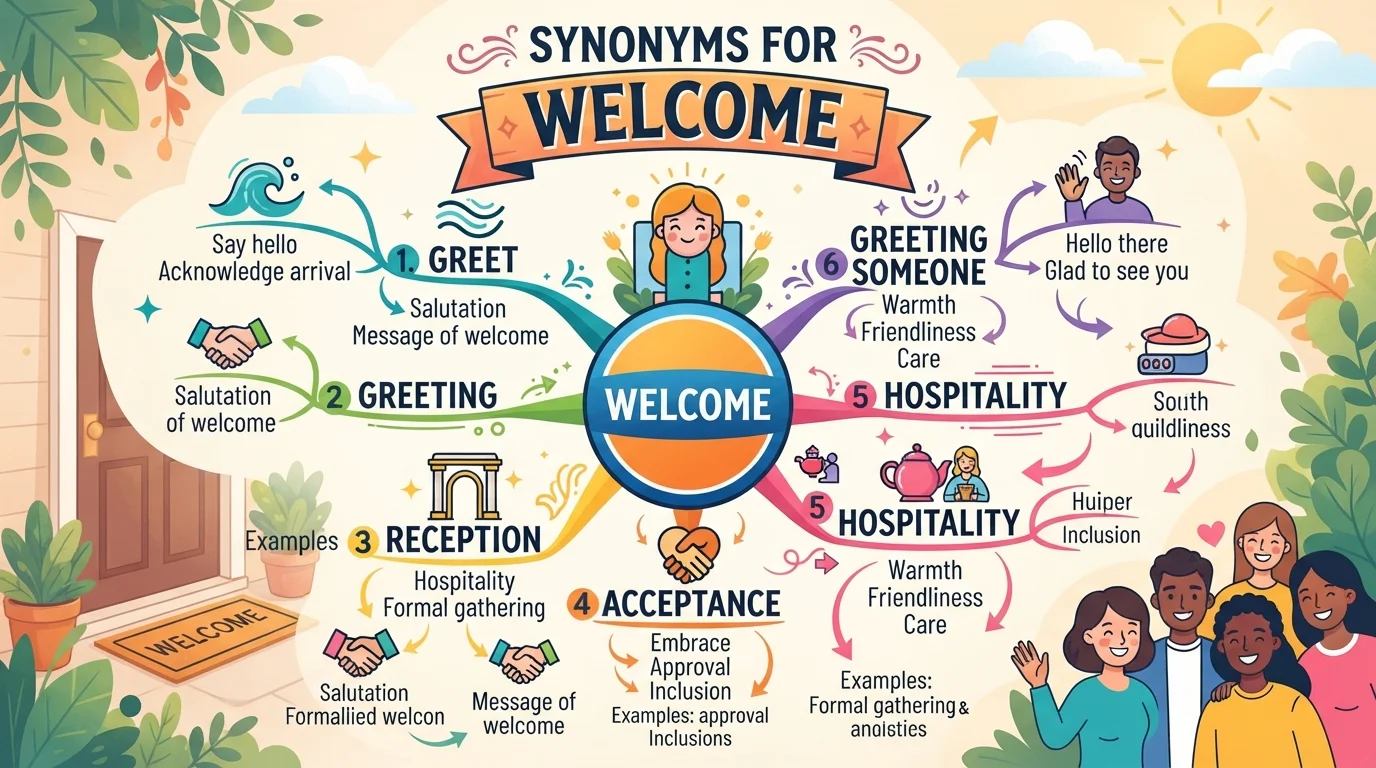
Welcome as a noun
It can mean a greeting or reception:
The visitors received a warm welcome.
Because these meanings differ, replacing welcome with a random thesaurus synonym can easily change the sentence.
1. Greet
Greet is the closest everyday alternative when welcome means saying hello to someone or acknowledging their arrival.
Example:
She greeted the guests at the entrance.
Tone
Neutral.
Best for
- Everyday English
- Hospitality
- Events
- Business
- Formal writing
Difference from “welcome”
Greet focuses on acknowledging someone’s arrival. Welcome often adds the idea that the person is wanted or received warmly.
He greeted the visitors.
This does not necessarily tell us how he felt about them.
He welcomed the visitors.
This usually suggests a positive reception.
2. Receive
Receive can mean to accept or host someone when they arrive.
Example:
The ambassador received the visiting delegation.
Tone
Neutral to formal.
It is especially useful in formal, diplomatic, business, or ceremonial contexts.
Difference from “welcome”
Receive focuses on the act of taking or hosting someone, while welcome often emphasizes warmth or acceptance.
3. Accept
Accept is useful when welcome means being willing to receive or approve of something.
The board accepted the proposal.
The community welcomed the proposal.
Both can indicate a positive response, but welcome usually sounds more positive or enthusiastic.
Best for
- Decisions
- Offers
- Proposals
- Changes
- Ideas
- People
4. Embrace
Embrace means to accept something enthusiastically or support it strongly.
Example:
The company embraced the new technology.
Tone
Positive and often strong.
Best for
- Ideas
- Change
- Innovation
- New approaches
- Social or cultural developments
Watch out
Embrace is stronger than welcome. It suggests active or enthusiastic acceptance.
The team welcomed the change.
is less strong than:
The team embraced the change.
5. Invite
Invite means to ask someone to come, participate, or attend.
Example:
We invited several local artists to the event.
Difference from “welcome”
Invite happens before or as someone is asked to come. Welcome generally concerns how someone is received once they arrive or whether they are wanted.
We invited them to dinner.
We welcomed them when they arrived.
They describe different stages of the interaction.
6. Admit
Admit can mean allow someone to enter a place or become a member of a group.
Example:
Visitors are admitted after showing identification.
Tone
Formal or administrative.
Watch out
Admit is not normally a warm synonym for welcome. It emphasizes permission or entry.
7. Accommodate
Accommodate can mean provide space, assistance, or suitable arrangements for someone.
Example:
The hotel can accommodate up to 200 guests.
Difference from “welcome”
Accommodate emphasizes practical arrangements rather than emotional warmth.
8. Include
Include means make someone part of a group, activity, or situation.
Example:
The program welcomes people from all backgrounds.
A contextual alternative might be:
The program includes people from all backgrounds.
However, the meanings are not identical. Welcome emphasizes openness and acceptance; include emphasizes participation or membership.
9. Hail
Hail can mean greet or call out to someone, especially in literary or formal language.
Example:
The crowd hailed the returning champion.
It can also mean publicly praise or celebrate someone.
Tone
Formal, literary, or dramatic.
It is not a normal replacement for welcome in everyday conversation.
10. Salute
Salute means greet or honor someone, often formally.
Example:
The soldiers saluted the visiting commander.
Tone
Formal, ceremonial, or military.
It does not simply mean welcome.
11. Acknowledge
Acknowledge means recognize someone’s presence, arrival, contribution, or message.
Example:
The host acknowledged the guests as they entered.
Difference from “welcome”
Acknowledgment can be neutral. A welcome usually communicates acceptance or friendliness.
12. Appreciate
Appreciate can replace welcome when you mean that someone is pleased about or values something.
Example:
We welcome your feedback.
We appreciate your feedback.
The second emphasizes gratitude or value rather than openness.
13. Support
Support can work when welcome means approve of or favor a proposal, policy, action, or idea.
Example:
The organization welcomed the new initiative.
The organization supported the new initiative.
Difference
Support generally suggests active backing. Welcome may simply express a positive reaction.
14. Endorse
Endorse means publicly express support or approval.
Example:
The association endorsed the proposal.
Tone
Formal and professional.
Watch out
Endorse is stronger and more specific than welcome. A person can welcome an idea without formally endorsing it.
15. Favor
Favor means prefer, support, or view something positively.
Example:
The committee welcomed the proposed changes.
The committee favored the proposed changes.
Favor emphasizes preference or support rather than reception.
16. Encourage
Encourage means give support or confidence to an action.
Example:
The school welcomes parents to participate.
The school encourages parents to participate.
The second more clearly suggests that the school wants parents to take action.
17. Appreciate
When someone says:
Your feedback is welcome.
They may mean:
Your feedback is appreciated.
But the emphasis changes.
- welcome = gladly accepted or invited
- appreciated = valued or regarded with gratitude
18. Receive Warmly
Receive warmly is a useful phrase-level alternative to welcome.
Example:
The delegation was received warmly by local officials.
It works particularly well when describing someone’s arrival and the positive way they were treated.
19. Make Someone Feel at Home
This phrase means to make someone feel comfortable, accepted, and relaxed.
Example:
Our hosts made us feel at home.
Tone
Warm, friendly, conversational.
It is a useful alternative when welcome refers to hospitality rather than simply greeting someone.
20. Take In
Take in can mean provide someone with a place to stay or accept them into one’s home or care.
Example:
The family took in a child who needed temporary care.
Watch out
This is context-dependent and is not a general synonym for welcome.
Synonyms for “Welcome” as an Adjective
When welcome means wanted, accepted, or gladly received, different alternatives work better.
Invited
You are welcome to join us.
You are invited to join us.
Invited emphasizes permission or an invitation.
Accepted
The new employee felt welcome.
The new employee felt accepted.
Accepted emphasizes being regarded as part of a group.
Wanted
Your help is welcome.
Your help is wanted.
Wanted can sound more direct and sometimes stronger.
Appreciated
Your advice is welcome.
Your advice is appreciated.
Appreciated emphasizes value or gratitude.
Valued
Your contribution is welcome.
Your contribution is valued.
Valued emphasizes importance and respect.
Well Received
The proposal was welcome.
The proposal was well received.
Well received is especially useful in professional and formal writing.
Synonyms for “Welcome” as a Noun
When welcome is a noun, it usually refers to a greeting or reception.
Greeting
The host gave us a warm welcome.
The host gave us a warm greeting.
Greeting is often the closest noun alternative.
Reception
The visitors received a warm welcome.
The visitors received a warm reception.
Reception focuses on how someone was received.
Hospitality
We appreciated their warm welcome.
We appreciated their hospitality.
Hospitality emphasizes generosity and treatment of guests.
Invitation
The message was a welcome to new members.
Depending on context, this could become:
The message was an invitation to new members.
But invitation specifically involves asking someone to participate or attend.
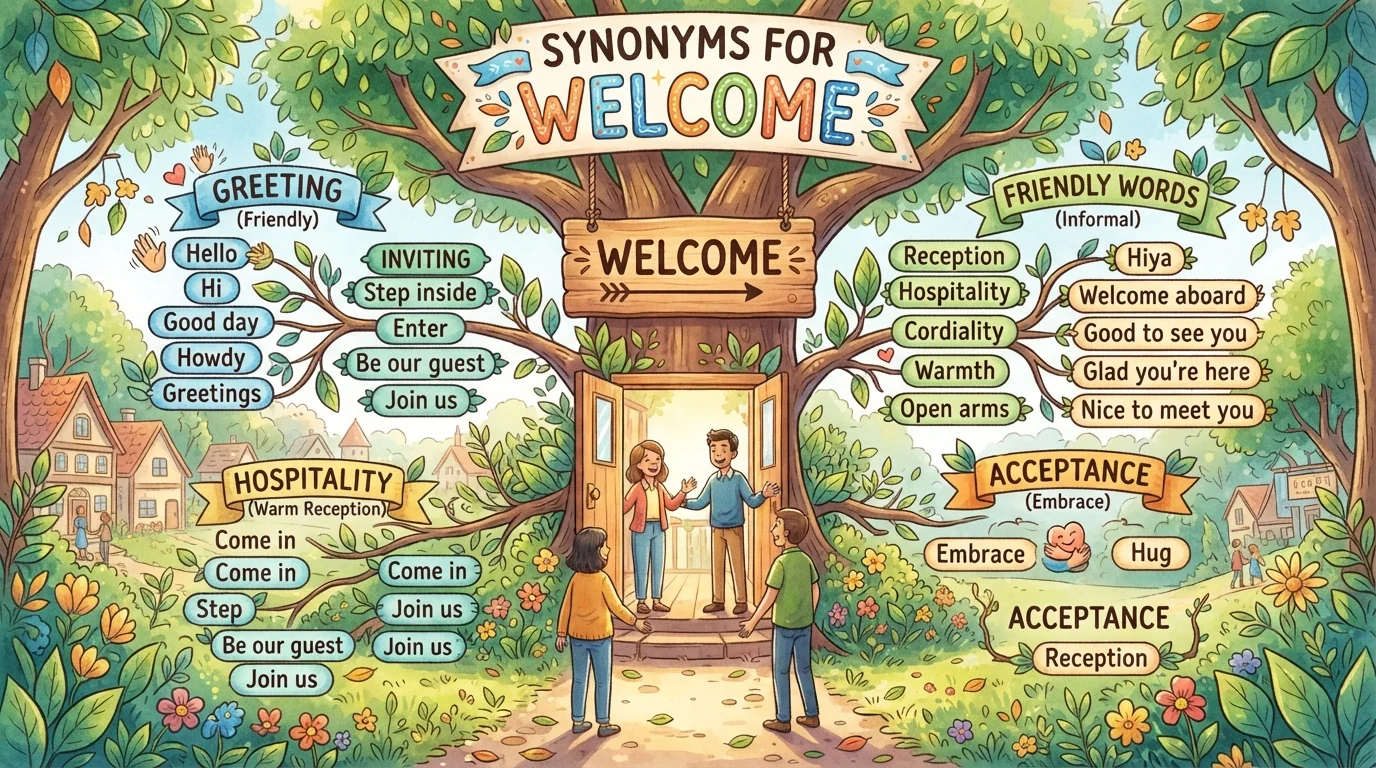
“Welcome” in Different Contexts
Welcoming a Person
Best alternatives:
- greet
- receive
- meet
- acknowledge
- receive warmly
- make someone feel at home
Example:
The manager welcomed the new employees.
The manager greeted the new employees.
Welcoming Guests
Best alternatives:
- greet
- receive
- host
- entertain
- receive warmly
- offer hospitality
Example:
The hotel welcomed its guests.
The hotel received its guests.
The first sounds warmer; the second is more formal.
Welcoming an Idea
Best alternatives:
- accept
- embrace
- support
- approve of
- favor
- appreciate
- endorse
Example:
The team welcomed the suggestion.
The team embraced the suggestion.
The second suggests stronger enthusiasm.
Welcoming Change
Useful alternatives:
- embrace
- accept
- support
- adopt
- favor
- respond positively to
Example:
The company welcomed the changes.
The company embraced the changes.
Use embraced when you want to show stronger acceptance.
Welcoming Feedback
Useful alternatives:
- invite
- encourage
- appreciate
- value
- accept
Example:
We welcome your feedback.
Depending on your intended meaning:
We invite your feedback.
We value your feedback.
We appreciate your feedback.
These are not identical, but each can be more precise.
Welcoming an Opportunity
Useful alternatives:
- embrace
- accept
- appreciate
- seize
- take advantage of
Example:
She welcomed the opportunity to lead the project.
She embraced the opportunity to lead the project.
Embraced adds enthusiasm.
Welcome vs. Greet
This is one of the most important distinctions.
| Word | Main idea | Warmth implied? | Example |
|---|---|---|---|
| Welcome | Receive positively | Usually | We welcomed the guests. |
| Greet | Acknowledge someone’s arrival | Not necessarily | We greeted the guests. |
You can greet someone without making them feel especially welcome.
A welcome generally carries a stronger sense of acceptance or friendliness.
Welcome vs. Invite
| Word | Main idea | Timing |
|---|---|---|
| Welcome | Receive or accept positively | Usually arrival/presence |
| Invite | Ask someone to come or participate | Before participation |
We invited Sarah to the event.
We welcomed Sarah when she arrived.
Welcome vs. Accept
| Word | Main idea | Typical use |
|---|---|---|
| Welcome | Receive gladly or positively | People, ideas, changes |
| Accept | Agree to receive or recognize as valid | Offers, proposals, decisions |
Welcome usually has a warmer or more positive tone.
Welcome vs. Embrace
| Word | Strength | Meaning |
|---|---|---|
| Welcome | Moderate | Receive positively |
| Embrace | Stronger | Accept enthusiastically or wholeheartedly |
The company welcomed the new policy.
The company embraced the new policy.
The second sentence communicates stronger support.
Comparison Table: Which Synonym Should You Use?
| Word/Phrase | Meaning | Tone | Strength | Direct Replacement? |
|---|---|---|---|---|
| Greet | Say hello/acknowledge arrival | Neutral | Moderate | Often |
| Receive | Formally accept or host | Formal/neutral | Moderate | Sometimes |
| Accept | Agree to receive/approve | Neutral | Moderate | Context-dependent |
| Embrace | Accept enthusiastically | Positive | Strong | Sometimes |
| Invite | Ask someone to come | Neutral | — | No |
| Admit | Allow entry | Formal | — | No |
| Accommodate | Provide space/support | Formal | Moderate | No |
| Include | Make part of a group | Neutral | Moderate | Context-dependent |
| Acknowledge | Recognize presence | Neutral/formal | Mild | Sometimes |
| Support | Actively back something | Neutral | Strong | Context-dependent |
| Endorse | Publicly support | Formal | Strong | No |
| Favor | Prefer/support | Neutral/formal | Moderate | Sometimes |
| Encourage | Promote an action | Neutral | Moderate | Context-dependent |
| Appreciate | Value/be grateful for | Neutral | Positive | Sometimes |
| Hail | Greet or praise | Literary/formal | Strong | Rarely |
| Salute | Greet or honor formally | Formal | Strong | Rarely |
| Welcome warmly | Receive positively | Warm | Strong | Often |
| Make someone feel at home | Make comfortable | Warm/informal | Strong | Phrase-level |
| Well received | Positively received | Formal/neutral | Moderate | Context-dependent |
| Hospitality | Friendly treatment of guests | Warm/formal | — | Noun only |
Sentence Transformations
1. Welcoming guests
Original:
The host welcomed the guests at the door.
Alternative:
The host greeted the guests at the door.
Why: Greeted focuses on acknowledging their arrival.
2. Formal reception
Original:
The president welcomed the visiting delegation.
Alternative:
The president received the visiting delegation.
Why: Received has a more formal and ceremonial tone.
3. Supporting an idea
Original:
The committee welcomed the proposal.
Alternative:
The committee supported the proposal.
Why: Supported suggests active approval rather than simply a positive reaction.
4. Enthusiastic acceptance
Original:
The team welcomed the new technology.
Alternative:
The team embraced the new technology.
Why: Embraced suggests stronger enthusiasm and acceptance.
5. Requesting feedback
Original:
We welcome your feedback.
Alternative:
We invite your feedback.
Why: Invite clearly tells readers that feedback is being requested.
6. Showing gratitude
Original:
We welcome your support.
Alternative:
We appreciate your support.
Why: Appreciate emphasizes gratitude.
7. Formal approval
Original:
The organization welcomed the new policy.
Alternative:
The organization endorsed the new policy.
Why: Endorsed indicates explicit public support and is stronger than welcomed.
8. Hospitality
Original:
The family welcomed us into their home.
Alternative:
The family made us feel at home.
Why: The phrase emphasizes comfort and hospitality rather than the simple act of receiving guests.
9. Positive response
Original:
The announcement was welcomed by employees.
Alternative:
The announcement was well received by employees.
Why: Well received is concise and natural in professional or formal writing.
10. Inclusion
Original:
The organization welcomes people from all backgrounds.
Alternative:
The organization includes people from all backgrounds.
Why: Includes emphasizes participation or membership. However, welcomes better communicates openness and acceptance, so the original may actually be preferable.
Common Collocations With “Welcome”
These combinations are especially useful:
- warmly welcome
- welcome guests
- welcome visitors
- welcome customers
- welcome newcomers
- welcome members
- welcome students
- welcome change
- welcome feedback
- welcome suggestions
- welcome ideas
- welcome support
- welcome opportunity
- welcome news
- welcome development
- welcome decision
- welcome addition
- welcome relief
- welcome news
- welcome contribution
- welcome invitation
Common phrases
- You are welcome.
- You are always welcome.
- welcome aboard
- welcome back
- welcome home
- welcome in
- welcome to the team
- welcome to the community
- warmly welcomed
- warmly received
- well received
- a warm welcome
- a friendly welcome
- a heartfelt welcome
Common Mistakes With “Welcome” Synonyms
1. Using “greet” when you mean “accept”
The company greeted the new policy.
This sounds unnatural if you mean that the company approved or appreciated the policy.
Better:
The company welcomed the new policy.
or:
The company embraced the new policy.
2. Using “invite” as a synonym for every use of “welcome”
An invitation asks someone to come. A welcome describes positive reception.
3. Treating “embrace” as exactly equal to “welcome”
Embrace is usually stronger and suggests enthusiastic acceptance.
4. Using “endorse” when you only mean “welcome”
A person can welcome a proposal without formally endorsing it.
5. Using “receive” when warmth matters
Receive can sound neutral or formal.
We received our guests.
We welcomed our guests warmly.
The second sentence communicates more warmth.
6. Using “accept” when “welcome” is more natural
We accept your feedback.
This can sound as though you are merely permitting feedback.
We welcome your feedback.
This sounds more open and encouraging.
7. Confusing “welcome” with “hospitality”
Hospitality describes generous treatment of guests. It is not simply another form of the verb welcome.
8. Replacing “welcome” just to avoid repetition
If welcome is the most accurate and natural word, keep it. Good writing is not about using the largest possible number of synonyms.
When Not to Replace “Welcome”
Keep welcome when you mean a combination of positive reception, openness, and acceptance that another word cannot express as naturally.
For example:
We welcome your questions.
This is often better than:
We accept your questions.
The latter can sound like permission rather than encouragement.
Likewise:
Everyone is welcome here.
is more natural than:
Everyone is accepted here.
The two sentences communicate related but different ideas.
Which Synonym Should You Choose?
| If you mean… | Best choice |
|---|---|
| Say hello to someone | greet |
| Receive someone formally | receive |
| Accept something positively | accept / welcome |
| Accept something enthusiastically | embrace |
| Ask someone to attend | invite |
| Allow someone to enter | admit |
| Make someone part of a group | include |
| Publicly support something | endorse |
| Back an idea or plan | support |
| Show gratitude | appreciate |
| Encourage participation | encourage / invite |
| Treat guests generously | show hospitality |
| Make guests comfortable | make someone feel at home |
| Describe positive reception | well received |
| Formally greet or honor | salute |
| Greet or praise dramatically | hail |
Editor’s Choice: The Most Useful Alternatives
These are practical editorial choices, not an objective ranking.
Greet
The clearest everyday alternative when welcome means acknowledging someone’s arrival.
Receive
Useful for formal, official, or ceremonial contexts.
Embrace
Best when you want to show enthusiastic acceptance.
Invite
Best when the real meaning is asking someone to participate or attend.
Well received
A concise phrase for professional and formal writing.
The key is to identify the sense of welcome before choosing a replacement.