
What Does “Compare” Mean?
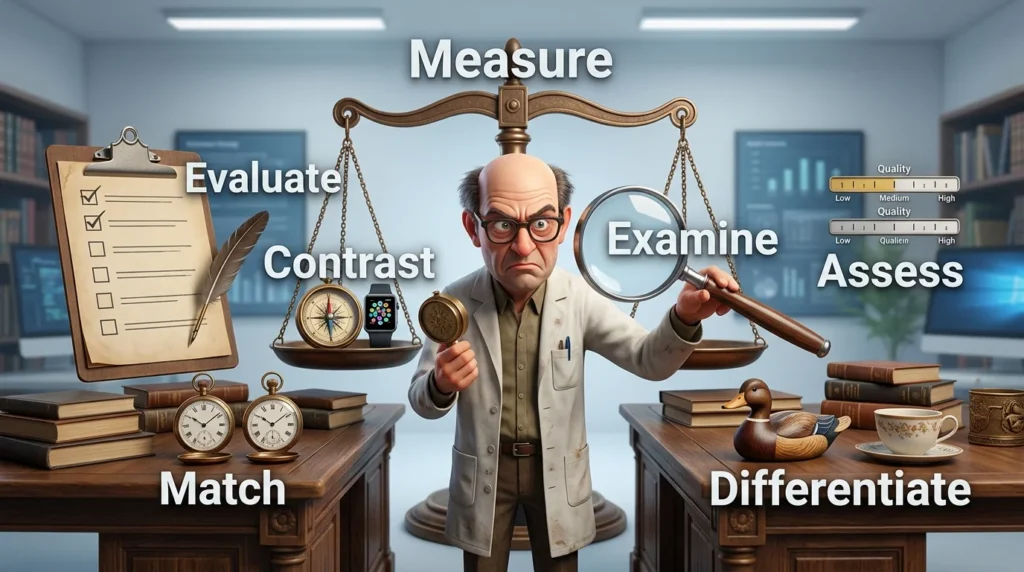
Compare means to examine two or more things in order to determine how they are similar, different, better, worse, or otherwise related.
Examples:
We need to compare the two products before buying one.
The researcher compared the results from both studies.
It is difficult to compare the two athletes because they compete in different sports.
The word compare can focus on either similarities, differences, or both.
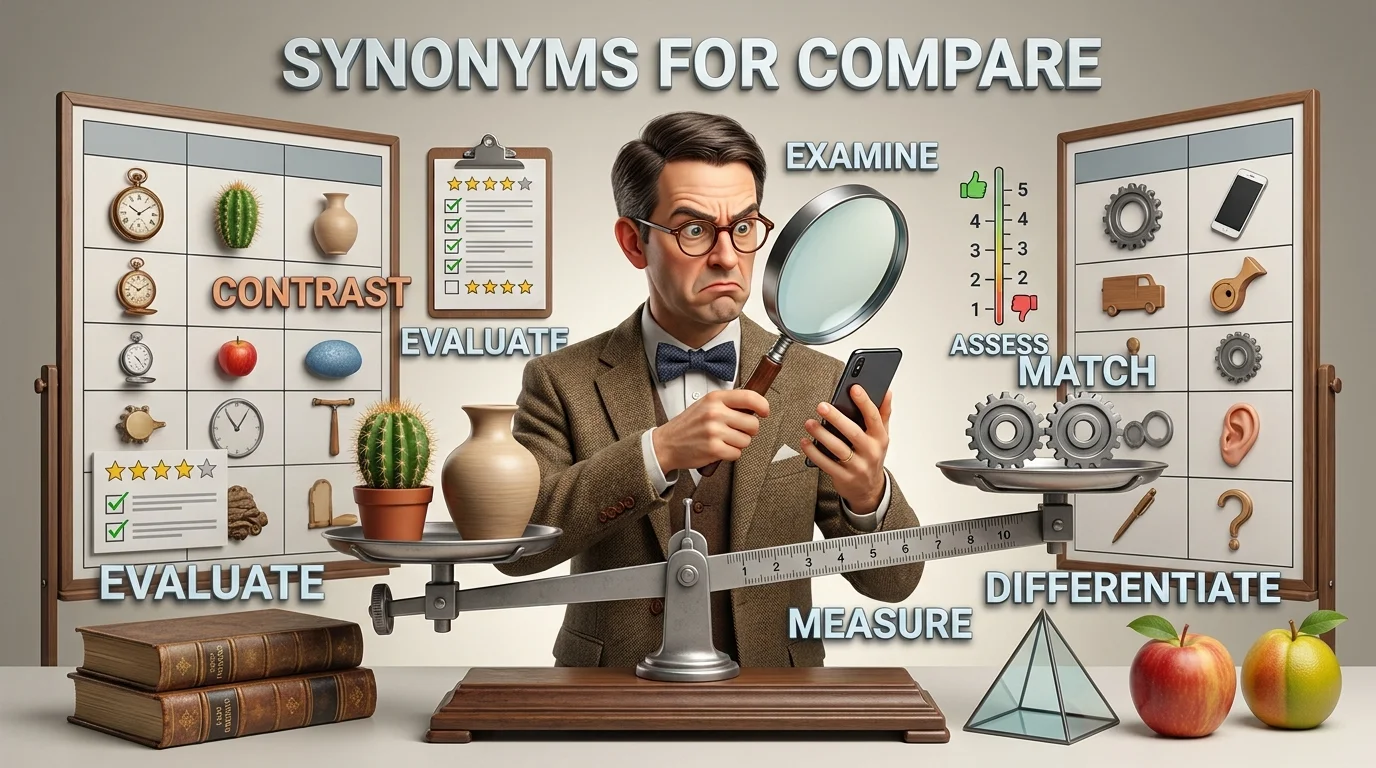
Quick List of Synonyms for Compare
Here are some of the most useful alternatives:
Contrast
Evaluate
Assess
Examine
Analyze
Study
Consider
Review
Measure
Match
Relate
Differentiate
Weigh
Judge
Benchmark
Cross-check
Correlate
Rank
Balance
Set against
Draw parallels
Put side by side
Look at alongside
Find similarities
Identify differences
However, these words have different meanings and levels of similarity. The best choice depends on your context.
Best Synonyms for Compare
1. Contrast
Contrast is one of the closest alternatives to compare, but it specifically emphasizes differences between two or more things.
Example:
The study contrasts traditional education with online learning.
Compare: focuses on similarities and/or differences.
Contrast: focuses mainly on differences.
2. Evaluate
Evaluate means to judge something carefully based on its quality, effectiveness, value, or performance.
Example:
The manager will evaluate the performance of each employee.
Use evaluate when your comparison involves making a judgment.
3. Assess
Assess means to carefully judge or estimate the quality, importance, condition, or effectiveness of something.
Example:
We need to assess the advantages of both options.
Assess is especially common in academic, professional, medical, and business writing.
4. Examine
Examine means to look at something carefully and in detail.
Example:
The researcher examined the results of both experiments.
Unlike compare, examine does not necessarily require two things. It can refer to studying one thing carefully.
5. Analyze
Analyze means to study something closely by breaking it into parts and examining how those parts work or relate to one another.
Example:
The report analyzes the differences between the two markets.
Analyze is particularly useful in academic and professional writing.
6. Study
Study means to investigate or examine something carefully in order to understand it.
Example:
The scientists studied the behavior of both species.
It is broader than compare and does not always involve multiple subjects.
7. Consider
Consider means to think carefully about something, especially before making a decision.
Example:
We should consider both options before making a final decision.
This works well when comparison is part of a decision-making process.
8. Review
Review means to examine something carefully, often to determine its quality, accuracy, or suitability.
Example:
The committee reviewed the two proposals.
It is common in business, education, publishing, and professional settings.
9. Measure
Measure means to determine the size, amount, degree, or performance of something, often against a standard.
Example:
The company measures its performance against industry standards.
Use this word when your comparison involves a specific standard or metric.
10. Match
Match means to compare things to determine whether they are equal, compatible, or suitable.
Example:
The system matched the candidate’s skills with the job requirements.
It can also mean that two things are similar or correspond to each other.
Formal Synonyms for Compare
In formal, academic, or professional writing, these alternatives can sound more precise:
Evaluate
Assess
Analyze
Examine
Contrast
Measure
Review
Benchmark
Differentiate
Correlate
Example
Instead of:
The researchers compared the two methods.
You could write:
The researchers evaluated the effectiveness of the two methods.
Or:
The researchers analyzed the differences between the two methods.
The best choice depends on what the researchers actually did.
Academic Synonyms for Compare
Academic writing often requires more precise language than simply repeating compare.
Useful alternatives include:
Analyze
Contrast
Evaluate
Examine
Assess
Correlate
Differentiate
Measure
Identify similarities
Identify differences
Draw parallels
Examples:
The essay contrasts two approaches to environmental policy.
The study evaluates the effectiveness of both treatments.
The researcher analyzes similarities between the two theories.
The paper examines the relationship between education and income.
Professional and Business Synonyms for Compare
In business writing, you may want to avoid repeating compare when discussing products, prices, performance, or competitors.
Useful alternatives include:
Evaluate
Assess
Benchmark
Measure
Review
Analyze
Weigh
Rank
Examine
Examples:
We need to evaluate the proposals before choosing a supplier.
The company benchmarks its performance against competitors.
Customers can compare prices across different providers.
Management will assess the benefits of each strategy.
Synonyms for Compare When Focusing on Differences
If your main purpose is to identify differences, use:
Contrast
Differentiate
Distinguish
Set against
Separate
Identify differences
Highlight differences
Examples
Original:
The article compares traditional and modern teaching methods.
Better when emphasizing differences:
The article contrasts traditional and modern teaching methods.
Another option:
The article highlights differences between traditional and modern teaching methods.
Synonyms for Compare When Focusing on Similarities
If your goal is to show similarities, these expressions can work:
Relate
Match
Equate
Draw parallels
Find similarities
Identify common features
Show similarities
Link
Examples:
The author draws parallels between the two characters.
Researchers identified similarities between the two cultures.
The two approaches can be related in several ways.
Compare vs. Contrast
These words are closely related but are not identical.
| Word | Main Focus | Example |
|---|---|---|
| Compare | Similarities and differences | Compare the two plans. |
| Contrast | Differences | Contrast the two plans. |
If you are discussing both similarities and differences, compare is usually the better word.
If you specifically want to emphasize differences, contrast is more precise.
Compare vs. Evaluate
Compare means examining two or more things.
Evaluate means judging their quality, effectiveness, value, or performance.
For example:
We compared three smartphones.
This simply means we looked at their characteristics.
We evaluated three smartphones.
This suggests that we judged which ones performed better or offered greater value.
Compare vs. Assess
Assess is similar to evaluate, but it often emphasizes determining the condition, importance, risk, or effectiveness of something.
The teacher compared the two assignments.
versus:
The teacher assessed the two assignments.
The second sentence suggests the teacher judged their quality or performance.
Compare vs. Examine
Examine means looking carefully at something.
The scientist examined the samples.
This does not necessarily mean that the scientist compared them.
But:
The scientist examined and compared the samples.
This clearly indicates that multiple samples were studied against one another.
Compare vs. Analyze
Analyze generally involves deeper investigation.
The researcher compared the two datasets.
This tells us that the datasets were considered alongside each other.
The researcher analyzed the two datasets.
This suggests a deeper investigation of their structure, patterns, or relationships.
Compare vs. Match
Match has a more specific meaning.
Compare these two documents.
means to examine them.
Match these two documents.
can mean to determine whether they correspond or belong together.
Therefore, match should not automatically replace compare.
Compare vs. Relate
Relate can mean to establish a connection between two things.
The study relates sleep patterns to academic performance.
This means the study examines the relationship between the two subjects.
It does not necessarily mean the subjects are directly compared.
Compare vs. Benchmark
Benchmark is commonly used in business, technology, and performance analysis.
It means measuring something against a recognized standard, competitor, or best-performing example.
Example:
The company benchmarks its customer service against industry leaders.
This is more specific than simply saying:
The company compares its customer service with other companies.
Best Synonym for Compare by Context
| Context | Best Alternative |
|---|---|
| Showing differences | Contrast |
| Judging quality | Evaluate |
| Judging condition or effectiveness | Assess |
| Studying closely | Examine |
| Detailed investigation | Analyze |
| Business performance | Benchmark |
| Checking compatibility | Match |
| Showing relationships | Relate |
| Making a decision | Weigh |
| Checking against a standard | Measure |
| Looking at previous information | Review |
| Showing similarities | Draw parallels |
| Separating two concepts | Differentiate |
Other Useful Alternatives to Compare
Weigh
Weigh means to carefully consider different choices before deciding.
We need to weigh the advantages and disadvantages of both options.
Judge
Judge means to form an opinion or make a decision about something.
The panel judged the performances based on several criteria.
Rank
Rank means to arrange people or things according to quality, importance, performance, or another standard.
The website ranked the five laptops from best to worst.
Differentiate
Differentiate means to recognize or explain the differences between things.
The guide helps users differentiate between genuine and counterfeit products.
Correlate
Correlate means to identify or demonstrate a relationship between two variables or sets of information.
The researchers correlated exercise levels with health outcomes.
It should not be used as a general replacement for compare.
Cross-check
Cross-check means to compare information with another source to verify its accuracy.
The editor cross-checked the statistics with the original report.
Sentence Transformations
Here are several ways to replace compare without changing the basic idea too much.
Original
We compared the prices of five laptops.
Alternatives
We examined the prices of five laptops.
We reviewed the prices of five laptops.
We evaluated the prices of five laptops.
We analyzed the prices of five laptops.
We measured the prices against the available budget.
Notice that each alternative slightly changes the emphasis.
How to Choose the Right Synonym for Compare
Ask yourself what you are actually doing.
Are you looking at similarities and differences?
Use compare.
Are you mainly showing differences?
Use contrast.
Are you judging quality or effectiveness?
Use evaluate.
Are you judging condition, risk, or importance?
Use assess.
Are you studying something in detail?
Use examine.
Are you performing a deeper investigation?
Use analyze.
Are you checking against a standard?
Use measure or benchmark.
Are you checking whether two things correspond?
Use match.
Are you identifying a relationship?
Use relate or correlate, depending on the context.
Are you deciding between alternatives?
Use weigh.
This approach helps you choose a synonym based on meaning rather than simply replacing one word with another.
Common Mistakes When Using Synonyms for Compare
Mistake 1: Using “contrast” for every comparison
Contrast mainly emphasizes differences.
Incorrect or awkward:
The researcher contrasted the similarities between the groups.
Better:
The researcher compared the similarities between the groups.
Or:
The researcher identified similarities between the groups.
Mistake 2: Using “evaluate” when no judgment is involved
If you are only identifying similarities and differences, evaluate may imply more than you mean.
Instead of:
We evaluated the colors of the two paintings.
If you are simply looking at their colors, say:
We compared the colors of the two paintings.
Mistake 3: Using “match” as a universal synonym
Match usually involves compatibility, correspondence, or equality.
Compare the two reports.
does not necessarily mean:
Match the two reports.
Mistake 4: Using “correlate” incorrectly
Correlate suggests a relationship between variables.
You should not use it simply because two things are being examined together.
Mistake 5: Overusing formal alternatives
Words such as benchmark, correlate, differentiate, and assess can be useful, but they should not replace compare when the simple word is clearer.
Sometimes the best writing is simply:
Let’s compare the two options.
There is no need to make it more complicated.
Grammar and Usage of “Compare”
Compare can be used with different grammatical structures.
Compare A with B
This commonly means examining two things to identify similarities and differences.
Compare this model with the previous version.
Compare A to B
This construction can emphasize similarity or analogy.
The poet compared the moon to a silver lamp.
In everyday modern English, compare with and compare to can overlap, but the intended relationship and context matter.
Compare two or more things
We compared three different plans.
The word can also be used without explicitly naming the objects:
It is difficult to compare.
Related Words and Expressions
If you are writing about comparison, these expressions can also be useful:
In comparison
By comparison
Compared with
Compared to
In contrast
Similarly
Likewise
On the other hand
By contrast
Relative to
Against
Side by side
In relation to
Corresponding to
These are not all synonyms for compare, but they are useful language tools when discussing similarities and differences.