
Quick Answer
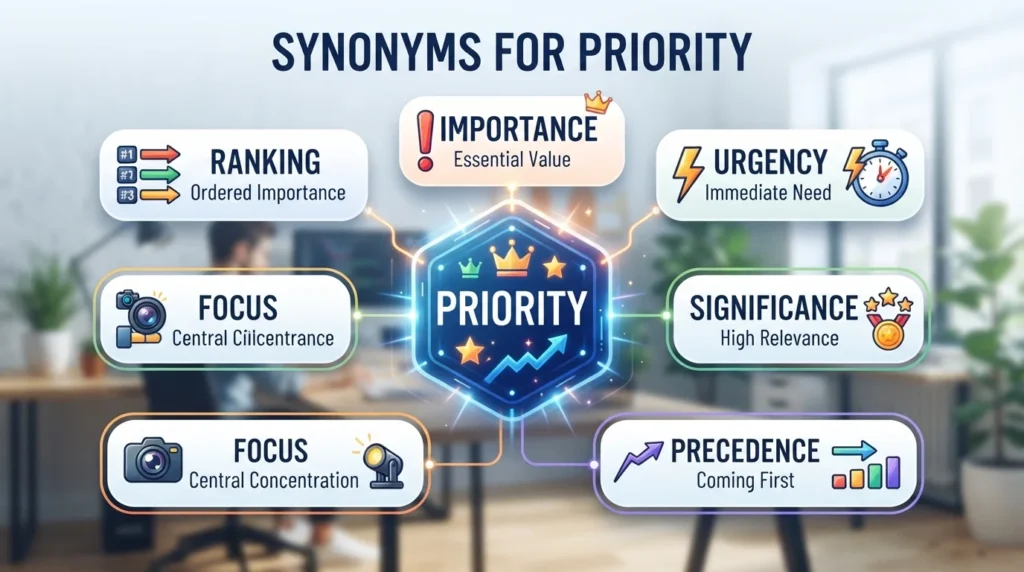
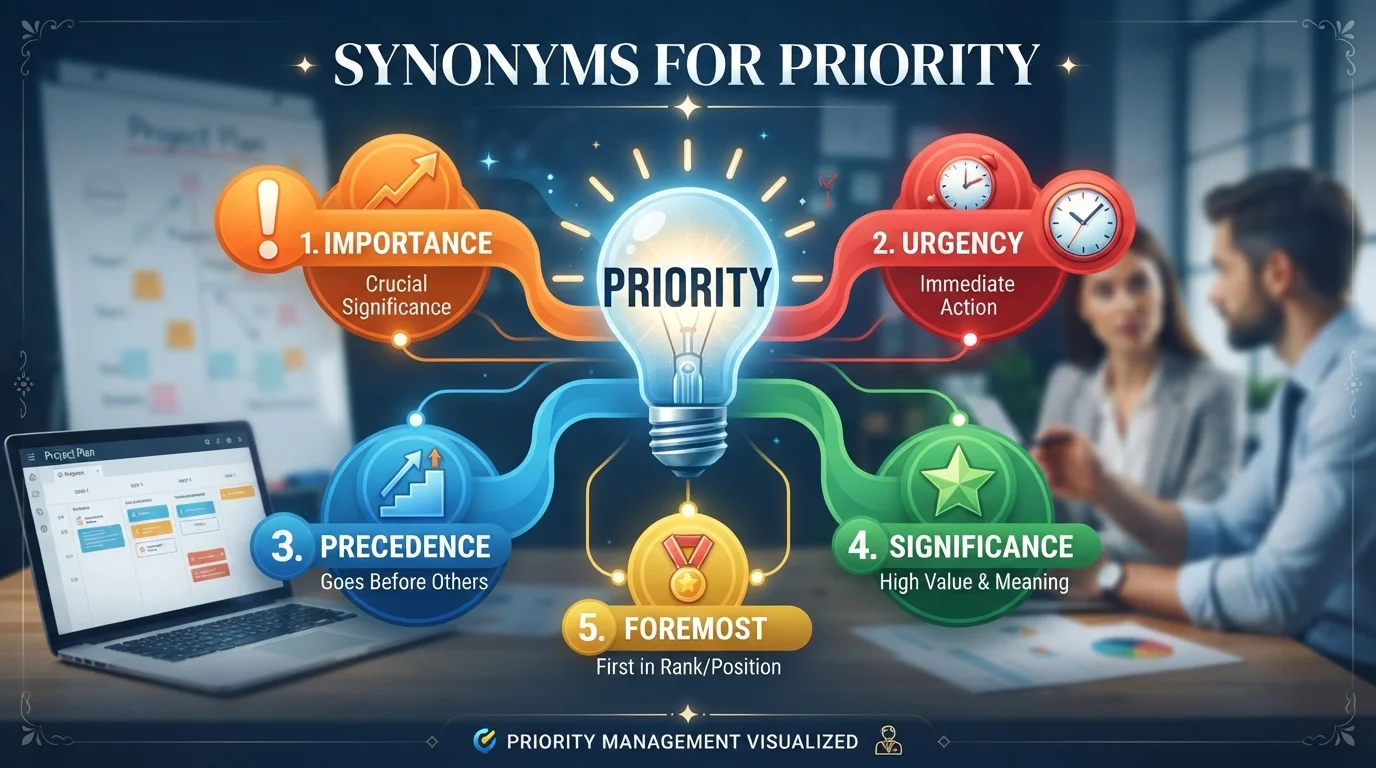
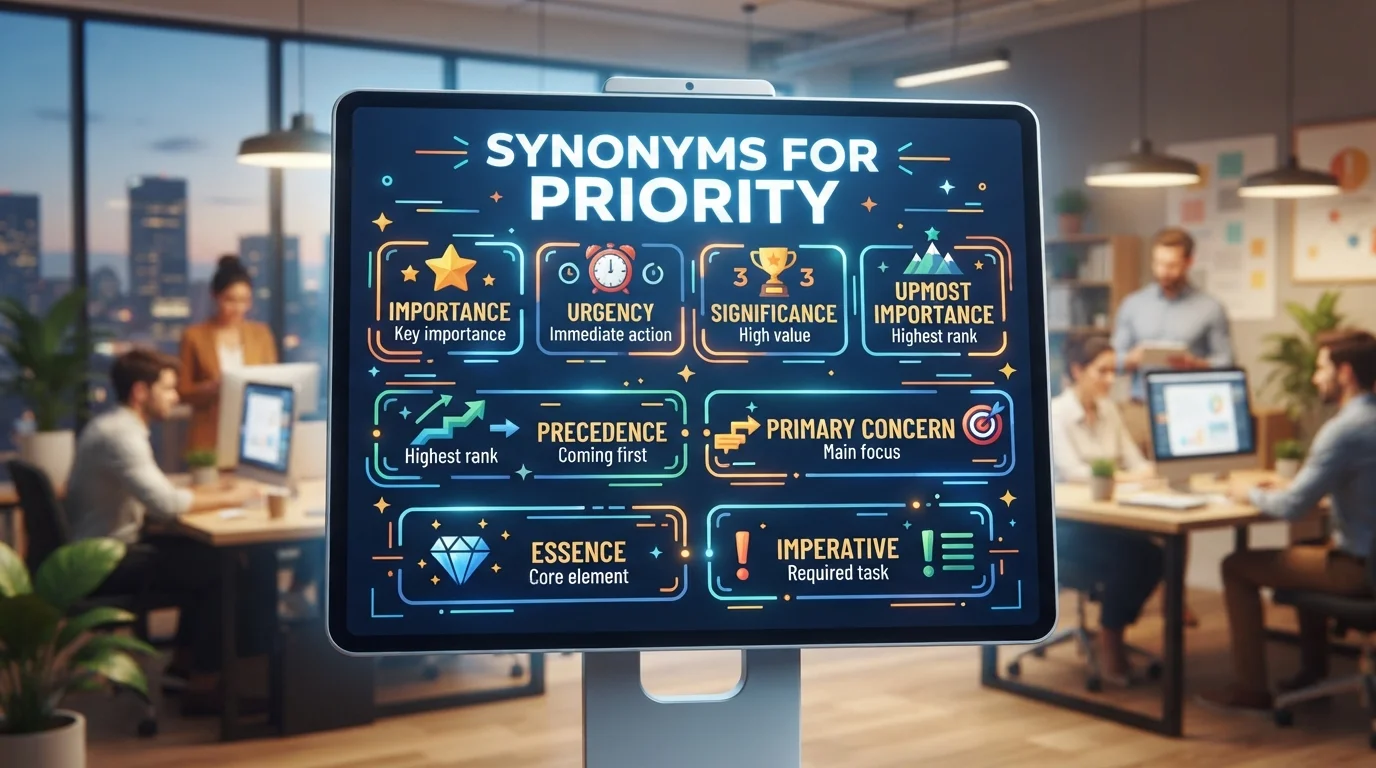
Common synonyms for priority include importance, precedence, urgency, focus, preference, concern, objective, goal, emphasis, attention, significance, and rank. Use importance when something matters greatly, precedence when it comes first, urgency when it needs immediate action, and focus when it receives concentrated attention.
Quick Synonym Reference
| Alternative | Main meaning | Register | Can replace “priority”? |
|---|---|---|---|
| importance | degree of value or significance | Neutral | Often |
| precedence | being dealt with first | Formal | Often |
| urgency | need for immediate attention | Neutral | Sometimes |
| focus | concentrated attention | Neutral | Often |
| emphasis | special attention or importance | Neutral/formal | Sometimes |
| preference | favored choice or treatment | Neutral | Sometimes |
| concern | important matter requiring attention | Neutral | Sometimes |
| objective | desired result | Professional | Sometimes |
| goal | desired outcome | Neutral | Sometimes |
| aim | intended result | Neutral | Sometimes |
| significance | importance or meaning | Formal | Sometimes |
| attention | consideration or focus | Neutral | Sometimes |
| rank | position in an order of importance | Neutral | Sometimes |
| order | sequence in which things are handled | Neutral | Sometimes |
| top concern | most important matter | Neutral | Often |
| key concern | important matter | Professional | Often |
| main focus | central area of attention | Neutral | Often |
| top consideration | factor given greatest weight | Neutral/formal | Often |
| first consideration | matter considered first | Formal | Often |
| central issue | main matter under discussion | Neutral | Sometimes |
| main objective | primary desired outcome | Professional | Sometimes |
| principal aim | main purpose | Formal | Sometimes |
| strategic priority | important strategic focus | Professional | Yes, in context |
| critical need | especially important need | Neutral | Context-dependent |
| requirement | something necessary | Neutral | No |
| necessity | something essential | Neutral/formal | Sometimes |
| precedence | superior position in order | Formal | Yes |
| preeminence | superior importance/status | Formal | Rarely |
| primacy | state of being first or most important | Formal | Yes |
| predominance | greater influence or importance | Formal | Rarely |
| preference | favored option | Neutral | Context-dependent |
| privilege | special advantage or treatment | Neutral | Sometimes |
| first place | highest position | Neutral | Sometimes |
| front burner | matter receiving immediate attention | Informal | Sometimes |
| top spot | highest rank | Informal | Sometimes |
| foremost concern | most important concern | Formal | Often |
| paramount concern | extremely important concern | Formal | Often |
| chief concern | main concern | Formal/neutral | Often |
| key focus | central attention | Professional | Often |
| leading consideration | important factor | Formal | Sometimes |
| order of importance | ranking by significance | Neutral | Context-dependent |
What Does “Priority” Mean?
Priority is a noun meaning something that is considered more important than other things and therefore deserves attention, resources, or action before them.
Finishing the project is our top priority.
Here, priority means the most important task.
Safety should be a priority.
Here, it means something that deserves special importance and attention.
Customers with urgent cases receive priority.
Here, priority means preferential treatment or being handled before others.
The word therefore has several related meanings.
1. Priority Meaning “Importance”
When priority means something that matters more than other things, the closest alternatives include importance, significance, concern, and value.
Importance
Importance is one of the closest general alternatives.
Employee safety is our top priority.
Employee safety is of great importance.
The difference is useful:
- priority = importance combined with attention or action
- importance = how much something matters
Something can be important without being an immediate priority.
Significance
Significance emphasizes importance, meaning, or impact.
The issue has become a priority.
The issue has gained significance.
This is more formal and is often useful in academic or analytical writing.
Concern
Concern means a matter that deserves attention or consideration.
Cost reduction is a priority for the company.
Cost reduction is a major concern for the company.
Concern does not necessarily imply that it comes before everything else.
Value
Value can work when priority is based on usefulness, benefit, or worth.
Customer satisfaction is a priority.
Customer satisfaction is highly valued.
But these are not exact equivalents: value describes worth, while priority describes what receives precedence or attention.
2. Priority Meaning “Handled First”
When something should happen before something else, precedence is especially useful.
Precedence
Precedence means the condition of coming before something else in order, importance, or treatment.
Safety takes priority over speed.
Safety takes precedence over speed.
This is one of the strongest formal alternatives to take priority.
Common expression
X takes precedence over Y.
This means X should come before Y.
Primacy
Primacy means the state of being first in importance, position, or influence.
The organization gives priority to public safety.
The organization gives primacy to public safety.
Primacy is formal and less common in everyday English.
First Place
In less formal contexts, first place can express the highest position.
Family comes first in her priorities.
Family takes first place in her life.
This is more conversational and often more personal.
3. Priority Meaning “Urgency”
Priority and urgency overlap, but they are not identical.
Urgency
Urgency means something needs attention or action quickly.
The issue has become a priority.
The issue has become urgent.
The difference:
- priority = importance/order of attention
- urgency = need for speed
Something can be a high priority without being urgent.
For example:
Long-term planning is a high priority, but it is not urgent.
That distinction matters in project management and workplace communication.
Immediate Need
Immediate need works when something requires prompt attention.
Addressing the safety problem is our top priority.
Addressing the safety problem is an immediate need.
This emphasizes necessity and timing rather than ranking.
Critical Need
Critical need suggests something is extremely important and often requires prompt action.
The hospital made emergency supplies a priority.
The hospital identified emergency supplies as a critical need.
4. Priority Meaning “Focus”
In business, planning, and project management, priority often means an area receiving concentrated attention.
Focus
Focus is one of the most useful modern alternatives.
Customer retention is our top priority.
Customer retention is our main focus.
The distinction:
- priority = what should receive attention first or most
- focus = what attention is concentrated on
They frequently overlap in professional writing.
Main Focus
Main focus is useful when there is one central area of attention.
Improving quality is our top priority.
Improving quality is our main focus.
Key Focus
Key focus is common in business and organizational writing.
Sustainability is a key priority for the company.
Sustainability is a key focus for the company.
It emphasizes an important area rather than necessarily the single highest priority.
Emphasis
Emphasis means special attention or importance given to something.
The new strategy places priority on customer service.
The new strategy places emphasis on customer service.
Emphasis focuses on what receives special attention, not necessarily what must happen first.
5. Priority Meaning “Goal or Objective”
In strategic planning, a priority can refer to something an organization intends to accomplish.
Objective
Objective means a specific desired result.
Improving customer service is a priority.
Improving customer service is an objective.
These words are related but not identical.
A priority says something deserves attention.
An objective says something is being pursued as a result.
Goal
Goal is a broad desired outcome.
Reducing costs is a major priority.
Reducing costs is a major goal.
A goal may be a priority, but not every priority is a goal.
Aim
Aim means an intended result or purpose.
One of our priorities is to expand internationally.
One of our aims is to expand internationally.
Aim focuses on intention rather than order of importance.
6. Priority Meaning “Preference”
Sometimes priority means one person or group is given preference over another.
Preference
Preference means that one option or person is favored.
Existing customers receive priority.
Existing customers receive preference.
This works when the idea is preferential treatment.
Privilege
Privilege means a special advantage or benefit given to someone.
Members receive priority booking.
Members receive the privilege of early booking.
The meaning changes slightly: privilege emphasizes the benefit, while priority emphasizes being served first.
Preferential Treatment
Preferential treatment is a precise phrase for treating someone or something more favorably than others.
The system gives priority to emergency cases.
The system provides preferential treatment to emergency cases.
This is useful when explaining how a system allocates access or resources.
7. Priority Meaning “Rank or Position”
Sometimes priorities are organized from highest to lowest.
Rank
Rank refers to position within an ordered scale.
The issue is a high priority.
The issue ranks highly among our concerns.
Order
Order can refer to the sequence in which tasks or issues are handled.
We need to establish our priorities.
We need to establish the order in which tasks will be handled.
Order of Importance
This phrase is useful when several matters need to be arranged according to significance.
The team discussed its priorities.
The team discussed the order of importance of its tasks.
8. Professional and Business Synonyms
In workplace writing, useful alternatives include:
- main focus
- key focus
- top concern
- key concern
- strategic priority
- strategic focus
- main objective
- key objective
- primary goal
- principal aim
- top consideration
- leading consideration
- critical need
- central issue
- area of emphasis
- major focus
- foremost concern
Example
Instead of:
Customer satisfaction is our priority.
You could write:
Customer satisfaction is our main focus.
Or:
Customer satisfaction is a strategic priority.
Or:
Customer satisfaction is a key objective.
Each version communicates a slightly different idea.
9. Academic and Formal Alternatives
For academic, analytical, or formal writing, consider:
- importance
- significance
- precedence
- primacy
- emphasis
- principal concern
- foremost concern
- central consideration
- primary objective
- principal aim
- order of importance
- paramount consideration
Example
The study gives priority to long-term environmental effects.
More formally:
The study gives precedence to long-term environmental effects.
Or:
The study places particular emphasis on long-term environmental effects.
The best choice depends on whether you mean order, attention, or importance.
Priority vs. Importance
These words are close but not identical.
Importance tells you how much something matters.
Priority tells you how much attention or precedence it receives.
Compare:
Exercise is important to me.
This says exercise matters.
Exercise is a priority for me.
This suggests that you deliberately make time for it or place it ahead of other activities.
A useful rule:
Importance = value or significance.
Priority = importance plus action, attention, or order.
Priority vs. Urgency
This is one of the most important distinctions.
| Priority | Urgency |
|---|---|
| What matters most | What needs action quickly |
| Related to importance/order | Related to time |
| Can be long-term | Usually time-sensitive |
| Can exist without immediate action | Usually requires prompt action |
Example:
Strategic planning is a high priority but not urgent.
Fixing the broken server is urgent.
Priority vs. Precedence
These are very close in formal contexts.
Priority is more common and broader.
Precedence specifically emphasizes coming before something else.
Safety has priority over convenience.
Safety takes precedence over convenience.
The second sounds more formal.
Priority vs. Focus
Priority answers:
What should receive attention first or most?
Focus answers:
What are we concentrating our attention on?
Reducing costs is a priority.
Reducing costs is our focus.
Both are natural, but priority often carries a stronger sense of ranking.
Priority vs. Goal
A goal is something you want to achieve.
A priority is something you decide deserves attention.
Increasing sales is a goal.
Increasing sales is a priority.
You can have a goal without making it a current priority.
Priority vs. Objective
An objective is usually a defined result or target.
A priority is something given greater attention or precedence.
Launching the product is our objective.
Launching the product is our top priority.
The first identifies the desired outcome; the second identifies its importance in the current plan.
True Synonyms vs. Related Alternatives
| Word/Phrase | Relationship | Can Replace “Priority”? | Main Difference |
|---|---|---|---|
| importance | Near synonym | Often | Degree of significance |
| precedence | Close synonym | Often | Coming first |
| urgency | Related | Sometimes | Need for speed |
| focus | Near synonym | Often | Concentrated attention |
| emphasis | Related | Sometimes | Special attention |
| preference | Contextual alternative | Sometimes | Favoring one option |
| concern | Near synonym | Sometimes | Matter needing attention |
| objective | Related | Sometimes | Desired result |
| goal | Related | Sometimes | Desired outcome |
| significance | Near synonym | Sometimes | Importance/meaning |
| attention | Related | Sometimes | Mental or organizational focus |
| rank | Related | Sometimes | Position in an order |
| primacy | Close formal alternative | Sometimes | First importance |
| necessity | Related | Sometimes | Something required |
| requirement | Related | Rarely | Something mandatory |
| privilege | Contextual alternative | Sometimes | Special advantage |
| preference | Contextual alternative | Sometimes | Favored treatment |
| top concern | Phrase-level synonym | Often | Most important concern |
| main focus | Phrase-level synonym | Often | Central area of attention |
| top consideration | Phrase-level synonym | Often | Factor given greatest weight |
10 Sentence Transformations
1. Importance
Original:
Safety is our top priority.
Alternative:
Safety is of paramount importance.
Why: The alternative emphasizes the extremely high importance of safety rather than its position in an action plan.
2. Precedence
Original:
Quality takes priority over speed.
Alternative:
Quality takes precedence over speed.
Why: Takes precedence is a formal way to say something comes first.
3. Focus
Original:
Customer service is our main priority.
Alternative:
Customer service is our main focus.
Why: Focus emphasizes concentrated attention rather than ranking.
4. Urgency
Original:
Fixing the leak is our top priority.
Alternative:
Fixing the leak is an urgent matter.
Why: Urgent highlights the need for quick action.
5. Business strategy
Original:
Growth is a strategic priority.
Alternative:
Growth is a strategic objective.
Why: Objective presents growth as a desired result rather than simply an area receiving priority.
6. Attention
Original:
The project gives priority to sustainability.
Alternative:
The project places particular emphasis on sustainability.
Why: Emphasis highlights special attention.
7. Preferential treatment
Original:
Emergency cases receive priority.
Alternative:
Emergency cases receive preferential treatment.
Why: This makes the allocation advantage explicit.
8. Academic writing
Original:
The study gives priority to long-term outcomes.
Alternative:
The study gives precedence to long-term outcomes.
Why: Precedence is more formal and specifically expresses being placed before other considerations.
9. Planning
Original:
We need to establish our priorities.
Alternative:
We need to determine the order of importance.
Why: The alternative explicitly describes ranking items by importance.
10. Personal use
Original:
Getting enough sleep is a priority for me.
Alternative:
Getting enough sleep is a major concern for me.
Why: Concern changes the meaning slightly by emphasizing importance rather than deliberate prioritization.
Common Collocations with “Priority”
Some combinations are especially natural:
Common expressions
- top priority
- highest priority
- first priority
- main priority
- primary priority
- key priority
- major priority
- high priority
- low priority
- immediate priority
- urgent priority
- current priority
- strategic priority
- long-term priority
- short-term priority
- competing priorities
- shared priorities
- organizational priorities
- business priorities
- personal priorities
Common verbs
- make something a priority
- give priority to
- set priorities
- establish priorities
- identify priorities
- determine priorities
- define priorities
- rank priorities
- reassess priorities
- review priorities
- change priorities
- shift priorities
- balance priorities
- manage priorities
- prioritize tasks
- take priority over
- receive priority
Useful phrases
Safety should be a priority.
Customer service is our top priority.
This issue takes priority over other concerns.
We need to set our priorities.
The project has several competing priorities.
Common Mistakes
1. Treating importance and priority as identical
Something can be important without being the thing you handle first.
2. Confusing priority with urgency
A priority does not always require immediate action. Urgency specifically relates to time pressure.
3. Using “objective” when you mean ranking
An objective is a desired outcome, not necessarily something that comes first.
4. Using “preference” for every use
Preference means favoring one option. It does not automatically mean that the option should be handled first.
5. Assuming a priority must be the single most important thing
Organizations and individuals can have multiple priorities.
We have three major priorities this year.
6. Overusing “top priority”
If everything is described as the “top priority,” the phrase loses its ranking meaning.
7. Confusing “priority” with “requirement”
A priority deserves attention. A requirement is something that must be met.
8. Using “urgency” when speed is not the issue
Long-term environmental protection can be a high priority without being an urgent task.
When Not to Replace “Priority”
Priority is often the clearest word when you mean that something deserves attention before other matters.
Protecting customer data is a priority.
Replacing it with importance changes the focus:
Protecting customer data is important.
The second sentence says it matters but does not clearly communicate that it should receive special attention or resources.
Likewise, focus, goal, urgency, and objective each introduce a slightly different meaning.
A good synonym should make the sentence more precise, not simply more sophisticated.
A Simple Decision Guide
| If you mean… | Best choice |
|---|---|
| Something matters greatly | importance |
| Something comes first | precedence |
| Something needs action quickly | urgency |
| Something receives concentrated attention | focus |
| Something receives special attention | emphasis |
| Something is a matter of concern | concern |
| Something is a desired result | goal / objective |
| Something is the main purpose | aim |
| Something is favored over another option | preference |
| Someone gets served before others | preferential treatment |
| Something ranks highest | primacy |
| Something is absolutely necessary | necessity |
| Something is mandatory | requirement |
| A factor receives greatest weight | top consideration |
| One issue matters most | top concern / foremost concern |
| An organization concentrates on something | main focus / strategic focus |
Editor’s Choice: The Most Useful Alternatives
For everyday and professional writing, these five cover the most important meanings:
- Importance — when the point is how much something matters.
- Precedence — when something should come first.
- Focus — when attention is concentrated on something.
- Urgency — when quick action is the key issue.
- Objective — when the priority is actually a desired result.
The best replacement depends on whether you are describing importance, order, attention, time pressure, or a goal.