
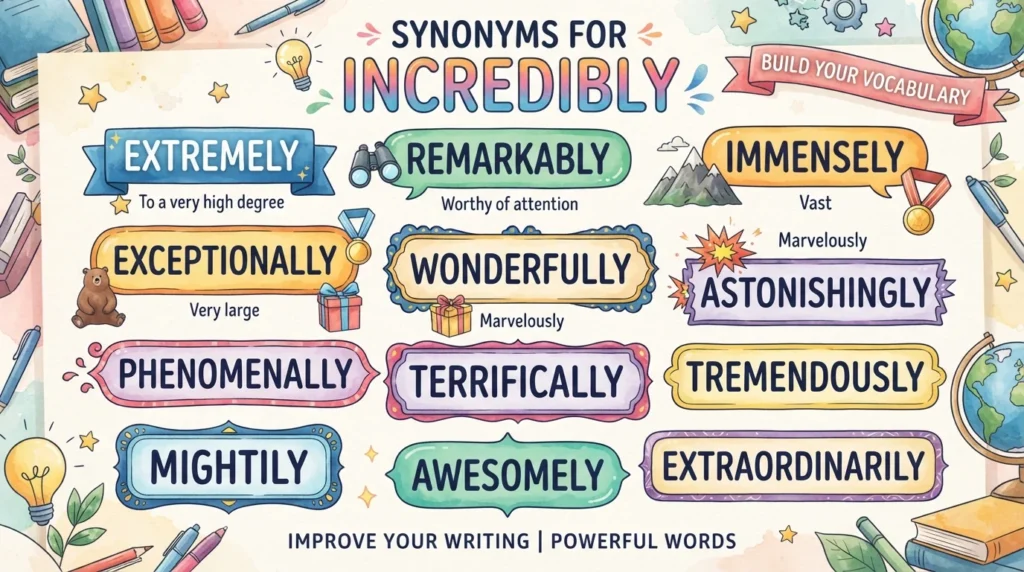
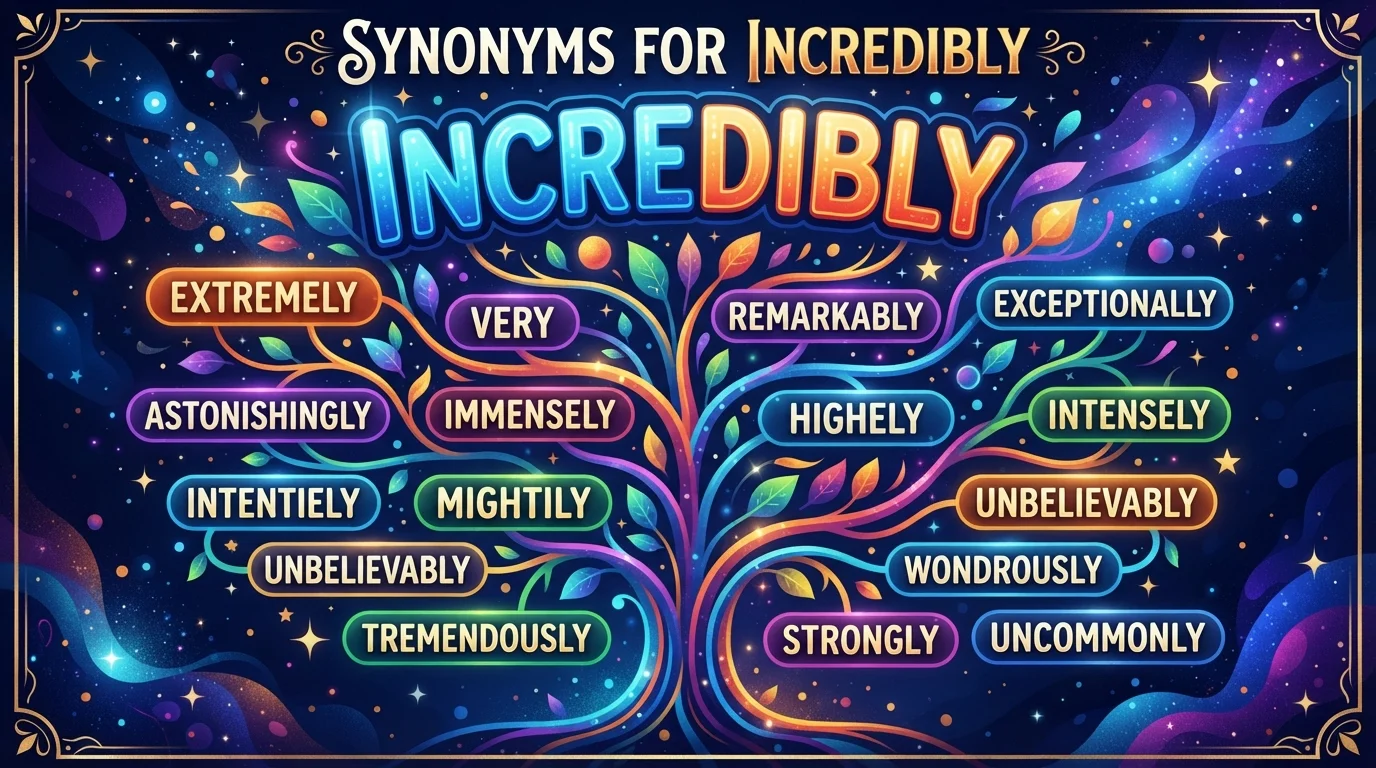
Quick List: Synonyms for Incredibly
Meaning “extremely”
- extremely
- exceptionally
- extraordinarily
- tremendously
- immensely
- remarkably
- exceedingly
- highly
- unusually
- especially
- notably
- intensely
- enormously
- hugely
- deeply
- profoundly
- particularly
- overwhelmingly
Meaning “surprisingly or impressively”
- remarkably
- astonishingly
- amazingly
- extraordinarily
- spectacularly
- impressively
- strikingly
- exceptionally
- astoundingly
- astonishingly
- stunningly
Meaning “hard to believe”
- unbelievably
- implausibly
- improbably
- inconceivably
- unimaginably
- unbelievably
- fantastically
- improbably
Informal alternatives
- really
- very
- super
- hugely
- amazingly
- unbelievably
- insanely
- ridiculously
Note: Some informal intensifiers, such as insanely and ridiculously, are hyperbolic. They can sound casual or exaggerated and are not suitable for every context.
What Does “Incredibly” Mean?
Incredibly is an adverb. It commonly serves two related purposes:
- To an extreme or unusually high degree
- The test was incredibly difficult.
- Meaning: The test was extremely difficult.
- In a way that is difficult to believe
- The story was incredibly unlikely.
- Meaning: The story seemed hard to believe.
The first meaning is much more common in everyday English.
This distinction matters because replacing incredibly with extremely works well in the first sentence, while unbelievably may change the meaning.
1. Incredibly = Extremely
When incredibly simply strengthens an adjective or adverb, these are the most useful alternatives.
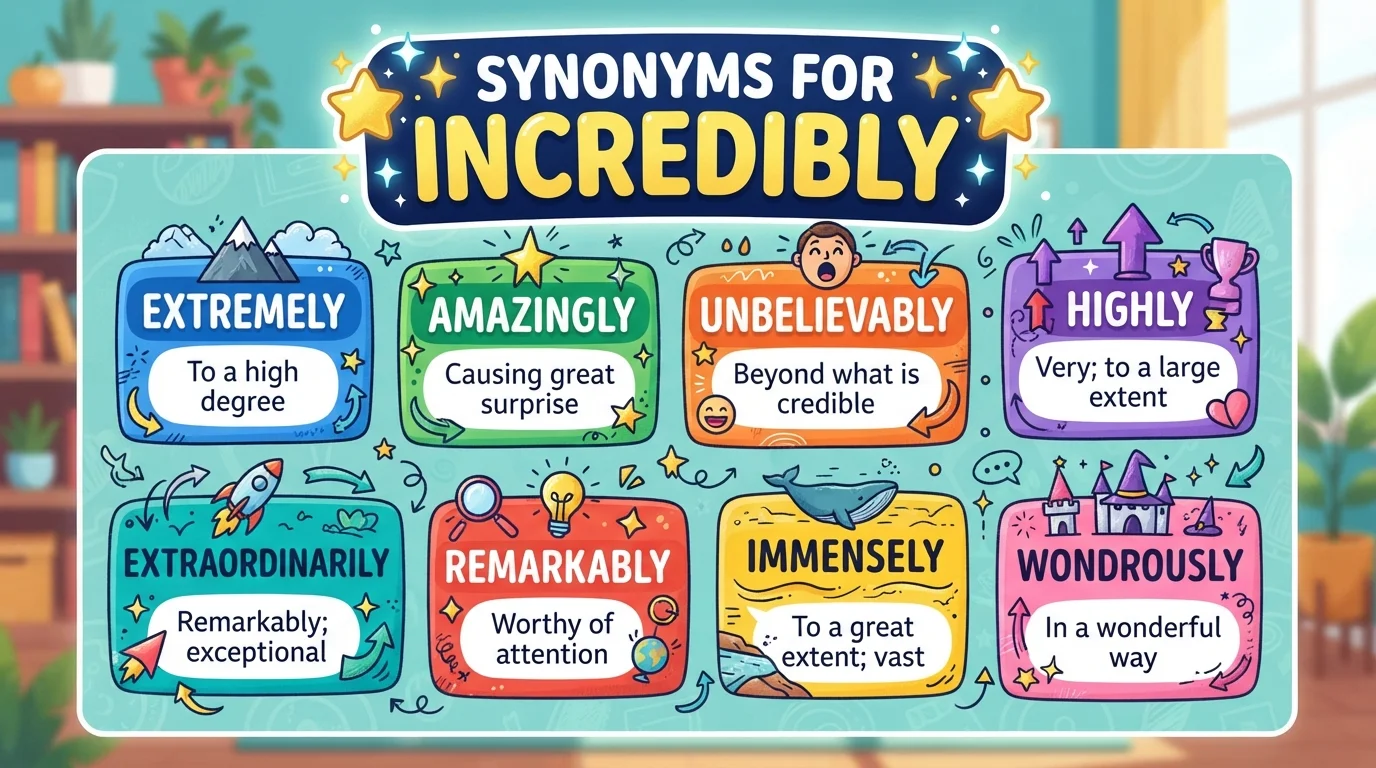
Extremely
Extremely means to a very high degree.
The hotel was incredibly comfortable.
The hotel was extremely comfortable.
Tone: neutral
Best for: everyday, professional, academic, and general writing.
Why choose it: It is one of the clearest direct replacements when incredibly is being used as an intensifier.
Exceptionally
Exceptionally means unusually or extremely, often suggesting that something stands out from the normal level.
She is exceptionally talented.
Compared with extremely talented, exceptionally talented more strongly suggests that her ability is unusual.
Tone: neutral to formal
Best for: professional, academic, evaluative, and formal writing.
Exceedingly
Exceedingly means extremely or to a very high degree.
The procedure was exceedingly complex.
Tone: formal
Best for: formal prose and literary writing.
Watch out: It can sound old-fashioned or more formal than necessary in casual conversation.
Tremendously
Tremendously means to a very great degree.
The project was tremendously successful.
Tone: positive, energetic
Best for: achievements, benefits, success, impact, enthusiasm.
Immensely
Immensely means extremely or to a very great extent.
We were immensely grateful for your help.
Tone: neutral to formal
Best for: gratitude, value, enjoyment, importance, benefit.
Common combinations include:
- immensely valuable
- immensely popular
- immensely grateful
- immensely useful
- immensely proud
Highly
Highly means to a great degree and is especially common with particular adjectives.
She is highly skilled.
The book is highly recommended.
Best for: professional and academic writing.
Watch out: Highly does not work naturally with every adjective.
For example:
✓ highly effective
✓ highly successful
✗ highly tired
For tired, extremely tired or very tired is more natural.
Enormously
Enormously means extremely or to a very large degree.
The decision was enormously important.
Tone: neutral
Best for: importance, benefit, influence, popularity, scale.
Exceedingly
The landscape was exceedingly beautiful.
This is a strong intensifier with a formal or literary feel.
2. Incredibly = Remarkably or Unusually
Sometimes incredibly does more than simply intensify. It suggests that something is surprising, unusual, notable, or impressive.
Remarkably
Remarkably means in a way that deserves attention because it is unusual or impressive.
She recovered incredibly quickly.
She recovered remarkably quickly.
The second sentence suggests that the speed of recovery was notable, not merely fast.
Tone: neutral to formal
Best for: professional, academic, journalistic, and descriptive writing.
Extraordinarily
Extraordinarily means to an unusual or exceptional degree.
He was incredibly patient.
He was extraordinarily patient.
The alternative emphasizes that his patience was far beyond what is typical.
Tone: formal
Astonishingly
Astonishingly emphasizes that something is surprising or difficult to believe.
The device is astonishingly powerful.
Tone: strong
Best for: surprising results, impressive achievements, dramatic observations.
Amazingly
Amazingly means in a surprising or impressive way.
She performed incredibly well.
She performed amazingly well.
Tone: conversational
It can sound enthusiastic and is common in everyday speech.
Impressively
Impressively emphasizes that something creates admiration because of its quality or achievement.
The team worked incredibly efficiently.
The team worked impressively efficiently.
The second version focuses more directly on the positive impression created by the performance.
Strikingly
Strikingly means in a way that is particularly noticeable or remarkable.
The two photographs were incredibly similar.
The two photographs were strikingly similar.
Best for: comparisons, visual observations, patterns, differences, data, and analysis.
Exceptionally
The candidate demonstrated exceptionally strong analytical skills.
Here, exceptionally indicates a level that stands out from ordinary performance.
3. Incredibly = Unbelievably
This sense is different.
When incredibly means that something seems difficult to believe, alternatives include:
Unbelievably
Unbelievably means in a way that seems impossible or very difficult to believe.
The price was incredibly low.
Depending on context, this could mean:
The price was extremely low.
or:
The price was unbelievably low.
The second version adds a sense of surprise or disbelief.
Improbably
Improbably means in an unlikely or unexpected way.
They incredibly managed to escape.
A more precise sentence might be:
They improbably managed to escape.
However, this is not a natural replacement in every sentence. Improbably specifically concerns likelihood.
Implausibly
Implausibly means in a way that seems unlikely to be true or believable.
The character survives an incredibly unlikely series of events.
The character survives an implausibly unlikely series of events.
Be careful: implausibly often introduces a critical judgment that something does not seem believable.
Inconceivably
Inconceivably means beyond what can reasonably be imagined or conceived.
The task was incredibly difficult.
The task was inconceivably difficult.
The second version is dramatically stronger and should be used carefully.
Unimaginably
Unimaginably means beyond what can reasonably be imagined.
The disaster caused incredibly high costs.
The disaster caused unimaginably high costs.
This is highly emphatic and often dramatic.
4. Strong Alternatives for “Incredibly”
When you want a powerful intensifier, consider:
- extremely
- exceptionally
- extraordinarily
- tremendously
- immensely
- enormously
- exceedingly
- remarkably
- astonishingly
- astoundingly
- overwhelmingly
- intensely
- profoundly
- deeply
- spectacularly
But strength is not the only issue. Collocation matters.
For example:
deeply concerned ✓
profoundly concerned ✓
extremely concerned ✓
But:
spectacularly concerned ✗
The synonym needs to fit the adjective naturally.
5. Formal Synonyms for “Incredibly”
For formal, academic, or professional writing, these alternatives can be useful:
Extremely
Clear and widely accepted.
Exceptionally
Suggests a level that stands out.
Remarkably
Highlights something notable.
Exceedingly
Strong and formal.
Extraordinary
Emphasizes unusual magnitude or quality.
Highly
Useful with established collocations such as highly effective and highly significant.
Profoundly
Best with emotions, effects, and abstract conditions.
profoundly important
profoundly troubling
profoundly grateful
Intensely
Best when the adjective describes strong feeling, sensation, or concentration.
intensely focused
intensely competitive
intensely emotional
Tip: In academic writing, extremely is often clearer than a more elaborate intensifier. Do not choose exceedingly simply because it sounds formal.
6. Informal Alternatives for “Incredibly”
In casual conversation, people often use:
- really
- very
- super
- hugely
- amazingly
- unbelievably
- insanely
- ridiculously
- seriously
- so
Examples:
That movie was really good.
The food was super tasty.
It was ridiculously expensive.
She’s seriously talented.
These are not perfect synonyms. They differ in tone and degree.
“Insanely”
Insanely is an informal hyperbole meaning extremely.
That car is insanely fast.
It is common in casual speech but can sound inappropriate in formal writing.
“Ridiculously”
Ridiculously suggests that something is excessive to an almost absurd degree.
The jacket was ridiculously expensive.
This can add humor, criticism, or exaggeration.
7. Positive Alternatives for “Incredibly”
When the sentence describes something especially good or impressive, these words can add a positive nuance:
- exceptionally
- remarkably
- extraordinarily
- impressively
- amazingly
- outstandingly
- tremendously
- spectacularly
- wonderfully
- superbly
Examples:
She is incredibly talented.
She is exceptionally talented.
She is remarkably talented.
She is extraordinarily talented.
She is impressively talented.
Each one changes the emphasis slightly.
Exceptionally focuses on unusual quality.
Remarkably focuses on how notable the quality is.
Extraordinarily emphasizes an exceptional degree.
Impressively focuses on the effect the ability has on observers.
8. Negative or Critical Alternatives
When incredibly intensifies something negative, the replacement should preserve that meaning.
The process was incredibly complicated.
Possible alternatives:
- extremely complicated
- exceptionally complicated
- remarkably complicated
- extraordinarily complicated
- excessively complicated
Notice that excessively is not a general synonym for incredibly. It adds the idea that something is more than necessary or appropriate.
The process was excessively complicated.
This means the complexity itself is considered too great.
Comparison Table
| Word | Main Meaning | Tone | Strength | Best Use |
|---|---|---|---|---|
| incredibly | very/extremely; sometimes hard to believe | neutral | strong | general emphasis |
| extremely | to a very high degree | neutral | strong | almost any suitable adjective |
| exceptionally | unusually high or good | neutral/formal | strong | quality, ability, performance |
| remarkably | unusually or notably | neutral/formal | strong | notable facts or qualities |
| extraordinarily | unusually or extremely | formal | very strong | exceptional situations |
| exceedingly | extremely | formal | very strong | formal/literary prose |
| tremendously | to a very great degree | neutral | strong | success, benefit, impact |
| immensely | to a very great degree | neutral/formal | strong | value, gratitude, enjoyment |
| highly | to a great degree | neutral/formal | moderate–strong | common professional collocations |
| enormously | to a very large degree | neutral | strong | importance, influence, scale |
| astonishingly | surprisingly or amazingly | strong | very strong | surprising results |
| amazingly | surprisingly/impressively | conversational | strong | everyday enthusiasm |
| unbelievably | hard to believe | conversational | very strong | surprise/disbelief |
| implausibly | in an unlikely way | formal/neutral | strong | probability or credibility |
| profoundly | deeply and significantly | formal | strong | emotions, effects, ideas |
| intensely | with great intensity | neutral/formal | strong | emotions, activity, focus |
| really | very | conversational | moderate | everyday speech |
| super | very | informal | strong | casual conversation |
| insanely | extremely, hyperbolically | informal | very strong | casual speech |
| ridiculously | excessively, absurdly | informal | very strong | humor, criticism, exaggeration |
“Incredibly” vs. “Extremely”
These two are often interchangeable.
The room was incredibly cold.
The room was extremely cold.
Both mean the temperature was very low.
The main difference is style and emphasis. Extremely is more straightforward and neutral. Incredibly can sometimes sound more expressive.
For precise professional or academic writing, extremely is often the safer choice when no additional nuance is intended.
“Incredibly” vs. “Remarkably”
These words overlap but are not identical.
Incredibly often means simply very.
The software is incredibly fast.
Remarkably suggests that the speed is unusual or worthy of notice.
The software is remarkably fast.
Choose remarkably when you want to draw attention to an unexpected or notable quality.
“Incredibly” vs. “Unbelievably”
This is an especially important distinction.
Incredibly
Often means extremely.
The mountain was incredibly high.
Unbelievably
Often means so extreme that it is difficult to believe.
The mountain was unbelievably high.
The second sentence carries more surprise.
Do not automatically substitute unbelievably for incredibly.
“Incredibly” vs. “Exceptionally”
Exceptionally emphasizes that something is outside the ordinary range.
She is incredibly skilled.
She is exceptionally skilled.
The second sentence suggests that her skill stands out compared with others.
Use exceptionally when the idea of unusual quality matters.
“Incredibly” vs. “Highly”
These are not freely interchangeable.
highly effective ✓
incredibly effective ✓
But:
highly tired ✗
incredibly tired ✓
Highly works naturally with certain adjectives, especially those describing quality, effectiveness, importance, probability, or professional assessment.
Common combinations include:
- highly effective
- highly successful
- highly skilled
- highly unlikely
- highly competitive
- highly desirable
- highly significant
- highly respected
Sentence Transformations
1. Original
The restaurant was incredibly popular.
Alternative: The restaurant was extremely popular.
Why: Extremely is a direct, neutral replacement.
2. Original
She is incredibly talented.
Alternative: She is exceptionally talented.
Why: Exceptionally emphasizes that her talent is unusually high.
3. Original
The results were incredibly surprising.
Alternative: The results were remarkably surprising.
Why: Remarkably highlights that the results deserve attention.
4. Original
The machine is incredibly efficient.
Alternative: The machine is highly efficient.
Why: Highly efficient is a common professional and technical collocation.
5. Original
He was incredibly grateful.
Alternative: He was immensely grateful.
Why: Immensely works naturally with strong feelings such as gratitude.
6. Original
The journey was incredibly difficult.
Alternative: The journey was extremely difficult.
Why: Extremely preserves the meaning without adding unnecessary nuance.
7. Original
The athlete performed incredibly well.
Alternative: The athlete performed remarkably well.
Why: Remarkably suggests that the performance was notably good.
8. Original
The price was incredibly high.
Alternative: The price was unbelievably high.
Why: This works when the high price was surprising or difficult to believe.
9. Original
The issue is incredibly complicated.
Alternative: The issue is exceedingly complex.
Why: Exceedingly creates a formal tone, while complex is slightly more formal than complicated in many analytical contexts.
10. Original
She was incredibly focused during the competition.
Alternative: She was intensely focused during the competition.
Why: Intensely emphasizes concentration and mental effort.
Collocations With “Incredibly”
Incredibly commonly appears before adjectives and adverbs.
Incredibly + adjective
- incredibly good
- incredibly useful
- incredibly difficult
- incredibly important
- incredibly successful
- incredibly popular
- incredibly powerful
- incredibly fast
- incredibly expensive
- incredibly beautiful
- incredibly simple
- incredibly complex
- incredibly effective
- incredibly strong
- incredibly helpful
- incredibly talented
- incredibly lucky
- incredibly busy
- incredibly interesting
- incredibly rare
Incredibly + adverb
- incredibly quickly
- incredibly well
- incredibly slowly
- incredibly carefully
- incredibly easily
- incredibly effectively
- incredibly successfully
Common Mistakes
1. Assuming every synonym means exactly “incredibly”
They do not.
Remarkably adds notability.
Unbelievably adds disbelief.
Exceptionally suggests unusual excellence or degree.
Excessively suggests too much.
Choose according to meaning, not just dictionary similarity.
2. Using “unbelievably” when you only mean “very”
The apartment is unbelievably comfortable.
This may suggest that the comfort is surprising or difficult to believe.
If you simply mean very comfortable:
The apartment is extremely comfortable.
3. Using “highly” with every adjective
Highly has strong collocational limits.
highly effective ✓
highly skilled ✓
highly important ✓
highly tired ✗
Use extremely tired instead.
4. Overusing strong intensifiers
A sentence filled with words such as incredibly, extremely, tremendously, and exceptionally can lose impact.
Compare:
It was incredibly beautiful, incredibly exciting, and incredibly impressive.
with:
It was beautiful, exciting, and surprisingly impressive.
Specific description is often stronger than repeated intensification.
5. Using informal hyperbole in formal writing
Words such as insanely, ridiculously, and super are appropriate in some conversations but may weaken a formal report.
The system is extremely efficient.
is generally more suitable than:
The system is insanely efficient.
6. Confusing “excessively” with “extremely”
These words are not equivalent.
Extremely expensive = very expensive.
Excessively expensive = more expensive than is considered reasonable or appropriate.
The second contains a judgment.
7. Adding unnecessary drama
Words such as astonishingly, astoundingly, and unimaginably make strong claims.
If the fact is not genuinely surprising, extremely or very may be more accurate.
When Not to Replace “Incredibly”
Keep incredibly when:
- it sounds natural in the sentence
- you want a conversational or expressive tone
- the sentence benefits from emotional emphasis
- the exact meaning is simply “extremely”
- a replacement would sound too formal
- the common collocation is already natural
For example:
That was incredibly helpful.
This is perfectly natural. There is no need to replace it with exceedingly helpful merely to avoid repetition.
A synonym should solve a writing problem, not create one.
How to Choose the Right Synonym
For everyday writing
Use:
- extremely
- really
- very
- amazingly
- incredibly
For professional writing
Use:
- extremely
- highly
- exceptionally
- remarkably
- significantly
- tremendously
For academic writing
Use:
- extremely
- highly
- remarkably
- exceptionally
- substantially
- profoundly
Choose the word that matches the evidence and the exact claim.
For formal writing
Use:
- exceedingly
- extraordinarily
- exceptionally
- remarkably
- profoundly
Use them selectively.
For casual conversation
Use:
- really
- super
- amazingly
- unbelievably
- insanely
- ridiculously
The last two are strongly hyperbolic.
For surprise
Use:
- remarkably
- astonishingly
- amazingly
- unbelievably
- extraordinarily
For extreme degree without extra meaning
Use:
- extremely
- tremendously
- immensely
- enormously
- exceedingly
A Better Approach Than Replacing “Incredibly”
If you find yourself using incredibly too often, do not simply swap it for another intensifier every time.
Instead, ask what you really mean.
Instead of:
The presentation was incredibly good.
Try:
The presentation was clear, persuasive, and well organized.
Instead of:
The problem was incredibly difficult.
Try:
The problem required several layers of analysis.
Instead of:
The product is incredibly useful.
Try:
The product reduces the time needed to complete the task.
Specific language often gives readers more information than an intensifier.