
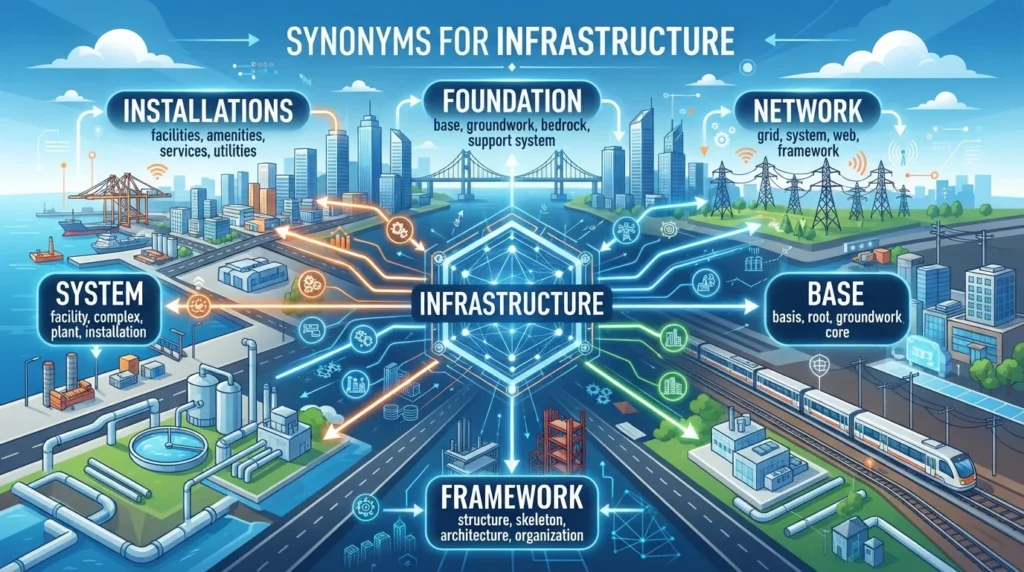
Quick Synonym List
Closest and general alternatives
- Systems
- Facilities
- Framework
- Structure
- Foundation
- Network
- Support system
- Framework
- Physical assets
- Public works
Physical infrastructure
- Facilities
- Buildings
- Structures
- Installations
- Public works
- Utilities
- Transport systems
- Roads and bridges
- Physical assets
- Civic facilities
Business and organizational infrastructure
- Systems
- Framework
- Organizational structure
- Support system
- Operating framework
- Resources
- Foundation
- Institutional structure
- Administrative system
- Operational framework
Technology infrastructure
- IT systems
- Technical environment
- Architecture
- Platform
- Network
- Technology stack
- Computing environment
- IT framework
- Systems architecture
- Technical foundation
Figurative and conceptual alternatives
- Foundation
- Framework
- Structure
- Backbone
- Underpinning
- Support system
- Basis
- Foundation layer
- Enabling system
- Organizational framework
What Does “Infrastructure” Mean?
Infrastructure is the basic physical, organizational, or technological systems and structures that allow a society, organization, service, or activity to operate.
For example:
“The city needs better infrastructure.”
Here, infrastructure could include roads, bridges, water systems, electricity networks, public transportation, and other essential facilities.
The word can also refer to systems inside an organization:
“The company is investing in its digital infrastructure.”
This could include servers, networks, software systems, data storage, security tools, and other technology that supports the business.
Because infrastructure has several meanings, there is no single synonym that works in every sentence.
The Closest Synonyms for Infrastructure
1. Systems
Meaning: Connected components or processes that work together to provide a service or function.
Best for: Technology, transportation, utilities, government, and business.
Example:
“The country needs stronger transportation systems.”
How it differs:
Systems emphasizes how components work together. Infrastructure often emphasizes the underlying physical or organizational foundation that supports those systems.
2. Facilities
Meaning: Buildings, equipment, or places provided for a particular purpose.
Best for: Schools, hospitals, factories, offices, sports centers, and public services.
Example:
“The university is upgrading its facilities.”
How it differs:
Facilities usually refers to physical places or equipment. Infrastructure can include facilities but is broader.
3. Framework
Meaning: A basic structure or system that supports something.
Best for: Organizations, policies, technology, processes, and abstract systems.
Example:
“The company needs a stronger framework for managing data.”
How it differs:
Framework can be physical or conceptual, while infrastructure often refers to the underlying systems and resources needed for operation.
4. Structure
Meaning: The way something is organized or built.
Best for: Organizations, institutions, physical construction, and systems.
Example:
“The organization needs a stronger administrative structure.”
How it differs:
Structure is broader. It can describe arrangement or organization without implying the supporting resources associated with infrastructure.
5. Foundation
Meaning: The basic support on which something is built or developed.
Best for: Figurative writing, business, technology, education, and development.
Example:
“Reliable data provides the foundation for the company’s digital services.”
How it differs:
Foundation emphasizes basic support. It is often figurative, while infrastructure usually refers to a broader set of interconnected systems.
6. Network
Meaning: A connected group of people, places, devices, or systems.
Best for: Telecommunications, transportation, utilities, and technology.
Example:
“The region needs a more reliable transportation network.”
How it differs:
A network is one type of infrastructure. Infrastructure can include networks as well as buildings, equipment, utilities, and other supporting assets.
7. Public Works
Meaning: Government-funded or government-managed physical projects and facilities that serve the public.
Best for: Roads, bridges, drainage systems, public buildings, water systems, and similar projects.
Example:
“The government announced a major public works program.”
How it differs:
Public works is narrower than infrastructure. It usually refers to publicly funded physical projects.
8. Utilities
Meaning: Essential services such as electricity, water, gas, sewage, and sometimes telecommunications.
Best for: Cities, housing, construction, property, and public services.
Example:
“The new development has access to basic utilities.”
How it differs:
Utilities are a major component of infrastructure, not a complete synonym for it.
Infrastructure by Meaning and Context
Infrastructure for Roads and Transportation
When infrastructure refers to transportation, useful alternatives include:
- Transportation system
- Transport network
- Road network
- Transit system
- Public transportation system
- Transport facilities
- Roadways
- Highways
- Bridges
- Public works
Example
Original:
“The country needs to improve its transportation infrastructure.”
“The country needs to improve its transportation network.”
“The country needs to upgrade its public transportation system.”
“The country needs to modernize its transport facilities.”
The best choice depends on exactly what is being improved.
Infrastructure for Cities and Communities
Urban infrastructure can include roads, water systems, electricity, sewage, public transportation, telecommunications, schools, hospitals, and public facilities.
Useful alternatives include:
- Civic infrastructure
- Public facilities
- Public works
- Municipal systems
- Urban systems
- Community facilities
- Essential services
- Public utilities
- Municipal infrastructure
- Urban facilities
Example
“Rapid population growth is putting pressure on the city’s infrastructure.”
Could become:
“Rapid population growth is putting pressure on the city’s public services.”
However, public services is not always an exact replacement because services are what people receive, while infrastructure is the physical and organizational foundation that helps provide them.
Infrastructure in Technology
Technology uses the word infrastructure frequently.
IT infrastructure may include:
- Servers
- Networks
- Data centers
- Storage systems
- Computing resources
- Security systems
- Cloud services
- Hardware
- Software platforms
- Communication systems
Useful alternatives include:
IT Systems
“The company is upgrading its IT systems.”
This is natural when discussing the technology used by an organization.
Technical Environment
“The application runs in a secure technical environment.”
This emphasizes the environment in which technology operates.
Technology Stack
“The development team is reviewing its technology stack.”
This is common in software development and refers to the technologies used to build and run a system.
Architecture
“The company redesigned its cloud architecture.”
Architecture focuses on how technological components are designed and organized.
Platform
“The new platform supports the company’s digital services.”
A platform is a technological base on which applications or services operate.
Computing Environment
“The software was tested in a controlled computing environment.”
This emphasizes the hardware, software, and configuration supporting computing activity.
Infrastructure in Business
In business writing, infrastructure can refer to the systems, processes, resources, facilities, and organizational structures that allow a company to function.
Useful alternatives include:
- Operating system
- Business systems
- Organizational structure
- Support system
- Operating framework
- Operational structure
- Business framework
- Administrative system
- Resources
- Institutional structure
Example
“The company has invested heavily in its operational infrastructure.”
Possible alternatives:
“The company has invested heavily in its operating systems.”
“The company has strengthened its operational framework.”
The company has expanded its business support systems.
The exact replacement depends on what the infrastructure actually consists of.
Infrastructure in Organizations and Institutions
For schools, universities, hospitals, governments, and nonprofit organizations, infrastructure can refer to the systems and facilities that support their work.
Possible alternatives include:
- Institutional structure
- Organizational framework
- Administrative systems
- Support systems
- Facilities
- Resources
- Operational framework
- Institutional capacity
- Organizational systems
Example
“The university needs better research infrastructure.”
Depending on the intended meaning, this could become:
“The university needs better research facilities.”
or:
“The university needs stronger research support systems.”
or:
“The university needs greater research capacity.”
These are related but not identical.
Infrastructure as a Figurative “Foundation”
Sometimes infrastructure is used metaphorically to describe the underlying support for an activity.
Foundation
“Education is the foundation of long-term economic development.”
Backbone
Backbone suggests something essential that supports the rest of a system.
“Small businesses are the backbone of the local economy.”
Underpinning
Underpinning refers to something that provides fundamental support.
“Reliable data is an important underpinning of effective decision-making.”
Basis
Basis means the fundamental support or starting point for something.
“Trust provides the basis for a successful partnership.”
Support System
A support system is something that helps another system, person, or activity function successfully.
“The organization has built a strong support system for new employees.”
These alternatives are especially useful in essays, reports, and explanatory writing.
True Synonyms vs. Related Alternatives
Not every word in a thesaurus is a direct synonym for infrastructure.
| Alternative | Relationship | Can Replace “Infrastructure”? | Best Context |
|---|---|---|---|
| Systems | Near synonym | Sometimes | Technology, business, public services |
| Facilities | Related term | Sometimes | Buildings and physical resources |
| Framework | Near synonym | Sometimes | Organizations, policies, technology |
| Structure | Broader term | Sometimes | Organization and physical design |
| Foundation | Contextual alternative | Sometimes | Figurative or foundational support |
| Network | Narrower term | Sometimes | Transport, telecommunications, IT |
| Public works | Narrower term | Sometimes | Government physical projects |
| Utilities | Narrower term | Sometimes | Water, electricity, gas, sewage |
| Backbone | Figurative alternative | Yes, in some contexts | Essential support |
| Resources | Related term | Rarely | Business, education, organizations |
| Architecture | Contextual alternative | Yes, in technology | IT and software |
| Platform | Narrower/contextual term | Sometimes | Technology |
| Facilities | Physical component | Sometimes | Schools, hospitals, businesses |
| Capacity | Related concept | Rarely | Institutional capability |
| Foundation | Figurative equivalent | Sometimes | Business, development, education |
The key point is simple: infrastructure is often a collective concept, while many alternatives refer to only one part of it.
Infrastructure vs. Systems
These words overlap but are not identical.
Infrastructure usually refers to the underlying resources and structures that support activity.
Systems emphasizes connected components working together.
Compare:
“The city’s infrastructure needs investment.”
This could include roads, bridges, water systems, electricity, public buildings, and transportation.
“The city’s transportation systems need investment.”
This specifically focuses on transportation.
Use infrastructure for the broad foundation. Use systems when you want to emphasize how components operate together.
Infrastructure vs. Facilities
Facilities usually means physical places, buildings, and equipment.
“The hospital has modern facilities.”
Infrastructure can include those facilities but can also include networks, utilities, transportation, and other supporting systems.
“The region’s healthcare infrastructure needs improvement.”
This can refer to hospitals, clinics, equipment, staffing systems, transportation access, and supporting services.
Infrastructure vs. Framework
A framework is often more abstract.
“The company developed a framework for data governance.”
An infrastructure is more likely to refer to the practical systems and resources that make operations possible.
“The company upgraded its data infrastructure.”
A framework tells people how something is organized or governed. Infrastructure helps provide the underlying means for it to operate.
Infrastructure vs. Foundation
These words are especially close in figurative writing.
Foundation emphasizes basic support:
“Trust is the foundation of the partnership.”
Infrastructure suggests a larger collection of supporting systems:
“The organization needs the infrastructure to support international operations.”
A foundation can be a single fundamental element. Infrastructure usually implies multiple connected components.
Infrastructure vs. Public Works
Public works refers to government-funded or publicly managed physical projects.
Examples include:
- Roads
- Bridges
- Sewage systems
- Water systems
- Public buildings
- Drainage systems
Infrastructure is broader and can be:
- Public
- Private
- Commercial
- Industrial
- Digital
- Organizational
Therefore:
“Infrastructure investment”
is broader than:
“Public works investment.”
Infrastructure vs. Utilities
Utilities are services such as:
- Electricity
- Water
- Natural gas
- Sewage
- Telecommunications
They are often part of infrastructure.
For example:
“The new housing development needs infrastructure.”
could include roads, drainage, electricity, water, telecommunications, and public facilities.
Saying:
“The new housing development needs utilities.”
focuses specifically on essential service connections.
Infrastructure vs. Architecture in Technology
In technology, these terms can overlap.
Infrastructure generally refers to the underlying hardware, networks, computing resources, services, and systems that support technology operations.
Architecture describes how technological components are designed and arranged.
Compare:
“The company is upgrading its cloud infrastructure.”
and:
“The company is redesigning its cloud architecture.”
The first focuses on the underlying technology resources. The second focuses on system design.
Infrastructure in Academic Writing
Academic writing often uses infrastructure in discussions of:
- Economic development
- Urban planning
- Transportation
- Public health
- Education
- Technology
- Government
- Digital transformation
- Research
- Industrial development
Useful alternatives include:
- Systems
- Facilities
- Institutional framework
- Support systems
- Public works
- Physical assets
- Organizational structure
- Technological framework
- Institutional capacity
- Foundational systems
Example
Original:
“Investment in infrastructure can support economic development.”
More specific:
“Investment in transportation networks can support economic development.”
Or:
“Investment in public facilities can support economic development.”
The more specific version is often stronger when you know exactly which part of infrastructure you mean.
Infrastructure in Business Writing
In business communication, avoid replacing infrastructure with a vague word simply to avoid repetition.
Original
“The company is investing in digital infrastructure.”
More specific
“The company is investing in cloud computing systems.”
Another option
“The company is expanding its IT architecture.”
Another option
“The company is upgrading its technology platform.”
Each sentence communicates something slightly different.
Infrastructure in Government and Policy Writing
In government and policy contexts, common alternatives include:
- Public works
- Public facilities
- Municipal systems
- Civic facilities
- Transport networks
- Utility systems
- Essential services
- Public assets
- Urban systems
Example
“The government announced a major infrastructure program.”
If the program specifically funds roads and bridges, a more precise sentence might be:
“The government announced a major public works program focused on roads and bridges.”
This gives readers more information instead of simply using a synonym.
Infrastructure in Real Estate and Construction
In construction and property contexts, infrastructure may refer to the basic physical systems serving a development.
Useful alternatives include:
- Site infrastructure
- Utilities
- Public works
- Roads
- Services
- Utility connections
- Physical facilities
- Supporting systems
- Site services
Example
“The development has adequate infrastructure.”
Depending on the meaning, you might write:
“The development has reliable utility connections.”
or:
“The development has completed roads and drainage systems.”
Specific language is often better in technical and construction documents.
Sentence Transformations
1. General city context
Original:
“The city needs better infrastructure.”
Alternative:
“The city needs better public facilities and transportation systems.”
Why:
This identifies two specific parts of infrastructure rather than using the broad term.
2. Technology
Original:
“The company is upgrading its IT infrastructure.”
Alternative:
“The company is upgrading its IT systems.”
Why:
IT systems works well when the focus is on connected technology rather than physical equipment.
3. Transportation
Original:
“The country needs to improve its transportation infrastructure.”
Alternative:
“The country needs to improve its transportation network.”
Why:
Transportation network is more specific when roads, railways, airports, or transit routes are the focus.
4. Public projects
Original:
“The government plans to invest in infrastructure.”
Alternative:
“The government plans to invest in public works.”
Why:
Public works is appropriate when the investment involves government-funded physical projects.
5. Technology architecture
Original:
“The organization has modern digital infrastructure.”
Alternative:
“The organization has a modern technical environment.”
Why:
Technical environment emphasizes the technology in which systems operate.
6. Business support
Original:
“The company lacks the infrastructure needed to expand.”
Alternative:
“The company lacks the support systems needed to expand.”
Why:
Support systems works when the missing infrastructure consists mainly of processes, resources, or organizational support.
7. Figurative writing
Original:
“Education provides infrastructure for economic growth.”
Better Alternative:
“Education provides a foundation for economic growth.”
Why:
Foundation is more natural when the meaning is figurative and refers to fundamental support.
8. Healthcare
Original:
“The country needs stronger healthcare infrastructure.”
Alternative:
“The country needs stronger healthcare facilities and support systems.”
Why:
The alternative makes the physical and organizational components more explicit.
9. Digital business
Original:
“The company built the infrastructure for its online services.”
Alternative:
“The company built the technical foundation for its online services.”
Why:
Technical foundation works well when the sentence emphasizes the underlying technology that enables the service.
10. Telecommunications
Original:
“The region has limited telecommunications infrastructure.”
Alternative:
“The region has a limited telecommunications network.”
Why:
Network is more precise when the main concern is connectivity.
Common Collocations With Infrastructure
These combinations are common and useful:
- build infrastructure
- develop infrastructure
- improve infrastructure
- upgrade infrastructure
- modernize infrastructure
- expand infrastructure
- maintain infrastructure
- invest in infrastructure
- fund infrastructure
- finance infrastructure
- infrastructure development
- infrastructure investment
- infrastructure projects
- infrastructure spending
- infrastructure needs
- infrastructure improvements
- critical infrastructure
- public infrastructure
- transportation infrastructure
- digital infrastructure
- IT infrastructure
- healthcare infrastructure
- educational infrastructure
- energy infrastructure
- water infrastructure
- urban infrastructure
- rural infrastructure
- industrial infrastructure
- social infrastructure
- economic infrastructure
Common Mistakes
Mistake 1: Treating “facilities” as a perfect synonym
Facilities usually means buildings, spaces, or equipment.
Infrastructure is broader.
“The hospital has excellent facilities.”
does not necessarily mean:
“The country has excellent healthcare infrastructure.”
Mistake 2: Using “utilities” for all infrastructure
Utilities are only one component of infrastructure.
Water, electricity, gas, sewage, and telecommunications can be utilities, but roads and public buildings are not necessarily utilities.
Mistake 3: Using “network” for everything
A network is a connected system.
It works well for:
- Transportation
- Telecommunications
- Computers
- Electricity distribution
But it may not accurately describe buildings, hospitals, schools, or administrative systems.
Mistake 4: Using “foundation” for physical infrastructure
Sometimes this works figuratively, but it can change the meaning.
“Infrastructure supports economic activity.”
and:
“Infrastructure is the foundation of economic activity.”
The second sentence uses foundation metaphorically. It does not necessarily refer to physical infrastructure.
Mistake 5: Assuming “public works” means all infrastructure
Public works usually refers to government-funded physical projects.
Private data centers, corporate IT systems, and privately owned industrial facilities can be infrastructure without being public works.
Mistake 6: Replacing infrastructure just to sound sophisticated
Infrastructure is already a precise and widely understood word.
Replacing it with framework, foundation, or structure can make a sentence less accurate if the original meaning is broader.
Mistake 7: Confusing infrastructure with services
Infrastructure supports services, but the two are not identical.
For example:
- Hospitals are infrastructure or facilities.
- Healthcare is a service.
- Roads are infrastructure.
- Transportation can refer to the system or service using those roads.
Keeping these distinctions clear improves technical and professional writing.
When Not to Replace “Infrastructure”
You should usually keep infrastructure when:
- you mean several connected supporting systems;
- the exact components are not important;
- you are discussing infrastructure as a broad policy or economic category;
- the word is already natural in the context;
- replacing it would make the sentence less precise.
For example:
“The country needs long-term investment in infrastructure.”
This is concise and natural.
Replacing it with:
“The country needs long-term investment in frameworks.”
would change the meaning.
Similarly:
“The company is developing the infrastructure required for global operations.”
is often better than forcing an alternative such as foundation or structure.
How to Choose the Right Alternative
| If you mean… | Use… |
|---|---|
| Broad supporting systems | Infrastructure |
| Connected components | Systems |
| Buildings and physical places | Facilities |
| Basic conceptual structure | Framework |
| Organizational arrangement | Structure |
| Fundamental support | Foundation |
| Connected routes or devices | Network |
| Government physical projects | Public works |
| Water, electricity, gas, sewage | Utilities |
| IT hardware and underlying technology | IT infrastructure |
| Software/system design | Architecture |
| Technology used to support services | Platform |
| Essential supporting element | Backbone |
| Fundamental support in figurative writing | Underpinning |
| Human or organizational support | Support system |
| Government or community facilities | Civic/public facilities |
Editor’s Choice
If you need a strong alternative to infrastructure, choose based on meaning rather than style.
Systems
A useful general alternative when the focus is on interconnected components and operations.
Facilities
Best when you specifically mean buildings, equipment, or physical locations.
Framework
Useful for organizational, technological, regulatory, or conceptual structures.
Foundation
Best for figurative writing about something that provides basic support.
Network
Strong when the infrastructure consists mainly of connected routes, devices, or locations.
These are not interchangeable in every sentence. The strongest choice is the one that preserves the original meaning while adding useful precision.