
Quick Answer
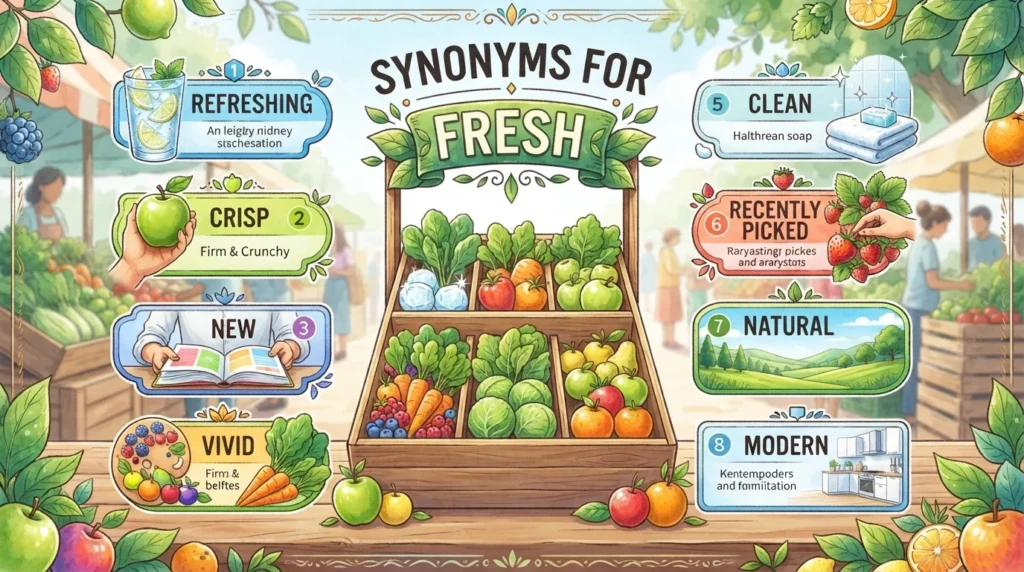
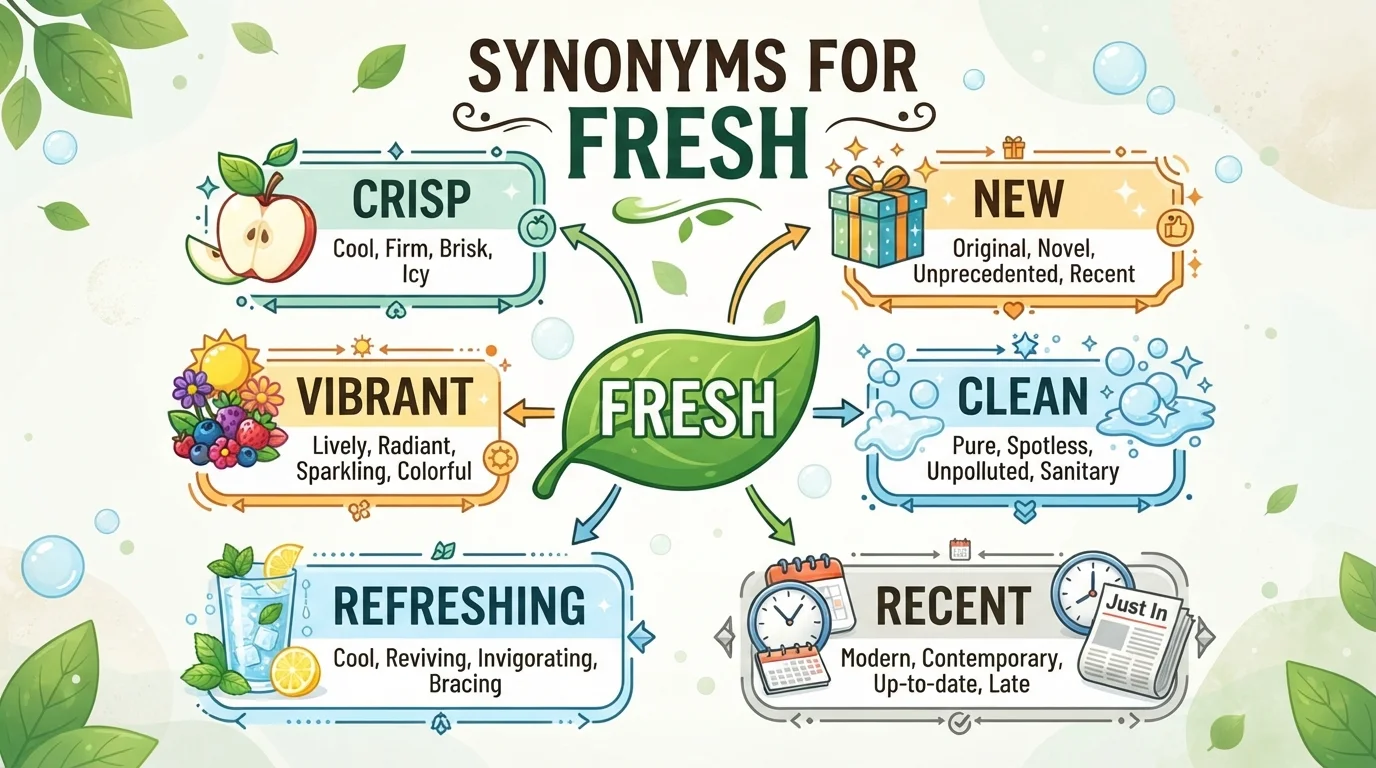
Common synonyms for fresh include new, recent, newly made, clean, pure, cool, crisp, original, innovative, lively, energetic, and unused. Use recent for something that happened lately, new for something newly introduced, crisp for food or air, original for ideas, and unused for something that has not been used before.
Quick Synonym List
| Meaning of freshUseful synonyms and alternatives | |
|---|---|
| Recently made or obtained | New, recent, newly made, newly prepared, just-made |
| Food quality | Crisp, wholesome, unspoiled, natural, ripe |
| Clean or pure | Clean, pure, clear, uncontaminated |
| Cool air or weather | Cool, crisp, brisk, refreshing |
| New ideas | Original, innovative, novel, creative, inventive |
| New perspective | Renewed, different, alternative, unconventional |
| Energy or appearance | Lively, energetic, vibrant, youthful, invigorated |
| Recently experienced | Recent, current, latest, new |
| Unused | New, unused, unopened, untouched |
| Recently washed | Clean, freshly washed, spotless |
| Rested | Refreshed, rested, revitalized, rejuvenated |
| New supply | Replenished, renewed, restocked |
| Informal expressions | Brand-new, like-new, just in, straight from |
Some of these are contextual alternatives rather than true synonyms. For example, innovative can describe a fresh idea, but it cannot replace fresh in fresh bread. Likewise, refreshed can describe a person after rest but does not normally describe newly harvested vegetables.
What Does “Fresh” Mean?
Fresh is an adjective with several major meanings.
Recently made, obtained, or produced
“We bought fresh bread this morning.”
Here, fresh means recently made.
In good condition
“The vegetables are still fresh.”
Here, it means not spoiled, stale, or deteriorated.
Cool and clean
“Open the window and let in some fresh air.”
Here, fresh suggests clean, cool, pleasant air.
New or original
“The team needs a fresh approach.”
Here, fresh means new, different, or original.
Full of energy
“I feel fresh after a good night’s sleep.”
Here, fresh means rested and energetic.
Unused
“Use a fresh sheet of paper.”
Here, fresh means new or unused.
The correct synonym changes with each meaning.
The Closest Synonyms for Fresh
1. New
Meaning: Recently created, introduced, acquired, or experienced.
Tone: Neutral.
Best for: Products, ideas, experiences, situations, and changes.
Example:
“We need a fresh approach to the problem.”
“We need a new approach to the problem.”
How it differs: New is one of the broadest alternatives to fresh, but it does not always preserve the positive sense of freshness. Fresh can suggest something invigorating or pleasantly different, while new simply indicates that something is not old.
2. Recent
Meaning: Happening or existing only a short time ago.
Tone: Neutral and professional.
Best for: Events, information, developments, research, and changes.
Example:
“The report contains fresh information.”
“The report contains recent information.”
Recent focuses on time, not quality or condition.
You can have recent information that is not particularly fresh or useful.
3. Newly Made
Meaning: Made only recently.
Tone: Neutral.
Best for: Food, products, crafts, and prepared items.
Example:
“They sell freshly baked bread.”
“They sell newly made bread.”
Freshly baked is much more natural than newly made for bread and similar foods.
4. Crisp
Meaning: Fresh, firm, cool, or pleasantly sharp in quality.
Tone: Positive.
Best for: Vegetables, fruit, air, clothing, sounds, and writing.
Example:
“The lettuce was fresh and crisp.”
“The morning air felt crisp.”
Crisp is more specific than fresh. It can suggest firmness in food or coolness in the air.
5. Clean
Meaning: Free from dirt, pollution, or unwanted substances.
Tone: Neutral to positive.
Best for: Air, water, surfaces, clothes, and environments.
Example:
“We opened the windows to let in fresh air.”
“We opened the windows to let in clean air.”
Clean emphasizes the absence of dirt or pollutants, while fresh can additionally suggest coolness and pleasantness.
6. Pure
Meaning: Free from contamination or unwanted substances.
Tone: Neutral to formal.
Best for: Water, ingredients, air, substances, and abstract descriptions.
Example:
“The spring provides fresh water.”
“The spring provides pure water.”
Pure focuses on freedom from contamination. Fresh can imply that water is clean and recently obtained but does not necessarily mean chemically pure.
7. Cool
Meaning: Moderately cold or pleasantly low in temperature.
Tone: Neutral.
Best for: Air, weather, drinks, rooms, and surfaces.
Example:
“A fresh breeze came through the window.”
“A cool breeze came through the window.”
Cool describes temperature. Fresh may describe the pleasant quality of the air rather than its exact temperature.
8. Refreshing
Meaning: Pleasantly revitalizing, cooling, or invigorating.
Tone: Positive.
Best for: Drinks, weather, experiences, breaks, and ideas.
Example:
“The cold water was refreshing.”
“The fresh breeze was refreshing.”
Refreshing emphasizes the effect something has on you, while fresh often describes the thing itself.
9. Original
Meaning: New, unusual, or not copied from something else.
Tone: Positive or neutral.
Best for: Ideas, approaches, designs, writing, and solutions.
Example:
“She offered a fresh perspective.”
“She offered an original perspective.”
Original is especially useful when fresh means new or unconventional thinking.
10. Innovative
Meaning: Introducing new ideas, methods, or technology.
Tone: Professional and positive.
Best for: Business, technology, products, strategies, and solutions.
Example:
“The company needs a fresh approach.”
“The company needs an innovative approach.”
Innovative is stronger and more specific than fresh. It suggests meaningful novelty rather than simply a different perspective.
11. Novel
Meaning: New, unusual, or unfamiliar.
Tone: Formal or academic.
Best for: Ideas, methods, approaches, theories, and solutions.
Example:
“The researchers developed a fresh method.”
“The researchers developed a novel method.”
Novel is particularly common in academic and technical writing.
12. Lively
Meaning: Full of energy, activity, or enthusiasm.
Tone: Positive.
Best for: People, conversations, writing, places, and performances.
Example:
“The discussion brought a fresh energy to the meeting.”
“The discussion became more lively.”
Lively focuses on activity and energy rather than newness.
13. Energetic
Meaning: Having or showing a lot of energy.
Tone: Positive.
Best for: People, performances, teams, and activities.
Example:
“She arrived at work feeling fresh and energetic.”
Energetic is more precise when fresh means physically or mentally full of energy.
14. Refreshed
Meaning: Restored after rest or recovery.
Tone: Positive.
Best for: People, minds, attitudes, and appearances.
Example:
“I felt fresh after the weekend.”
“I felt refreshed after the weekend.”
Refreshed specifically suggests recovery from tiredness.
15. Rested
Meaning: Having had enough rest.
Tone: Neutral to positive.
Best for: People and mental or physical states.
Example:
“She looked fresh after her vacation.”
“She looked well rested after her vacation.”
Rested is more precise when the intended meaning is freedom from fatigue.
Fresh Food: The Best Alternatives
When fresh describes food, the right replacement depends on what quality you want to emphasize.
Crisp
Use for food that is firm and pleasantly crunchy.
“The salad contains fresh lettuce.”
“The salad contains crisp lettuce.”
Ripe
Use for fruit or vegetables that have reached the desired stage of maturity.
“The market sells fresh peaches.”
“The market sells ripe peaches.”
Ripe does not mean newly harvested. It describes maturity.
Wholesome
Use when emphasizing healthy, nourishing qualities.
“They serve fresh, wholesome food.”
Unspoiled
Use when emphasizing that food has not deteriorated.
“The fish was still fresh.”
“The fish was still unspoiled.”
Unspoiled is more literal and does not necessarily suggest the appealing quality associated with fresh.
Natural
Use when emphasizing minimal processing or ingredients.
“The restaurant uses fresh ingredients.”
“The restaurant uses natural ingredients.”
These are not identical: something can be natural without being fresh.
Fresh Ideas and Perspectives
When fresh means new, different, or original, several stronger alternatives are available.
| Word | Main emphasis | Example |
|---|---|---|
| New | Recently introduced | “We need a new strategy.” |
| Original | Not copied; creatively different | “She presented an original idea.” |
| Innovative | Uses new methods or ideas | “They developed an innovative solution.” |
| Novel | Unusual or newly developed | “The study uses a novel technique.” |
| Creative | Imaginative and inventive | “He suggested a creative approach.” |
| Unconventional | Different from established practice | “They took an unconventional approach.” |
| Alternative | Different from the usual option | “We need an alternative strategy.” |
| Cutting-edge | Highly advanced or new | “The company uses cutting-edge technology.” |
Example
“We need some fresh ideas.”
Possible alternatives:
“We need some new ideas.”
“We need some original ideas.”
“We need some creative ideas.”
“We need some innovative ideas.”
The best choice depends on what you want to emphasize. New emphasizes novelty, original emphasizes independence from existing ideas, and innovative emphasizes useful new methods or solutions.
Fresh Air: Synonyms and Alternatives
The phrase fresh air has a specific natural meaning, so not every synonym sounds equally natural.
Useful alternatives include:
- clean air
- cool air
- crisp air
- outdoor air
- clean outdoor air
- invigorating air
Examples
“We went outside for some fresh air.”
“We went outside for some clean air.”
“The crisp mountain air felt invigorating.”
Crisp air is especially natural when the air is cool and pleasant.
Clean air emphasizes the absence of pollution or unpleasant odors.
Fresh Start and Fresh Beginning
When fresh means new and free from previous problems, useful alternatives include:
- new beginning
- new start
- clean slate
- renewed beginning
- second chance
- reset
- new chapter
Example
“Moving to a new city gave her a fresh start.”
“Moving to a new city gave her a new beginning.”
Clean slate is more idiomatic and suggests starting without being burdened by past mistakes or circumstances.
Fresh Perspective
A fresh perspective is a new or different way of looking at something.
Useful alternatives include:
- new perspective
- different perspective
- alternative viewpoint
- new outlook
- different approach
- original viewpoint
- new angle
Example
“We need a fresh perspective on the problem.”
“We need a new angle on the problem.”
New angle is especially natural in conversational and professional English.
Fresh Approach
For fresh approach, consider:
- new approach
- different approach
- innovative approach
- alternative approach
- unconventional approach
- original approach
- revised approach
The distinction matters:
“A new approach” = different from the previous one.
“An innovative approach” = introduces a new method or idea.
“An alternative approach” = another possible method.
“An unconventional approach” = outside normal practice.
Fresh Energy
When fresh describes renewed energy, alternatives include:
- renewed energy
- new energy
- vitality
- vigor
- enthusiasm
- momentum
- dynamism
- renewed enthusiasm
Example
“The new manager brought fresh energy to the team.”
“The new manager brought renewed energy to the team.”
Renewed energy is particularly useful in professional writing because it clearly communicates that energy has returned or increased.
Fresh Appearance
When someone looks fresh, the meaning may involve looking rested, healthy, youthful, or clean.
Possible alternatives include:
- refreshed
- rested
- rejuvenated
- revitalized
- healthy-looking
- youthful
- radiant
- well-rested
Example
“She looked fresh after her vacation.”
Possible rewrite:
“She looked refreshed after her vacation.”
This is more precise if the reason for her appearance is rest.
Formal and Professional Alternatives
| Everyday phrase | More precise/professional alternative |
|---|---|
| Fresh information | Recent information |
| Fresh data | New or updated data |
| Fresh approach | Alternative or innovative approach |
| Fresh ideas | Original or innovative ideas |
| Fresh perspective | New perspective |
| Fresh energy | Renewed energy |
| Fresh opportunity | New opportunity |
| Fresh evidence | New evidence |
| Fresh supply | New or replenished supply |
| Fresh analysis | Updated analysis |
In professional writing, recent, updated, new, renewed, and innovative are often more precise than fresh.
True Synonyms vs. Related Alternatives
| Alternative | Relationship | Can replace fresh? | Tone | Best context |
|---|---|---|---|---|
| New | Close synonym | Often | Neutral | Ideas, products, situations |
| Recent | Contextual synonym | For time-related meaning | Neutral/formal | Events and information |
| Crisp | Contextual synonym | For food or air | Positive | Food and weather |
| Clean | Contextual alternative | For air or surfaces | Neutral | Air and environments |
| Original | Contextual synonym | For ideas | Positive | Ideas and perspectives |
| Innovative | Contextual alternative | For new methods | Professional | Business and technology |
| Refreshed | Contextual synonym | For people after rest | Positive | People and appearances |
| Unused | Contextual synonym | For objects | Neutral | Products and materials |
| Ripe | Related alternative | For suitable food | Neutral | Fruit and vegetables |
| Replenished | Contextual alternative | For supplies | Formal | Resources and inventory |
| Wholesome | Related alternative | For healthy food | Positive | Food and nutrition |
| Cool | Contextual alternative | For temperature | Neutral | Air, drinks, weather |
Fresh vs. New vs. Recent
These three words are often confused.
Fresh can mean new, but it often adds a sense of renewal, quality, cleanliness, or pleasantness.
New simply means not old or previously existing.
Recent focuses specifically on time.
Compare:
“We received new information.”
This means the information was not previously available.
“We received recent information.”
This emphasizes that it became available recently.
“We received fresh information.”
This can suggest information that is recent, useful, or newly available.
Fresh vs. Clean
These words overlap when describing air, water, or surfaces, but they are not identical.
“The room needs fresh air.”
This suggests air that feels pleasant, clean, or newly circulated.
“The room needs clean air.”
This specifically emphasizes the absence of pollution or contaminants.
Fresh can describe an experience or quality, while clean focuses more directly on freedom from dirt or contamination.
Fresh vs. Crisp
Crisp is a more specific word.
“The vegetables are fresh.”
means they are in good condition.
“The vegetables are crisp.”
means they are firm and pleasantly crunchy.
Likewise:
“The morning air was fresh.”
is broad.
“The morning air was crisp.”
suggests cool, sharp, invigorating air.
Fresh vs. Refreshed
Fresh can describe a person who looks or feels rested.
Refreshed specifically means restored after rest or relaxation.
“I feel fresh this morning.”
“I feel refreshed after my vacation.”
The second sentence more clearly explains the result of rest.
Fresh vs. Original
When describing ideas:
Fresh = new, different, or invigorating.
Original = independently created or unlike existing ideas.
“She offered a fresh perspective.”
“She offered an original perspective.”
Both work, but original makes the idea’s distinctiveness more explicit.
Comparison Table
| Word | Main meaning | Tone | Strength | Best use | Interchangeable? |
|---|---|---|---|---|---|
| Fresh | New, recent, clean, or lively depending on context | Neutral/positive | Variable | General use | Original |
| New | Not old or previously existing | Neutral | Variable | Ideas, products | Often |
| Recent | Happened lately | Neutral | Variable | Events, information | Sometimes |
| Crisp | Firm, cool, or pleasantly sharp | Positive | Moderate | Food, air | Context-dependent |
| Clean | Free from dirt or contamination | Neutral | Variable | Air, water, surfaces | Sometimes |
| Original | New and independently different | Positive | Moderate | Ideas, designs | Sometimes |
| Innovative | Introducing useful new methods | Positive/professional | Strong | Business, technology | Sometimes |
| Refreshed | Restored after rest | Positive | Moderate | People | Sometimes |
| Ripe | Fully developed or mature | Neutral | Variable | Fruit | No |
| Unused | Never used | Neutral | Variable | Objects | Sometimes |
| Replenished | Restored to previous level | Neutral/formal | Moderate | Supplies | Context-dependent |
How to Choose the Right Alternative
What do you mean by “fresh”?
Recently made or obtained
Food in good condition
Clean or cool
A new idea or approach
Rested and energetic
Unused
A renewed supply
[Annotation: if freshMeaning === "recent"]
New · Recent · Newly made
“Fresh information has just arrived.”
Use recent when time is the main idea and new when something was not previously available.
[Annotation: end if]
[Annotation: if freshMeaning === "food"]
Crisp · Ripe · Wholesome · Unspoiled
“The vegetables were fresh and crisp.”
Use ripe for maturity, wholesome for healthy qualities, and unspoiled when emphasizing that food has not deteriorated.
[Annotation: end if]
[Annotation: if freshMeaning === "air"]
Clean · Cool · Crisp · Refreshing
“The mountain air was crisp and refreshing.”
Use clean for air quality and crisp for cool, invigorating air.
[Annotation: end if]
[Annotation: if freshMeaning === "ideas"]
New · Original · Innovative · Novel
“She suggested a fresh approach to the problem.”
Use original for distinct ideas and innovative for new methods or solutions.
[Annotation: end if]
[Annotation: if freshMeaning === "energy"]
Refreshed · Rested · Revitalized · Energetic
“He felt fresh after the weekend.”
Use refreshed when rest or recovery is the reason for the renewed energy.
[Annotation: end if]
[Annotation: if freshMeaning === "unused"]
New · Unused · Unopened · Untouched
“Please use a fresh sheet of paper.”
Use unused when you specifically mean that something has not been used before.
[Annotation: end if]
[Annotation: if freshMeaning === "supply"]
New · Replenished · Restocked · Renewed
“The store received a fresh supply of products.”
Use replenished when an existing supply has been restored.
[Annotation: end if]
Sentence Transformations
1. Recent information
Original:
“We need fresh information before making a decision.”
Better alternative:
“We need recent information before making a decision.”
Why: Recent makes the time-related meaning explicit.
2. Food
Original:
“The restaurant serves fresh vegetables.”
Better alternative:
“The restaurant serves crisp vegetables.”
Why: Crisp emphasizes firm, pleasantly crunchy texture rather than general freshness.
3. New ideas
Original:
“The team needs fresh ideas.”
Better alternative:
“The team needs innovative ideas.”
Why: Innovative suggests ideas that introduce new methods or solutions.
4. Clean air
Original:
“We went outside to get some fresh air.”
Better alternative:
“We went outside to get some clean air.”
Why: Clean emphasizes the absence of pollution, although fresh air remains the more natural everyday expression.
5. Rest
Original:
“I feel fresh after sleeping for eight hours.”
Better alternative:
“I feel refreshed after sleeping for eight hours.”
Why: Refreshed directly communicates recovery from tiredness.
6. Unused paper
Original:
“Take a fresh sheet of paper.”
Better alternative:
“Take a new sheet of paper.”
Why: New naturally means the sheet has not previously been used.
7. Professional writing
Original:
“The company needs a fresh approach.”
Better alternative:
“The company needs an innovative approach.”
Why: Innovative is more specific if the intended meaning is a genuinely new method.
8. Fruit
Original:
“The market sells fresh peaches.”
Better alternative:
“The market sells ripe peaches.”
Why: Ripe emphasizes maturity, which is a different quality from freshness.
9. Renewed energy
Original:
“The new manager brought fresh energy to the team.”
Better alternative:
“The new manager brought renewed energy to the team.”
Why: Renewed makes it clear that energy has been restored or increased.
10. New perspective
Original:
“She offered a fresh perspective on the problem.”
Better alternative:
“She offered a new angle on the problem.”
Why: New angle is a natural alternative when someone approaches an issue from a different viewpoint.
Grammar and Natural Usage
Fresh is primarily an adjective.
Common combinations include:
- fresh food
- fresh bread
- fresh vegetables
- fresh fruit
- fresh air
- fresh water
- fresh ideas
- fresh perspective
- fresh approach
- fresh start
- fresh opportunity
- fresh evidence
- fresh information
- fresh supply
- fresh energy
- fresh look
Fresh vs. Freshly
Fresh is an adjective:
“We bought fresh bread.”
Freshly is an adverb meaning recently or just before the action:
“We bought freshly baked bread.”
Common expressions include:
- freshly baked
- freshly prepared
- freshly picked
- freshly cut
- freshly washed
- freshly painted
- freshly brewed
Comparative Forms
The normal comparative and superlative forms are:
- fresh
- fresher
- freshest
“The air is fresher in the morning.”
“These are the freshest vegetables in the market.”
Common Mistakes
1. Treating “fresh” and “new” as identical
New focuses on age or previous existence. Fresh can also communicate quality, renewal, cleanliness, or energy.
2. Using “recent” for food
Recent refers to time.
“recent information”
It is not normally a natural replacement for:
“fresh bread”
3. Using “innovative” for every fresh idea
An idea can be fresh simply because it is different or newly considered. Innovative usually suggests a meaningful new method or solution.
4. Confusing fresh with ripe
Fresh fruit can be unripe. Ripe describes maturity, not how recently the fruit was harvested.
5. Confusing fresh air with clean air
Fresh air may feel clean and pleasant, but clean air specifically emphasizes air quality.
6. Using crisp for every type of food
Crisp usually suggests firmness or crunch. Soft fresh bread can be fresh without being crisp.
7. Using refreshed for new objects
Refreshed usually describes someone or something that has been restored or renewed.
“I feel refreshed.”
But:
“a refreshed sheet of paper”
is not natural.
8. Replacing fresh simply to avoid repetition
Fresh is often the most natural word:
“fresh bread”
“fresh air”
“fresh ideas”
Replacing it with a more complicated synonym can make the sentence less natural rather than better.
When Fresh Is the Better Word
Sometimes fresh communicates several positive qualities at once, so replacing it with a narrower synonym loses meaning.
Consider:
“The restaurant uses fresh ingredients.”
This can suggest ingredients that are recently purchased, in good condition, minimally processed, or simply not stale or spoiled.
Replacing fresh with new would sound unnatural.
Likewise:
“We need a fresh perspective.”
The word can suggest something new, different, useful, and invigorating without committing to one specific quality.
Use a synonym when you need to make one of those qualities more precise.